Introduction
TL;DR You hit send on a campaign, and the open rate barely moves. The problem often has nothing to do with your subject line. Email deliverability decides whether your message even reaches the inbox in the first place. Without strong deliverability, even the best campaign never gets a real chance.
This guide breaks down what drives email deliverability and how to fix common problems. You will learn the technical setup, the list habits, and the content choices that keep your emails out of the spam folder.
Table of Contents
What Is Email Deliverability?
Email deliverability measures whether your emails land in the inbox instead of the spam folder or getting blocked entirely. This differs from delivery, which just confirms a message reached the receiving server. A message can technically deliver and still land in spam, which is exactly why the two terms need separate tracking in your reports.
Strong email deliverability depends on trust signals built over time. Internet service providers watch how recipients interact with your messages. They watch your sending patterns. They decide, message by message, whether your brand deserves inbox placement.
This trust builds slowly and breaks quickly. A domain with years of clean sending history can still see problems within days if engagement drops or complaints spike. Providers reassess reputation constantly, not just once during setup.
Deliverability vs Delivery
Many marketers confuse these two terms, and the mix-up causes real reporting problems. Delivery rate tells you a message reached a server without bouncing. Deliverability tells you whether a real person actually saw that message in their inbox. A high delivery rate with poor inbox placement still means your campaign failed its actual purpose.
Why Email Deliverability Matters for Your Business
Poor email deliverability quietly drains revenue every single month. Campaigns that never reach the inbox cannot generate clicks, sales, or signups, no matter how strong the offer looks on paper.
Revenue Impact
Every email that lands in spam represents a missed opportunity. For ecommerce brands, this often means missed sales tied directly to a promotion. For B2B teams, this means missed pipeline from a nurture sequence nobody ever opened. Weak deliverability turns a solid marketing budget into wasted spend.
Sender Reputation
Email deliverability also protects your long-term sender reputation. Once major providers like Gmail or Outlook flag your domain as risky, recovery takes real time and effort. A damaged reputation affects every future campaign, not just the one that triggered the problem.
Key Factors That Affect Email Deliverability
Several factors combine to shape whether your messages reach the inbox. Understanding each one helps you diagnose problems faster.
Sender Reputation
Internet service providers track your sending history closely. Consistent sending volume, low complaint rates, and steady engagement all build a strong reputation over time. A sudden spike in volume or a jump in spam complaints can damage this reputation within days.
Reputation scores often reset partially after long gaps in sending too. A domain that goes quiet for several months should expect to rebuild some trust before resuming full-volume campaigns, much like a brand new sender would.
Authentication Records
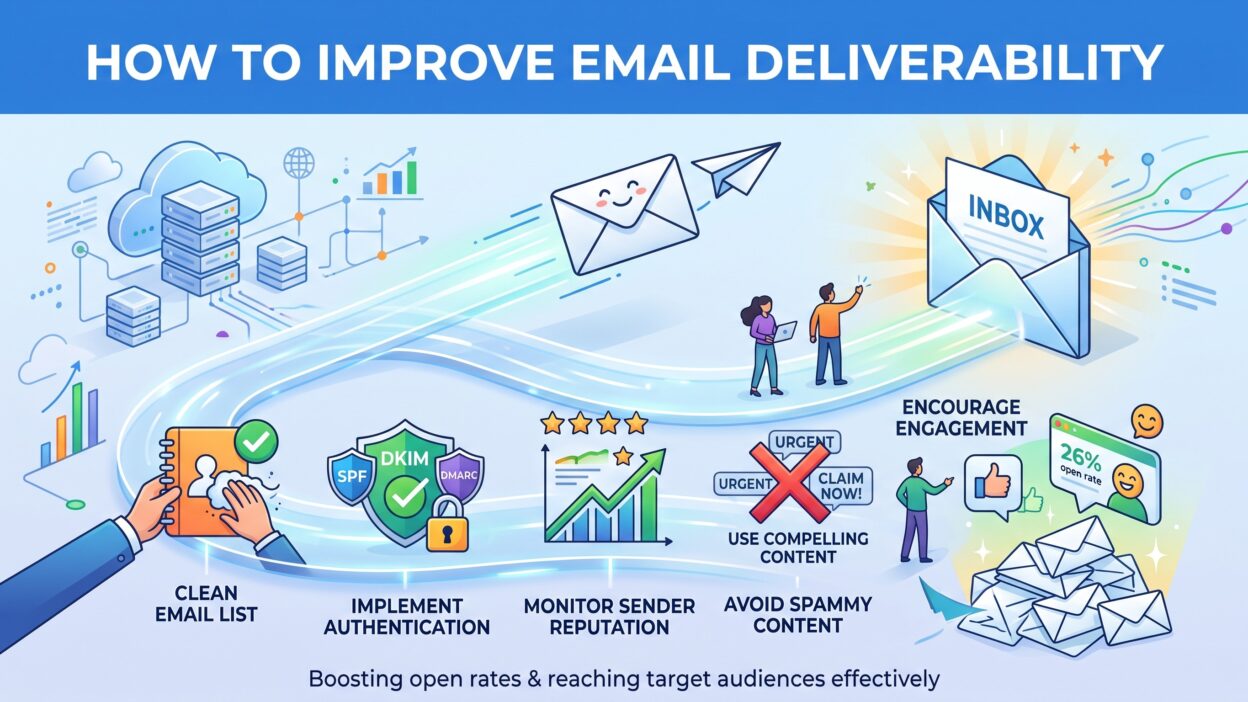
Proper authentication proves your emails actually come from your domain, not an impersonator. Missing or broken authentication records remain one of the most common causes of poor email deliverability across companies of every size.
List Quality
Sending to old, unengaged, or fake addresses hurts your sender reputation fast. A smaller list of engaged subscribers performs far better than a bloated list full of inactive contacts. List quality directly shapes email deliverability more than almost any other factor.
Many teams resist shrinking their list because the total subscriber count feels like a vanity metric worth protecting. In practice, a list cut down to genuinely engaged contacts almost always outperforms a larger, stagnant one across every meaningful metric that matters to revenue.
Engagement Rates
Providers watch how recipients treat your messages. Opens, clicks, and replies signal real interest. Deletions without opening, and spam complaints, signal the opposite. Low engagement over time pushes future messages straight into the spam folder.
Content and Spam Triggers
Certain words, excessive punctuation, and broken links can trigger spam filters automatically. Strong email deliverability depends partly on clean, well-formatted content that avoids common spam trigger patterns.
How to Set Up Email Authentication
Authentication forms the technical foundation of strong email deliverability. Three protocols work together to prove your emails are legitimate.
SPF
Sender Policy Framework lists which servers can send email on behalf of your domain. This record lives in your DNS settings and tells receiving servers exactly which sources are authorized. Without SPF, spammers can spoof your domain more easily.
DKIM
DomainKeys Identified Mail adds a digital signature to every outgoing message. Receiving servers check this signature against a public key stored in your DNS. A valid signature confirms the message was not altered in transit.
DMARC
Domain-based Message Authentication, Reporting, and Conformance ties SPF and DKIM together into one policy. DMARC tells receiving servers what to do when a message fails authentication, whether to quarantine it or reject it outright. This protocol also sends reports back to you, showing exactly who is sending email using your domain.
Warming Up a New Sending Domain
A brand new domain or IP address carries no reputation at all, good or bad. Providers treat unknown senders with extra caution, which makes warming a critical step for any new email program.
Start by sending small volumes to your most engaged contacts only. This might mean a few hundred emails a day during the first week. Watch open rates and complaint rates closely at this stage, since early signals shape how quickly providers trust the new domain.
Increase volume gradually over several weeks, roughly doubling the send size every few days as engagement stays healthy. Rushing this process by jumping straight to full list volume often triggers spam folder placement before the domain earns any real trust.
Consistency matters as much as volume during warming. Sending on an irregular schedule, with big gaps between sends, slows the process down. Steady, predictable sending patterns help providers build a clearer picture of your typical behavior.
How to Build and Maintain a Clean Email List
List hygiene plays a massive role in long-term email deliverability. A clean list keeps engagement high and complaints low.
Double Opt In
Double opt in requires a new subscriber to confirm their email address before joining your list. This extra step filters out fake addresses and typos immediately. Lists built this way tend to show stronger engagement and fewer spam complaints down the road.
Some marketers worry double opt in shrinks list growth too much. The tradeoff usually favors quality, since the contacts who do confirm tend to stay far more engaged than those added through a single click alone.
Regular List Cleaning
Remove addresses that bounce or show no engagement after several months. Many teams run this cleanup quarterly, removing contacts who never open or click. A smaller, active list protects email deliverability far better than a larger, stagnant one.
Set a specific inactivity window, such as six months without an open, as your cleaning threshold. Having a defined rule removes guesswork and keeps the process consistent every time your team reviews the list.
Suppression Lists
Maintain a suppression list for unsubscribes, hard bounces, and spam complaints. Sending to these addresses again, even by accident, damages your reputation and hurts email deliverability across your entire program.
Syncing suppression lists across every tool your team uses matters just as much as maintaining the list itself. A contact suppressed in your email platform but still active in a separate automation tool can slip through and trigger a fresh complaint, undoing careful work elsewhere in your program.
How to Improve Engagement to Boost Deliverability
Engagement signals matter enormously to inbox providers. Higher engagement directly improves email deliverability over time.
Segment Your Audience
Sending the same message to your entire list ignores real differences in interest and behavior. Segment based on purchase history, engagement level, or content preference. Relevant messages naturally earn higher open and click rates.
A simple starting point splits your list into highly engaged, moderately engaged, and inactive groups. Each group can receive a different sending frequency, with your most engaged contacts getting more frequent messages than a group showing signs of fatigue.
Send Relevant Content
Generic, one-size-fits-all content generates weak engagement. Tailor subject lines and offers to match what each segment actually cares about. Stronger relevance drives stronger engagement, which in turn protects email deliverability.
Testing different content approaches with smaller segments before a full send also helps. A/B testing subject lines or send times on a portion of your list reveals what resonates before you commit the whole audience to one approach.
Re-engagement Campaigns
Inactive subscribers drag down your overall engagement metrics. Run a dedicated re-engagement campaign before removing these contacts entirely. A short win-back series often revives a portion of the list, while the rest can get removed safely.
A strong win-back sequence usually acknowledges the gap directly, asks whether the subscriber still wants to hear from you, and offers a clear, low-friction way to opt back in or unsubscribe. This clarity protects your list quality either way the recipient chooses to respond.
Common Email Deliverability Mistakes to Avoid
Many teams struggle with email deliverability because of a few repeated mistakes. Fixing these often solves the majority of inbox placement issues.
One frequent mistake involves buying email lists. Purchased lists almost always contain outdated, fake, or unengaged addresses. Sending to this kind of list tanks engagement rates and spikes spam complaints almost immediately.
Another mistake happens when companies skip authentication setup entirely. Many small businesses never configure SPF, DKIM, or DMARC properly, leaving their domain vulnerable to spoofing and their emails vulnerable to filtering.
Sending too frequently without checking engagement also creates problems. A brand that emails daily without watching open rates often burns out its list, driving unsubscribes and spam complaints higher over time.
Ignoring mobile formatting causes a quieter but real issue. A large share of email opens happen on phones, and a message that looks broken on mobile gets deleted fast, which signals disinterest to inbox providers over time.
Finally, some teams ignore bounce management completely. Hard bounces should get removed from the list immediately. Continuing to send to these addresses tells providers your list quality is poor, which drags down email deliverability across every future campaign.
Using a shared IP address without understanding its history creates another hidden risk. Some email service providers place customers on shared infrastructure, meaning your reputation partly depends on how other senders on that same IP behave. Ask your provider about IP reputation history if you notice unexplained placement problems.
Neglecting feedback loops rounds out the common mistake list. Major providers like Yahoo and AOL offer feedback loop programs that notify you directly when a recipient marks your email as spam. Ignoring these signals means missing an early warning that something in your program needs attention.
Tools to Monitor Email Deliverability
Several tools help track performance and catch problems early. Google Postmaster Tools shows domain reputation directly from Gmail’s perspective, including spam rate and authentication status. This free tool gives a clear window into how Gmail specifically views your sending domain.
Sender score platforms like Validity provide a broader reputation score across multiple providers. Email service providers like Mailchimp, Klaviyo, and HubSpot also include built-in deliverability reporting, showing bounce rates, complaint rates, and inbox placement estimates.
Seed list testing tools place test addresses across major providers to check exactly where a campaign lands before it reaches your full list. This kind of testing catches placement problems before they affect real subscribers.
Content Practices That Support Strong Placement
Beyond technical setup, the actual content of your emails influences placement decisions too. A healthy balance of text and images reads as more legitimate than an email built entirely from one large image, which many spam filters flag automatically.
Personalizing the sender name and reply address also helps. A recognizable sender name builds familiarity, while a reply address that actually accepts responses signals a real, active brand rather than a mass blast operation.
Avoid excessive links crammed into a single message. A cluttered email with dozens of links resembles spam patterns closely. Focus each message around one or two clear calls to action instead.
Testing subject lines for spam trigger words also helps before a send goes out. Words tied to urgency or free offers, used excessively, raise flags with filters even when the actual offer is legitimate. A quick review before sending catches these patterns early.
How to Recover From a Deliverability Problem
A sudden drop in email deliverability requires quick, deliberate action. Start by pausing large sends immediately. Continuing to blast a damaged list only deepens the problem.
Review recent list growth and engagement data for warning signs. A recent purchased list, a spike in spam complaints, or a sudden volume increase often points to the root cause. Fix the specific issue before resuming normal sending.
Rebuild sender reputation gradually through a process called warming. Start with small sends to your most engaged subscribers only. Slowly increase volume over several weeks while watching engagement closely at each step. Rushing this process often triggers another drop before reputation fully recovers.
Document what caused the initial drop once you identify it. Keeping a clear record helps your team avoid repeating the same mistake in future campaigns, especially as new people join the marketing team over time.
Reach out to your email service provider if the problem persists. Many providers offer deliverability specialists who can review your specific sending patterns and suggest targeted fixes based on real data from their platform.
How Different Industries Approach Email Deliverability
Deliverability challenges shift depending on the type of business sending the email. Understanding these differences helps set realistic expectations for your own program, since a benchmark that fits one industry may look completely wrong for another.
Ecommerce Brands
Ecommerce companies often send high volume during sales events, which creates natural spikes that providers watch closely. Spreading sends across a longer window, rather than blasting an entire list at once, helps maintain steadier engagement patterns during these peak periods.
B2B Companies
B2B senders typically deal with smaller lists and longer sales cycles. Engagement often looks different here, with fewer opens per contact but higher intent behind each one. Nurture sequences need careful pacing to avoid fatiguing a smaller list of important contacts.
Publishers and Newsletter Senders
Publishers rely heavily on consistent daily or weekly engagement to maintain strong sender reputation. A single missed send rarely causes harm, but a pattern of declining opens over several weeks signals a content or frequency problem worth addressing quickly.
Nonprofit Organizations
Nonprofits often work with donor lists gathered over many years, some of which include outdated or inactive addresses. Regular list maintenance matters even more here, since donor engagement tends to fluctuate around specific campaigns or giving seasons rather than staying steady year-round.
FAQs About Email Deliverability
What is a good email deliverability rate? Most healthy programs land in the inbox for ninety-five percent or more of sent messages. Rates below this level usually signal a reputation or list quality problem worth investigating.
How long does it take to fix email deliverability issues? Minor issues can resolve within a few days once authentication gets corrected. Reputation damage from spam complaints or a bad list often takes several weeks of careful warming to fully recover.
Does email deliverability affect small businesses differently than large companies? Smaller companies often feel the impact faster since they run fewer campaigns and have less room for error. That said, the same fundamentals of authentication and list quality apply at every company size.
Can a single bad campaign hurt email deliverability long term? One campaign rarely causes lasting damage on its own. Repeated patterns, like consistently high complaint rates or poor engagement, cause the real long-term harm.
Do free email providers like Gmail treat business senders differently? Gmail and other major providers apply the same authentication and engagement checks to every sender, regardless of size. Business senders simply face more scrutiny since they typically send higher volumes.
Should I stop sending emails entirely if deliverability drops? A full pause on large campaigns makes sense during recovery, but sending small, targeted messages to your most engaged subscribers actually helps rebuild reputation faster than stopping completely.
Does the time of day I send emails affect deliverability? Send time itself rarely triggers filters directly, but it does influence engagement. A message sent when recipients are likely to check email tends to get opened faster, and quick opens send a positive signal to providers.
Can changing email service providers fix a deliverability problem? Switching providers alone rarely solves an underlying reputation issue, since the problem often follows your domain rather than the platform. Fix the root cause first, then consider a provider change if platform-specific issues remain afterward.
Read More:-The Art and Science of Marketing: How B2B Teams Balance Creativity and Data
Conclusion

Email deliverability determines whether your marketing efforts ever reach a real inbox. Strong authentication, a clean list, and genuine engagement all work together to build the trust that inbox providers reward. Weak habits in any of these areas quietly erode your results over time.
Set up your authentication records correctly, clean your list on a regular schedule, and watch engagement metrics closely after every send. Treat email deliverability as an ongoing practice, not a one-time fix. Consistent attention here protects your sender reputation and keeps your campaigns landing exactly where they need to land, in the inbox.
Small, steady improvements compound over time. A team that reviews engagement data monthly, keeps its list clean, and responds quickly to warning signs builds a sending reputation that competitors struggle to match. The businesses that treat email deliverability as a core marketing discipline, rather than an afterthought, see the strongest and most durable results from every campaign they send.