Introduction
TL;DR Choosing a sales intelligence tool feels harder than it should. Apollo and Seamless.AI both promise clean contact data and faster pipeline growth. Both sit at the top of most shortlists for sales teams in 2026. But they solve the problem in different ways, and that difference matters more than any feature list. This Apollo vs Seamless.AI comparison breaks down data quality, pricing, features, and real user feedback, so you can pick the right tool for your team instead of guessing.
Sales leaders rarely have time to test every tool on the market. Most teams narrow their search down to two or three names and then dig deeper. Apollo and Seamless.AI consistently make that shortlist, which is exactly why this comparison matters. This guide walks through both platforms section by section, so you finish with a clear answer instead of more open tabs.
Table of Contents
What Is Apollo.io?
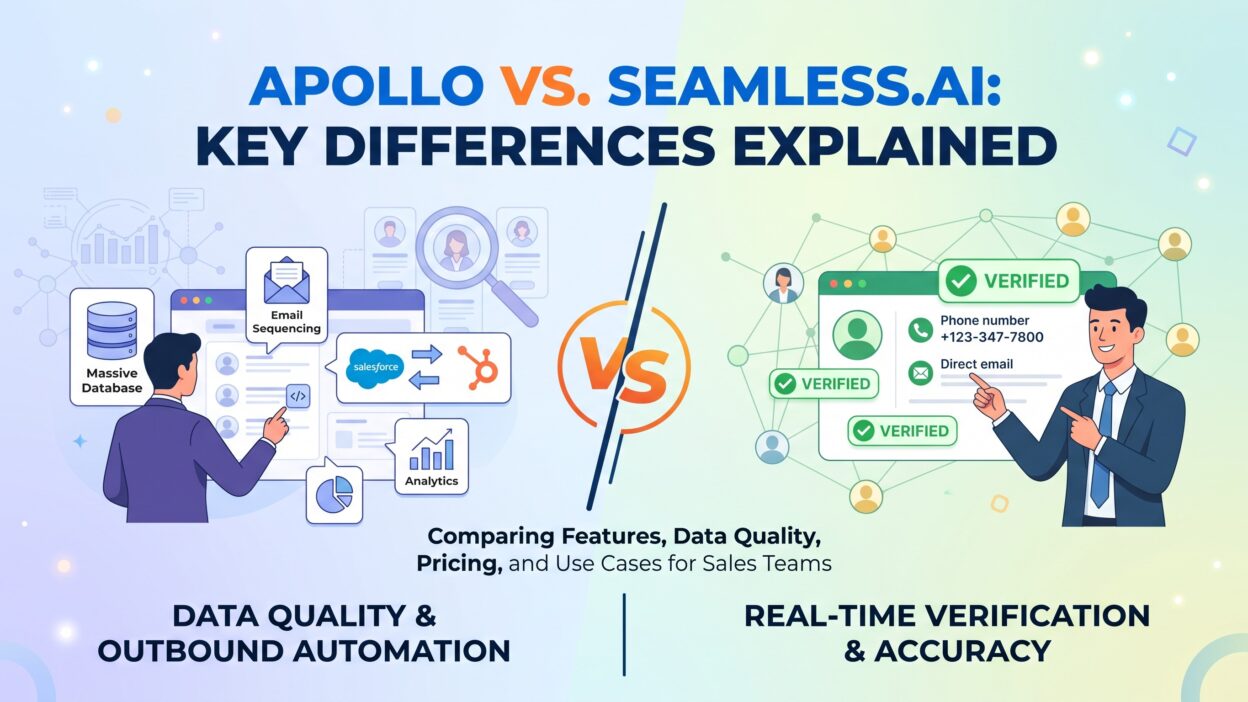
Apollo.io works as a full sales engagement platform. It combines a large contact database with built-in outreach tools inside one product. Sales reps search for prospects, build lists, and launch email sequences without leaving the platform.
The database sits at the center of the product. Apollo pulls contact records from web crawling, a contributor network, and third-party data partners. The company runs this data through a multi-step verification process before it reaches a user’s search results.
Apollo also bundles a dialer, call recording, and AI writing assistance into higher tiers. This turns the product into more than a data source. Teams comparing Apollo vs Seamless.AI often note that Apollo removes the need for a separate outreach tool, since sequencing and calling live inside the same login.
Founded as a prospecting tool, Apollo grew into a broader revenue platform over time. Product updates now touch deal management, conversation intelligence, and even meeting transcription. A sales manager can track a deal from first contact through a closed sale without switching between five different applications.
What Is Seamless.AI?
Seamless.AI takes a different approach. It positions itself as a real-time contact search engine rather than a static database. The platform searches and verifies contact details at the moment a user runs a query, instead of serving records stored from a previous month.
A Chrome extension anchors much of the daily workflow. Reps browse LinkedIn profiles and pull contact details directly through this extension without switching tabs. Seamless.AI also offers a feature called Autopilot, which builds prospect lists automatically based on saved search criteria.
Job change alerts round out the feature set. These alerts notify a rep when a saved contact switches companies, which helps sales teams stay ahead of a shifting buyer landscape. Anyone researching Apollo vs Seamless.AI should know this real-time search model shapes almost every feature Seamless.AI offers.
The company built its brand around speed. Marketing materials lean heavily on the promise of instant, verified contact data pulled fresh at search time. This pitch appeals strongly to reps who value speed over a deep, built-in outreach suite.
Apollo vs Seamless.AI: Data Accuracy and Contact Database
Data accuracy decides whether a prospecting tool earns its price tag. Apollo reports a database of over 275 million contacts across more than 73 million companies. The company shows data collection dates on many records, which helps reps judge how fresh a contact actually is.
Seamless.AI markets a larger raw number, citing access to over a billion business contacts worldwide. The company doesn’t publish detailed coverage metrics the way Apollo does, which makes independent verification harder for a buyer comparing the two platforms.
Real user reviews tell a more grounded story than either company’s marketing page. Reports across review sites describe Apollo’s email bounce rates landing somewhere in the 30 percent range for some users, while Seamless.AI users report a similarly wide range depending on region and industry. Neither platform hits the near-perfect accuracy their homepages sometimes suggest.
This gap between marketing claims and field results shows up constantly in the Apollo vs Seamless.AI debate. Teams running high-volume outreach often add a third-party email verification step regardless of which platform they choose, simply to protect their sender reputation from bounced sends.
Phone number accuracy tells a similar story. Direct dial numbers carry huge value for a sales rep trying to skip a gatekeeper, but both platforms show inconsistent hit rates on mobile numbers. Larger companies tend to see fresher records than small local businesses, since public data sources cover big organizations more thoroughly than small ones.
Data refresh speed separates the two platforms conceptually, even if real-world results land closer together than either marketing page admits. Apollo runs verification upstream, meaning it checks and cleans records before a rep ever searches for them. Seamless.AI runs verification at the moment of search, which sounds faster on paper but doesn’t always translate into a meaningfully higher hit rate once a rep pulls the actual list.
Segment matters just as much as platform choice. Fortune 500 contact records tend to stay accurate longer on both tools, since large companies update their public information often. Small and mid-size business contacts lag behind, sometimes by six months or more, regardless of which database a team searches.
Apollo vs Seamless.AI: Features and Functionality
Feature depth separates these two platforms more than raw data volume does. Apollo builds toward an all-in-one experience. Seamless.AI builds toward speed and simplicity around one core function: finding a verified contact fast.
Sales Engagement and Outreach Tools
Apollo bundles email sequences directly into its platform. Reps build a multi-step outreach cadence and launch it without exporting a single contact to another tool. Higher tiers add a US-based dialer, along with parallel and power dialing options for teams making high call volumes.
Seamless.AI offers no built-in sequencing or dialer. It functions purely as a data and discovery tool. Teams that choose Seamless.AI for its contact search still need a separate platform, such as an email sequencer or a CRM’s own outreach module, to actually contact the leads they find.
This difference matters most for small teams. A five-person sales team comparing Apollo vs Seamless.AI often prefers Apollo simply because it removes a second software subscription and a second login from the daily workflow.
Call analytics add another layer to Apollo’s engagement stack. Managers review call recordings, track talk time, and coach reps using real conversation data instead of relying only on a rep’s own notes. This kind of visibility rarely exists in a pure data tool like Seamless.AI.
AI Capabilities
Apollo’s AI assistant helps draft outreach emails and suggests talking points based on a prospect’s role and company data. The platform also applies AI-driven lead scoring, which ranks prospects by their likelihood to convert based on historical deal patterns.
Seamless.AI applies AI mainly to its search and verification process. The company describes its engine as continuously crawling and validating contact records in real time, rather than relying only on a static, previously indexed database.
Both platforms lean on AI language in their marketing, but the practical application differs. Apollo’s AI touches the outreach and scoring side of the funnel. Seamless.AI’s AI touches the search and discovery side.
Intent data adds a third layer worth mentioning here. Apollo offers intent topics and filters that flag accounts actively researching a related product category. This signal helps reps prioritize outreach toward buyers already showing interest, rather than cold contacts pulled at random from a database.
Integrations and CRM Support
Apollo connects natively to major CRMs, including Salesforce and HubSpot. It also offers a Chrome extension for pulling contact data while browsing LinkedIn or a company website. The platform lists roughly a dozen and a half integrations across common sales and marketing tools.
Seamless.AI also integrates with popular CRMs and provides its own Chrome extension. Many users describe this extension as central to their daily workflow, since it pulls verified contact data directly from a LinkedIn profile without a separate search step.
Both platforms handle CRM sync well enough for most small and mid-size teams. Larger organizations with complex tech stacks sometimes report gaps in either tool, which pushes them toward a dedicated data enrichment platform layered on top.
API access matters for technical teams building custom workflows. Apollo publishes API documentation that developers use to pull contact and company data directly into internal tools. Seamless.AI offers API access as well, though it often sits behind a higher-tier plan rather than a base subscription.
Apollo vs Seamless.AI: Pricing Comparison
Pricing transparency marks one of the clearest differences in this Apollo vs Seamless.AI matchup. Apollo publishes its pricing openly on its website. Plans span a free tier, a Basic tier around $49 per user monthly on an annual plan, a Professional tier near $79, and an Organization tier close to $119.
Apollo’s free plan isn’t a short trial either. It runs on a permanent basis, with a set number of credits granted to each user every month. This lets a small team test real search results before committing any budget.
Seamless.AI takes a different pricing path. Its free plan offers a limited number of credits per user each year, which an active rep can burn through within weeks. Most of the platform’s stronger features sit behind a paid tier that requires a sales conversation instead of a published price.
This opacity creates real budgeting friction. Teams report that Seamless.AI’s paid plans often land in a wide range, and some contracts carry lengthy cancellation notice periods. Buyers weighing Apollo vs Seamless.AI on cost alone tend to favor Apollo, purely because its pricing can get modeled out in a spreadsheet before any sales call happens.
Credit systems deserve a closer look too. A rep running fifty lookups a day can burn through a monthly credit allotment fast on either platform. Add-on credit packs raise the effective monthly cost well above the advertised base price, so it pays to model real daily usage before signing any contract.
Contract length adds another layer worth checking before signing. Some Seamless.AI agreements include a cancellation notice period stretching past sixty days, which can trap a team into paying for a tool it no longer wants. Apollo’s monthly billing option, even at a slight premium over the annual rate, gives smaller teams an easier exit if the platform doesn’t fit their workflow.
Hidden costs also show up in overage charges. A team that exceeds its monthly credit limit on either platform often pays a per-credit rate well above the value baked into the original plan. Building a buffer into the budget from day one avoids an unpleasant surprise on next month’s invoice.
Apollo vs Seamless.AI: Ease of Use
Apollo earns consistent praise for its interface. New sales reps often reach a comfortable pace within a week or two, since the platform groups search, sequencing, and calling under one clean navigation structure.
Seamless.AI also scores well for ease of use, particularly around its Chrome extension. Reps who spend most of their day on LinkedIn appreciate pulling a verified contact without switching to a separate browser tab or application window.
Both tools keep onboarding relatively short compared to older, more complex sales software. The real difference shows up once a team scales past a handful of users. Apollo’s all-in-one structure keeps admin overhead lower, since managers configure one platform instead of stitching together a search tool and a separate outreach tool.
Mobile access plays a smaller but growing role in this comparison. Reps working outside the office benefit from quick mobile access to contact records, and both companies continue to improve this experience through regular product updates.
Training resources also shape how fast a team gets comfortable. Apollo publishes detailed help articles alongside video walkthroughs for its sequencing and dialer features. Seamless.AI offers similar guides focused mainly on its search filters and Chrome extension setup. A manager rolling out either tool to a full team should budget a short training session in the first week, even with strong self-serve documentation available.
Apollo vs Seamless.AI: Customer Support
Apollo and Seamless.AI both offer support through phone, email, and live chat channels. Each platform also maintains a self-serve help center with articles covering common setup and troubleshooting questions.
Where the two differ is response depth on complex issues. Some Apollo users report faster resolution on account and billing questions, particularly on higher-tier plans that include dedicated account management.
Seamless.AI users describe a similar support experience for basic questions, though some reviews mention slower response times on account access issues. Teams switching from a different sales intelligence tool should expect a short learning curve either way, and strong support resources ease that transition regardless of which platform wins the decision.
Onboarding calls also factor into the support experience. Apollo often includes a guided setup session on paid tiers, which helps a new team configure sequences and filters correctly from day one. Seamless.AI offers similar onboarding support, typically tied to its higher-priced plans.
Apollo vs Seamless.AI: Which One Should You Choose?
Team size and workflow needs should drive this decision more than any single feature. A small sales team, especially one under ten reps, generally fits better with Apollo. The published pricing, generous free tier, and built-in sequencing remove the need for extra tools and extra logins.
Seamless.AI suits a team that already owns a separate outreach platform and simply needs a fast, real-time way to find verified contacts. Reps who live inside LinkedIn all day benefit heavily from the Chrome extension’s speed.
Enterprise teams weighing Apollo vs Seamless.AI often run a short pilot with both platforms before committing to an annual contract. A two to four week test, run against a real target account list rather than a generic demo dataset, reveals far more than any comparison article or vendor pitch ever could.
Budget predictability plays a bigger role in this decision than most buyers expect going in. A tool that looks cheaper on a sales call can quietly cost more once credit overages and add-on packs enter the picture. Reading the fine print before signing protects a growing team’s budget far better than trusting a demo alone.
Industry fit matters too. A B2B software company targeting large enterprise accounts may lean toward Apollo’s deeper filtering by technology stack and funding stage. A local services business or a niche vertical player may find both tools struggle equally, since static databases tend to miss smaller companies without a strong digital footprint.
Growth stage plays a role as well. An early-stage startup with a lean sales motion often values Apollo’s low entry cost and bundled sequencing, since every extra tool adds overhead the team can’t spare. A more established company with a dedicated sales operations function may tolerate Seamless.AI’s pricing conversations better, since that team already has the internal resources to negotiate a custom contract.
Existing tech stack should factor into the final call too. A team already running Outreach or Salesloft for sequencing may prefer Seamless.AI purely for its contact search strength, since the sequencing need is already covered elsewhere. A team starting from scratch usually saves both money and setup time by choosing Apollo’s bundled approach instead.
Frequently Asked Questions
Which is more accurate, Apollo or Seamless.AI? Neither platform hits perfect accuracy. Independent user reports describe meaningful bounce rates on both sides, so most teams add a verification step regardless of which tool they pick for prospecting.
Does Apollo have a free plan? Yes. Apollo offers a permanent free tier with a set number of credits granted monthly per user, not just a short trial window.
Is Seamless.AI good for small businesses? Seamless.AI works for small teams that need fast, real-time contact search. Its free tier credits run out quickly for an active rep, though, so many small teams eventually move to a paid plan or a different tool.
Can I use Apollo and Seamless.AI together? Some teams do run both platforms side by side, using one for outreach sequencing and the other purely for contact discovery. This approach adds cost, so most smaller teams pick one platform instead of paying for both.
Which tool has better customer support? Both platforms offer similar support channels, including live chat, email, and phone. Response quality varies by plan tier and by the complexity of the issue, based on user reports across review sites.
Do these tools require an annual contract? Apollo publishes monthly and annual pricing openly, giving buyers a choice. Seamless.AI often ties stronger features to annual commitments that require a sales conversation before signing.
How does Apollo vs Seamless.AI look for enterprise teams? Enterprise buyers often value Apollo’s transparent pricing model and its deep filtering options for account-based targeting. Seamless.AI can still fit an enterprise workflow, particularly one already built around a separate outreach platform.
Read More:-What Is Context Data? A Complete Guide for GTM Teams
Conclusion
Apollo and Seamless.AI both solve the prospecting problem, just from different starting points. Apollo builds an all-in-one platform around transparent pricing, built-in sequencing, and a dialer that keeps outreach inside one login. Seamless.AI focuses on real-time contact search and a Chrome extension built for reps who live inside LinkedIn every day.
Small teams under ten reps generally find more value in Apollo, thanks to its published pricing and generous free plan. Teams that already own a separate outreach stack and just need fast contact discovery may lean toward Seamless.AI instead.
Run a real pilot before committing to either platform. Test against your actual target accounts, not a generic demo list. That single step settles the Apollo vs Seamless.AI decision far better than any comparison article, including this one.