Introduction
TL;DR Picking a CRM shapes how a sales team works for years, not months. Maximizer CRM and Salesforce both show up on shortlists for teams outgrowing a spreadsheet or a smaller tool. But these two platforms serve very different teams, and that difference decides which one earns your budget. This Maximizer CRM vs Salesforce comparison breaks down features, pricing, implementation speed, and real user feedback, so you finish with a clear answer instead of more open browser tabs.
Sales leaders rarely have months to test every CRM on the market. Most teams narrow the field down to a couple of names and then dig into specifics. Maximizer CRM and Salesforce consistently make that shortlist for very different reasons, which is exactly why a direct comparison matters here.
A CRM renewal quote often triggers this whole search in the first place. A team gets hit with a price increase, loses the admin who configured everything, or simply outgrows a tool built for a different stage of growth. Whatever the trigger, the underlying question stays the same: does your team need a focused, fast tool, or a platform built to scale across an entire company?
Table of Contents
What Is Maximizer CRM?
Maximizer CRM works as a focused, fast-to-deploy platform built for sales teams and financial advisors. It centers on core CRM functions: contact management, pipeline tracking, and activity monitoring, without the sprawling feature set larger platforms carry.
The platform earns particular attention in financial services. Its Financial Services Edition ships with pre-configured KYC review tracking, AUM analytics, and compliance audit logs built specifically for wealth management workflows. Insurance carrier data import connects directly with more than a dozen Canadian carriers, a detail generalist CRMs rarely replicate without months of custom configuration.
Deployment speed sets Maximizer apart from bigger competitors. The platform typically goes live within about two weeks according to user reviews, and it holds G2’s Fastest Implementation badge in the financial services CRM category. Teams weighing Maximizer CRM vs Salesforce on speed alone usually find Maximizer the quicker path to an actual working system.
Recent product updates continue to modernize the platform without abandoning its core focus. A 2025 release added an onboarding checklist that walks new admins through initial setup step by step. The company keeps iterating on its interface too, even though reviewers still describe the overall look as more function than form compared to newer, flashier competitors.
What Is Salesforce?
Salesforce takes the opposite approach. It positions itself as a comprehensive platform spanning sales, service, marketing, and commerce under one ecosystem. Large enterprises favor Salesforce specifically because it scales across departments and industries without hitting a functional ceiling.
Customization sits at the center of Salesforce’s pitch. The platform supports extensive configuration, AI-driven insights through its Agentforce layer, and integration with thousands of third-party apps through its AppExchange marketplace. This flexibility comes with real tradeoffs, since that same depth demands dedicated administrators and a longer setup process.
Pricing reflects this broader scope too. A free tier supports up to two users with basic features, while meaningful functionality requires higher tiers priced well above Maximizer’s entry point. Anyone comparing Maximizer CRM vs Salesforce on raw capability will find Salesforce covers more ground, though that ground comes at a real cost in both budget and setup time.
Salesforce’s scale shows up in its partner network too. The company recently launched a Forward Deployed Engineering partner program, bringing in outside firms to help large organizations implement its Agentforce AI tools. This kind of partner ecosystem barely exists for smaller, more focused platforms, which reflects how differently these two companies approach the market.
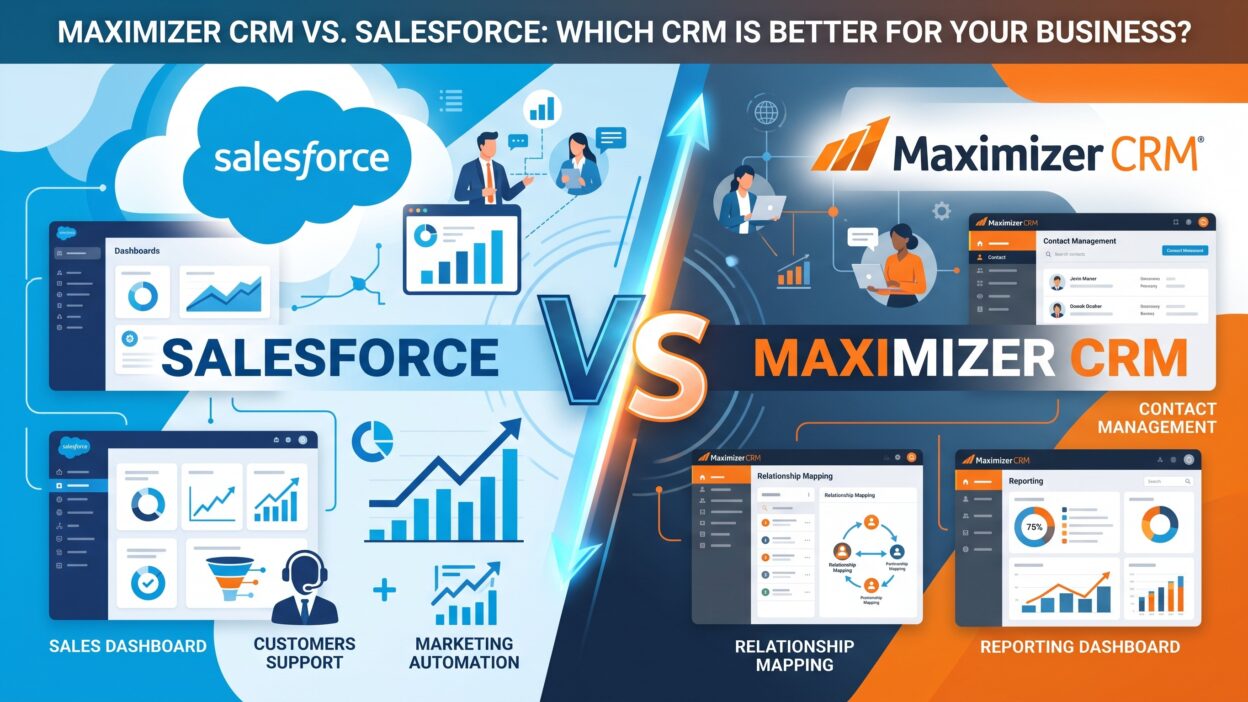
Maximizer CRM vs Salesforce: Feature Comparison
Feature depth marks one of the clearest differences between these platforms. Independent analyst comparisons show Salesforce covering a wider range of CRM functionality overall, while Maximizer covers the core sales process well without matching that full breadth.
Sales Automation and Pipeline Management
Salesforce supports the complete set of sales force automation features tracked in independent comparisons, including lead and opportunity tracking, sales forecasting, and account management. Its workflow builder handles complex, multi-step automation across departments, which large sales organizations rely on for intricate approval chains and cross-team handoffs.
Maximizer covers the same core processes but stops short of that same depth. It supports pipeline automation, email sequences, and Zapier-based integrations for connecting third-party tools. What it lacks is Salesforce’s deep multi-step workflow builder and its expansive AppExchange ecosystem, which limits how far a team can push custom automation before hitting a wall.
Team size determines how much this gap actually matters. A team under fifty people rarely builds automation complex enough to notice Maximizer’s limits. Organizations above a hundred users, especially ones with cross-departmental processes, tend to outgrow Maximizer’s automation layer and eventually need Salesforce’s deeper tooling.
Independent feature audits back up this pattern with real numbers. One detailed comparison tracked 246 separate sales force automation criteria and found Salesforce supporting every single one, while Maximizer covered 238 of them. That gap sits mostly around advanced capabilities like sales gamification and deep social media integration, areas that matter far more to a large, distributed sales organization than a lean regional team.
AI Capabilities
Maximizer’s AI feature, called IQ Boost, focuses narrowly on meeting preparation and compliance surfacing for financial advisors. Early users report significantly faster meeting prep time using this tool, and the feature runs with Canadian data residency and SOC 2-compliant data handling built in from the start.
Salesforce’s Agentforce takes a far broader approach. It deploys autonomous AI agents across sales, service, and marketing functions, handling tasks like lead engagement and case resolution without constant human input. This positions Agentforce as an operational layer running throughout an organization, not a single-purpose assistant.
Both platforms lean on AI as a selling point, but scope differs sharply in this Maximizer CRM vs Salesforce comparison. Maximizer’s AI solves one specific problem well. Salesforce’s AI aims to automate work across an entire revenue organization, which naturally comes with a steeper price tag and setup process.
Data handling standards matter just as much as feature scope when AI touches sensitive client information. Maximizer built IQ Boost around Canadian data residency requirements from the start, which appeals directly to financial firms operating under strict regional compliance rules. Salesforce’s Agentforce operates at a larger scale but requires more careful configuration to meet the same kind of regional data handling requirements a smaller, purpose-built tool already covers by default.
Industry-Specific Tools
Financial services stands out as the clearest use case where Maximizer competes directly with Salesforce on functionality rather than just price. Maximizer’s Financial Services Edition includes intergenerational wealth management tools and pre-built compliance workflows that a financial advisory firm can use almost immediately after setup.
Salesforce offers a comparable product called Financial Services Cloud, but it requires considerably more configuration and implementation time to reach similar vertical-specific functionality. This gap in setup effort often outweighs Salesforce’s broader feature set for a firm that just needs KYC tracking and AUM dashboards working on day one.
Construction and publishing sectors also favor Maximizer for similar reasons, since these industries typically need straightforward CRM functionality rather than the deep customization Salesforce supports. Salesforce fits better for tech-driven industries and large enterprises running complex, cross-departmental processes that justify its broader scope.
Maximizer CRM vs Salesforce: Pricing Comparison
Pricing structure separates these two platforms sharply. Maximizer charges a transparent, per-seat rate. The Core plan starts around $65 per user monthly, with Financial Services and Business tiers running $79 to $89 per user monthly. Enterprise pricing requires a custom quote, and no free plan or self-serve trial exists.
Salesforce spans a much wider pricing range. A free CRM tier covers up to two users with basic features. Starter Suite begins around $25 per user monthly, but meaningful functionality typically requires Pro Suite near $100 per user monthly or Enterprise around $175. Add-ons compound this cost quickly: Agentforce runs about $125 per user monthly, Premier Success support costs roughly 30 percent of net license fees, and Digital Engagement adds another $75 per user monthly on top.
Real-world cost estimates make this gap concrete. A ten-person sales team running Maximizer typically pays between $650 and $890 monthly. The same team on Salesforce Starter might pay closer to $250 monthly at the entry tier, though costs climb fast once that team needs features that only exist on higher tiers or paid add-ons.
Financial services pricing widens the gap even further. Salesforce’s Financial Services Cloud starts around $325 per user monthly, while Maximizer’s comparable Financial Advisor edition runs $79 to $100 per user monthly. For a ten-advisor firm, that difference adds up to tens of thousands of dollars in annual savings before any implementation cost even enters the picture.
Salesforce’s pricing structure has drawn criticism even from within the company. Salesforce itself acknowledged in a recent update that its pricing needed to become easier to understand and more predictable, pointing to the same complexity many buyers already run into when comparing Maximizer CRM vs Salesforce for their own budget. Recent price increases across several Salesforce editions have only added to this concern for teams trying to plan a multi-year budget.
Maximizer CRM vs Salesforce: Implementation and Ease of Use
Implementation speed might be the single biggest practical difference in this Maximizer CRM vs Salesforce decision. Maximizer typically deploys within about two weeks, based on user reviews and its Fastest Implementation recognition in the financial services CRM category. A small team can be live and running real pipeline within a single sprint.
Salesforce implementation stretches considerably longer for most organizations, often spanning months rather than weeks. This timeline reflects the platform’s depth. Configuring custom objects, workflow automation, and department-wide processes takes real time, and larger deployments often require a dedicated consultant or implementation partner to do it well.
User interface design reflects a similar tradeoff. Maximizer prioritizes function over visual polish, and reviewers describe the platform as capable but more dated-looking compared to newer tools. Salesforce earns praise for its depth and configurability but gets described just as often as powerful yet heavy to administer, particularly once a company’s admin who originally configured it moves on to a new role.
This admin dependency creates a real risk for Salesforce customers over time. A platform configured well by one skilled administrator can become confusing and underused once that person leaves, since nobody else fully understands every custom field and workflow they built. Maximizer’s simpler structure means less institutional knowledge gets locked inside a single employee’s head, which reduces this specific risk considerably.
Maximizer CRM vs Salesforce: Integrations and Extensibility
Salesforce’s AppExchange marketplace gives it a clear edge in raw integration count. Thousands of third-party apps connect directly into the platform, covering everything from marketing automation to specialized industry tools built by outside developers.
Maximizer takes a leaner approach here. It connects to other tools mainly through Zapier-based integrations, which cover common use cases well but don’t match Salesforce’s deep, native app ecosystem. Teams needing a highly specific integration built by a niche vendor often find that vendor already listed on Salesforce’s marketplace before they find it for Maximizer.
This gap matters most for organizations with a complex existing tech stack. A company already running a dozen specialized tools benefits from Salesforce’s broader native connections. A leaner team running just a handful of core tools rarely notices Maximizer’s smaller integration library as a real limitation.
Data migration deserves a mention in this comparison too, since it rarely gets the attention it deserves. Switching from one CRM to another exposes stale contact records that have quietly accumulated over years. Cleaning and verifying that data before a migration matters more than any feature comparison, since a perfect new platform still underperforms when it’s filled with outdated emails and disconnected phone numbers from day one.
Maximizer CRM vs Salesforce: Customer Support
Salesforce provides support around the clock, including both email and phone channels, built to serve large enterprises with constant operational needs across time zones. Enterprise customers typically get access to more dedicated support resources, especially on higher-tier plans.
Maximizer also offers support around the clock, though primarily through phone rather than a broader mix of channels. The platform supplements this with webinar training and a detailed user guide, which helps smaller teams get comfortable without needing a dedicated support contract.
Response quality on complex issues varies by review source for both platforms. Some Salesforce users describe support as costly once a team needs deeper help beyond basic troubleshooting. Maximizer users report a similar mix, with straightforward setup questions resolved quickly and more complex configuration issues taking longer regardless of which platform a team chooses.
Training resources round out the support picture for both vendors. Maximizer offers webinar training sessions alongside its user guide, which helps a small team build internal expertise without hiring an outside consultant. Salesforce’s larger partner network, including firms trained specifically on its Agentforce tools, gives enterprise customers a deeper bench of outside help, though that expertise usually comes at an additional cost beyond the base subscription.
Maximizer CRM vs Salesforce: Which One Should You Choose?
Team size should drive most of this decision. A team of five to fifty people that wants to go live within weeks, not months, generally fits better with Maximizer. Its transparent, predictable pricing removes the need for a dedicated consultant or admin just to get started.
Salesforce fits organizations running a hundred or more users with a dedicated administrator, a substantial implementation budget, and workflows complex enough to justify the platform’s depth. Teams below that threshold often pay for complexity they’ll never fully use, and low feature adoption on an expensive platform wastes more money than a simpler tool ever would.
Industry plays a deciding role for financial services firms specifically. A wealth management practice or financial advisory firm usually finds Maximizer’s Financial Services Edition delivers comparable compliance functionality at a fraction of Salesforce Financial Services Cloud’s cost. Firms outside financial services should weigh feature breadth against setup time before committing either way.
Average deal size offers one more useful signal. A team closing deals under roughly $15,000 with fewer than fifty people rarely needs Salesforce’s full depth. A larger organization managing complex, multi-stakeholder deals across departments typically justifies the platform’s steeper learning curve and higher price.
Adoption rate deserves just as much weight as feature count in this final decision. A platform packed with five hundred features that only twenty percent of the team actually uses delivers less real value than a simpler tool with fifty features and ninety percent daily adoption. Choosing the CRM your team will actually use every day beats choosing the one with the longest feature list on paper.
Frequently Asked Questions
Is Maximizer CRM cheaper than Salesforce? At the entry level, yes. Maximizer’s Core plan starts near $65 per user monthly with transparent pricing. Salesforce’s free and Starter tiers cost less upfront, but meaningful functionality on Salesforce usually requires a higher tier that costs more than Maximizer’s comparable plan.
Which CRM is better for financial advisors? Maximizer’s Financial Services Edition includes pre-built KYC tracking, AUM dashboards, and compliance audit logs at a fraction of Salesforce Financial Services Cloud’s price. Most independent financial advisory firms find Maximizer delivers comparable functionality without the higher cost.
How long does Salesforce take to implement? Salesforce implementation often spans several months for a full deployment, especially for larger organizations configuring custom workflows across departments. Simpler deployments move faster, but rarely match Maximizer’s typical two-week timeline.
Can a small business use Salesforce? Yes, though smaller teams often find Salesforce’s full feature set more than they need. A team under fifty people with straightforward workflows may get better value from a more focused platform like Maximizer instead.
Does Maximizer CRM have AI features? Yes. Maximizer’s IQ Boost feature focuses on meeting preparation and compliance surfacing, particularly for financial advisors, with strong data residency and compliance standards built in.
Which platform has better integrations? Salesforce wins on raw integration count through its AppExchange marketplace. Maximizer connects to other tools mainly through Zapier, which covers common needs but offers a smaller native ecosystem overall.
How many features does each platform actually cover? Independent audits of core sales automation criteria show Salesforce supporting essentially all tracked features, while Maximizer covers the large majority of them. The gap concentrates in advanced areas like gamification and deep social integration rather than core pipeline management.
Read More:-Context Engineering for B2B AI: How to Build Agents That Perform
Conclusion

Maximizer CRM and Salesforce solve the CRM problem from very different directions. Maximizer delivers a focused, fast-to-deploy platform with transparent pricing and a two-week implementation timeline, particularly strong for financial advisory firms and smaller sales teams. Salesforce delivers a comprehensive platform spanning every department, with deeper automation and a vastly larger integration ecosystem built for organizations that need that scale.
Teams of five to fifty people looking for quick setup and predictable cost generally do better with Maximizer. Organizations above a hundred users, with dedicated admin resources and complex cross-departmental workflows, typically get more value from Salesforce despite its steeper price and longer rollout.
Neither platform wins this comparison outright, and that’s the real point. The right choice depends entirely on your team’s size, your industry, and how much complexity your actual sales process needs on day one. A fast, focused tool that your whole team actually opens every morning beats a powerful platform that sits half-configured and underused.
Test both platforms against your actual workflow before signing a contract with either vendor. Run a real trial with your own data and your own team, not a generic demo. That step settles the Maximizer CRM vs Salesforce decision better than any comparison article, including this one.