Introduction
Tl;DR Revenue growth breaks down when teams work in silos. Sales chases leads its own way. Marketing measures success on its own terms. Customer success fights fires with no visibility into what sales promised. A RevOps Framework fixes this problem at the root. It connects sales, marketing, and customer success under one shared system. This article breaks down the four pillars of a working RevOps Framework and shows you how to build one inside your own company.
Table of Contents
What Is a RevOps Framework?
A RevOps Framework is a structured model that unites sales, marketing, and customer success around one revenue goal. It removes the walls between departments. Each team still owns its function. But every team now shares the same data, the same process, and the same metrics.
The idea grew out of a simple observation. Companies lost revenue not because teams worked badly. They lost revenue because teams worked apart. Marketing generated leads that sales ignored. Sales closed deals that customer success couldn’t support. This model replaces a disconnected setup with one connected engine.
This approach isn’t a title or a single hire. It’s a set of principles that guide how a company runs its entire revenue operation. Companies that adopt this model treat revenue as one continuous journey, not three separate departments.
The term itself borrows from a manufacturing idea called operations excellence. Factories learned decades ago that a single broken link in a supply chain slows down the entire line. Revenue teams face the same reality today. A weak handoff between marketing and sales slows down the whole customer journey, even if every individual team performs well on its own.
Small businesses sometimes assume this concept only applies to large enterprises. That assumption costs them growth. A five-person sales team still loses deals when marketing hands off unqualified leads. A two-person customer success team still struggles when nobody tells them what a new customer expects. Size doesn’t remove the need for shared process and shared data.
Why Companies Need a RevOps Framework Today
Buyers today move fast. They research on their own. They talk to multiple stakeholders inside their own company before they ever speak to a sales rep. A disjointed revenue team can’t keep pace with this behavior.
Data fragmentation makes the problem worse. Sales teams use one tool. Marketing teams use another. Customer success tracks its own spreadsheets. Nobody sees the full customer picture. A shared revenue operations model solves this by creating one source of truth everyone trusts.
Investors and boards also expect predictable revenue. Guesswork doesn’t satisfy a board meeting anymore. A strong RevOps Framework gives leadership real forecasting power, built on shared data instead of separate opinions pulled from three different spreadsheets.
Remote work adds another layer of pressure. Teams spread across cities and time zones can’t rely on hallway conversations to stay aligned. A written, shared system replaces those informal check-ins with something durable. This need has pushed many companies to formalize a RevOps strategy that used to live only in a few managers’ heads.
The Four Pillars of the RevOps Framework
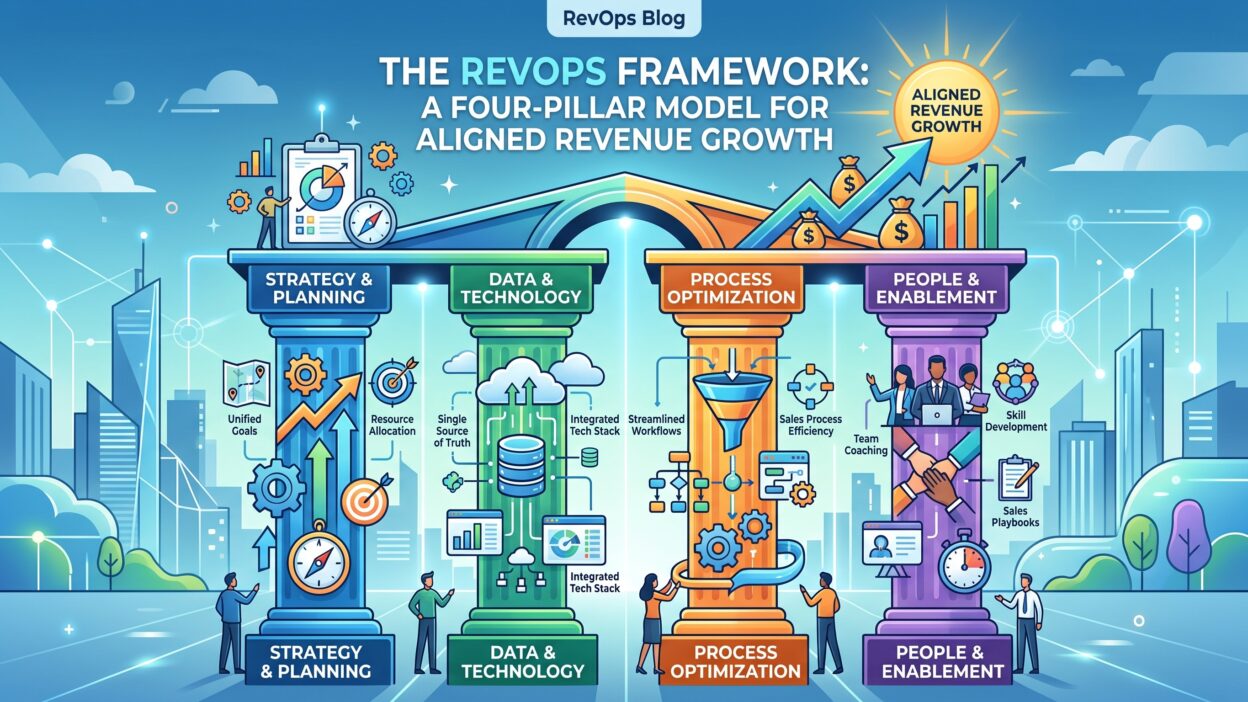
A working RevOps Framework rests on four pillars. Each pillar supports the others. Skip one, and the whole system weakens. Build all four together, and revenue becomes predictable instead of accidental.
Pillar One: Process Alignment
Process alignment means every handoff between teams follows a clear path. A lead moves from marketing to sales with full context. A closed deal moves from sales to customer success with the same clarity. Nothing gets lost in translation.
Most companies lose deals at these handoff points. A lead sits in a queue too long. A new customer waits days for onboarding because nobody owned the transition. This pillar maps every stage of the customer journey and assigns clear ownership at each step.
This part of the model also standardizes definitions. What counts as a qualified lead? What counts as a closed deal? Without shared definitions, sales and marketing argue over numbers instead of working toward the same goal. Process alignment ends this argument by giving both teams one definition to work from.
Documentation matters here too. A written process outlives any single employee. New hires learn the system fast when the process lives on paper, not in someone’s head. This pillar turns tribal knowledge into a repeatable system anyone can follow, even after a key employee leaves the company.
Weekly process reviews keep this pillar healthy long after launch. A process that worked in January can break by June once product lines change or team sizes grow. Building a short review habit into the calendar catches these breaks early, before they cost a quarter of missed deals.
Pillar Two: Technology and Data Alignment
Technology alignment means every tool talks to every other tool. Your CRM connects to your marketing platform. Your billing system connects to your customer success software. Nobody has to export a spreadsheet and manually update another team.
Data alignment goes one step further. It means everyone works from the same numbers. Sales shouldn’t see one pipeline figure while finance sees a different one. A single source of truth removes this confusion and builds trust across departments.
Many companies buy tools before they fix their process. This creates a second silo, just a digital one instead of a departmental one. A properly built RevOps Framework flips this order. Process comes first. Technology supports the process instead of dictating it.
Clean data also drives better decisions. Duplicate records, outdated contact fields, and inconsistent naming conventions all quietly damage a revenue engine. This pillar treats data hygiene as a daily habit, not a yearly cleanup project squeezed in before an audit.
Security and access also belong under this pillar. A shared system only works when the right people see the right data. Sales reps don’t need access to every financial record. Support agents don’t need edit rights on marketing campaigns. Clear permission structures keep the shared system trustworthy instead of chaotic.
Pillar Three: People and Team Alignment
People alignment means every team member understands how their role connects to revenue. A marketing specialist should know how their campaign affects the sales pipeline. A support agent should know how their renewal conversation affects the growth number.
Many companies now build a dedicated RevOps team to own this alignment. This team doesn’t replace sales, marketing, or customer success leaders. It sits alongside them and removes friction between departments. The RevOps team owns the shared process, the shared tools, and the shared reporting.
Incentives matter just as much as structure. If marketing gets rewarded only for lead volume, quality suffers. If sales gets rewarded only for closed deals, customer success inherits problems nobody solved. This pillar aligns incentives so every team wins when the whole revenue engine wins.
Communication routines support this pillar too. Weekly syncs between sales and marketing leaders keep both sides honest about what’s actually working. Without this rhythm, teams drift back into old habits within a few months, and the earlier alignment work quietly unravels.
Hiring practices shift under this pillar as well. Companies that build a strong RevOps team look for candidates who understand data and process, not just candidates who know one department’s tools. This hybrid skill set becomes rare and valuable as more companies adopt shared revenue models.
Pillar Four: Performance and Reporting Alignment
Performance alignment means every team reports on the same metrics. Marketing doesn’t just report leads generated. It reports pipeline influenced. Sales doesn’t just report deals closed. It reports customer lifetime value created.
Shared dashboards replace separate reports. Leadership pulls one view of the business instead of stitching together three conflicting spreadsheets. This single view speeds up decision making and removes the political arguments over whose numbers are right.
Forecasting improves dramatically under this pillar. When every team feeds the same data into the same system, forecasts reflect reality instead of optimism. A strong RevOps Framework turns forecasting from a guessing game into a data backed exercise leadership can trust.
Regular reporting cadences also catch problems early. A dip in one stage of the funnel shows up immediately instead of hiding until quarter end. Teams fix small problems before they become quarter ending disasters that surprise the board.
Reporting also needs a clear owner. Without one person accountable for dashboard accuracy, numbers drift out of sync within a few weeks. A named data owner checks the reports weekly and flags mismatches before leadership ever sees them.
How to Build a RevOps Framework Step by Step
Building a RevOps Framework doesn’t happen overnight. It follows a clear sequence. Skipping steps creates gaps that show up later as broken handoffs or messy data. Follow this order and the framework holds together.
Step 1: Audit Your Current Revenue Process
Start by mapping how a lead becomes a customer today. Write down every stage, every handoff, and every tool involved. This audit reveals gaps most leaders never noticed before. Some companies find three different definitions of a qualified lead during this single step.
Talk to frontline employees during this audit, not just department heads. A sales rep often knows exactly where deals stall. A support agent often knows exactly why customers churn early. Their input grounds the audit in daily reality instead of assumptions from a leadership meeting.
Step 2: Align Sales, Marketing, and Customer Success Goals
Bring leaders from all three teams into one room. Agree on one revenue number everyone works toward. Break that number down into shared targets each team can influence. This step turns three separate agendas into one shared mission.
Document these shared goals somewhere visible. A goal that lives only in a meeting note fades within weeks. A goal posted on a shared dashboard stays in front of every team every single day.
Step 3: Choose the Right RevOps Tools
Pick tools that integrate with each other, not tools that work in isolation. A CRM should connect directly to your marketing automation platform. Your customer success software should sync with the same CRM. Choose fewer tools that connect well over many tools that don’t talk to each other.
Test integrations before committing to a full rollout. A vendor’s sales page can promise smooth integration, but a short pilot reveals the real experience. Spend a few weeks testing data flow between two core systems before signing a company wide contract.
Step 4: Set Shared Metrics and KPIs
Define the handful of numbers that matter most. Pipeline velocity, customer acquisition cost, and net revenue retention work well as shared metrics. Put these numbers on one dashboard every leader checks weekly. This step locks the framework into daily operations instead of a one time project.
Review these metrics on a fixed schedule. A monthly leadership review keeps the numbers relevant and keeps every department leader accountable to the same shared targets.
Benefits of a Strong RevOps Framework
Companies that build a real RevOps Framework see revenue become predictable. Forecasts match actual results because every team feeds the same data into the same system. Leadership stops guessing and starts planning with confidence.
Sales cycles shorten under this model too. Reps spend less time chasing bad leads because marketing hands off better qualified prospects. Handoffs move fast because process alignment removes the friction that used to slow deals down.
Customer churn drops as well. Customer success teams walk into new accounts with full context instead of starting from zero. They know what the customer bought, why they bought it, and what problem they expected to solve. This context prevents the early churn that comes from misaligned expectations.
Employee experience improves too, though people rarely mention this benefit first. Teams stop blaming each other for missed numbers once they share the same data and the same goals. This shared model replaces finger pointing with shared accountability, and that shift changes company culture for the better.
New employees ramp up faster under this system as well. A documented process gives a new sales rep or new marketing hire a clear playbook from day one. They spend less time guessing how things work and more time contributing to actual revenue.
Budget conversations also get easier. When leadership sees one clear picture of what drives revenue, they fund the right programs instead of splitting budget evenly across departments out of habit. Marketing gets credit for pipeline it actually influences. Customer success gets budget for retention work that protects existing revenue.
Common Mistakes When Implementing a RevOps Framework
Many companies buy software first and build process second. This backwards approach creates expensive tools nobody uses correctly. This model works best when process comes first and technology follows to support that process.
Skipping executive buy in causes another common failure. Without a senior leader championing the framework, old habits creep back within a few weeks. Department heads retreat to their own dashboards and their own definitions of success.
Ignoring customer success is a costly mistake too. Many companies build alignment only between sales and marketing. This leaves the post sale experience disconnected from the rest of the revenue engine, and churn quietly climbs as a result.
Unclear ownership derails many frameworks as well. Someone needs to own the RevOps Framework day to day. Without a named owner, the framework becomes a slide deck from a planning meeting instead of a living system teams actually use.
Rushing the rollout hurts many companies too. Leaders sometimes try to fix every process and connect every tool within a single quarter. Teams overwhelmed by rapid change often revert to old habits within weeks. A phased rollout, built one pillar at a time, sticks far better than an all at once overhaul.
RevOps Framework vs Traditional Sales Operations
Traditional sales operations focuses narrowly on the sales team. It handles territory planning, quota setting, and sales tool administration. Its scope stops at the edge of the sales department.
A RevOps Framework covers far more ground. It spans marketing, sales, and customer success together. It owns the full customer journey, not just the sales stage. This wider scope gives leadership one connected view of revenue instead of three separate department views.
Sales operations reports to a sales leader in most companies. This broader revenue operations model often reports directly to the CEO or CFO because it touches every revenue generating function. This reporting structure reflects how central the framework becomes to overall business strategy.
Data ownership differs too. Sales operations owns CRM data related to deals. A company wide revenue model owns the full customer data set, connecting marketing engagement, sales activity, and customer success history into one record.
Career paths differ as well. A sales operations analyst often moves up within the sales department alone. A RevOps professional builds skills across marketing technology, sales process, and customer analytics, which opens doors across the whole revenue organization.
Tools That Support a RevOps Framework
A strong CRM sits at the center of any RevOps Framework. It holds every customer interaction in one place and gives every team a single view of the account. Salesforce and HubSpot both serve this role well for companies of different sizes.
Marketing automation software connects to this CRM and tracks every touchpoint a prospect has with your brand. This connection lets marketing prove its impact on closed revenue instead of just reporting lead counts in isolation.
A data warehouse often sits behind these tools for larger companies. It pulls information from every system into one place and feeds clean data into reporting dashboards. This layer prevents the data fragmentation that breaks weaker revenue models.
Forecasting software rounds out the stack. It uses historical data from the CRM to predict future revenue with real accuracy. Combined with the other tools, this software turns a RevOps Framework from a concept into a daily operating system.
Customer success platforms complete the picture for subscription businesses. These tools track product usage, flag at risk accounts, and feed renewal data back into the shared CRM. Without this piece, a company loses visibility into the second half of the customer journey right after the deal closes.
Frequently Asked Questions
What does RevOps stand for? RevOps stands for revenue operations. It describes the function that aligns sales, marketing, and customer success around one shared revenue goal.
Is RevOps the same as sales operations? No. Sales operations supports only the sales team. A RevOps Framework spans sales, marketing, and customer success together, covering the full customer journey rather than one department.
Who owns the RevOps Framework in a company? Many companies name a dedicated RevOps leader or team to own this function. This owner reports directly to a senior executive, often the CEO or CFO, because the framework touches every part of the revenue engine.
How long does it take to build a RevOps Framework? Most companies need three to six months to build a working framework. The audit and alignment stages take the longest because they involve multiple departments agreeing on shared definitions and goals.
Do small businesses need a RevOps Framework? Yes. Even a small team benefits from shared data and shared process. A simple revenue operations model prevents the silos that grow harder to fix once a company scales past its early stage.
What is the biggest risk of skipping a RevOps Framework? The biggest risk is slow, unpredictable revenue. Without shared process and shared data, teams work against each other instead of toward the same goal, and leadership loses the ability to forecast accurately.
Read More:-GTM Motion: How to Choose, Run, and Evolve Your Go-to-Market Model
Conclusion

A RevOps Framework turns three separate departments into one connected revenue engine. Process alignment removes friction at every handoff. Technology alignment gives every team the same data. People alignment connects incentives across departments. Performance alignment gives leadership one true view of the business.
Companies that build this framework see shorter sales cycles, lower churn, and forecasts that actually match reality. The path isn’t complicated, but it does require commitment from leadership and patience through the early stages.
Start with an honest audit of your current process. Bring your sales, marketing, and customer success leaders into one room. Agree on shared goals and shared metrics. Build the RevOps Framework one pillar at a time, and your revenue engine will run stronger for it.