Introduction
TL;DR Picking between HubSpot and Outreach trips up a lot of sales leaders. Both names show up constantly in sales software research. Both promise faster pipeline growth and less manual work for reps. But these two platforms solve different problems, and that difference decides which one actually fits your team. This HubSpot vs Outreach comparison walks through features, pricing, integrations, and real use cases, so you finish with a clear answer instead of a longer shortlist.
Sales leaders rarely have the time to test every platform on the market themselves. Most teams narrow the field down to a couple of names and then dig into the details. HubSpot and Outreach consistently make that shortlist, which is exactly why a direct HubSpot vs Outreach comparison matters more than a generic feature list. This guide breaks the decision down section by section.
Table of Contents
What Is HubSpot Sales Hub?
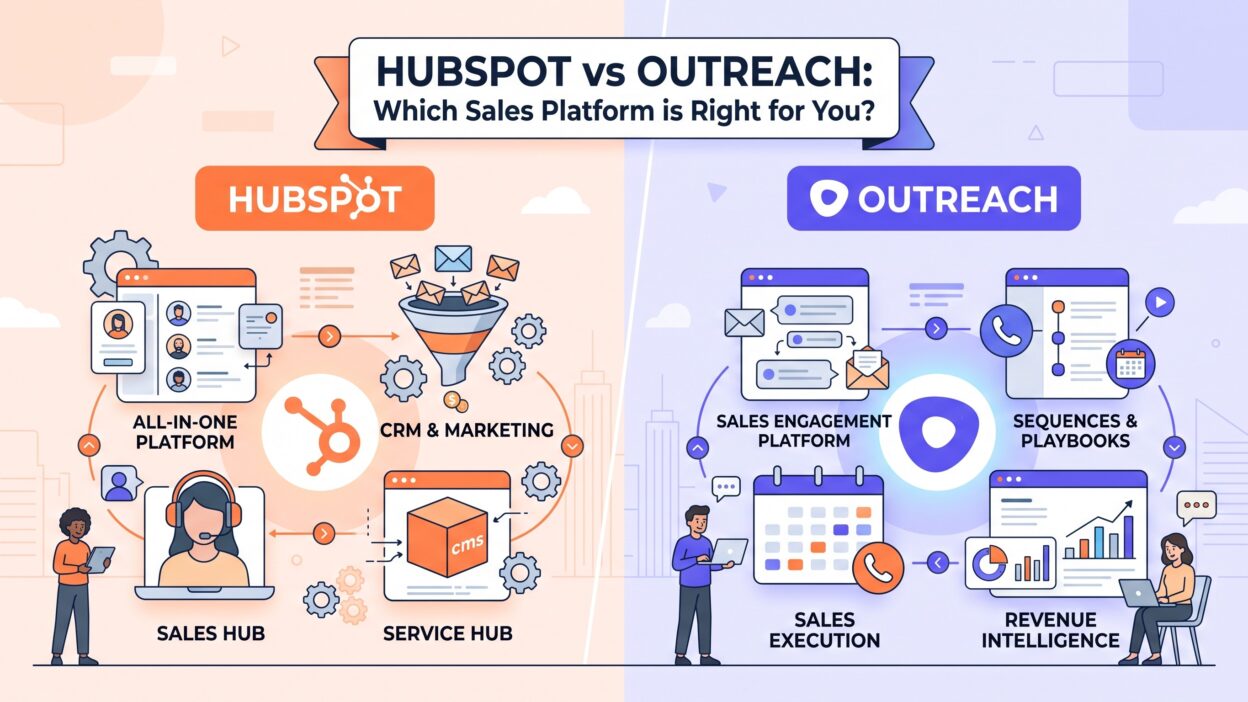
HubSpot works as a full customer platform, not just a sales tool. It bundles a CRM with Marketing Hub, Sales Hub, Service Hub, Content Hub, and Operations Hub under one login. Sales reps manage contacts, deals, and outreach without leaving the same system marketing and support teams already use.
The free CRM sits at the core of this pitch. HubSpot offers unlimited contacts and basic sales tools at no cost, which gives small teams a real starting point before any paid commitment. Paid Sales Hub plans start near $20 per user monthly for Starter and climb toward $100 or more per user on Professional and Enterprise tiers.
HubSpot’s Breeze AI layer spans three parts across the platform. Breeze Assistant drafts emails and summarizes activity. Breeze Agents run more autonomous workflows on higher tiers. Breeze Intelligence adds predictive scoring and forecasting, though this piece stays gated to Professional and Enterprise plans. Teams weighing HubSpot vs Outreach should know this unified structure is HubSpot’s whole selling point.
More than 278,000 customers across over 135 countries run some part of their business on HubSpot today. That scale gives the platform a large marketplace of third-party apps and a steady stream of product updates across every hub. A sales manager can track a deal from a first marketing touch through a closed contract without ever leaving the platform or stitching together a separate reporting tool.
Content and service tools round out HubSpot’s pitch further. Marketing teams build landing pages and email campaigns inside Content Hub. Support teams manage tickets inside Service Hub. Every interaction across these hubs feeds back into the same contact record a sales rep already sees, which is the core promise behind HubSpot’s all-in-one positioning.
What Is Outreach?
Outreach takes a narrower, deeper approach. It functions as a dedicated sales engagement platform built to run outbound sequences, track conversations, and forecast deals. The company designs it to sit alongside a CRM like Salesforce or HubSpot, not replace one.
No free plan or self-serve trial exists for Outreach. The platform targets larger sales organizations willing to commit through a sales conversation rather than a published price. This positions Outreach as a tool for teams that already know they need deep sales engagement, not one testing the waters.
Outreach’s AI engine trains on billions of real B2B sales interactions weekly, which the company says gives its models a strong edge in predicting what actually moves a deal forward. Features like Kaia conversation intelligence and Smart Account Assist analyze past calls and emails to generate coaching notes and personalized follow-ups. Anyone comparing HubSpot vs Outreach on pure engagement depth will find Outreach built specifically for that job.
Weekly active usage numbers back up this positioning. Hundreds of thousands of reps log into Outreach every week, and the platform reports tens of millions of deals moved through its pipeline over time. This scale comes from large, established sales organizations rather than early-stage startups still testing their outbound motion.
HubSpot vs Outreach: Core Feature Comparison
Feature depth marks the clearest line between these two platforms. HubSpot spreads its features across a wide customer platform. Outreach concentrates everything around one function: executing and optimizing outbound sales activity.
Sequences and Outreach Automation
HubSpot Sequences support automated emails, manual tasks, calls, and LinkedIn steps inside the Sales Hub. Professional tier plans cap daily sequence emails at 500 per assigned seat, and each sequence tops out around 10 email templates. Step-level A/B testing doesn’t exist in HubSpot’s sequence builder yet.
Outreach goes considerably deeper here. The platform supports multi-stakeholder sequences that adjust based on who responds within a buying committee. A/B testing runs with real statistical validation rather than a simple split test. Out-of-office detection automatically pauses and resumes a sequence when a prospect steps away, which saves a rep from manually tracking every away message.
This gap matters most for high-volume outbound teams. A twenty-rep SDR floor sending 300 or more touches per rep daily runs into HubSpot’s caps fast. Reps running that kind of volume usually need the deeper automation Outreach was actually built for.
Buyer sentiment analysis adds one more layer to Outreach’s sequence engine. The platform reads reply tone and flags positive or hesitant responses, which helps a rep prioritize which prospect to call first thing in the morning. HubSpot’s sequence tools stop well short of this level of behavioral analysis today.
AI Capabilities
HubSpot’s Breeze Assistant drafts prospecting emails and suggests talking points based on stored contact and deal data. HubSpot’s own research reports that a majority of sales reps using this AI say it helps personalize their outreach, though this figure comes from the company’s internal studies rather than independent testing.
Outreach applies AI further into the deal cycle. Smart Account Assist reviews dozens of recorded conversations and hundreds of emails tied to an account, then generates personalized voicemail scripts and next-step recommendations. Deal health scoring flags at-risk opportunities before a rep notices the warning signs on their own.
Both platforms lean heavily on AI marketing language, and the practical gap between HubSpot vs Outreach here comes down to scope. HubSpot’s AI touches drafting and basic scoring. Outreach’s AI touches coaching, forecasting, and account-level strategy across an entire sales floor.
Reporting and Forecasting
HubSpot builds reporting directly into its unified CRM. Custom reports, interactive dashboards, and attribution tracking span the full customer journey, from a first marketing touch through a closed deal. Sales leaders pull this data without connecting an external business intelligence tool.
Outreach delivers reporting focused tightly on sales execution. Real-time dashboards track team activity, engagement rates, and forecast categories that sales leaders say they trust more than a generic CRM report. Machine learning models predict deal outcomes based on patterns pulled from millions of historical interactions.
Neither platform serves as a full replacement for the other’s reporting strength. HubSpot wins on customer-journey-wide visibility. Outreach wins on deep, sales-specific forecasting accuracy.
Forecast categories illustrate this difference well. HubSpot organizes deals into stages tied to the broader CRM pipeline, which works fine for a straightforward sales motion. Outreach builds forecast categories around actual rep behavior and historical close patterns, giving sales leaders a number they can defend in a board meeting with more confidence than a stage-based guess.
HubSpot vs Outreach: Pricing Comparison
Pricing transparency separates these two platforms sharply. HubSpot publishes its pricing openly, starting with a permanently free CRM and moving through Starter, Professional, and Enterprise tiers as a team’s needs grow. A ten-seat Sales Hub Professional deployment runs roughly $12,000 annually before onboarding fees, which typically add another $1,500 to $3,500.
Outreach doesn’t publish pricing anywhere on its website. Buyers estimate a per-seat cost near $100 monthly based on reported deals, plus implementation fees that can range from $1,000 to $8,000 depending on team size and setup complexity. A ten-seat deployment paired with a separate CRM can land well past $17,000 in year one once every fee gets counted.
This pricing gap shapes the whole HubSpot vs Outreach decision for budget-conscious teams. HubSpot lets a manager model costs in a spreadsheet before any sales call happens. Outreach requires a conversation just to get a real number, and annual contract terms can limit renegotiation leverage once a team reaches renewal.
Usage-based AI credits add another layer of cost uncertainty on Outreach’s side. Some teams report sticker shock at renewal once these credits get tacked onto the base contract. Budgeting a buffer above the initial quote protects a team from an unpleasant surprise the following year.
Hidden onboarding costs deserve a closer look too. HubSpot’s onboarding packages run in the low thousands and cover initial setup and training. Outreach’s implementation fees swing much wider, since a large enterprise rollout with complex sequences and custom integrations naturally costs more to configure than a lean ten-seat deployment.
Contract flexibility rounds out this comparison. HubSpot offers monthly billing options on most tiers, which gives a growing team room to scale seats up or down without waiting for a renewal date. Outreach typically locks customers into annual terms from the start, which can work fine for a stable enterprise team but adds real risk for a team still refining its outbound strategy.
HubSpot vs Outreach: Integration and CRM Sync
HubSpot’s marketplace lists thousands of third-party apps, which lets a team connect nearly any tool it already uses. Because HubSpot is itself a CRM, most of this integration work happens natively, without a separate sync tool sitting in between.
Outreach connects to over a hundred integrations, with especially deep ties to Salesforce, Microsoft Dynamics, and HubSpot itself. A developer platform supports REST API access, webhooks, and custom objects for teams building their own connections.
The Outreach-to-HubSpot sync deserves special attention here. This connection only flows one way. Emails sent from Outreach sync into HubSpot automatically, but emails sent from HubSpot never sync back into Outreach. Tasks and opportunity edits don’t move between the two systems either. Teams running both platforms should expect real workarounds, not full two-way parity, no matter how the sales page describes the integration.
Support ownership adds one more wrinkle worth planning for. HubSpot’s own engineers manage this integration, not Outreach’s support team, so any sync issue gets routed through HubSpot rather than the platform where the sequence actually started. A team running both tools should budget time for these workarounds up front, or plan to treat one system as the primary record and the other as a read-only reference.
API access adds a final layer worth checking for technical teams. Outreach supports REST API access with OAuth 2.0, webhooks, and direct data sharing into warehouses like Snowflake, which appeals to a data team building custom reporting outside the platform itself. HubSpot offers similarly broad API access, plus a large library of pre-built app integrations that reduce the need for custom development in the first place.
HubSpot vs Outreach: Ease of Use
HubSpot earns strong marks for onboarding and setup speed. Review data consistently shows HubSpot ahead on ease of use, largely because its interface groups CRM records, deals, and sequences under one consistent navigation pattern a new rep learns quickly.
Outreach carries a steeper learning curve by comparison. The platform’s own depth works against it here. Multi-stakeholder sequences, conversation intelligence, and forecasting models take longer to configure correctly, and reps need real training time before they use these features well.
This tradeoff shows up clearly across independent review platforms. The most common complaint about HubSpot centers on limited features once a team outgrows the basics. The most common complaint about Outreach centers on exactly the opposite problem: a learning curve steep enough to slow a new team down in its first few weeks.
Admin overhead follows a similar pattern. A HubSpot administrator manages one connected platform, which keeps configuration relatively simple even as a team adds new hubs. An Outreach administrator often manages a more complex setup involving sequence rules, integration mapping, and permission settings tuned for a larger sales organization.
HubSpot vs Outreach: Best Use Cases by Team Size
Team size and outbound volume should drive this decision more than any single feature comparison. HubSpot fits SMB and mid-market teams sending under roughly 200 outbound touches per rep daily. These teams get a CRM and sequencing tool bundled together, with no integration tax and no second login to manage.
Outreach fits larger sales organizations running ten or more SDRs through complex, multi-channel sequences. Teams that need statistically validated A/B testing, deep conversation intelligence, and account-level AI coaching find HubSpot’s sequence tools too shallow for that scale.
Existing CRM investment matters too. A team already running Salesforce as its system of record often layers Outreach on top purely for engagement, since Outreach’s Salesforce integration runs deeper than its HubSpot connection. A team starting from scratch, without an existing CRM, usually saves setup time and cost by choosing HubSpot’s bundled approach instead.
Growth trajectory plays a role as well. A startup with a lean sales motion benefits from HubSpot’s low entry cost and free CRM tier while it proves out its sales process. A company scaling past twenty reps with complex, multi-stakeholder deals eventually outgrows what HubSpot’s sequence builder can support, and that’s usually the point where Outreach earns a serious look.
Deliverability infrastructure deserves a mention here too, since it rarely makes it into a typical HubSpot vs Outreach comparison. Neither platform includes serious inbox rotation or domain warming tools out of the box. Both assume a team has already solved cold email deliverability before sequences ever go live, so a growing outbound program often needs a dedicated deliverability tool regardless of which platform runs the sequences.
Industry and deal complexity shape this choice too. A company selling a simple, single-stakeholder product often finds HubSpot’s straightforward sequence builder more than sufficient. A company selling complex enterprise software with multiple decision-makers per deal benefits more from Outreach’s multi-stakeholder sequencing and account-level coaching tools, since a single-threaded outreach approach rarely works at that deal size.
Internal resources matter just as much as the tools themselves. A team with a dedicated sales operations or revenue operations function can handle Outreach’s steeper setup and ongoing administration without much friction. A leaner team without that dedicated support often finds HubSpot’s simpler admin model a better match for its actual bandwidth, even if Outreach’s feature list looks more impressive on paper.
HubSpot vs Outreach: Customer Support
HubSpot offers support through live chat, email, and phone, with response speed and access varying by plan tier. Free and Starter customers rely mostly on self-serve help articles and community forums, while Professional and Enterprise customers get faster ticket response and dedicated onboarding specialists.
Outreach provides support primarily through email and a dedicated customer success contact, since most Outreach customers already sit on larger, higher-touch contracts. Enterprise accounts typically get a named customer success manager who checks in regularly on adoption and usage, which fits the platform’s focus on larger sales organizations.
Documentation quality plays a role in the daily support experience too. HubSpot’s help center covers an enormous range of topics across every hub, reflecting the platform’s broad scope. Outreach’s documentation goes deeper on sales engagement specifics, including sequence configuration and conversation intelligence setup, since that’s the entire focus of the product.
Frequently Asked Questions
Can HubSpot replace Outreach? For smaller teams sending moderate outbound volume, HubSpot’s built-in sequences often cover the need. Larger teams running complex, multi-channel outbound at scale usually find HubSpot’s sequence caps too limiting to fully replace Outreach.
Does Outreach have a free plan? No. Outreach doesn’t offer a free tier or a self-serve trial. Every deployment starts with a sales conversation and a paid contract.
Can I use Outreach and HubSpot together? Yes, many teams run both. The sync between them only flows one way, from Outreach into HubSpot, so plan for manual workarounds on tasks and opportunity updates.
Which platform is better for small teams? HubSpot generally fits small teams better. The free CRM tier and bundled sequencing remove the cost and complexity of running two separate platforms.
Which platform has stronger AI features? Outreach’s AI reaches deeper into coaching, forecasting, and account-level strategy. HubSpot’s Breeze AI covers drafting and basic predictive scoring, gated mostly to higher-tier plans.
Is Outreach worth it for a small SDR team? Usually not. Outreach’s deeper automation and pricing structure fit high-volume outbound teams best. A small team below that threshold often pays for complexity it won’t use.
What does onboarding cost for each platform? HubSpot onboarding packages typically run between $1,500 and $3,500 depending on the tier. Outreach implementation fees vary more widely, often landing between $1,000 and $8,000 based on team size and setup complexity.
Read More:-Seven Essential Sales KPIs that Enterprise Leaders Need to Track
Conclusion

HubSpot and Outreach solve different problems, even though both show up on the same shortlist. HubSpot bundles a free CRM, marketing tools, and sequencing into one connected platform built for teams that want everything under one roof. Outreach concentrates on deep sales engagement, conversation intelligence, and forecasting for teams already running high outbound volume.
Small and mid-market teams sending fewer than 200 touches per rep daily generally do better with HubSpot’s bundled approach and lower cost. Larger sales organizations running complex, multi-channel sequences at scale usually get more value from Outreach’s deeper automation, even with its higher price and steeper learning curve.
Cost shouldn’t be the only factor in this decision, but it should never be an afterthought either. Model your real year-one spend on both platforms, including onboarding and any add-on credits, before signing an annual contract with either vendor.
Test your actual workflow before committing to either platform. Run a real pilot with your own sequences and your own reps, not a generic demo. That step settles the HubSpot vs Outreach decision better than any comparison article, including this one.