Introduction
TL;DR Every revenue team has a strategy. Most of them have a deck, a document, or a shared folder that explains it. Very few have something that actually works in the field when a rep opens a deal, when a marketer launches a campaign, or when a CS manager tries to save a churning account.
That gap between strategy and execution is where GTM Playbooks come in.
GTM Playbooks are not strategy documents. They are operational guides that translate strategy into repeatable action. They tell your team exactly what to do, when to do it, and how to do it — for every critical revenue motion your business runs.
This blog covers what GTM Playbooks are, why most companies build them wrong, and the right way to create them so they actually drive results.
Table of Contents
What Are GTM Playbooks?
The Foundational Definition
GTM Playbooks are structured, role-specific guides that document how your go-to-market team executes every major revenue motion. They cover the full customer lifecycle — from prospecting and outbound to onboarding, expansion, and retention.
A playbook is not a strategy overview. It does not explain why your company exists or what your long-term vision is. It explains exactly how a specific team member executes a specific motion — what they say, what they do, what tools they use, and what success looks like at each step.
The best GTM Playbooks are living documents. They update as market conditions shift. They improve as new data comes in. They reflect what actually works — not what someone hoped would work when they wrote the first draft.
Why GTM Playbooks Matter
Revenue teams deal with complexity. Multiple segments. Multiple channels. Multiple personas. Multiple products. Without GTM Playbooks, every rep operates differently. Every campaign follows a slightly different logic. Every CS manager runs their own retention approach.
That inconsistency kills performance. It makes it impossible to know what is working and what is not. It creates ramp time problems for new hires. It produces unpredictable results from quarter to quarter.
GTM Playbooks create consistency. Consistency creates data. Data creates improvement. That cycle is how top-performing revenue organizations build compounding advantages over time.
What GTM Playbooks Are Not
GTM Playbooks are not vision documents. They are not product roadmaps. They are not culture decks. They are not sales training manuals that cover product features in exhaustive technical detail.
They are operational. Practical. Specific. A good playbook reads like a field guide that a rep could open mid-call and immediately find useful guidance.
If your playbook requires a two-hour training session to understand, it is too complicated. If a new hire cannot find value in it within their first week, it is not built for real use.
The Most Common GTM Playbook Mistakes
Building Playbooks Without Data
Many teams build GTM Playbooks based on assumptions. They document how they think the sales process should work — not how it actually works for the customers who close and stay.
The result is a playbook that looks complete but does not reflect reality. Reps ignore it. Managers stop referencing it. It sits in a shared drive and collects digital dust.
The right approach uses data from closed-won deals, churned accounts, successful onboardings, and failed sequences. The playbook should reflect what actually drives results — not what leadership believes should drive results.
Making Playbooks Too Long
Length is not quality. A 60-page playbook intimidates everyone who opens it. Reps skim it once and never return. The sections they actually need are buried under content they will never use.
GTM Playbooks work best when they are specific, modular, and concise. Each section should address one motion, one scenario, or one persona. A rep working an inbound enterprise lead should not have to read through SMB outbound sections to find what they need.
Not Assigning Ownership
A playbook without an owner decays quickly. Markets change. Messaging evolves. New objections emerge. Products add features. Without someone accountable for keeping GTM Playbooks current, they become outdated faster than they become useful.
Assign a specific owner to each playbook. That owner is responsible for quarterly reviews, updates based on new performance data, and communicating changes to the team.
Treating Playbooks as One-Time Projects
Building a playbook is not a box to check. It is a continuous process. The companies with the best GTM Playbooks treat them as living systems. They gather field feedback. They test new approaches. They retire tactics that stop working. They add new sections as the business evolves.
A playbook that was excellent 12 months ago may be partially obsolete today. Markets move. Buyer behavior shifts. Competitive landscapes change. Your GTM Playbooks must move with them.
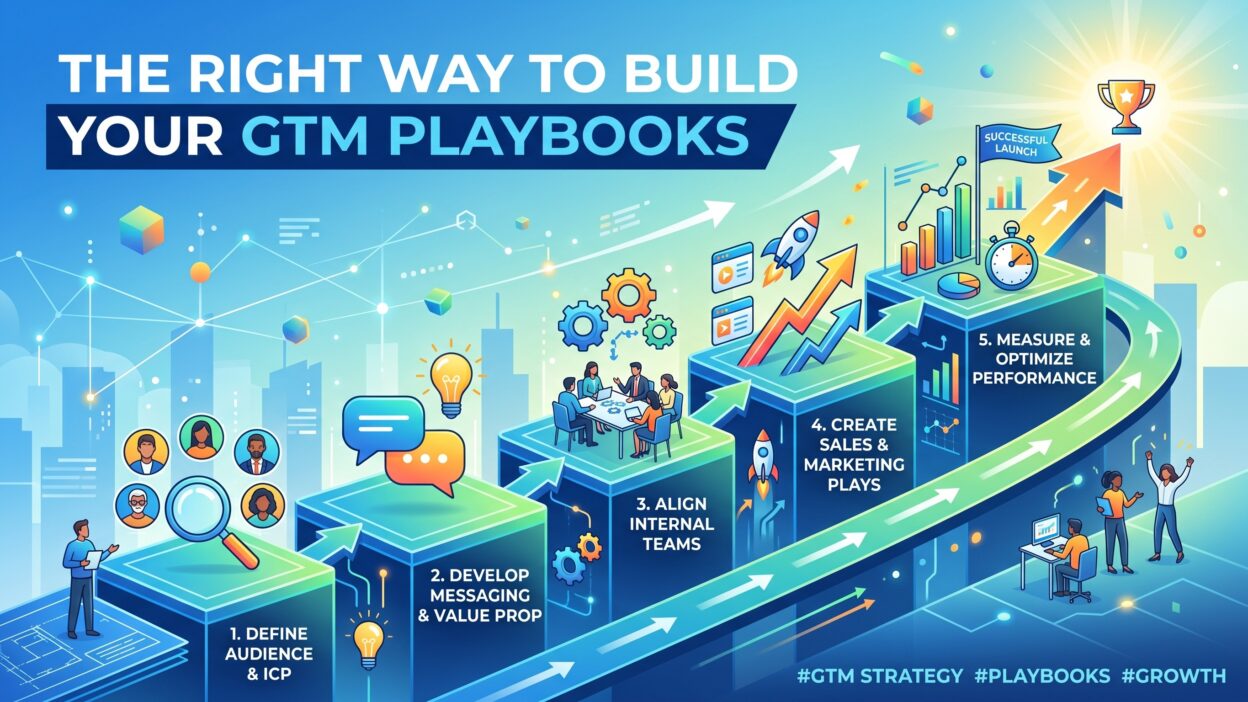
The Right Framework for Building GTM Playbooks
Start with Your ICP and Segments
Every strong set of GTM Playbooks begins with a clear Ideal Customer Profile. Your ICP defines who the playbook is for. Without that clarity, the playbook tries to serve everyone and ends up serving no one well.
Document your ICP in specific terms. Company size by employee count and revenue range. Industry verticals. Geographic markets. Technology stack requirements. Organizational structure. Buying committee composition.
Then segment your ICP further. Enterprise accounts behave differently from mid-market accounts. Inbound leads behave differently from cold outbound targets. Each segment may need its own playbook variation — or at minimum, its own section within the broader GTM Playbooks framework.
Map the Full Customer Journey
Your GTM Playbooks should cover every stage of the customer journey. Awareness. Consideration. Decision. Onboarding. Expansion. Renewal. Advocacy.
Most teams build playbooks for the pre-sales stages and ignore what happens after the signature. That is a mistake. Post-sale execution is where retention rates are won or lost. Expansion revenue often represents the highest-margin growth available to a business.
Map the journey first. Then build playbook content for each stage. Identify handoff points between teams. Define what information transfers at each handoff. Specify who owns which stage and what success looks like at each transition.
Define the Core Motions
Each playbook covers a specific motion. A motion is a repeatable action pattern your team runs to achieve a specific outcome.
Common GTM motions include outbound prospecting, inbound qualification, discovery calls, product demos, proposal delivery, contract negotiation, onboarding, quarterly business reviews, upsell campaigns, and churn prevention sequences.
List every motion your revenue team runs. Prioritize the ones that have the biggest impact on pipeline and revenue. Build those playbooks first. Expand from there as capacity allows.
Build Role-Specific Playbooks
A great GTM Playbooks system is organized by role. The SDR playbook looks different from the AE playbook. The CS playbook looks different from the marketing playbook. Each role needs guidance specific to their responsibilities and their part of the customer journey.
Role-specific playbooks are easier to use. Reps do not have to filter through content that does not apply to them. They find their section, follow the guidance, and execute the motion.
Cross-functional sections can address handoffs and collaboration moments where two roles interact. Keep those sections clear about who does what and when.
Core Components Every GTM Playbook Needs
The Situation Overview
Every playbook section should open with a clear description of the situation it addresses. What motion does this cover? Which role runs it? What does success look like?
A two-paragraph situation overview eliminates ambiguity. Reps know immediately whether they are looking at the right section for their current need.
The Target Profile
Each motion in your GTM Playbooks should specify who it targets. Which segment? Which persona? Which stage in the buyer journey?
A discovery call playbook for an enterprise CFO looks different from one targeting a VP of Marketing at a mid-market company. Specify the target profile clearly so reps can adapt accordingly.
The Messaging Framework
Messaging is the heart of most GTM Playbooks sections. What do you say? How do you position value? How do you handle the most common objections?
Document your core value proposition for each segment. List the three to five most common objections and provide tested responses. Include proof points, customer stories, and data that support your claims.
Messaging should feel conversational. It is not a script reps read word-for-word. It is a framework they internalize and deliver naturally in their own voice.
The Step-by-Step Process
This is the operational core of GTM Playbooks. Document the exact sequence of steps for each motion.
For an outbound prospecting motion, that sequence might include account research, multi-channel touchpoint sequencing, voicemail scripts, email templates, LinkedIn connection messaging, and follow-up cadence timing.
Make the steps specific. Avoid vague instructions like “personalize your outreach.” Say exactly what personalization looks like — what data to reference, where to find it, and how to incorporate it into the first touchpoint.
The Tools and Resources
Each playbook section should list the tools the rep uses to execute the motion. CRM fields to update at each stage. Sequencing tools and their settings. Content assets to share at specific touchpoints. Tracking and reporting dashboards to monitor performance.
Linking directly to tools and resources within the playbook saves time. It removes the friction of hunting for assets while trying to execute a live motion.
Success Metrics
GTM Playbooks should specify what success looks like for each motion. Not just output metrics — input metrics that reps can track in real time.
For an outbound prospecting motion, input metrics might include daily activity counts, connection request acceptance rates, and reply rates by sequence step. Output metrics include meetings booked, pipeline generated, and influenced revenue.
Clear metrics make GTM Playbooks more than guides. They make them accountability frameworks that managers can use for coaching and performance review.
Types of GTM Playbooks Every Revenue Team Needs
The Outbound Prospecting Playbook
Outbound drives pipeline for most B2B revenue teams. The outbound prospecting playbook documents exactly how your SDRs and AEs identify, research, engage, and qualify target accounts.
It covers ICP criteria for outbound targeting. It specifies research steps before first contact. It provides the multi-touch sequence — email, phone, LinkedIn — with timing and messaging for each step. It handles common early objections. It defines what qualifies a prospect for next-stage progression.
Strong GTM Playbooks for outbound are tested and data-driven. They reflect the sequences that generate the highest reply rates and the most qualified meetings — not the sequences someone theorized might work.
The Inbound Qualification Playbook
Inbound leads require different handling from outbound prospects. They already know who you are. They have shown intent. The motion is qualification, not cold outreach.
The inbound qualification playbook covers how fast reps must respond to new leads. It specifies the qualification criteria — what makes a lead worth a discovery call. It provides the questions to ask. It defines the scoring threshold for passing a lead to an AE.
Speed matters enormously in inbound qualification. GTM Playbooks for this motion should set clear SLA expectations and document the consequences of missing them.
The Discovery Call Playbook
Discovery is where deals are won or lost. A rep who runs a great discovery call understands the buyer’s situation deeply. They uncover pain. They connect that pain to business outcomes. They set the stage for a compelling demo or proposal.
The discovery call playbook covers the pre-call preparation steps. It provides the question framework — open questions that surface business context, challenges, priorities, and buying dynamics. It specifies what information must be captured in the CRM before the call ends. It addresses how to handle common discovery traps and objections.
GTM Playbooks for discovery should include real call examples. What does a great discovery call sound like? What questions unlock the most insight? What responses signal strong opportunity versus weak fit?
The Demo and Presentation Playbook
A product demo is not a feature tour. It is a proof of value. The demo playbook documents how reps connect specific product capabilities to the specific pain points uncovered in discovery.
The demo playbook covers how to open, set an agenda, and frame the demonstration around the buyer’s stated priorities. It provides the core demo flow for each segment and persona. It addresses how to handle live questions, technical objections, and competitor comparisons during the presentation.
The Onboarding Playbook
The customer relationship begins — not ends — at the signature. GTM Playbooks for onboarding cover every step from contract signature to value realization.
Who kicks off the onboarding? What happens in the first call? What milestones define a successful 30-60-90 day onboarding? What risks indicate the customer might struggle to adopt the product?
Strong onboarding playbooks reduce time-to-value. They set customers up for long-term success. They are critical to retention outcomes that compound over time.
The Expansion and Upsell Playbook
Expansion revenue is the highest-margin growth available to most SaaS and subscription businesses. GTM Playbooks for expansion document how CS and sales teams identify and pursue upsell opportunities within existing accounts.
This playbook covers the signals that indicate expansion readiness. Usage patterns. Engagement levels. Business growth indicators from the account. It documents how to open expansion conversations without feeling transactional. It provides the framework for presenting expansion value in business outcome terms.
The Churn Prevention Playbook
Every revenue team deals with churn. GTM Playbooks for churn prevention turn reactive account recovery into a proactive, systematic motion.
The churn prevention playbook covers risk identification — what signals indicate an account is at risk. It documents the intervention sequence: who reaches out, what they say, and how the conversation is structured. It specifies escalation paths when initial interventions do not move the needle.
How to Roll Out GTM Playbooks Across Your Team
Involve Reps in the Build Process
The worst GTM Playbooks get built in boardrooms by executives who have not been in the field recently. The best ones get built with active input from the reps who run the motions every day.
Involve your top performers in the playbook development process. Ask them what works. Record their calls. Deconstruct their most successful sequences. Translate their tacit knowledge into documented best practices that the whole team can use.
Reps who contribute to GTM Playbooks adopt them more readily. Ownership drives utilization.
Train Around the Playbooks
A playbook rollout is not an email with a link. It requires structured training. Walk through each section in team sessions. Role-play the scenarios the playbook covers. Let reps practice the messaging in a safe environment before they use it with real prospects.
Record training sessions so new hires can access them during onboarding. The playbook plus the training session creates a complete learning package for future team members.
Embed Playbooks in Daily Workflows
GTM Playbooks only work if reps use them. Reps only use them if they are easy to find and reference during active work.
Embed playbook links in CRM stages. Add them to the tools reps use every day. Reference them in manager coaching conversations. Make them the shared language your revenue team uses when discussing how to approach a deal, a call, or a campaign.
Review and Update Quarterly
Set a quarterly cadence for playbook reviews. Gather feedback from reps. Review performance data. Identify sections that are underperforming or outdated. Update messaging based on competitive changes. Add new sections as new motions emerge.
The review process is not optional. GTM Playbooks that do not evolve become obstacles. They describe a reality that no longer exists and guide reps away from what actually works today.
Related Concepts
Go-to-Market Strategy
GTM Playbooks operationalize your go-to-market strategy. Strategy defines direction. The playbook defines execution. Without a strong strategy foundation, the playbook lacks coherence. Without the playbook, the strategy never reaches the field.
Sales Enablement
Sales enablement is the function responsible for ensuring reps have the skills, tools, and content they need to execute effectively. GTM Playbooks are the central artifact of any serious sales enablement program. They document best practices, provide messaging frameworks, and create a shared standard for how the team sells.
Revenue Playbook
Revenue playbook is often used interchangeably with GTM Playbooks. The term emphasizes full-funnel coverage — not just the sales motion, but marketing, CS, and post-sale motions as well. The best revenue playbooks cover every team that contributes to revenue generation and retention.
Pipeline Generation
GTM Playbooks for pipeline generation cover how marketing and sales work together to build top-of-funnel demand. They specify the channels, messages, and tactics that produce the highest-quality pipeline — and the criteria that define pipeline quality in the first place.
Product-Led Growth Playbook
Product-led growth companies need GTM Playbooks that reflect their unique motion. Free trials. In-product onboarding. Usage-triggered sales outreach. Expansion driven by product adoption signals. PLG playbooks require deep integration between product data and sales and CS motions.
Frequently Asked Questions (FAQs)
What are GTM Playbooks?
GTM Playbooks are structured, role-specific operational guides that document how a revenue team executes each major go-to-market motion. They translate strategy into repeatable action by specifying what to do, when to do it, what to say, and how to measure success for each scenario.
How long should a GTM Playbook be?
Length depends on the complexity of the motion being documented. A single-motion playbook — like an outbound prospecting playbook for one segment — might run 10 to 20 pages. A comprehensive GTM Playbooks system covering all motions across all roles might be much longer but organized into modular sections. Prioritize clarity and usability over exhaustive length.
Who should build GTM Playbooks?
GTM Playbooks work best when built collaboratively. Revenue operations, sales leadership, and marketing leadership typically own the process. Top-performing reps and CS managers contribute field insight. The playbook reflects both strategic intent from leadership and practical reality from the field.
How often should GTM Playbooks be updated?
Quarterly reviews are the minimum standard. Fast-moving markets, competitive changes, or significant shifts in buyer behavior may require more frequent updates. Assign a named owner to each playbook who is accountable for keeping it current.
What is the difference between a GTM Playbook and a sales playbook?
A sales playbook typically focuses on the pre-sale motion — prospecting, qualification, demos, and closing. GTM Playbooks cover a broader scope that includes marketing motions, post-sale CS motions, onboarding, expansion, and retention. GTM Playbooks address the full revenue cycle, not just the acquisition phase.
Can small teams benefit from GTM Playbooks?
Absolutely. Small teams benefit enormously from documented playbooks. With a small team, one person leaving can mean a significant loss of institutional knowledge. GTM Playbooks capture that knowledge and make it available to the whole team regardless of individual turnover.
What tools are commonly used to house GTM Playbooks?
Teams use a range of tools. Notion, Confluence, and Google Docs are common choices for document-based playbooks. Some teams use dedicated sales enablement platforms that embed playbook content directly into CRM workflows. The best tool is the one your team actually opens and references during their workday.
How do I know if my GTM Playbooks are working?
Track utilization — are reps using the playbook? Track performance metrics for the motions the playbook covers. Compare outcomes before and after playbook implementation. Gather qualitative feedback from reps about which sections are most and least useful. Improving metrics and strong adoption signal a working playbook system.
Best Practices for High-Impact GTM Playbooks
Ground Every Section in Real Data
Use closed-won analysis to validate your messaging. Use churn data to refine your risk identification criteria. Use sequence performance data to select the highest-performing outbound templates.
GTM Playbooks grounded in data outperform those built on intuition. Data-backed guidance builds rep confidence. Reps trust guidance that reflects what has actually worked.
Write for the Rep, Not for Leadership
Playbooks often fail because they are written for executives reviewing strategy — not for reps executing in the field. Use simple language. Write short sections. Organize for quick reference, not deep reading.
Ask yourself: could a rep find what they need in this playbook while on a live call? If the answer is no, simplify.
Include Real Examples
Abstract frameworks are harder to apply than concrete examples. Include real email templates. Include actual call scripts. Include annotated call recordings linked from the playbook.
Real examples make GTM Playbooks immediately useful. They give reps a clear picture of what excellent execution looks like — not just a description of it.
Build a Feedback Loop
Create a channel where reps can submit feedback on each playbook section. A Slack channel, a feedback form linked from the playbook, or a standing agenda item in team meetings all work.
The feedback loop surfaces what is outdated, what is unclear, and what is missing. It keeps the playbook in close contact with field reality.
Read More:-Top 10 Revenue Action Orchestration Tools for 2026
Conclusion

Most revenue teams know what they want to achieve. They have targets. They have strategies. What they often lack is a clear, consistent, data-backed system for achieving those targets in the field every single day.
GTM Playbooks fill that gap. They translate strategy into action. They capture institutional knowledge before it walks out the door. They create consistency that makes performance data meaningful and improvement possible.
Building GTM Playbooks the right way takes real work. It requires honest data analysis, input from the field, clear role-specific structure, and a commitment to treating playbooks as living documents that evolve with your business.
The payoff is significant. Teams with strong GTM Playbooks ramp new hires faster. They maintain performance consistency across the team. They improve continuously because they have the documentation infrastructure to test, learn, and update.
Do not build GTM Playbooks because it feels like the right thing to do. Build them because your revenue team deserves a clear operational system — and your business cannot afford the compounding cost of inconsistency.
Start with one motion. Build it right. Deploy it with your team. Measure what changes. Then build the next one.