Introduction
TL;DR Every business wants fast growth. Every founder dreams of explosive revenue. Every sales leader wants a full pipeline.
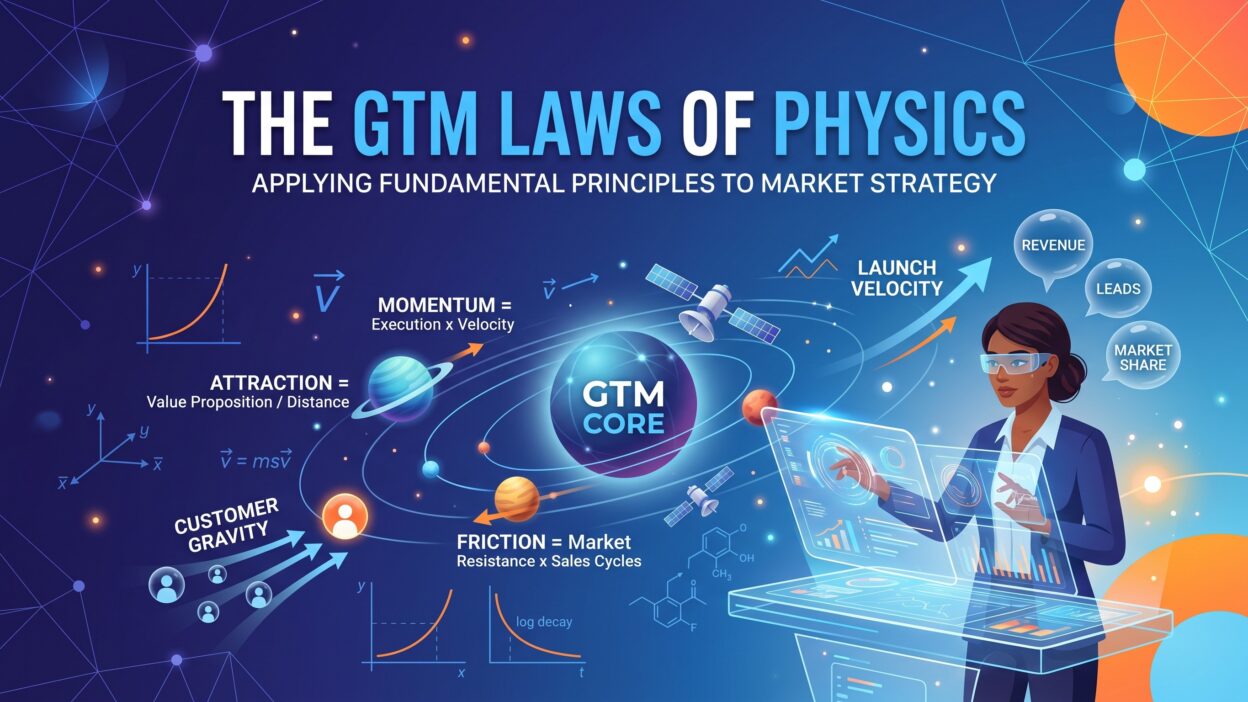
But growth does not come from wishful thinking. It comes from understanding forces that govern how deals move, how markets respond, and how teams perform.These forces are the GTM Laws of Physics.
Just like physics governs the physical world, the GTM Laws of Physics govern how go-to-market motion works. Ignore them, and your pipeline stalls. Respect them, and revenue compounds.
This blog breaks down each law in plain language. It shows you what each law means, why it matters, and how to apply it inside your business right now.
Table of Contents
What Are the GTM Laws of Physics?
The GTM Laws of Physics are principles that define how go-to-market strategies behave in the real world. They are not theories. They are observable patterns that repeat across industries, company sizes, and economic cycles.
Think about Newton’s laws of motion. Objects stay at rest unless force is applied. Objects in motion stay in motion unless something stops them. Action creates equal and opposite reaction.
The same logic applies to GTM.
A deal at rest tends to stay stuck. A pipeline in motion tends to keep moving. Every GTM decision creates a reaction, positive or negative, in revenue output.
Understanding the GTM Laws of Physics gives revenue teams a shared language. It helps leaders diagnose problems faster. It helps teams make smarter decisions without guessing.
GTM Law #1: The Law of Inertia in Sales
Deals at Rest Stay at Rest
Every stalled deal follows the Law of Inertia. A prospect who is not moving is not going to move on their own.
Sales inertia is real. A lead goes cold. A prospect stops replying. A champion goes silent. These are not random events. They follow a pattern.
The GTM Laws of Physics teach us that inertia is the enemy of pipeline health. Deals need constant force applied to them. That force is value, urgency, relevance, or proof.
Without applied force, a stalled deal stays stalled. With focused energy, a cold lead can warm up fast.
How to Apply Force to Stalled Deals
Revenue teams must stop waiting for prospects to self-activate. They must create momentum deliberately.
Personalized outreach works better than generic follow-ups. A new case study can restart a conversation. A product update creates a natural reason to reconnect. An economic trigger, like a competitor announcement, adds urgency.
The key insight from the GTM Laws of Physics is simple: momentum does not create itself. Someone must initiate force.
GTM Law #2: The Law of Velocity and Direction
Speed Means Nothing Without the Right Direction
Speed is overrated. Many GTM teams celebrate busyness. They track calls made, emails sent, demos booked. But raw activity is not the same as progress.
The GTM Laws of Physics demand clarity on both velocity and direction. A sales team moving fast in the wrong direction closes zero deals. A team moving steadily toward the right ICP closes consistently.
Velocity in GTM is not just how fast reps move. It is how fast the right deals move toward close.
Defining the Right Direction for Your GTM Motion
Direction in GTM comes from Ideal Customer Profile clarity. If your ICP is vague, your team aims at everything and hits nothing.
A well-defined ICP creates a targeting vector. Every outbound message, every campaign, every channel becomes aligned to a specific type of buyer.
One of the core principles inside the GTM Laws of Physics is this: focused energy always outperforms scattered energy. Narrow your ICP. Sharpen your message. Move with intention.
Measuring GTM Velocity Correctly
Do not measure activity. Measure outcomes per unit of time.
How many qualified opportunities does each rep create per week? How fast do deals move from discovery to proposal? How many days does an average deal sit in each stage?
These numbers reveal whether your GTM motion has real velocity or just the appearance of it.
GTM Law #3: The Law of Force and Mass
Revenue Requires the Right Amount of Force Applied to the Right Mass
Newton’s second law says force equals mass times acceleration. In GTM, this translates directly.
The “mass” in your GTM system is the size, complexity, and resistance of your target market. The “force” is your team, budget, messaging, and product capability. The resulting “acceleration” is revenue growth.
The GTM Laws of Physics make this clear: small force applied to a massive market produces weak acceleration. Adequate force applied to the right segment produces strong growth.
Many startups fail here. They target the entire market with a small team and wonder why growth is slow. The physics does not lie.
Choosing the Right Market Segment
Market selection is a force multiplier. A smaller, well-defined segment feels like less opportunity but produces more revenue faster.
Enterprise deals require more force. They need more stakeholders, longer cycles, deeper proof points, and broader team coverage. Mid-market deals need less force and move faster.
The GTM Laws of Physics recommend matching your available force to a segment where it can produce real acceleration. Do not overextend your team into segments you cannot win with your current resources.
Increasing Force Without Burning Out Your Team
Force in GTM does not only mean headcount. It includes product quality, brand strength, customer proof, and content.
A strong case study reduces resistance in a deal. A clear ROI framework speeds up decision cycles. Competitive battle cards equip reps to handle objections faster.
Build force through assets, not just effort. This is how you scale GTM without burning your team.
GTM Law #4: The Law of Equal and Opposite Reaction
Every GTM Action Creates a Market Reaction
Newton’s third law is unavoidable. Every action produces a reaction. The GTM Laws of Physics work the same way.
When you price aggressively, competitors respond. When you enter a new market, incumbents defend territory. When you change your messaging, some prospects engage and others disengage.
Every GTM move has consequences. Some are visible immediately. Others take months to surface.
Anticipating Competitive Reactions
Smart GTM leaders model competitor responses before making big moves. If you drop price, will competitors drop theirs too? If you hire aggressively into a market, will that signal your intent and trigger a response?
The GTM Laws of Physics require strategic thinking beyond the immediate outcome. Before launching a new campaign or entering a new segment, ask: what happens next?
Scenario planning is underused in GTM. Teams that model reactions before acting make far better decisions than those who react after the fact.
Using Reaction to Your Advantage
Reactions are not always bad. A competitor overreacting to your move can exhaust their resources. A competitor ignoring your move gives you time to compound market position.
Study how the market reacts to your GTM actions. Build feedback loops that tell you when your moves are working and when they trigger unwanted consequences.
GTM Law #5: The Law of Gravity in Pipeline
Deals Always Tend to Fall Downward
Gravity pulls objects down. In GTM, deals always tend to move backward unless energy is applied to move them forward.
This is one of the most important principles in the GTM Laws of Physics. Deals do not naturally progress. They naturally regress.
A prospect who was excited last month is not automatically still excited today. A champion who loved your product in Q1 may face new priorities in Q2. A deal close to signing can fall apart if a new stakeholder enters the picture.
The GTM Laws of Physics remind us: never assume a deal is safe. Every deal needs attention to fight the gravitational pull backward.
Building Anti-Gravity Systems in Your Sales Process
Anti-gravity systems keep deals moving forward despite natural regression tendencies.
Regular executive sponsor outreach counters the loss of deal energy at the top. Scheduled multi-threaded engagement counters single-threaded deal risk. Periodic ROI reinforcement keeps business case fresh in the buyer’s mind.
Review your CRM stages. Identify where deals fall most often. Build a specific intervention for each dropout point.
Why Pipeline Reviews Must Happen Weekly
Monthly pipeline reviews miss the gravity problem entirely. A deal that slips back takes weeks to recover.
Weekly pipeline reviews catch regressing deals early. They allow teams to apply corrective force before a deal is lost. They create accountability and visibility across the revenue team.
The GTM Laws of Physics demand weekly attention, not quarterly hope.
GTM Law #6: The Law of Thermodynamics in GTM Energy
GTM Energy Cannot Be Created From Nothing
The first law of thermodynamics says energy cannot be created or destroyed. It can only be converted.
In GTM, this means revenue energy is not created out of thin air. It is converted from input sources: marketing spend, sales effort, product investment, customer success attention.
The GTM Laws of Physics teach that output is always proportional to input. If you want more pipeline, you must invest more energy somewhere. If you want more closed revenue, you must convert energy more efficiently.
Identifying Where GTM Energy Is Lost
Most GTM teams bleed energy in predictable places.
Marketing generates leads that sales ignores. Sales creates proposals that procurement delays indefinitely. Customer success fights churn without product help to fix the root cause.
Each of these is an energy leak. The GTM Laws of Physics demand a systemic view of where energy enters your GTM motion and where it leaks out.
An energy audit of your GTM system is one of the most valuable exercises a revenue leader can run.
Converting GTM Energy More Efficiently
Efficiency gains are compound. A 10% improvement in lead-to-opportunity conversion creates leverage across the entire funnel.
Invest in conversion rate optimization at each stage. Test new messaging in discovery. Improve demo-to-proposal ratios with better qualification. Accelerate proposal-to-close with stronger mutual action plans.
Each improvement multiplies the value of the energy already entering your system.
GTM Law #7: The Law of Resonance
Your Message Must Match the Frequency of Your Buyer
Physics teaches that resonance occurs when two frequencies align. When they match, energy transfers efficiently. When they do not match, energy dissipates.
In GTM, resonance is messaging alignment. When your message matches the exact pain your buyer feels right now, it resonates. When it misses the mark, it falls flat.
The GTM Laws of Physics make this unavoidable. A brilliant product with a misaligned message still fails in market. A good-enough product with a perfectly resonant message wins deals.
Finding the Frequency of Your Buyer
Buyer frequency shifts over time. A CFO’s priorities in a growth environment differ from those in a cost-cutting environment. A CTO’s concerns about security shift based on recent industry breaches.
Run win/loss analysis consistently. Talk to lost prospects. Survey recently closed customers. Find out what language they use to describe their own pain.
Mirror that language back in your messaging. When your words match their internal thoughts, resonance occurs and deals move faster.
Testing for Resonance Across Segments
Different segments resonate at different frequencies. A message that works for mid-market finance teams may completely miss enterprise operations leaders.
Create segment-specific messaging. Test subject lines, talk tracks, and value propositions across each segment. Measure which messages produce the highest response and engagement rates.
The GTM Laws of Physics require tuning, not guessing.
GTM Law #8: The Law of Friction
Friction Slows Every Stage of the Buyer Journey
Friction is resistance to motion. In physics, friction converts kinetic energy into heat. In GTM, friction converts buyer intent into delay, confusion, or abandonment.
The GTM Laws of Physics identify friction as one of the top destroyers of revenue potential. Every unnecessary step in a buying process is friction. Every unclear message is friction. Every slow response from sales is friction.
Friction does not always feel dramatic. It accumulates quietly. A slightly confusing proposal here. A three-day response lag there. A pricing page that requires a call to understand.
These small frictions compound into lost deals.
Mapping Friction Points Across the Buyer Journey
Start from the moment a buyer first becomes aware of your product. Trace every touchpoint to the moment they sign.
Where do buyers have to work hard to get information? Where do internal approvals slow things down unnecessarily? Where does your own process create confusion?
Map each friction point. Assign an owner to reduce or eliminate each one.
Reducing Friction in the Sales Process
Provide pricing transparently where possible. Create one-page proposals that are easy to share internally. Use mutual action plans to give buyers a clear roadmap to close.
Speed also reduces friction. Fast responses signal to buyers that your team is organized and responsive. A slow follow-up, even by one day, creates doubt.
The GTM Laws of Physics demand relentless friction reduction at every stage.
GTM Law #9: The Law of Compounding Returns
GTM Investment Compounds Over Time
Compound interest is physics applied to money. Returns build on previous returns. The same law applies to GTM investment.
A strong brand reduces CAC over time. A library of customer proof compounds trust across the market. A well-trained sales team gets better every quarter.
The GTM Laws of Physics reward patience and consistency. Short-term thinking destroys compounding. Long-term investment creates it.
Building Assets That Compound
Content compounds. A high-ranking blog post generates leads for years. A well-produced video case study closes deals while your team sleeps.
Customer relationships compound. A happy customer refers others. A successful implementation produces an upsell. A champion who changes companies becomes a new logo.
Brand compounds. Consistent positioning creates market recognition. Recognition reduces friction. Reduced friction increases win rates.
The GTM Investment That Pays the Slowest and Most
Partner ecosystems compound slowly. Building a referral network or channel partnership takes 12 to 18 months before it produces real revenue. But once it produces, it does so without proportional headcount cost.
The GTM Laws of Physics tell us to start compounding investments early. The teams that plant these seeds in Year One harvest them in Year Three.
GTM Law #10: The Law of Equilibrium
Markets Seek Balance and So Must Your GTM Motion
Physical systems seek equilibrium. Pressure equalizes. Temperature balances. Forces reach a stable state.
Markets do the same. A market with one dominant player attracts challengers. A market with dozens of undifferentiated vendors begins consolidating.
The GTM Laws of Physics require you to understand where your market sits in its equilibrium cycle. A market in consolidation rewards scale. A market in disruption rewards differentiation.
Positioning for Market Equilibrium
When a market is in early disruption, be bold with differentiation. Be the alternative. Be the new approach.
When a market is consolidating, compete on trust, scale, and reliability. Buyers in consolidating markets fear risk. Reduce their fear and you win their business.
Understanding equilibrium dynamics keeps your GTM motion aligned to where the market actually is, not where you wish it were.
Rebalancing Your GTM Motion When Market Conditions Shift
Markets shift. Economic conditions change. Buyer priorities evolve. Regulatory environments tighten or loosen.
Your GTM motion must rebalance when conditions change. Rigid GTM strategies that worked in 2021 may be completely wrong for 2024 market conditions.
Build sensing mechanisms. Track market signals. Listen to buyers every quarter. Be willing to rebalance before the market forces you to.
Frequently Asked Questions About the GTM Laws of Physics
FAQ Section
What does GTM Laws of Physics mean in business?
The GTM Laws of Physics refer to observable principles that govern how go-to-market strategies perform in real markets. They borrow concepts from classical physics, such as inertia, velocity, force, gravity, and friction, and apply them to revenue generation, sales motion, and market behavior.
How do the GTM Laws of Physics help sales teams?
They give sales teams a diagnostic framework. When deals stall, inertia is the culprit. When pipeline regresses, gravity is at work. When deals are slow, friction is the issue. Naming the law makes the solution clearer and faster to implement.
Are the GTM Laws of Physics applicable to all business models?
Yes. The GTM Laws of Physics apply to SaaS, services, e-commerce, and enterprise sales. The specific manifestations differ but the underlying forces are universal. Inertia, velocity, friction, and compounding work the same way whether you sell software or professional services.
How do I start applying the GTM Laws of Physics in my company?
Start with a GTM audit. Map your current pipeline stages. Identify where deals stall (inertia), where they fall back (gravity), and where buyers disengage (friction). Assign one owner to each problem law. Build a 30-day intervention plan for each.
What is the most important of the GTM Laws of Physics?
Most revenue leaders find the Law of Gravity most urgent because it quietly kills healthy pipelines. Deals that seem strong can regress without notice. Weekly pipeline reviews based on the GTM Laws of Physics framework catch these regressions before they become lost deals.
Read More:-AI Marketing Automation: What It Is and How It Works
Conclusion

The GTM Laws of Physics Are Always at Work
Whether you know these laws or not, they are operating inside your business right now.
Deals are either in motion or stuck. Pipeline is either growing or regressing. Your message is either resonating or falling flat. Energy is either compounding or leaking out.
The GTM Laws of Physics do not give you magic. They give you clarity.
When you name the force at work, you can respond to it intelligently. Inertia? Apply targeted outreach. Gravity? Build anti-regression systems. Friction? Eliminate unnecessary steps. Misaligned resonance? Rewrite your messaging.
Every revenue problem has a physics explanation. Every GTM challenge has a law behind it.
The leaders who master the GTM Laws of Physics build more predictable pipelines, win more deals, and grow more efficiently than those who rely on instinct alone.
Study these laws. Apply them. Watch your GTM motion shift from reactive to engineered.
Revenue does not happen by accident. It follows the laws.