Introduction
TL;DR Marketing has always been about reaching the right person at the right time. That goal has never changed. The tools to achieve it have changed enormously.AI Marketing Automation is the latest — and most powerful — evolution of that pursuit. It combines artificial intelligence with marketing workflows to deliver smarter, faster, and more personalized campaigns at scale.
Brands that adopt it gain a measurable edge. Brands that ignore it fall behind competitors who do not.
This blog covers what AI Marketing Automation is, how it works, who it benefits, and why it is reshaping modern marketing from the ground up.
Table of Contents
What Is AI Marketing Automation?
The Core Definition
AI Marketing Automation is the use of artificial intelligence to execute, optimize, and personalize marketing tasks without constant human input. It goes far beyond traditional automation, which simply follows preset rules and triggers.
Traditional marketing automation does what you tell it to do. AI Marketing Automation learns what works and improves over time.
The intelligence layer makes all the difference. Machine learning models analyze data. They detect patterns. They make decisions. They improve with every campaign cycle.
How It Differs from Traditional Marketing Automation
Traditional marketing automation runs on logic trees. If a user opens an email, send a follow-up. If they click a link, add them to a segment. These rules work well for simple sequences.
AI Marketing Automation operates on a different level entirely. It does not need pre-written rules for every scenario. It builds its own understanding of audience behavior. It adjusts messaging, timing, and channel selection dynamically.
The shift from rule-based to intelligence-based marketing is profound. It frees marketers from building every workflow manually. It handles complexity that human-built logic trees simply cannot scale to match.
The Role of Machine Learning
Machine learning is the engine inside AI Marketing Automation. Algorithms train on historical data. They learn which subject lines drive opens. They identify which customer segments respond to which offers. They predict which leads are most likely to convert.
Over time, the models become more accurate. Every interaction adds to the training data. Every campaign result sharpens the next prediction.
This self-improving quality is what makes AI Marketing Automation genuinely different from anything that came before it.
Key Components of AI Marketing Automation
Data Collection and Integration
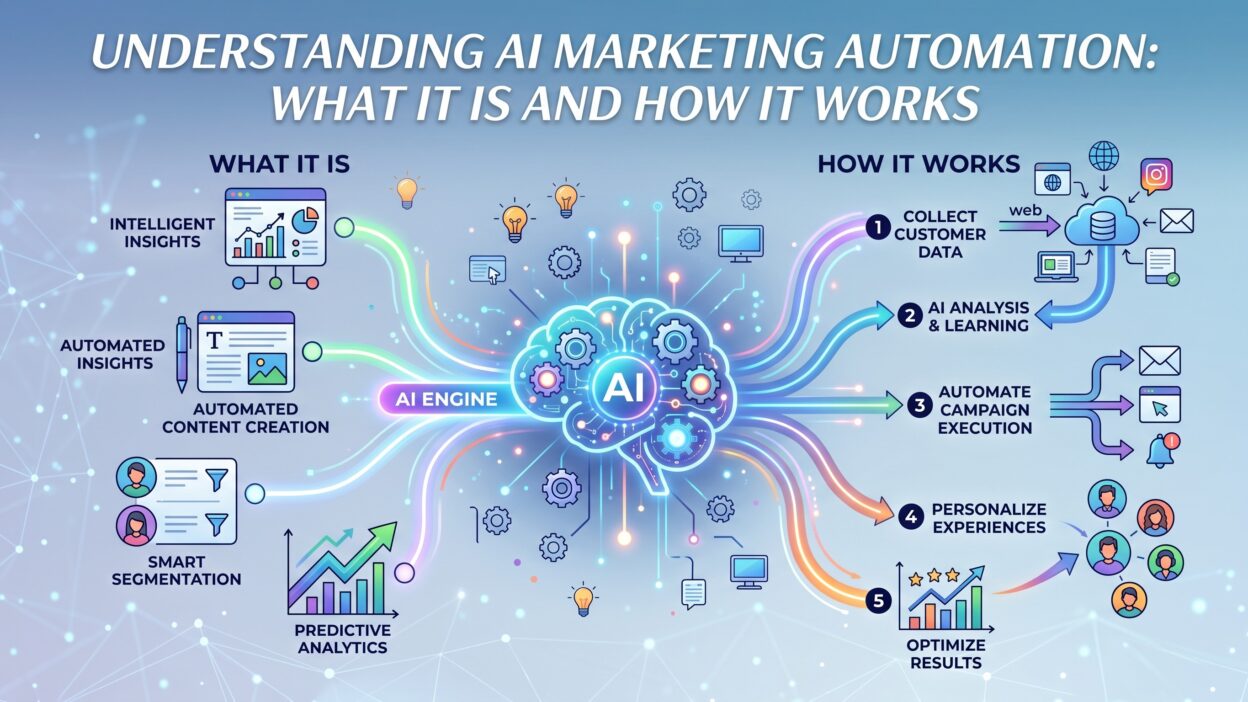
AI Marketing Automation starts with data. Customer data. Behavioral data. Purchase history. Website activity. Email engagement. Social interactions. CRM records.
The system pulls all of this together into a unified customer view. Without clean, connected data, the AI has nothing meaningful to learn from.
Most AI marketing platforms integrate with CRMs, ad platforms, email tools, and analytics systems. The richer the data input, the smarter the output.
Predictive Analytics
Predictive analytics is one of the most valuable capabilities inside AI Marketing Automation. The AI uses historical patterns to forecast future behavior.
Which contacts are likely to churn? Which accounts are ready to buy? Which customers are about to lapse? Predictive models surface answers before the problem or opportunity becomes obvious to a human analyst.
Marketers act on predictions instead of reacting to events that already happened. This shift from reactive to proactive strategy changes campaign outcomes significantly.
Personalization at Scale
Personalization used to require manual segmentation. A marketer would build five audience segments and write five different email variations. That was considered sophisticated.
AI Marketing Automation makes that approach look primitive. The AI can personalize at the individual level. It determines the right message for each specific contact based on their behavior, preferences, and stage in the customer journey.
This level of granularity was impossible before AI entered the picture. Now it runs automatically, across millions of contacts, without proportional increases in human workload.
Dynamic Content Generation
AI Marketing Automation platforms increasingly include content generation capabilities. The AI writes subject lines. It generates ad copy variations. It drafts email body text. It recommends the best-performing version for each audience segment.
This does not replace human creativity. It accelerates execution. Marketers set the strategic direction. The AI handles volume and variation at speed.
Campaign Optimization
Every marketing campaign has variables. Send time. Channel selection. Message length. Creative format. Audience targeting. Call-to-action phrasing.
AI Marketing Automation tests and optimizes these variables continuously. It does not wait for a campaign to end before learning. It adjusts in real time as performance data comes in.
This live optimization capability delivers better results than any static campaign plan a human team could build and maintain manually.
How AI Marketing Automation Works
Data Ingestion
The process begins with data. The AI platform connects to your existing marketing stack. It pulls in customer records, behavioral signals, transaction history, and engagement data.
Data hygiene matters here. Duplicate records, outdated information, and missing fields all limit what the AI can do. Most platforms include data normalization steps to clean inputs before analysis begins.
Audience Segmentation
The AI analyzes the ingested data and builds audience segments. These are not the broad segments a human marketer creates manually. They are micro-segments based on dozens of behavioral and demographic signals simultaneously.
A contact’s segment can shift dynamically as their behavior changes. Someone who was a cold lead last month may have shown high-intent signals this week. The AI catches that shift and adjusts their treatment immediately.
Campaign Triggering
AI Marketing Automation triggers campaigns based on behavior, not just calendar schedules. A contact visiting a pricing page triggers an outreach sequence. A customer who has not purchased in 90 days triggers a re-engagement campaign.
These behavioral triggers create relevance. A message sent because of a specific action the customer just took is far more timely than a message sent on a predetermined schedule.
Content Delivery and Personalization
The AI determines what content each recipient sees, through which channel, and at what time. It draws on the contact’s full history to make these decisions.
An email going to 10,000 people does not look the same for all 10,000. Subject lines vary. Product recommendations differ. Call-to-action language adapts to each recipient’s stage in the journey.
This is AI Marketing Automation delivering on its core promise: mass personalization at a scale no human team can replicate manually.
Performance Measurement and Learning
After campaigns run, the AI analyzes performance. Open rates. Click rates. Conversion rates. Revenue attribution. Time to close.
It compares outcomes across segments, messages, and channels. It identifies what worked. It updates its models. The next campaign benefits from everything the previous one taught the system.
This continuous learning loop is the mechanism that separates AI Marketing Automation from static tools that stay the same regardless of results.
Core Use Cases for AI Marketing Automation
Email Marketing Automation
Email remains one of the highest-ROI marketing channels. AI Marketing Automation makes it dramatically more effective.
The AI determines optimal send times for individual contacts — not just the best time for the average subscriber. It tests subject line variations and automatically promotes winners. It personalizes body content based on past behavior and stated preferences.
The result is higher open rates, higher click rates, and stronger revenue per email sent.
Lead Scoring and Nurturing
Manual lead scoring is slow and often subjective. Sales reps disagree on what makes a lead “hot.” Scoring models built in spreadsheets decay quickly as market conditions shift.
AI Marketing Automation scores leads dynamically. It weighs dozens of signals simultaneously: job title, company size, website behavior, content downloads, email engagement, social interactions. The score updates in real time as new signals come in.
Nurture sequences adjust based on score. High-intent leads get fast-tracked to sales. Lower-intent leads enter longer educational sequences. The right treatment reaches each lead without manual routing decisions.
Social Media Automation
Social media demands constant attention. Publishing schedules, engagement monitoring, ad optimization, and audience targeting all consume significant time.
AI Marketing Automation handles much of this workload. It identifies the best posting times for each platform. It analyzes audience engagement patterns. It optimizes paid social campaigns in real time based on performance data.
Marketers focus on creative strategy and brand voice. The AI handles execution and optimization.
Customer Retention Campaigns
Acquiring a new customer costs far more than keeping an existing one. AI Marketing Automation makes retention programs smarter and more proactive.
Churn prediction models identify at-risk customers before they cancel or go silent. Retention campaigns trigger automatically when risk scores cross a threshold. Personalized offers, check-in sequences, and loyalty rewards reach customers at the moment they matter most.
Retention rates improve. Customer lifetime value rises. Revenue from the existing base becomes more predictable.
Ad Campaign Optimization
Paid advertising involves constant variable management. Audience targeting. Bid strategy. Creative performance. Budget allocation. Placement selection.
AI Marketing Automation platforms integrate with major ad networks. They adjust bids based on real-time performance. They pause underperforming creative and scale winning variants. They shift budget toward the channels and audiences delivering the strongest returns.
Human media buyers set strategy and guardrails. The AI manages execution at a granularity no human team could maintain manually across dozens of campaigns simultaneously.
Website Personalization
Every visitor to your website arrives with a different context. A returning customer sees something different from a first-time visitor. A prospect from an enterprise account sees something different from an SMB contact.
AI Marketing Automation powers dynamic website experiences. Content blocks, CTAs, product recommendations, and chatbot responses all adapt based on visitor identity and behavior.
This personalization increases engagement, reduces bounce rates, and improves conversion rates across the site.
Benefits of AI Marketing Automation
Efficiency Gains
Marketing teams carry enormous workloads. Campaign management, content production, data analysis, reporting, and audience management all compete for limited hours.
AI Marketing Automation removes repetitive tasks from the human workload. It handles execution, testing, optimization, and reporting automatically. Marketers redirect their time toward strategy, creativity, and higher-leverage decisions.
Teams accomplish more with the same headcount. Output quality rises even as manual effort falls.
Improved Customer Experience
Customers respond to relevance. They ignore generic messages. They engage with content that feels personal and timely.
AI Marketing Automation creates that relevance at scale. Every touchpoint reflects what the platform knows about that specific customer. Messages arrive at the right moment through the right channel with the right content.
Customer satisfaction improves. Brand perception strengthens. Loyalty deepens.
Higher Revenue Performance
Better targeting, better timing, and better personalization all translate to better conversion rates. AI Marketing Automation improves performance across the entire funnel.
More leads convert to opportunities. More opportunities close to customers. Customers spend more and stay longer. Revenue per marketing dollar invested rises measurably.
Scalability
A human marketing team hits a ceiling. There are only so many campaigns they can run, so many segments they can maintain, and so many messages they can personalize manually.
AI Marketing Automation scales without that ceiling. Adding 100,000 new contacts to the database does not require hiring 10 more marketers. The AI handles the additional volume with the same sophistication it applies to existing records.
Growth does not create proportional cost increases in marketing operations.
Data-Driven Decision Making
Gut instinct has its place in marketing. Data beats instinct when both are available.
AI Marketing Automation generates continuous performance data. It surfaces insights that human analysts would miss in the volume of information. It turns data into decisions faster than any reporting workflow can match.
Marketers make better choices because they have better information, delivered faster.
Who Should Use AI Marketing Automation?
B2B Marketing Teams
B2B sales cycles are long and complex. Multiple stakeholders. Extended evaluation periods. High deal values. Every interaction matters.
AI Marketing Automation helps B2B teams manage long nurture sequences intelligently. It keeps prospects engaged through extended cycles. It scores accounts based on engagement across the entire buying committee. It alerts sales when account-level intent signals spike.
B2B marketing becomes more precise and more productive with AI at the center.
E-commerce Brands
E-commerce marketers deal with massive product catalogs, high transaction volumes, and frequent customer interactions. Manual personalization at that scale is impossible.
AI Marketing Automation powers product recommendation engines, abandoned cart sequences, post-purchase upsell campaigns, and loyalty programs. It segments buyers by purchase behavior and serves targeted promotions automatically.
Revenue per customer increases. Cart recovery rates improve. Customer lifetime value climbs.
SaaS Companies
SaaS businesses grow through acquisition and retention. AI Marketing Automation serves both goals.
Acquisition campaigns target look-alike audiences based on best customer profiles. Onboarding sequences adapt to how new users engage with the product. Retention campaigns catch at-risk users before they churn. Expansion campaigns identify accounts ready for upsell.
The entire customer lifecycle runs more efficiently with AI Marketing Automation in place.
Enterprise Marketing Organizations
Large enterprises run dozens of campaigns across multiple regions, languages, and business units. Coordination and consistency at that scale is a genuine challenge.
AI Marketing Automation provides centralized intelligence across distributed marketing operations. It maintains brand consistency while enabling local personalization. It aggregates performance data across the organization for unified reporting and strategic decision-making.
Choosing the Right AI Marketing Automation Platform
Integration Capabilities
Your AI marketing platform must connect to your existing stack. CRM integration is non-negotiable. Ad platform connections matter. Email delivery infrastructure needs to work seamlessly.
Evaluate integration depth before committing. A platform that connects broadly but shallowly will limit what the AI can learn from your data.
AI Transparency
Some platforms offer black-box AI. The system makes decisions, but you cannot see why. Others provide transparency into model logic and decision rationale.
Transparency matters for trust and for learning. When you understand why the AI made a choice, you can improve your inputs and strategy accordingly.
Ease of Use
AI Marketing Automation is powerful. It should not require a data science team to operate. The best platforms put that intelligence behind intuitive interfaces that marketing practitioners can use without engineering support.
Evaluate ease of setup, campaign building, and reporting. A platform that takes months to implement delays the value you need now.
Scalability and Pricing
Choose a platform that grows with your business. Some tools price per contact, some per email sent, some per feature tier. Understand the cost model before you scale.
The right platform delivers strong value at your current size and remains cost-effective as your database and campaign volume grow.
Related Topics
Marketing Automation Tools
The market for marketing automation tools is crowded. Platforms range from lightweight email tools to full-stack AI marketing suites. The distinction between traditional tools and AI-native platforms is becoming the most important buying criterion.
Predictive Analytics in Marketing
Predictive analytics gives marketing teams foresight. Knowing which customers are likely to buy next, churn, or increase spend changes how teams allocate budget and attention. AI Marketing Automation embeds predictive analytics into everyday campaign decisions.
Personalized Marketing at Scale
Personalization at scale was once a paradox. True personalization required manual effort that did not scale. AI Marketing Automation resolves that paradox. Individual-level personalization now runs automatically across audiences of any size.
Customer Journey Automation
The customer journey spans many touchpoints. Awareness. Consideration. Decision. Retention. Advocacy. AI Marketing Automation manages the customer through each stage with appropriate, timely messaging — without requiring human coordination of every step.
Machine Learning in Marketing
Machine learning powers the core capabilities of AI Marketing Automation. Segmentation models. Predictive scoring. Content optimization. Churn detection. Understanding how machine learning works helps marketers configure their tools more effectively and interpret outputs more critically.
Frequently Asked Questions (FAQs)
What is AI Marketing Automation?
AI Marketing Automation is the application of artificial intelligence and machine learning to marketing workflows. It enables brands to execute, personalize, and optimize campaigns at scale without proportional increases in human effort. The AI learns from data and improves campaign performance continuously over time.
How is AI Marketing Automation different from regular marketing automation?
Regular marketing automation follows fixed rules. If X happens, do Y. AI Marketing Automation learns from data and makes intelligent decisions beyond what preset rules can handle. It personalizes at the individual level, predicts behavior, and optimizes in real time — capabilities that rule-based systems cannot replicate.
What types of marketing can AI Marketing Automation handle?
AI Marketing Automation applies across email marketing, paid advertising, social media, lead nurturing, website personalization, content distribution, customer retention, and more. Most modern AI marketing platforms support multi-channel orchestration from a single interface.
Do small businesses benefit from AI Marketing Automation?
Yes. While enterprise brands have historically been the primary adopters, AI marketing tools have become more accessible and affordable at smaller scales. Small businesses benefit from smarter email campaigns, better lead prioritization, and more effective ad spend — all with smaller teams than enterprise operations require.
Is AI Marketing Automation expensive?
Pricing varies widely across platforms. Some offer free tiers with limited AI capabilities. Mid-market platforms are accessible to growth-stage companies. Enterprise solutions carry higher price tags. The right question is not the absolute cost but the return on investment. AI Marketing Automation typically delivers measurable revenue gains that exceed platform costs.
How long does it take to see results from AI Marketing Automation?
Early results often appear within the first few campaign cycles. Email performance improvements can show up in weeks. Lead scoring accuracy improves over months as the model trains on more data. Full ROI realization typically takes six to twelve months as the AI accumulates enough history to optimize effectively.
What data does AI Marketing Automation need to work?
The more data, the better. AI marketing platforms work with CRM data, email engagement history, website behavior, ad performance data, purchase records, and customer support interactions. Clean, connected data produces better AI outputs than fragmented or low-quality inputs.
Can AI Marketing Automation replace human marketers?
No. AI Marketing Automation handles execution, optimization, and data analysis. It does not replace strategic thinking, creative direction, brand voice development, or relationship management. It amplifies what human marketers can accomplish by removing repetitive tasks and surfacing intelligence that improves strategic decisions.
What industries benefit most from AI Marketing Automation?
E-commerce, SaaS, financial services, healthcare marketing, B2B technology, and retail all see strong results. Any industry with large customer databases, multi-channel marketing programs, and meaningful data assets can benefit significantly from AI Marketing Automation.
How do I get started with AI Marketing Automation?
Start by auditing your existing data infrastructure. Clean your CRM. Connect your marketing channels. Then evaluate platforms based on integration depth, AI transparency, ease of use, and scalability. Most platforms offer trials or demos. Begin with one or two use cases — email personalization and lead scoring are common starting points — before expanding to full multi-channel automation.
Best Practices for Implementing AI Marketing Automation
Start with Clean Data
Garbage in, garbage out. Before any AI tool can perform well, the underlying data must be clean, complete, and connected. Deduplicate your CRM. Fill critical field gaps. Establish data governance processes that keep inputs clean as new records come in.
Define Clear Goals Before Implementation
AI Marketing Automation can improve many things simultaneously. That breadth can become a distraction. Define two or three specific goals before you start. Higher email conversion rates. Faster lead-to-opportunity velocity. Lower churn rate. Specific goals drive better platform configuration and clearer ROI measurement.
Give the AI Time to Learn
Resist the urge to judge AI performance in the first few weeks. Machine learning models improve with data volume and time. Early results may not reflect the platform’s full potential. Set expectations internally and give the system enough campaign cycles to optimize effectively.
Maintain Human Oversight
AI Marketing Automation is a tool, not a replacement for judgment. Review AI recommendations before implementing major strategic shifts. Audit model outputs for bias or errors. Keep human marketers in the loop on decisions that carry significant brand or budget risk.
Measure Incrementally
Track performance changes from a pre-AI baseline. Compare open rates, conversion rates, pipeline velocity, and customer lifetime value before and after implementation. Incremental measurement shows where the AI is adding value and where further configuration or refinement is needed.
The Future of AI Marketing Automation
Generative AI Integration
Generative AI is already entering marketing platforms. It writes campaign copy, generates ad creative, produces landing page variations, and drafts nurture sequences. As generative models improve, content production within AI Marketing Automation platforms will become faster and more sophisticated.
Hyper-Personalization
Personalization today operates at the segment and micro-segment level. The next frontier is true individual-level personalization — a unique experience for each customer across every touchpoint, in real time, across every channel simultaneously.
AI Marketing Automation is the only scalable path to that level of personalization. The technology is advancing rapidly toward making hyper-personalization the new standard.
Autonomous Campaign Management
Today’s AI marketing tools assist human marketers. Tomorrow’s tools will run entire campaign programs autonomously. Humans set strategic objectives. The AI designs, executes, and optimizes the campaigns required to meet them — without step-by-step human direction at the campaign level.
This shift will redefine the role of the marketing practitioner. Strategic thinking, creativity, and oversight will matter more. Manual execution will matter less.
Cross-Channel Intelligence
Current AI marketing platforms often optimize channels in relative isolation. Future platforms will build unified intelligence across every channel simultaneously. A signal in one channel will immediately inform decisions across all others. The customer experience will feel coherent and continuous regardless of where each interaction happens.
Read More:-Your CRM Data is a Mirage – and It’s Costing You Deals
Conclusion

Marketing has always required reaching the right person at the right moment with the right message. That goal is timeless. The ability to achieve it at scale, with precision and efficiency, has historically been limited by human capacity and tool sophistication.
AI Marketing Automation removes those limits. It brings intelligence, personalization, and continuous learning to marketing programs of every size and complexity. It turns data into decisions faster than any human team can manage manually. It scales without proportional cost increases. It improves with every campaign cycle.
Brands that invest in AI Marketing Automation today are not just improving their current campaigns. They are building a compounding advantage. Every campaign makes the system smarter. Every customer interaction enriches the data. Every optimization cycle improves the next.
The gap between teams using AI Marketing Automation and those relying on traditional approaches will widen with time. The smarter move is to start now, build capability, and let the system learn while competitors are still debating whether to begin.
Your audience deserves relevant, timely, personalized marketing. AI Marketing Automation is how you deliver that — at scale, consistently, and without burning out your team.