Introduction
TL;DR Most revenue teams in 2026 work harder than they should. Marketing sends campaigns. Sales runs outreach. Customer success handles renewals. Nobody communicates with the others.
Deals slip through. Buyers get confused. Pipeline stalls at every handoff point. The problem is coordination, not effort.
Revenue action orchestration tools solve this problem at its root. They connect every go-to-market team around a shared set of signals and plays. Everyone acts at the right moment on the right account.
This is not another word for automation. Orchestration means intelligence-driven coordination. A platform detects a buying signal and fires the right action across sales, marketing, and success simultaneously.
The market for these tools grew fast between 2024 and 2026. Dozens of platforms now compete for attention. The quality gap between them is wide.
This guide covers the top 10 options available today. Each entry explains what the tool does, who it serves best, and what makes it worth putting on your shortlist.
Whether you run a ten-person startup or a 500-seat enterprise, this list has a platform built for your revenue motion.
Table of Contents
1. What Are Revenue Action Orchestration Tools?
Revenue action orchestration tools are platforms that coordinate go-to-market activities across sales, marketing, and customer success. They use real-time data signals to trigger specific, context-aware actions at every stage of the buyer journey.
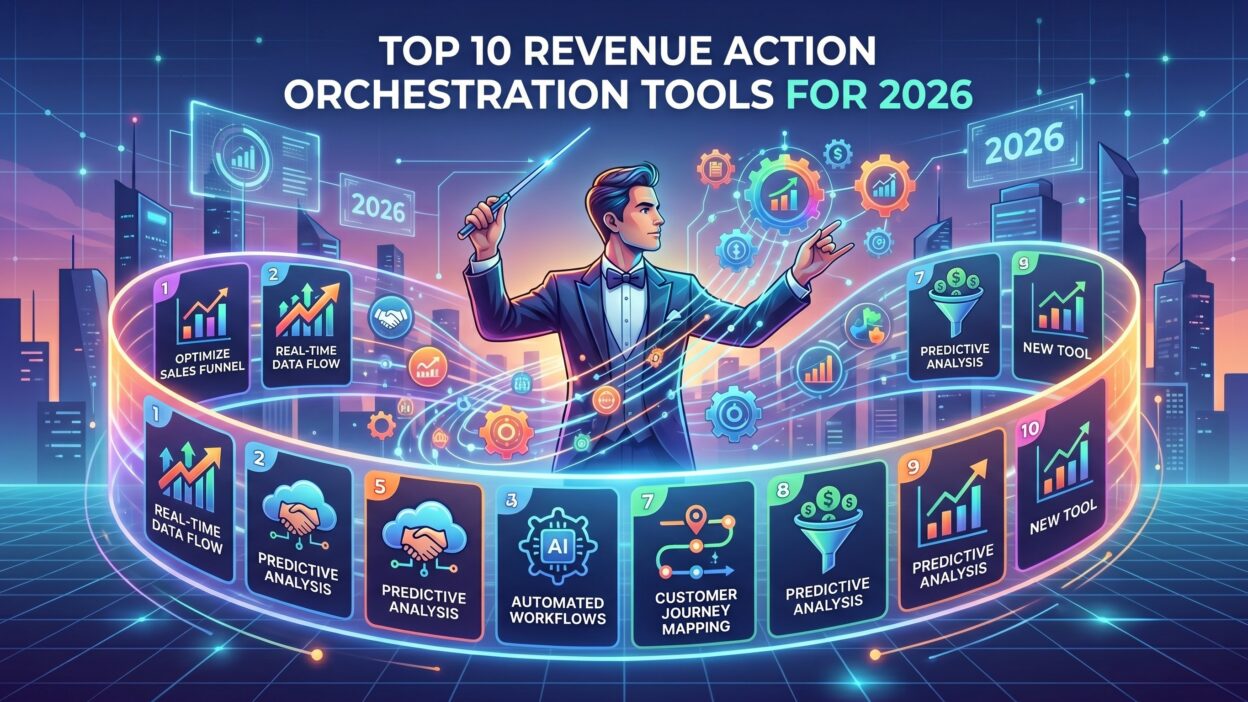
Think of the revenue team as an orchestra. Every section plays a different instrument. Without a conductor, every musician reads their own sheet music at their own pace. The result is noise.
Revenue action orchestration tools act as that conductor. They read incoming signals from multiple data sources. They decide which team should act, what action to take, and exactly when to take it.
These tools ingest data from CRM systems, marketing platforms, product analytics, third-party intent providers, and sales engagement tools. They process all of that in real time. Then they execute coordinated plays across every channel at once.
Here is a practical example. A target account visits your pricing page four times in three days. The orchestration engine detects that behavioral signal. It alerts the assigned account executive immediately. It adds the account to a high-intent marketing sequence. It updates the CRM deal stage automatically. All three actions happen in under a minute without any human trigger.
That kind of coordinated response requires revenue action orchestration tools. Manual processes cannot move that fast or that consistently across multiple teams.
The Difference Between Orchestration and Automation
Automation executes a task. You define a trigger. You define an action. The tool connects them. Simple.
Orchestration is different. It coordinates multiple tasks across multiple teams with context-awareness built into every decision. The platform knows which actions conflict. It knows which accounts are off-limits for certain plays. It adapts based on what other teams are doing simultaneously.
A marketing automation tool sends a welcome email when someone subscribes. A revenue orchestration platform decides whether to send the email, alert a rep, or suppress all contact based on where that person sits inside an active deal.
Automation follows instructions. Orchestration makes decisions. That distinction matters enormously in complex B2B sales environments.
2. Why Revenue Teams Need Orchestration in 2026
B2B buying committees grew larger over the last five years. The average enterprise deal now involves seven to eleven decision-makers. Each one interacts with your brand on different channels at different times.
Coordinating messaging across that entire buying committee manually is not realistic. Revenue action orchestration tools handle that coordination automatically at account scale.
Speed is the second major driver. Research consistently shows that the first vendor to engage an in-market account wins a disproportionate share of those deals. Buyers form early opinions. Speed of response signals competence and urgency.
Human processes cannot detect and act on intent signals fast enough. An orchestration platform detects a signal and fires a response in seconds. The human SDR reads an alert in their inbox hours later. That gap costs deals.
Revenue leakage is the third driver. Leakage happens in the white space between teams. Marketing qualifies a lead and passes it to sales. Sales never follows up. The lead goes cold. That lost deal cost real money in pipeline generation.
Customer success faces the same problem in reverse. A health score drops. No one notices. The customer churns three months later. That churn erases months of acquisition spend.
Revenue action orchestration tools close both gaps. They catch every signal. They trigger every action. Nothing falls through.
The Financial Impact of Coordinated GTM Execution
Companies deploying revenue action orchestration tools report measurable gains across every key metric. Deal velocity increases 20 to 40 percent. Pipeline coverage improves within the first quarter. Win rates climb when every buyer touchpoint arrives in the right sequence.
Customer retention improves when success teams act on health signals before churn becomes likely. Expansion revenue accelerates when upsell plays fire at the right product adoption milestone.
The compounding effect across all three areas — faster pipeline, higher win rates, better retention — produces significant revenue lift within six to twelve months of deployment.
3. Key Features to Evaluate Before Buying
Vendors use the term orchestration loosely. Some platforms are sophisticated workflow tools dressed in modern interfaces. Knowing what genuine orchestration looks like protects your purchasing decision.
Real-Time Signal Detection Across All Data Sources
Strong revenue action orchestration tools process signals from every relevant source simultaneously. First-party behavioral data from your website and product sits alongside CRM activity, third-party intent feeds, and conversation intelligence outputs.
The platform must process all of that in real time. Hourly batch processing is not enough in competitive markets. Signals decay fast. A buying trigger that fires an action one hour later misses a critical window.
Ask every vendor how their platform handles signal latency. The answer tells you a lot about how seriously they built the intelligence layer.
Cross-Team Playbook Logic and Conflict Resolution
The best revenue action orchestration tools let revenue leaders build plays that span every team simultaneously. A single buying signal can fire actions across sales, marketing, and customer success at the same time.
Conflict resolution logic is equally important. What happens when marketing wants to run a campaign on an account that sales is actively working? The platform must suppress the marketing play automatically. Without that logic, teams step on each other’s outreach and damage buyer experience.
Look for platforms with built-in suppression rules, priority queuing, and team-level visibility into every active play on every account.
Native Integration with Your Existing GTM Stack
Revenue action orchestration tools only deliver value when they connect deeply to the rest of your stack. Salesforce and HubSpot integrations are baseline expectations. Deeper native connections with Outreach, Salesloft, Gong, 6sense, Marketo, and product analytics platforms separate strong platforms from weak ones.
Bi-directional sync is critical. Data must flow both ways. Actions taken in the orchestration platform need to update the CRM in real time. CRM updates need to inform orchestration decisions in return.
4. Top 10 Revenue Action Orchestration Tools for 2026
This list covers platforms with proven market adoption and strong real-world results. Each tool serves a different primary use case. Read each entry relative to your specific revenue motion.
1. Salesloft — Best for Sales-Led GTM Orchestration
Salesloft sits at the forefront of revenue action orchestration tools for sales-led organizations. Its Revenue Orchestration Platform connects buyer signals, seller activity, and AI-generated recommendations in one unified system.
The Rhythm feature is the most impactful element for individual reps. Each morning, Rhythm surfaces the highest-priority actions based on deal stage, engagement recency, and account health. Reps stop deciding what to do next. They simply execute the queue.
Conversation intelligence from Salesloft Conversations feeds real outcomes back into the orchestration layer. A call ends with a specific objection. The platform fires the appropriate follow-up sequence for that objection automatically. The loop between insight and action closes without manual intervention.
The analytics layer gives revenue leaders full visibility into what plays drive results. Coaching becomes data-driven. Playbook iteration happens based on actual performance rather than gut instinct.
Best for: Sales-led B2B organizations that want rep productivity, signal intelligence, and deal management under a single orchestration layer.
2. Outreach — Best for Enterprise Pipeline Orchestration
Outreach built its platform around managing the full revenue lifecycle. From initial prospecting through close and into expansion, it coordinates actions at every stage. Enterprise organizations with large sales teams trust it for structured deal management at scale.
Smart Account Plans organize multi-threaded selling across entire buying committees. Every stakeholder at a target account gets sequenced engagement relevant to their specific role. Deal risk surfaces automatically before it becomes visible in the forecast.
Outreach Kaia provides real-time guidance during live calls. It listens, surfaces relevant talk tracks, and fires post-call actions based on conversation outcomes. Few revenue action orchestration tools match Outreach’s depth at true enterprise scale.
The platform’s analytics layer gives managers full pipeline visibility. Coaching recommendations surface directly inside deal records. Rep improvement compounds over time as the system learns from patterns across thousands of interactions.
Best for: Enterprise B2B sales teams managing complex, multi-stakeholder deals that require structured, scalable orchestration.
3. 6sense — Best for Intent-Driven Account Orchestration
6sense leads the market for intent-based account orchestration. Its AI model places target accounts into predicted buying stages based on keyword research activity, content consumption patterns, and technographic signals. This prediction happens before any prospect ever fills a form.
Revenue teams act on those predicted stages with precision. Marketing launches targeted ad campaigns. Sales reps prioritize accounts in the decision stage. Every action aligns with where the account actually sits in its buying journey.
6sense earns a top position among revenue action orchestration tools for ABM-focused organizations. The platform connects intent intelligence directly to orchestrated outreach across every channel simultaneously.
Pipeline quality improves because every action focuses on accounts that show real buying intent. Wasted outreach to cold accounts drops significantly. Every rep hour targets a warm opportunity.
Best for: ABM-focused B2B teams that want AI-powered buying stage prediction to drive coordinated, signal-triggered outreach.
4. Clari — Best for Revenue Operations and Pipeline Intelligence
Clari built its platform around revenue clarity for RevOps leaders. Pipeline data, activity signals, and conversation insights combine into a single unified revenue view. Forecast accuracy improves measurably after Clari deployment.
Clari Copilot adds real-time coaching during calls. It detects deal risks from conversation patterns and recommends next actions based on what the AI hears. Revenue teams act on intelligence instead of instinct.
As one of the leading revenue action orchestration tools for operations-focused teams, Clari provides the full-funnel visibility that revenue leaders need. Every deal gets the right level of attention based on objective signal data rather than rep self-reporting.
The integration with sales execution platforms is deep. Actions recommended by Clari fire directly inside tools like Salesforce and Outreach. RevOps teams manage the entire revenue system from one command center.
Best for: Revenue operations leaders who need deep pipeline inspection, accurate forecasting, and AI-guided deal prioritization.
5. Demandbase — Best for Account Intelligence and GTM Activation
Demandbase combines deep account intelligence with coordinated GTM activation. Its Go-to-Market Platform pulls intent data, firmographics, technographics, and engagement history into a single account profile that every team accesses.
Sales and marketing teams align around the same account intelligence. Both functions see the same buying signals at the same time. That alignment eliminates the finger-pointing that happens when both teams operate on different data sets.
Demandbase orchestrates advertising, email, and sales outreach based on account stage and intent level. Every touchpoint reinforces the others. The buying committee experiences a coordinated narrative rather than random vendor noise.
Best for: B2B companies that want shared account intelligence as the foundation for every orchestrated revenue action across all teams.
6. HubSpot Operations Hub — Best for SMB Revenue Coordination
HubSpot Operations Hub brings data synchronization, programmable automation, and revenue reporting together in one accessible platform. Smaller B2B teams access genuine revenue action orchestration tools capability without enterprise-level complexity or pricing.
Custom coded workflow actions handle sophisticated multi-step, multi-team playbooks. Data quality automation runs in the background to keep CRM records accurate and reliable. Clean data is the fuel that makes every orchestration decision smarter.
Lifecycle stage changes, deal updates, and engagement triggers fire coordinated actions across the full HubSpot ecosystem. Marketing sequences pause when a rep enters active selling. Sales tasks fire when a contact hits a specific engagement threshold.
For teams already on HubSpot, Operations Hub adds the orchestration intelligence layer without requiring a separate platform purchase. The total cost of ownership stays manageable for growing companies.
Best for: Small to mid-market B2B companies on HubSpot that want meaningful orchestration capability without investing in a standalone enterprise platform.
7. Gainsight — Best for Customer-Led Revenue Orchestration
Gainsight focuses orchestration entirely on the post-sale revenue motion. It coordinates customer success actions, expansion campaigns, and renewal management based on health scores, NPS data, and product usage signals.
Churn prediction models identify at-risk accounts weeks before the customer shows visible signs of leaving. The platform fires automated outreach from the customer success team at that early warning point. Retention rates improve because intervention happens before the customer mentally checked out.
Expansion plays fire when product usage signals indicate the right adoption milestone. CSMs get prioritized action lists each day based on objective account health data. High-value accounts receive proactive attention. At-risk accounts get intervention before the problem becomes a lost contract.
Gainsight stands apart from other revenue action orchestration tools because it treats existing customer revenue as a genuine growth lever rather than a maintenance task.
Best for: SaaS companies that want to build a dedicated, orchestrated revenue motion around renewals, expansion, and customer-led growth.
8. Marketo Engage — Best for Marketing-Led Revenue Orchestration
Marketo Engage remains one of the most capable revenue action orchestration tools for marketing-led B2B organizations. Engagement programs coordinate multi-channel touchpoints across the complete buyer journey from awareness through purchase.
Account-based marketing features let marketing teams build account-level plays that address every stakeholder inside the buying committee. Each contact gets messaging tailored to their specific role, seniority, and engagement history.
Lead scoring models continuously evaluate every contact against ideal customer profile criteria and behavioral signals. When a lead crosses the qualification threshold, the handoff to sales fires automatically. The rep receives full context alongside the lead record.
AI-powered content personalization adapts every email and landing page asset dynamically. Personalization happens at scale without manual content management. Marketing influence on pipeline stays measurable and attributable.
Best for: Marketing-led B2B organizations running complex multi-channel nurture programs with deep Salesforce integration requirements.
9. Groove by Clari — Best for Salesforce-Native Field Sales Teams
Groove brings full revenue orchestration directly inside Salesforce. Field sales reps work entirely within their CRM environment. Context switching between platforms disappears. Activity logging happens automatically without any manual data entry.
Flow orchestration sequences manage outreach across email, phone, and LinkedIn from a single interface inside Salesforce. Every touch logs to the correct account and contact automatically. Managers get complete activity visibility without chasing reps for status updates.
Groove sits comfortably among the best revenue action orchestration tools for Salesforce-native sales environments. The platform eliminates every friction point between insight and action for field reps who live inside their CRM.
Auto-dialer capabilities, email tracking, and LinkedIn integration combine in a unified interface. Reps complete more activities per day without working harder. The orchestration layer handles the sequencing logic invisibly in the background.
Best for: Salesforce-native enterprise field sales teams that want productivity and orchestration without ever leaving the CRM.
10. Pocus — Best for Product-Led Revenue Orchestration
Pocus serves product-led growth companies that want to convert product usage data into coordinated revenue actions. It sits at the exact intersection of product analytics and sales activation.
Product-qualified accounts get flagged automatically based on usage thresholds and activation milestones that the revenue team defines. Sales reps see which users hit trial limits, invite colleagues, or reach feature adoption signals that correlate with purchase intent.
Outreach fires at the precise moment a user shows buying behavior inside the product. The rep gets full context on the account, the user’s usage history, and recommended talking points. The conversation starts warm rather than cold.
Pocus earns its place among leading revenue action orchestration tools for companies where the product itself drives growth. It closes the loop between product behavior and human sales action in a way that no generic orchestration platform handles well.
Best for: Product-led B2B SaaS companies that need to layer sales-assisted conversion motions onto self-serve product growth.
5. How to Choose the Right Platform for Your Team
Every platform on this list serves a specific revenue motion well. Picking the wrong one wastes budget, creates frustration, and delays results. The selection process matters as much as the product itself.
Start by identifying your primary revenue motion. Sales-led organizations need platforms like Salesloft, Outreach, or Groove. Marketing-led teams lean toward Marketo or Demandbase. Product-led companies belong on Pocus. Customer-success-focused teams need Gainsight.
Map your biggest coordination failure next. Where do deals fall through most often? At the marketing-to-sales handoff? In the middle of multi-stakeholder deals? After close in the expansion phase? The answer narrows your shortlist to two or three platforms.
Evaluation Criteria That Most Teams Overlook
Integration depth gets evaluated last by most buyers. It should be evaluated first. Revenue action orchestration tools only deliver their full value when they connect deeply to your CRM, your engagement platforms, and your data sources. A platform with poor integrations gives you an island of intelligence disconnected from daily operations.
Time-to-value is the second underrated criterion. Some platforms require six months of implementation before any value appears. Others deploy meaningful plays within two weeks. Understand the timeline fully before signing. Short-term revenue pressure rarely allows for long implementation cycles.
Ask vendors about conflict resolution logic specifically. How does the platform handle two teams trying to reach the same contact simultaneously? The quality of that answer reveals the maturity of the orchestration engine.
6. Common Mistakes Teams Make When Deploying Orchestration Platforms
The right revenue action orchestration tools guarantee nothing on their own. Implementation failures happen more often than vendors admit. Most failures share the same root causes.
Starting with Dirty CRM Data
Orchestration engines process what you feed them. Old contact records, duplicate accounts, missing fields, and inconsistent lifecycle stages corrupt every playbook output. Clean data is not optional. It is the foundation everything runs on.
Conduct a full CRM audit before deployment. Standardize field values. Merge duplicates. Remove stale contacts. The orchestration platform performs exactly as well as the data quality underneath it.
Over-Engineering Playbooks on Day One
Most teams design twenty sophisticated plays on launch day. None of them go live for three months because the logic requires constant revision. Start with two high-impact plays instead. Prove value quickly. Build team confidence. Expand the playbook library after the first wins are visible.
Skipping Change Management
Revenue action orchestration tools touch every team. Sales reps see new workflows. Marketing managers follow new suppression rules. Customer success teams adopt new action queues. Change at that scale requires deliberate communication, not just a training session.
Show every team specifically how the platform makes their daily work easier. Early adopters become internal champions. Internal champions drive adoption faster than any vendor training program.
Treating the Platform as Set-and-Forget
Buyer behavior changes. Competitive dynamics shift. Product positioning evolves. Playbooks built in Q1 may not reflect reality by Q3. Schedule a monthly playbook review. Update suppression rules. Add new signals as data sources expand. Active management compounds returns over time.
7. The Future of Revenue Action Orchestration Beyond 2026
The category will look significantly different by 2028. Several technological and market forces are reshaping what revenue action orchestration tools can do.
AI Agents Running Autonomous Revenue Plays
AI agents will handle entire revenue plays without human involvement. A signal fires. The agent researches the account. It writes a personalized message. It schedules a follow-up. It reports outcomes back to the pipeline. Human reps get involved only at the conversation stage.
Early versions of this capability exist inside some platforms today. By 2028, autonomous revenue plays across the full funnel will become standard, not experimental.
Unified Revenue Data Platforms Replacing Point Solutions
The current landscape requires stitching six to ten tools together. Intent data, CRM, engagement platforms, conversation intelligence, and product analytics all sit in separate systems. Integration overhead creates brittleness and data latency.
Unified revenue data platforms will consolidate that stack. Signals, plays, and outcomes will live in one system. Orchestration decisions will draw on a complete data picture without any latency introduced by integration middleware.
Privacy-First Personalization as a Competitive Differentiator
Regulatory pressure on data use grows every year. Revenue action orchestration tools that personalize without overstepping will earn buyer trust that intrusive approaches destroy. Trust shortens sales cycles. Companies that build personalization on first-party data foundations will outperform those relying on third-party data purchases.
8. Frequently Asked Questions About Revenue Action Orchestration Tools
What is the primary purpose of revenue action orchestration tools?
Revenue action orchestration tools coordinate go-to-market activities across sales, marketing, and customer success using real-time buyer signals. Their primary purpose is to eliminate coordination failures between teams. Every signal triggers the right action from the right team at the right moment. No deal falls through because of a missed handoff or an undetected buying signal.
How do revenue action orchestration tools differ from CRM platforms?
A CRM records what already happened. It stores contact records, deal histories, and activity logs. Revenue action orchestration tools use that recorded data to decide what should happen next. A CRM is a system of record. An orchestration platform is a system of action. Both are necessary. Only one drives proactive revenue motion.
Which team should own the orchestration platform — sales, marketing, or RevOps?
Revenue operations should own it. RevOps sits across every team and has visibility into the full revenue system. Marketing ownership creates bias toward top-of-funnel plays. Sales ownership creates bias toward outbound sequence management. RevOps ownership produces balanced orchestration that serves every team’s priorities equally.
How much do revenue action orchestration tools typically cost?
Pricing ranges widely depending on platform scope and team size. Specialist tools like Pocus or Seventh Sense start at $500 to $1,500 per month. Mid-tier platforms like Salesloft and Clari run $2,000 to $8,000 monthly depending on seat count. Enterprise platforms like Salesforce Marketing Cloud, Marketo, and Outreach scale from $5,000 to $50,000 per month at large team sizes.
How long does implementation take before revenue teams see results?
Simpler platforms with pre-built playbooks deliver results within two to four weeks. Mid-tier platforms with custom configuration take four to eight weeks for full deployment. Enterprise platforms with deep integrations and complex playbook logic take two to four months. Most teams see initial ROI within 60 to 90 days regardless of platform tier.
Can small B2B companies benefit from revenue orchestration platforms?
Small teams benefit enormously from revenue action orchestration tools. Coordination failures hit small teams hardest because every dropped deal represents a larger percentage of total pipeline. Tools like HubSpot Operations Hub, Pocus, and Groove deliver genuine orchestration at accessible price points. A five-person revenue team using orchestration outperforms a ten-person team working without it.
What data sources should feed a revenue orchestration platform?
The platform needs CRM activity data, first-party website behavioral data, product usage analytics, email and call engagement history, and third-party intent data. The more complete the data picture, the more accurate every orchestration decision becomes. Start with CRM and first-party data. Add intent data after the core integration is stable.
Read More:-Your CRM Data is a Mirage – and It’s Costing You Deals
Conclusion

Disconnected revenue teams leave significant money on the table every single quarter. Buyers move fast. Signals arrive and expire within hours. Deals die quietly in the white space between sales, marketing, and success.
Revenue action orchestration tools solve that structural problem. They connect every team around the same signals. They fire the right actions automatically. They keep every account and every deal moving forward with precision.
The ten platforms in this guide cover every primary revenue motion in B2B. Salesloft and Outreach anchor sales-led organizations. 6sense and Demandbase power ABM programs. Gainsight and Pocus orchestrate post-sale and product-led growth. Clari and HubSpot Operations Hub serve RevOps teams at different stages of scale. Marketo drives marketing-led pipeline. Groove keeps Salesforce-native field teams running efficiently.
None of these platforms deliver results on autopilot. They need clean data, clear playbooks, strong change management, and regular iteration to reach their full potential.
Start by identifying your biggest coordination failure. Pick the platform built for your motion. Deploy two plays in the first month. Measure meetings booked, pipeline created, and deals saved from churn.
The right revenue action orchestration tools do not just improve efficiency. They change how your team competes. Coordinate deliberately and win consistently.