Introduction
TL;DR Every revenue leader is asking the same question right now.
How do we make AI work for our go-to-market team?
The answer is not about picking the right tool. It is not about hiring a prompt engineer. It is not about rolling out a new platform and hoping something sticks.
The answer starts with data.
GTM AI context — the ability of AI systems to understand your buyers, your market, your deals, and your pipeline — depends entirely on the quality of data you feed it. Without a solid data foundation, AI has nothing real to work with. It generates generic outputs. It misses the nuance your buyers demand. It produces recommendations that look smart but land flat.
Most companies jump straight to the AI layer. They buy the tool. They connect it to their CRM. They expect magic.
What they get instead is a fast engine running on bad fuel.
This blog breaks down exactly why GTM AI context starts — and ends — with your data foundation. You will learn what that foundation looks like, why most teams are missing it, and how to build it before your AI investment goes to waste.
If you want AI to actually move your revenue needle, keep reading. The foundation matters more than the technology sitting on top of it.
Table of Contents
What Is GTM AI Context — and Why Does It Matter?
Defining GTM AI Context in Plain Language
GTM AI context is the structured, accurate, and relevant information that AI systems use to make intelligent decisions about your go-to-market strategy.
Think of it this way. A sales rep walking into a discovery call knows things. They know the prospect’s industry. They know what problem that company is trying to solve. They know who the decision-makers are and what matters to them. That knowledge shapes every question the rep asks and every recommendation they make.
AI needs the same kind of knowledge. GTM AI context is that knowledge — captured, organized, and made available to AI systems so they can do useful work.
Without context, AI is just pattern matching on generic data. It cannot understand your specific market. It cannot reason about your specific buyers. It cannot personalize at the level your deals require.
Why GTM AI Context Is Not Just a Technology Problem
Most GTM leaders think of AI as a technology challenge. They focus on which tools to deploy, which models to use, and how to integrate everything into their existing stack.
That framing misses the real problem.
GTM AI context is a data problem first. The best AI tools in the world produce mediocre results when the underlying data is weak. A large language model does not know your ICP. A predictive scoring model does not know your actual win patterns unless you train it correctly. A generative AI tool cannot write relevant outreach if it has no real signal about the prospect.
The technology is the easy part. The data is the hard part. And most teams are getting it backwards.
Your GTM AI context is only as strong as what you feed it. That means the conversation about AI must start with a conversation about data — what you have, what is missing, and what needs to be fixed before AI can do its best work.
The Data Foundation — What It Actually Means
Four Layers of a Strong GTM Data Foundation
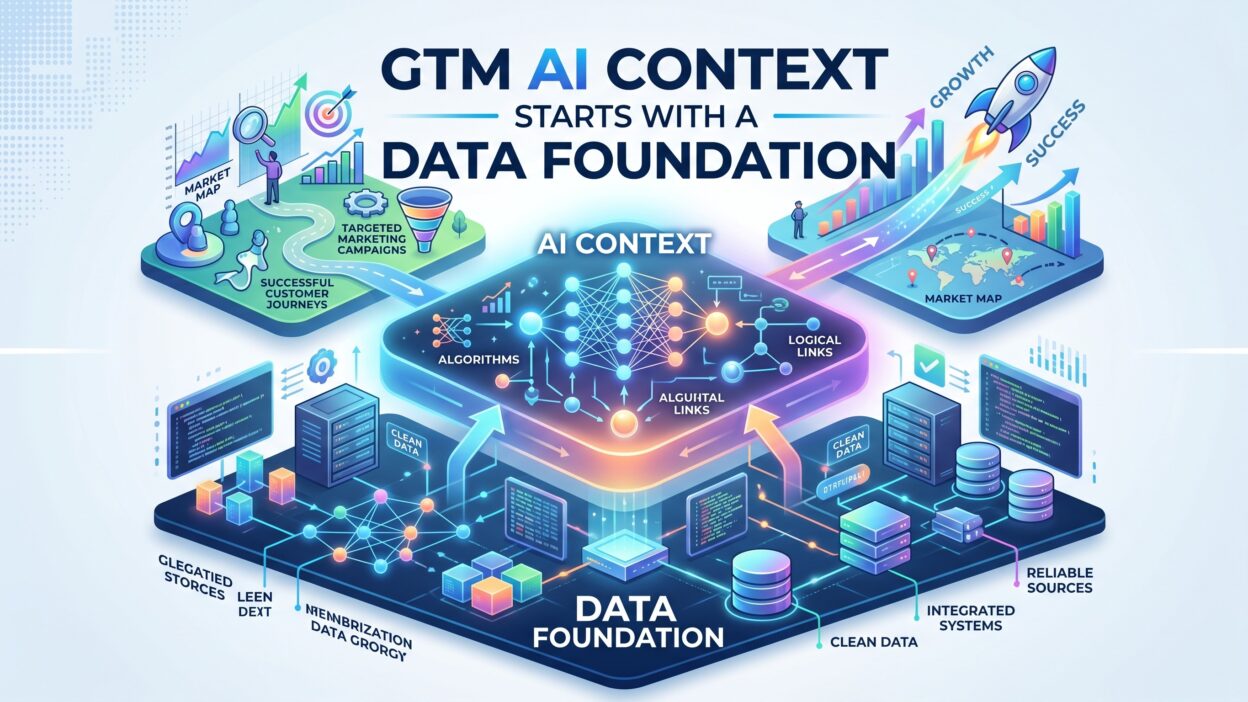
A GTM data foundation is not just a clean CRM. It is a structured, connected, and continuously updated ecosystem of data that feeds every revenue decision.
The first layer is contact and account data. This covers who your buyers are — their names, roles, companies, industries, locations, and firmographic details. This layer needs to be accurate, complete, and regularly refreshed. Stale contact data produces stale GTM AI context.
The second layer is behavioral and engagement data. This covers what your prospects and customers actually do — what emails they open, what content they consume, what pages they visit, what events they attend. Behavioral signals are gold for AI. They reveal intent that no form fill ever captures.
The third layer is conversational and deal data. This covers the actual words exchanged between your team and your buyers — call recordings, email threads, meeting notes, and deal commentary. This layer is where the real buying signals live. GTM AI context built on conversational data is far richer than context built on form data alone.
The fourth layer is outcome data. This covers what happened — which deals closed, which churned, which expanded, and why. Outcome data teaches your AI systems what good actually looks like. Without it, AI cannot learn from your history.
Why Most Teams Are Missing at Least Two Layers
Most revenue teams have some version of layer one. They have contact records and account data in their CRM. But they are frequently missing layers two, three, and four.
Behavioral data lives in the marketing automation platform — disconnected from the CRM. Conversational data sits in call recording tools that nobody syncs back to deal records. Outcome data gets tracked in finance systems that never talk to sales operations.
The result is a fragmented data landscape. AI cannot work with fragmentation. It needs connected layers.
GTM AI context requires all four layers to be present, accurate, and linked together. That is what a real GTM data foundation delivers. Without it, AI can only see a piece of the picture — and partial pictures produce bad recommendations.
How Weak Data Destroys GTM AI Context
Generic AI Outputs Come from Generic Data Inputs
The biggest complaint revenue leaders have about AI tools is that the outputs feel generic. The emails sound templated. The talking points feel off. The scoring recommendations do not match what reps actually see in their conversations.
This is not the AI’s fault. This is a data problem.
When AI systems receive incomplete or low-quality inputs, they fall back on what they know — which is general patterns from their training data. They produce outputs that work for an average company in an average situation. But your buyers are not average. Your market is not generic.
GTM AI context closes the gap between generic AI and relevant AI. It grounds the AI in your specific reality. Without it, you get outputs built for nobody in particular.
Data Silos Break the Context Chain
Revenue teams typically run five to ten tools in their GTM stack. CRM. Marketing automation. Sales engagement. Conversation intelligence. Intent data. Product analytics. Customer success platforms.
Each tool captures valuable data. But when those tools do not share data with each other, context breaks.
Your AI-powered sales engagement tool does not know the prospect already had a negative experience with your support team. Your marketing automation platform does not know the deal is in late-stage negotiation. Your CRM does not know the prospect just visited your pricing page three times this week.
Disconnected tools produce disconnected GTM AI context. And disconnected context produces recommendations that are tone-deaf at best and deal-killing at worst.
Inaccurate Data Teaches AI the Wrong Lessons
AI systems learn from the data you give them. If that data is wrong, the AI learns wrong patterns.
A predictive deal scoring model trained on inaccurate pipeline data will score deals incorrectly. A churn prediction model trained on incomplete customer records will miss the signals that actually predict churn. A generative AI tool producing outreach based on wrong job titles will send the wrong message to the wrong person.
Bad data does not just produce bad outputs today. It trains your AI systems to produce bad outputs tomorrow. The damage compounds over time.
Strong GTM AI context requires accurate data at its core. Every inaccuracy you allow into your data foundation becomes an error that AI amplifies — not one it corrects.
Building the Data Foundation That Powers GTM AI Context
Start With a GTM Data Audit
Before you build anything, you need to know where you stand.
A GTM data audit looks at every major data asset your revenue team relies on. It measures completeness — what percentage of records have all key fields filled in. It measures accuracy — how many records contain verified, current information. It measures connectivity — how many of your key tools share data with each other. It measures freshness — how recently each record was updated.
Most teams discover that their data landscape is far more fragmented and incomplete than they assumed. That discovery is uncomfortable. It is also essential. You cannot build strong GTM AI context on a foundation you have not honestly assessed.
Unify Your Data Before You Activate AI
The most common mistake is activating AI before unifying data.
Unification means connecting your tools so data flows bidirectionally. Contact records in your CRM should reflect email engagement from your marketing platform. Deal records should include call recording summaries from your conversation intelligence tool. Account records should pull intent signals from your intent data provider.
This is the work of revenue operations. Building a unified data layer is not glamorous. It requires integration work, field mapping decisions, and ongoing maintenance. But it is the single highest-leverage investment you can make in your GTM AI context.
Without unification, AI sees fragments. With unification, AI sees the full picture.
Invest in Continuous Data Enrichment
Your data foundation is not a one-time project. It is a living system that requires continuous attention.
B2B contact data decays at roughly 25% per year. Buyer personas shift as markets evolve. Intent signals change weekly. Deal context accumulates with every interaction.
Enrichment tools like ZoomInfo, Clearbit, and Apollo continuously refresh contact and company records with verified data. Conversation intelligence tools capture and structure every sales interaction automatically. Intent data providers surface which companies are actively researching your category right now.
These tools feed fresh data into your foundation. Fresh data produces richer GTM AI context. Richer context produces better AI outputs. Better outputs drive better revenue outcomes.
Define the Data Standards Your AI Needs
AI systems work best with structured, consistent data. That means you need to define exactly what good data looks like for your organization.
What fields are required before a contact record is created? What format should phone numbers follow? How do you define deal stages, and what criteria must be met before a deal advances? What does your ICP look like in data terms — what firmographic and technographic attributes define your best-fit accounts?
These definitions become the standards your data foundation is built on. They also become the standards your GTM AI context is grounded in. Without them, AI works with ambiguous inputs and produces ambiguous outputs.
Set the standards. Enforce them. Build your data foundation around them. Your AI investment depends on it.
Create Clear Data Ownership in Your Revenue Org
Data quality does not maintain itself. Someone needs to own it.
In high-performing revenue organizations, data ownership sits with Revenue Operations. RevOps sets data standards, monitors data health, runs regular audits, and manages integrations between tools.
When data ownership is unclear, quality degrades. Reps enter incomplete records. Integrations break without anyone noticing. Duplicates accumulate. Outdated records persist. The data foundation crumbles slowly — and GTM AI context crumbles with it.
Clear ownership is not optional. It is a prerequisite for any AI strategy that actually works.
What Great GTM AI Context Enables — Real Outcomes
Hyper-Personalized Outreach at Scale
When your GTM AI context is strong, AI can personalize outreach at a level no human team could achieve manually.
It knows the prospect’s role, their company’s recent news, their likely pain points based on firmographic data, their engagement history with your content, and where they sit in the buying journey. It uses all of that context to craft messages that feel specific and relevant — not like a mail merge gone slightly wrong.
Personalized outreach at scale drives higher reply rates, more booked meetings, and faster pipeline creation. That is the direct commercial output of strong GTM AI context.
Accurate Pipeline Forecasting
AI-powered forecasting is only accurate when the underlying pipeline data reflects reality.
Strong GTM AI context means deal records are complete, activity history is logged, and stage progression reflects actual buyer signals — not rep optimism. When that foundation is in place, AI forecasting models produce predictions that leaders can actually rely on.
Accurate forecasting changes how organizations operate. Leaders make confident hiring decisions. Finance builds reliable models. Reps focus on the right deals at the right time.
Smarter Territory and Segment Prioritization
Which accounts should your team focus on this quarter? That question gets an intelligent answer when your GTM AI context includes rich account-level data, intent signals, and historical win patterns.
AI can surface which accounts in your total addressable market look most like your recent wins. It can identify which segments show the strongest buying intent right now. It can recommend where reps should spend their time based on where the highest conversion probability lives.
That kind of prioritization intelligence used to require a senior analyst and weeks of work. Strong GTM AI context makes it available on demand — continuously updated as signals change.
Faster and More Consistent Onboarding
New reps ramp faster when GTM AI context gives them instant access to deal history, buyer profiles, and competitive intelligence. They do not need six months to develop pattern recognition. The AI supplies the patterns from day one.
Faster ramp means faster revenue contribution. That is a measurable business outcome — directly enabled by a strong data foundation.
Common Mistakes Companies Make with GTM AI Context
Deploying AI Before Fixing Data
This is the most expensive mistake in the AI playbook. Companies buy an AI tool, connect it to their existing data stack, and wonder why results disappoint.
The tool is not the problem. The data is the problem. You cannot generate strong GTM AI context from weak data inputs, no matter how sophisticated the AI model is.
Fix the data first. Deploy the AI second. The order matters enormously.
Treating GTM AI Context as a One-Time Setup
Some teams build an initial data foundation, activate their AI tools, and assume the work is done.
Data decays. Integrations break. New tools get added without being connected to the unified data layer. The foundation you built six months ago is already degrading.
GTM AI context requires ongoing maintenance. Build the processes, the ownership, and the tooling to keep your data foundation fresh — permanently.
Ignoring Conversational Data
Many teams build their data foundation on structured fields — contact records, deal stages, company data. That is a good start. But they miss the richest source of GTM AI context available to them: actual conversations.
Call recordings, email threads, and meeting notes contain buyer language, objections, priorities, and decision-making signals that no form field ever captures. Conversation intelligence tools can structure and surface that data automatically.
Teams that feed conversational data into their AI systems get dramatically richer GTM AI context. Teams that ignore it leave their best signal on the table.
Frequently Asked Questions About GTM AI Context
What exactly is GTM AI context, and why is it different from regular AI?
GTM AI context refers to the specific, structured, and relevant information that AI uses to make go-to-market decisions. Regular AI tools use general training data. GTM AI context grounds those tools in your specific buyers, market, deals, and outcomes. Without this context, AI produces generic outputs that do not reflect your real sales environment. With it, AI makes decisions that are relevant, accurate, and commercially useful.
How do I know if my current data foundation is strong enough for AI?
A strong data foundation for GTM AI context meets four criteria. First, your key contact and account fields have high completeness rates — above 80% for critical fields like email, title, and company. Second, your tools share data bidirectionally without manual intervention. Third, your records are updated regularly through enrichment or direct input. Fourth, your outcome data — wins, losses, churn, expansion — is captured and linked to deal and account records. If you cannot confirm all four, your foundation needs work before serious AI investment makes sense.
Can AI help build my data foundation, or does the data need to come first?
The data needs to come first. AI can help maintain and enrich a data foundation once it exists — through automated enrichment, activity capture, and deduplication. But AI cannot create a strong foundation from scratch. You need accurate, connected, and structured data before AI can do meaningful work. Think of AI as the engine and your data foundation as the fuel. The engine cannot run without fuel.
What tools are most useful for building GTM AI context?
The most useful tools combine data enrichment, conversation intelligence, intent data, and unified data platforms. Enrichment tools like ZoomInfo and Clearbit keep contact and account data accurate. Conversation intelligence tools like Gong and Chorus capture and structure deal interactions. Intent data tools like Bombora and G2 surface buying signals from across the web. A well-configured CRM — like Salesforce or HubSpot — serves as the central hub that connects all of these data sources into a coherent GTM AI context layer.
How often should companies review and update their GTM data foundation?
Data foundation health should be reviewed quarterly at minimum. Monthly reviews are better for fast-growing teams. Daily automated enrichment should run continuously in the background. Quarterly reviews should assess completeness rates, integration health, duplicate counts, and data freshness metrics. Annual reviews should revisit your ICP definition, data standards, and tooling to make sure everything still reflects how your market and business have evolved.
The Business Case for Investing in Your Data Foundation First
Strong GTM AI Context Is a Revenue Multiplier
Every dollar you invest in your data foundation pays back across your entire go-to-market operation.
Your AI tools work better. Your reps sell smarter. Your marketing spends more efficiently. Your leaders forecast with more confidence. Your customer success team retains more accounts.
The data foundation is not a cost center. It is the infrastructure that makes every other revenue investment more productive.
Strong GTM AI context does not just improve individual outcomes. It compounds. Better data produces better AI outputs. Better AI outputs drive better decisions. Better decisions produce better revenue results. Better results generate more data. The cycle reinforces itself.
The Cost of Skipping the Foundation Is Always Higher
Companies that skip the data foundation step and go straight to AI tools pay a tax on every output those tools produce. The recommendations are less accurate. The personalization is less relevant. The forecasts are less reliable. The ROI is lower than it should be.
Building the foundation takes time and intentional effort. But the alternative is running your GTM motion on guesswork dressed up as AI intelligence.
Your competitors are building their data foundations right now. The question is whether you will build yours before they use theirs against you.
Read More:-Predictive Intelligence: 3 Types of Data You Need
Conclusion

The AI era in go-to-market is not coming. It is already here.
Your competitors are deploying AI tools across their sales, marketing, and customer success functions. They are using AI to prioritize accounts, personalize outreach, forecast pipeline, and accelerate onboarding.
But the teams winning with AI are not the ones who bought the most tools. They are the ones who built the strongest data foundations first.
GTM AI context is what separates AI that generates noise from AI that generates revenue. And GTM AI context starts — completely and non-negotiably — with your data.
The framework is clear. Audit your current data landscape. Identify the gaps in completeness, accuracy, connectivity, and freshness. Unify your data layer across tools. Deploy enrichment and conversation intelligence to feed fresh signals continuously. Set data standards and enforce them. Assign clear ownership. Then activate AI on top of a foundation that can actually support it.
This is not the glamorous part of an AI strategy. It is the foundational part. The part that determines whether everything else works.
Strong GTM AI context is not a feature your tool provides. It is a capability your organization builds — deliberately, systematically, and continuously.
Build the foundation. The AI will do the rest.