Introduction
TL;DR Phone calls still close deals. That has not changed. What has changed is who — or what — makes those calls.
AI Voice & Phone Agent Tools have arrived at a level of maturity that revenue teams cannot afford to ignore. These tools make real calls. They hold real conversations. They qualify prospects, book meetings, handle objections, and hand off warm leads to human reps — all without a person dialing a single number.
In 2026, the best AI Voice & Phone Agent Tools do more than automate dials. They listen intelligently. They respond contextually. They learn from every conversation. They scale outbound calling programs in ways that human SDR teams simply cannot match on their own.
This blog covers the best platforms available right now, how they work, who should use them, and what to look for before making a purchase decision.
Table of Contents
Why AI Voice & Phone Agent Tools Matter in 2026
The State of Outbound Sales Calling
Cold calling has always been a numbers game. More dials produce more conversations. More conversations produce more meetings. More meetings produce more pipeline.
The problem is human capacity. An SDR makes 40 to 80 calls per day on a strong day. Most calls go to voicemail. Most live answers end in under 60 seconds. The effort-to-outcome ratio is punishing.
AI Voice & Phone Agent Tools break that ratio. A single AI agent can make hundreds of calls per day without fatigue, without distraction, and without performance variability. It does not have bad days. It does not need coaching on tone or energy. It executes the same high-quality call on attempt 500 as it did on attempt one.
What Has Changed in AI Voice Technology
Voice AI in 2024 sounded robotic. Buyers could tell immediately they were talking to a machine. The experience was jarring and often counterproductive.
In 2026, the best AI Voice & Phone Agent Tools sound genuinely human. Natural language processing has advanced dramatically. Latency between speaker and response has dropped to near-real-time. Voice modulation creates warmth, pacing, and emphasis that matches human conversation.
Buyers who interact with top-tier AI voice agents today often cannot reliably identify whether they are speaking with a human or a machine. That shift changes everything about how sales teams can deploy these tools.
The Business Case for AI Phone Agents
The economics are compelling. An AI voice agent costs a fraction of what a human SDR costs when you factor in salary, benefits, training, management overhead, and ramp time.
An AI agent is productive from day one. It does not ramp over 90 days. It does not call in sick. It does not quit after six months. It scales instantly — one agent handling 100 simultaneous calls if the volume demands it.
For high-volume outbound programs, AI Voice & Phone Agent Tools deliver a cost-per-meeting that human-only teams cannot compete with at scale.
How AI Voice & Phone Agent Tools Work
The Core Technology Stack
Every AI voice agent platform sits on a stack of interconnected technologies. Speech recognition converts spoken audio into text in real time. Natural language understanding interprets meaning, intent, and sentiment from that text. A response generation model produces the appropriate reply. Text-to-speech synthesis converts that reply into spoken audio and delivers it to the caller.
The entire cycle happens in milliseconds. The best AI Voice & Phone Agent Tools complete this loop fast enough that the conversation feels natural — not like waiting for a slow system to process a response.
Conversation Design and Call Scripts
AI voice agents do not improvise entirely. They operate within designed conversation flows. These flows define how the agent opens the call, how it handles common responses, how it pivots based on prospect answers, and how it escalates to a human rep when the conversation demands it.
Good conversation design is critical to call performance. A poorly designed flow produces awkward, robotic interactions even when the underlying voice quality is excellent. The best platforms provide conversation design tools, templates, and expert support to help teams build effective call flows.
Lead Qualification Logic
Qualification is where AI Voice & Phone Agent Tools add enormous value. The agent asks discovery questions. It listens to and processes the answers. It scores the prospect against predefined qualification criteria. Based on that score, it determines the next action — book a meeting, route to a human rep, mark as disqualified, or trigger a follow-up sequence.
This automated qualification process means human reps only engage prospects who already meet the criteria worth a rep’s time. Pipeline quality rises. Rep productivity rises. The entire sales motion becomes more efficient.
CRM Integration and Data Capture
Every AI voice call generates data. The platform records the call, transcribes it, extracts key information, and pushes it into your CRM automatically. No manual note-taking. No data entry. No lost context between the call and the rep follow-up.
Contact records update with call outcomes. Qualified prospects trigger automated workflows. Reps open their CRM to find complete call summaries, extracted objections, stated needs, and recommended next steps — all from calls they never made personally.
Human Handoff and Escalation
The best AI Voice & Phone Agent Tools know their limits. When a conversation reaches a complexity level beyond the agent’s designed capability — a highly technical question, an emotionally charged prospect, a senior executive wanting to speak with leadership — the system escalates to a human rep immediately.
Live transfer capabilities move the prospect from AI agent to human without dropping the call. The human rep receives a real-time briefing on the conversation so far. The prospect experiences a seamless transition rather than a jarring restart.
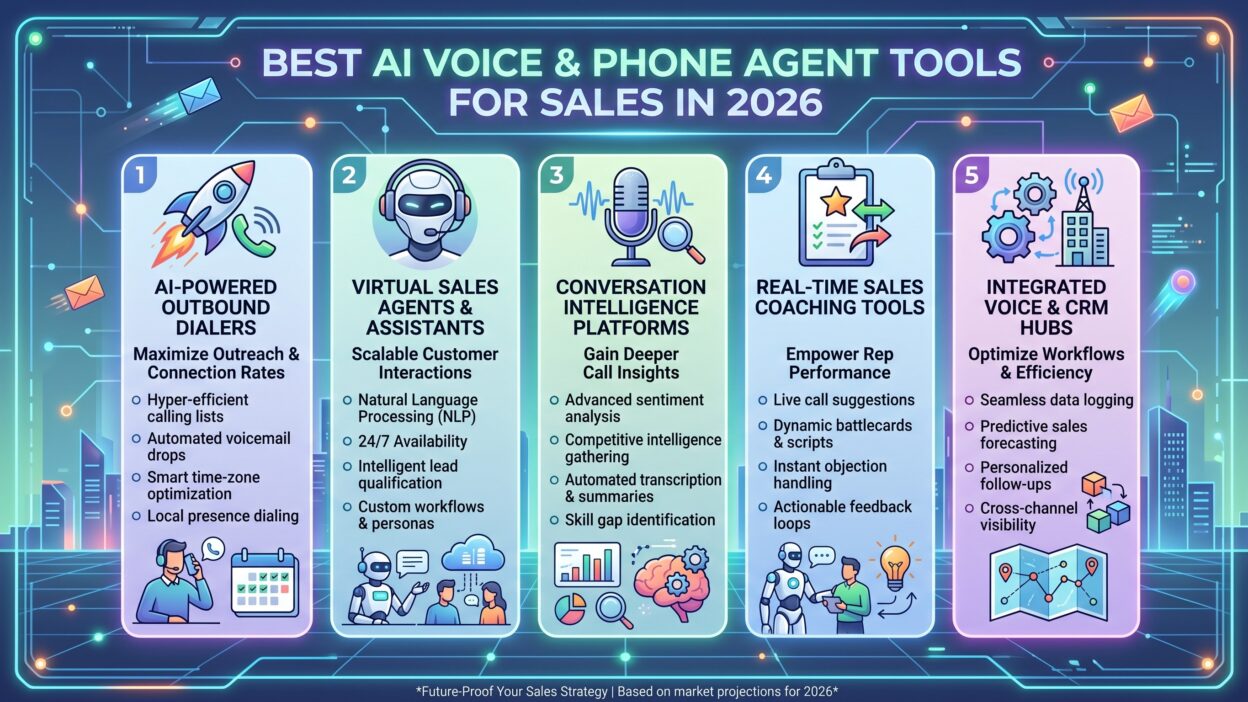
The Best AI Voice & Phone Agent Tools for Sales in 2026
Bland AI
Bland AI has established itself as one of the leading AI Voice & Phone Agent Tools for enterprise sales teams. Its voice quality ranks among the most natural on the market. Conversations flow at a cadence that closely mirrors human speech patterns.
Bland AI supports deep API integration. Enterprise teams build custom conversation flows tailored precisely to their sales motion, ICP, and product category. The platform handles high call volumes reliably. It scales from dozens of daily calls to thousands without infrastructure degradation.
The analytics dashboard gives sales managers visibility into call performance, qualification rates, drop-off points in conversation flows, and agent effectiveness metrics. Teams iterate on conversation design based on real performance data rather than guesswork.
Vapi
Vapi has become a favorite among technical GTM teams and AI-native startups. It is a developer-first AI voice platform with powerful APIs and deep customization capabilities. Teams build precisely the voice agent behavior they need without being constrained by preset templates.
Vapi supports multiple large language models as the conversational backbone. Teams choose the model that best fits their use case. The platform’s low latency architecture makes conversations feel genuinely responsive.
For revenue teams with engineering resources, Vapi delivers the most flexible implementation of AI Voice & Phone Agent Tools available. The tradeoff is setup complexity. Non-technical teams may find Vapi’s learning curve steeper than more packaged solutions.
Retell AI
Retell AI focuses specifically on sales use cases. The platform offers pre-built sales conversation templates that teams can deploy quickly without starting from scratch. Setup time is significantly lower than developer-first platforms.
Retell AI’s voice quality is strong. Its qualification logic is configurable without code. The CRM integration options cover the major platforms — Salesforce, HubSpot, and others — making it practical for existing revenue stacks.
Retell AI has become a go-to choice for mid-market sales teams that want capable AI Voice & Phone Agent Tools without the complexity of a fully custom build.
Synthflow
Synthflow offers a no-code interface for building AI voice agents. The platform targets non-technical users who need to deploy calling agents without engineering support. Its drag-and-drop conversation builder makes flow design accessible to sales ops and RevOps practitioners.
Synthflow supports inbound and outbound calling use cases. It handles appointment setting, lead qualification, customer reactivation, and survey collection. The platform integrates with popular CRMs and scheduling tools.
For teams prioritizing speed of deployment over deep customization, Synthflow delivers one of the most accessible entry points into AI Voice & Phone Agent Tools available in 2026.
AirCall AI (AI Layer on AirCall)
AirCall has long been a popular cloud phone system for sales teams. Its AI layer adds intelligence on top of the existing infrastructure. Call transcription, sentiment analysis, automated call summaries, coaching suggestions, and follow-up task generation all activate within the AirCall interface teams already know.
This is not a pure AI calling agent in the sense that it places autonomous calls. AirCall AI augments human reps rather than replacing the calling function entirely. Reps get real-time guidance during calls. Managers get automated coaching insights after calls. The administrative burden of call documentation drops significantly.
AirCall AI is ideal for teams that want to improve human rep performance rather than automate the calling function itself.
Orum
Orum is a parallel dialing platform with integrated AI capabilities. It dials multiple numbers simultaneously and connects the rep only when a live human answers. AI handles the voicemail detection, screen out disconnected numbers, and manage call disposition automatically.
Orum’s AI features include real-time call coaching, automated note-taking, and conversation intelligence that surfaces patterns across call libraries. The platform significantly increases the number of live conversations a human rep has per hour.
Orum sits in a different category from fully autonomous AI Voice & Phone Agent Tools. It amplifies human rep productivity rather than replacing the human caller. Teams that want to maximize rep efficiency while keeping humans on every call find Orum extremely effective.
Thoughtly
Thoughtly specializes in AI voice agents for high-volume outbound campaigns. The platform excels at appointment setting and lead qualification workflows. It has built a strong reputation in industries like real estate, insurance, home services, and financial services — sectors where phone outreach remains a primary customer acquisition channel.
Thoughtly’s conversation design tools are sophisticated without requiring deep technical expertise. Call analytics give campaign managers clear visibility into performance across variables like call time, conversation length, and qualification rates.
For industries with straightforward qualification criteria and high outbound call volumes, Thoughtly delivers strong ROI as part of an AI Voice & Phone Agent Tools stack.
Key Features to Evaluate in AI Voice & Phone Agent Tools
Voice Quality and Naturalness
Voice quality is the first filter. If the agent sounds robotic, prospects hang up. Evaluate every platform with live test calls before making a purchase decision. Listen for latency, pronunciation accuracy, tonal variation, and how the agent handles interruptions or overlapping speech.
The best AI Voice & Phone Agent Tools in 2026 handle these nuances well. Lesser platforms still struggle with natural pacing and interruption management.
Conversation Flow Flexibility
Rigid conversation flows produce rigid outcomes. Evaluate how much the platform allows you to customize the call script, branching logic, objection handling paths, and escalation triggers.
The more your sales motion deviates from a generic script, the more conversation flexibility you need from your AI Voice & Phone Agent Tools.
CRM and Stack Integration
Your AI voice platform must connect to your existing tools. CRM integration is essential. Sequencer integration matters for teams running multi-channel outbound. Calendar integration powers automated meeting booking.
Evaluate integration depth, not just availability. A shallow integration that pushes call outcomes as a note is far less valuable than a deep integration that updates specific CRM fields, triggers workflows, and syncs bidirectionally.
Compliance and Call Recording Capabilities
Phone outreach operates under legal requirements that vary by geography. TCPA compliance in the US. GDPR considerations in Europe. State-level call recording consent laws.
Evaluate how each AI Voice & Phone Agent Tools platform handles compliance. Does it support jurisdiction-specific disclosure statements? Does it manage do-not-call list scrubbing? Does it store call recordings in a compliant, accessible way?
Compliance gaps create legal exposure that can outweigh the efficiency gains from automation.
Analytics and Reporting
Every call generates performance data. The value of that data depends on how the platform presents and processes it.
Strong AI Voice & Phone Agent Tools provide conversation-level analytics, campaign-level performance dashboards, qualification rate tracking, and machine-learning-driven insights that surface what separates successful calls from failed ones.
Teams that use analytics effectively improve their conversation flows faster and achieve better outcomes per call over time.
Scalability and Uptime
Volume matters in outbound calling. Evaluate each platform’s ability to handle peak call volumes without quality degradation. Ask about uptime SLAs. Review published reliability metrics.
A platform that performs well at 50 calls per day but degrades at 5,000 is not a scalable foundation for a serious outbound program.
Who Should Use AI Voice & Phone Agent Tools?
High-Volume Outbound Sales Teams
Teams running large-scale outbound programs — thousands of dials per week — see the highest ROI from AI Voice & Phone Agent Tools. The volume advantage of AI calling multiplies at scale. More calls per day means more pipeline per week means faster revenue growth.
Sales Teams With Long Prospect Lists and Small SDR Headcount
Startups and growth-stage companies often have expansive target markets and limited SDR resources. AI Voice & Phone Agent Tools bridge that gap. One AI agent covers call volumes that would otherwise require multiple human hires.
Companies in High-Call-Volume Industries
Real estate, insurance, financial services, home services, and healthcare marketing all rely heavily on phone outreach. AI Voice & Phone Agent Tools are a natural fit for these industries. Qualification criteria are often clear and consistent. Call volumes are high. ROI from automation is immediate.
Revenue Operations Teams Seeking CRM Data Quality
RevOps teams use AI voice agents to enrich CRM data through proactive outreach. Verification calls, data update campaigns, and re-engagement sequences all run automatically. CRM records stay current without manual effort.
Implementation Best Practices for AI Voice & Phone Agent Tools
Start with a Single Use Case
AI Voice & Phone Agent Tools work best when deployed against a specific, well-defined use case. Appointment setting. Lead qualification. Re-engagement. Inbound call handling. Starting narrow lets you measure results clearly and iterate quickly.
Avoid trying to automate every calling motion simultaneously. Master one workflow before expanding to the next.
Invest in Conversation Design
The conversation flow is the product the prospect experiences. Treat it with the same care you would invest in a top-performing human rep’s script. Test different approaches. Record and review call samples. Identify where prospects disengage and redesign those moments.
Teams that treat conversation design as an ongoing discipline consistently outperform teams that set a flow once and never revisit it.
Set Clear Escalation Triggers
Define precisely when the AI agent should hand off to a human rep. Too few escalation triggers mean prospects with genuine interest get lost in automated flows. Too many escalation triggers defeat the efficiency purpose of using AI Voice & Phone Agent Tools.
Calibrate escalation logic based on call data from the first few weeks of deployment. Let real conversation patterns inform where the AI ends and the human begins.
Monitor and Iterate Continuously
Treat AI voice call performance as a continuous optimization challenge. Review analytics weekly. Identify underperforming flow stages. Test new approaches. Rotate messaging based on market feedback.
The best AI Voice & Phone Agent Tools provide the data to drive this iteration. Teams that use the data aggressively improve faster than those that set campaigns and walk away.
Related Topics
AI Cold Calling Platform
An AI cold calling platform automates the initial outreach call to prospects who have not yet engaged with your brand. The platforms covered in this blog all serve this function with varying degrees of sophistication and customization.
Conversational AI for Sales
Conversational AI for sales refers to AI systems that conduct natural-language dialogue with prospects to achieve sales objectives. AI Voice & Phone Agent Tools are the voice-based implementation of this broader category.
AI SDR Tools
AI SDR tools replicate the function of a Sales Development Representative using artificial intelligence. AI Voice & Phone Agent Tools form the calling component of a broader AI SDR stack that often also includes email automation and LinkedIn outreach.
Virtual Sales Agent
A virtual sales agent is an AI system that performs sales functions — calling, qualifying, booking, objection handling — without human involvement in each interaction. The platforms in this review all function as virtual sales agents of varying capability levels.
Voice AI Prospecting
Voice AI prospecting uses AI-powered phone agents to identify and qualify sales prospects through automated outbound calling. It is one of the fastest-growing applications of AI in the sales technology category.
Frequently Asked Questions (FAQs)
What are AI Voice & Phone Agent Tools?
AI Voice & Phone Agent Tools are software platforms that use artificial intelligence to conduct sales phone calls autonomously. They make outbound calls, carry on natural conversations with prospects, qualify leads based on defined criteria, book meetings, and hand off warm prospects to human sales reps — all without a human dialing or speaking on each call.
Are AI voice agents legal for sales calls?
Legality depends on jurisdiction and use case. In the United States, calls must comply with TCPA regulations. Some states require disclosure that the caller is an AI. Do-not-call list compliance is mandatory. Reputable AI Voice & Phone Agent Tools platforms include compliance features, but teams are responsible for understanding and adhering to the laws governing their markets.
Can prospects tell they are talking to an AI?
With 2026’s best platforms, prospects often cannot reliably identify an AI voice agent versus a human caller. Top-tier voice quality, low latency, and natural conversation design create experiences that pass basic human detection. Most platforms still recommend disclosing AI identity when asked directly, both for legal and ethical reasons.
How do AI voice agents handle objections?
AI voice agents handle objections through pre-designed conversation branches. Common objections — bad timing, no budget, already using a competitor, not the right person — each trigger specific response paths designed to address the concern and advance the conversation. More sophisticated platforms learn from call data which objection responses perform best and optimize accordingly.
What is the typical ROI of AI Voice & Phone Agent Tools?
ROI varies significantly based on call volume, qualification rate, meeting conversion rate, and deal values. Teams consistently report cost-per-meeting reductions of 40 to 70 percent compared to human-only SDR programs. Pipeline generation per dollar of investment improves materially when AI agents handle high-volume, early-stage outreach and human reps focus on qualified opportunities.
How long does it take to deploy an AI voice agent?
Deployment timelines vary by platform complexity and use case specificity. Packaged solutions like Synthflow and Retell AI can deploy a basic calling agent in days. Developer-first platforms like Vapi require more setup time but deliver deeper customization. A fully optimized, production-ready AI voice agent typically takes two to six weeks from initial setup through testing and launch.
Can AI Voice & Phone Agent Tools integrate with my existing CRM?
Yes. Most leading platforms integrate with Salesforce, HubSpot, Pipedrive, and other major CRMs. Integration depth varies — evaluate whether the integration updates specific fields, creates records, triggers workflows, and syncs bidirectionally rather than simply logging calls as notes.
What industries benefit most from AI voice calling?
Industries with high outbound call volumes and relatively consistent qualification criteria benefit most. Real estate, insurance, financial services, home services, SaaS sales, healthcare outreach, and recruiting all see strong results from AI Voice & Phone Agent Tools. Any industry where phone remains a primary customer acquisition channel is a strong candidate.
The Future of AI Voice & Phone Agent Tools
Emotional Intelligence in Voice AI
The next frontier for AI Voice & Phone Agent Tools is emotional intelligence. Current systems process words and intent. Future systems will detect vocal stress, enthusiasm, frustration, and hesitation in real time. They will adapt their tone, pacing, and messaging based on the emotional signals in the prospect’s voice.
This capability will make AI voice conversations feel even more natural and responsive. Prospects will feel heard rather than processed.
Multilingual Calling at Scale
Global sales teams need multilingual capabilities. AI Voice & Phone Agent Tools are advancing rapidly in this area. Platforms are adding support for more languages and regional dialects. Teams can run outbound programs in multiple languages simultaneously without building separate human teams for each market.
Deeper AI-to-AI Integration
AI voice agents increasingly connect to the rest of the AI marketing and sales stack. An AI enrichment tool identifies a high-intent prospect. An AI voice agent calls within minutes. An AI email tool follows up the same day. The entire outbound motion runs on connected AI systems that pass data and context between them.
Human reps engage only when genuine buying conversations demand their attention. The rest of the process runs autonomously.
Read More:-GTM AI Context Starts with a Data Foundation
Conclusion

The way sales teams use the phone has fundamentally shifted. Standing up a team of human SDRs to dial a prospect list at scale is no longer the only approach — or the most effective one.
AI Voice & Phone Agent Tools have matured to a point where they belong in every serious outbound sales stack. The voice quality is there. The conversation intelligence is there. The integration capabilities are there. The economics are compelling. The tools covered in this blog represent the best available options heading into 2026.
Choosing the right AI Voice & Phone Agent Tools depends on your use case, your technical capabilities, your call volume, and your compliance requirements. Bland AI and Vapi serve teams that need deep customization. Retell AI and Synthflow serve teams that need faster deployment. Orum and AirCall AI serve teams that want to amplify human rep performance rather than replace the calling function.
The common thread across all of them is clear. Revenue teams that deploy AI Voice & Phone Agent Tools generate more pipeline, at lower cost, with better data than teams relying solely on human callers at equivalent scale.
The phone is not dead. It is just getting a significant intelligence upgrade. Teams that adopt these tools now build the operational knowledge and competitive advantage that compounds with every quarter of use.
Start with one use case. Test rigorously. Optimize aggressively. Scale what works. The pipeline impact will make the investment case obvious.