Introduction
TL;DR Sales teams waste enormous amounts of time on bad data. They research prospects manually. They copy-paste information across tools. They send outreach to contacts who changed jobs six months ago.
That is not a people problem. It is a data infrastructure problem.Clay is a sales enrichment platform built to solve it. It combines data from 75+ sources, AI-powered research, and workflow automation into one platform. Sales and marketing teams use it to build smarter prospecting lists, enrich contact records automatically, and launch personalized outreach at a scale no manual process can match.
This blog covers what Clay is, how this sales enrichment platform actually works under the hood, who uses it, and whether it belongs in your revenue stack.
Table of Contents
What Is Clay?
The Core Product
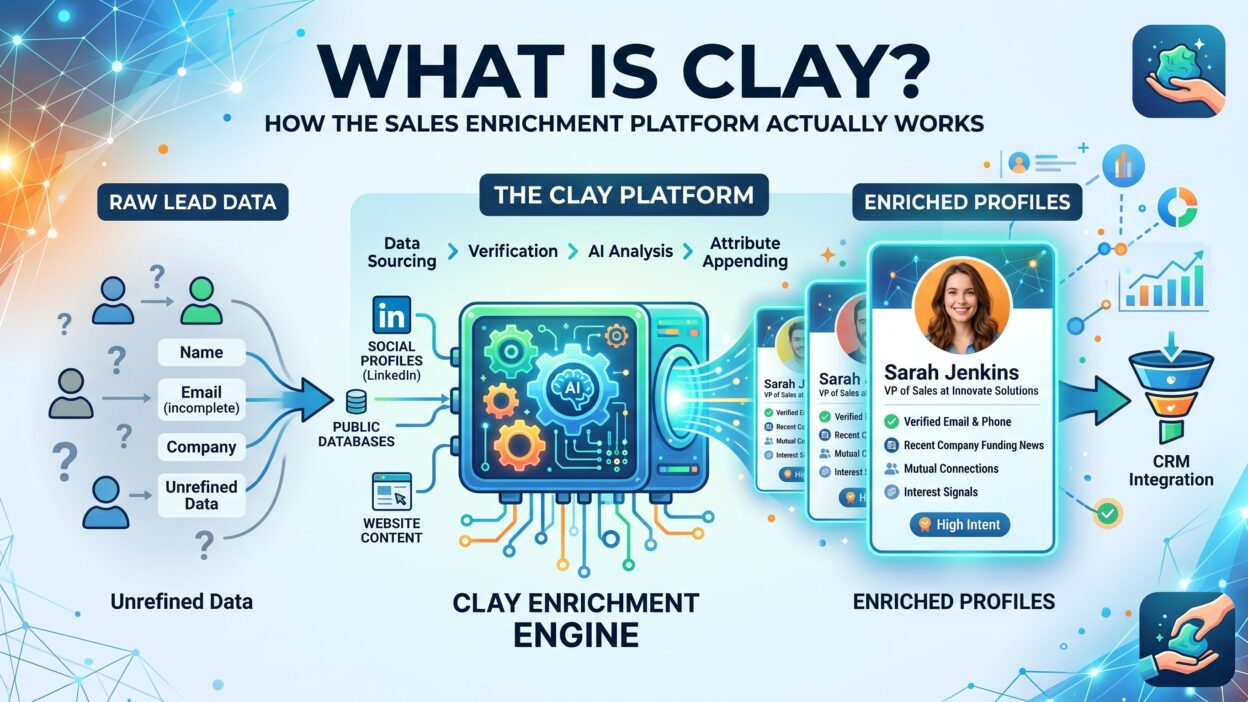
Clay is a sales enrichment platform that gives revenue teams a spreadsheet-like interface connected to dozens of data providers and AI tools. It looks familiar on the surface. The power is in what sits behind every column and row.
Each column in a Clay table can pull data from a different source. One column might pull company headcount from LinkedIn. The next pulls recent funding rounds from Crunchbase. The next uses an AI prompt to write a personalized first line for an outreach email based on the contact’s LinkedIn posts.
That combination of data enrichment and AI personalization makes Clay unlike any other sales enrichment platform on the market.
Where Clay Fits in the Revenue Stack
Clay sits between your lead sources and your outreach tools. You bring in raw data — a list of company domains, a set of LinkedIn URLs, a CRM export. Clay enriches that data. Then it pushes the enriched, personalized records into your sequencing tool, CRM, or wherever your outbound motion lives.
It does not replace your CRM. It does not replace your sequencer. It makes both of them significantly more effective by ensuring the data flowing into them is complete, accurate, and personalized.
The Problem Clay Solves
The fundamental problem every revenue team faces is data fragmentation. Useful data about prospects lives across dozens of platforms. LinkedIn. Crunchbase. Apollo. Clearbit. ZoomInfo. Hunter. News sites. Company career pages.
Pulling all of that together manually for every prospect is slow, expensive, and impossible to scale. Most teams either settle for incomplete data or pay for expensive all-in-one databases that still have significant coverage gaps.
Clay solves this by acting as an orchestration layer. It queries multiple data sources in sequence, combines the results, and uses AI to fill gaps and generate personalized content. That is the core value of this sales enrichment platform — breadth, depth, and automation in one place.
How Clay Works: The Technical Reality
Tables as the Core Interface
Clay organizes everything into tables. Each table is a workspace for a specific enrichment or prospecting workflow. You add rows — prospects, companies, contacts — and then you add columns that pull data about those rows from external sources.
This structure feels intuitive to anyone who has used a spreadsheet. The critical difference is that Clay columns are not static. They are live queries that pull real data from real sources every time you run them.
A table might start with 500 company domains. Thirty columns later, each company record includes employee count, tech stack, funding history, recent news mentions, key decision-maker names, verified emails, direct dial numbers, and an AI-written custom opener for the first outreach email.
The Data Provider Network
Clay connects to 75+ data providers. Each provider brings different data specialties and different coverage strengths. Some excel at contact emails. Others lead in company firmographics. Others specialize in technographic data or intent signals.
This sales enrichment platform does not force you to pick one provider. It lets you query multiple providers for the same field and use the best result. That approach — often called waterfall enrichment — dramatically improves fill rates compared to relying on any single source.
Providers in Clay’s network include Apollo, Hunter, Clearbit, LinkedIn (via People Data Labs and others), Crunchbase, BuiltWith, Bombora, ZoomInfo, and many more. The network continues expanding. Users benefit from every new provider addition automatically.
Waterfall Enrichment in Practice
Waterfall enrichment is one of the most valuable capabilities in this sales enrichment platform. Here is how it works in a Clay table.
You want verified business email addresses for 1,000 contacts. You set up a waterfall column. Clay queries Provider A first. If Provider A returns a confident match, the email field fills and the row moves forward. If Provider A returns nothing or a low-confidence result, Clay automatically queries Provider B. The sequence continues until the field fills or all providers in the waterfall are exhausted.
This automated fallback sequence produces far higher fill rates than querying a single provider. It also costs less than subscribing to every provider individually, because Clay only charges for successful results, not attempted queries.
AI-Powered Research with Claygent
Claygent is Clay’s built-in AI research agent. It uses large language models combined with web search capabilities to answer questions about prospects that no static database can answer.
You write a research question in plain language. “What has this company announced in the last 30 days?” “Does this company use Salesforce?” “What is this person’s professional background before their current role?” Claygent searches the web, reads relevant pages, and returns a structured answer — all automatically for every row in your table.
This research capability turns Clay from a data enrichment tool into a genuine sales intelligence platform. Reps get context that would take hours to compile manually. They get it automatically, at scale, before they ever open their outreach tool.
AI Personalization at Scale
Personalization is the other major AI capability inside this sales enrichment platform. Once you have enriched data and AI-researched context, Clay uses that information to generate personalized outreach content automatically.
You write a prompt. “Write a three-sentence email opener that references this company’s recent funding round, connects it to the challenge of scaling a sales team, and introduces our product as a solution.” Clay runs that prompt for every row in your table, using the specific data from each record.
The result is outreach that feels researched and personal — because it is. The AI is not making up context. It is drawing from real data that Clay pulled and organized. That distinction is what separates AI personalization in this sales enrichment platform from generic AI content generation.
Integrations and Workflow Automation
Clay does not operate in isolation. It integrates with the tools your team already uses. Outreach. Salesloft. HubSpot. Salesforce. Instantly. Smartlead. Slack. Google Sheets. Zapier. Webhooks.
Enriched records can push directly into your CRM, trigger sequences in your email tool, or update existing contact records automatically. Workflows run on schedules or triggers. A new lead submits a form on your website, Clay enriches the record within minutes, and the enriched contact lands in your sequencer ready for outreach — all without a human touching it.
That automation layer is what transforms Clay from a research tool into a full-stack sales enrichment platform that powers continuous revenue operations.
Key Use Cases for Clay
Building Outbound Prospecting Lists
Clay excels at list building. Define your Ideal Customer Profile criteria. Pull matching companies from a source like Apollo or LinkedIn Sales Navigator. Bring that list into Clay. Enrich every record with firmographics, technographics, contact data, and AI research. Export a clean, complete, personalized list ready for outreach.
The entire process that once took a research team days now runs in hours. The quality of the output — coverage, accuracy, personalization depth — exceeds what manual research produces.
Enriching Inbound Leads
Inbound leads often arrive with minimal information. A name, an email address, a company name. That is rarely enough for a rep to have a meaningful first conversation.
Clay enriches inbound leads automatically. The moment a form submits, Clay pulls firmographic data, finds the contact’s LinkedIn profile, identifies their role and seniority, researches their company’s recent activity, and delivers a complete record to the rep before they even open the lead in their CRM.
Reps reach out faster and with more context. Conversion rates from first contact improve. The sales enrichment platform does the research so the rep can focus on the conversation.
CRM Data Enrichment and Hygiene
CRM records decay at an estimated 22% per year. Contacts change jobs. Companies get acquired. Emails go stale. Phone numbers disconnect.
Clay connects to your CRM and runs periodic enrichment sweeps. It identifies outdated records and refreshes them with current data. It fills missing fields. It flags contacts who have changed employers. It keeps your CRM in a state where reps can trust what they see.
Clean CRM data improves every downstream process. Segmentation improves. Scoring improves. Reporting improves. Campaign targeting sharpens. This is one of the highest-leverage applications of a sales enrichment platform.
Account-Based Marketing Campaigns
ABM requires deep account intelligence. You need to know who the decision-makers are, what they care about, what technology the account uses, and what recent events might create a compelling reason to engage now.
Clay pulls all of this together at the account level. It maps buying committees. It surfaces relevant news and trigger events. It identifies technographic signals that indicate fit or timing. Marketing teams use Clay to build ABM target lists with the depth of intelligence that enterprise campaigns require.
Recruiting and Talent Sourcing
Clay’s enrichment capabilities extend beyond sales use cases. Talent acquisition teams use it to build candidate sourcing lists. They pull profiles matching specific criteria, enrich contact information, research professional backgrounds, and generate personalized outreach messages for passive candidates.
The same infrastructure that makes Clay a powerful sales enrichment platform also makes it effective for any workflow that requires finding, researching, and reaching the right people.
Who Uses Clay?
Sales Development Teams
SDRs and BDRs represent Clay’s largest user base. They use this sales enrichment platform to build prospect lists, enrich contact records, and generate personalized first touches at a volume no manual process can achieve.
An SDR who was previously researching 15 prospects per day can use Clay to research 150 with higher quality output. That multiplier effect changes what is possible for outbound pipeline generation.
Revenue Operations
RevOps teams use Clay to manage data quality across the stack. They build enrichment workflows that run automatically on new CRM records. They maintain data freshness across large contact databases. They connect Clay to existing tools to create seamless data flows between systems.
For RevOps, Clay is infrastructure. It is the plumbing that keeps data flowing correctly through the revenue tech stack.
Growth Marketers
Growth marketers use Clay for campaign list building, audience segmentation, and personalization. They build enriched lists for specific campaigns and push them into advertising platforms, email tools, or LinkedIn campaign manager.
The enrichment depth Clay provides enables more precise targeting. Instead of broad demographic segments, growth marketers work with highly specific micro-segments built around behavioral signals, technographic data, and real-time intent indicators.
Founders and Solopreneurs
Clay’s self-serve model makes it accessible to individual users. Founders at early-stage companies use it to do the research and outreach work that a full sales team would otherwise handle.
A single founder using Clay effectively can produce the prospecting output of a two or three-person SDR team. For early-stage companies where headcount is constrained, this sales enrichment platform changes what is achievable with a small team.
Agency and GTM Consultants
A growing ecosystem of agencies specializes in Clay-powered GTM services. These agencies build enrichment and outreach workflows for clients who want the results Clay delivers but prefer to outsource the setup and operation.
GTM consulting firms use Clay as the core tool in their service delivery model. Client campaigns run on Clay infrastructure, benefiting from the full vendor network and AI capabilities without requiring the client to manage the platform directly.
Clay Pricing: How It Works
The Credit Model
Clay operates on a credit-based pricing model. Credits are consumed when you run enrichment actions — querying a data provider, running a Claygent research task, or generating AI content.
Different actions consume different credit amounts. A basic email lookup might cost one credit. A Claygent research task that reads multiple web pages costs more. The cost structure reflects the compute and data access involved in each action.
This model means you pay for what you actually use. A team that runs modest enrichment volumes pays proportionally less than a team processing tens of thousands of records weekly.
Tiers and Access
Clay offers multiple pricing tiers. Entry-level plans give individuals and small teams access to core enrichment capabilities. Higher tiers unlock more credits, more providers, API access, and team collaboration features.
Enterprise plans include dedicated support, custom credit arrangements, and deeper integration options for organizations running Clay at significant scale.
Cost Versus Value
The credit model sometimes creates sticker shock for teams used to flat-rate SaaS pricing. The right frame is cost per outcome, not cost per seat.
Compare what Clay costs to run 1,000 fully enriched, personalized prospect records against what it costs to produce the same output manually — in research hours, freelancer fees, or multiple vendor subscriptions. The sales enrichment platform almost always wins on that comparison.
Clay vs. Other Sales Enrichment Platforms
Clay vs. ZoomInfo
ZoomInfo is a database. It gives you access to its proprietary contact and company records. Coverage is strong in certain segments. Gaps exist in others. Pricing is high. Customization is limited.
Clay is an orchestration layer. It is not a database. It connects to ZoomInfo and dozens of other databases simultaneously. Where ZoomInfo has gaps, Clay’s waterfall pulls from other providers. Clay also adds AI research and personalization capabilities that ZoomInfo does not offer.
Many teams use both — ZoomInfo as one provider within a Clay waterfall alongside others.
Clay vs. Apollo
Apollo combines a contact database with sequencing capabilities. It is a popular choice for outbound teams that want enrichment and outreach in one tool.
Clay offers far greater enrichment depth and flexibility. The 75+ provider network dramatically outperforms Apollo’s single database for coverage. The AI research capabilities have no Apollo equivalent.
Teams that prioritize enrichment quality and personalization depth often choose Clay over Apollo, even if it means using a separate sequencer for outreach delivery.
Clay vs. Clearbit
Clearbit is a real-time enrichment API. Developers integrate it into products and workflows to enrich data at the point of capture. It is powerful for technical teams building custom data pipelines.
Clay is more accessible to non-technical users. The spreadsheet interface means sales ops and RevOps professionals can build sophisticated enrichment workflows without writing code. Clay also offers broader provider coverage than Clearbit’s single-source model.
Related Topics
Waterfall Enrichment
Waterfall enrichment describes the sequential querying of multiple data providers to maximize fill rates for any given data field. Clay pioneered the accessible version of this approach for sales teams. The concept is now central to how modern sales enrichment platforms operate.
Contact Data Enrichment
Contact data enrichment focuses specifically on filling and verifying contact-level information: email addresses, phone numbers, job titles, LinkedIn URLs, and professional background. Clay’s provider network covers all of these fields with multiple sources per field.
Lead Enrichment Software
Lead enrichment software adds context to inbound and outbound leads before reps engage. Clay functions as lead enrichment software in addition to its broader enrichment and research capabilities.
CRM Enrichment
CRM enrichment keeps existing customer and prospect records accurate and complete. Clay’s CRM integrations enable automated enrichment workflows that maintain data quality without manual effort from ops teams.
B2B Prospecting Platform
Clay serves as a B2B prospecting platform for teams building outbound lists from scratch. Its data sourcing, enrichment, and AI research capabilities make it more powerful than traditional prospecting databases for teams that prioritize data quality over raw list volume.
Automated Prospecting
Automated prospecting uses software to research, enrich, and engage prospects without proportional increases in human effort. Clay is among the most capable tools for automated prospecting available to revenue teams today.
Frequently Asked Questions (FAQs)
What is Clay used for in sales?
Clay is a sales enrichment platform used to build prospecting lists, enrich contact and company records, conduct AI-powered research on prospects, and generate personalized outreach content at scale. Sales teams use it to improve data quality, increase personalization, and automate research workflows that would otherwise require significant manual effort.
How does Clay’s waterfall enrichment work?
Clay queries multiple data providers in a defined sequence for each data field. If the first provider returns a confident result, the field fills and the process stops. If not, Clay queries the next provider automatically. This cascade continues until the field is filled or all providers are exhausted. The result is significantly higher fill rates than any single-provider approach can achieve.
Is Clay a CRM?
Clay is not a CRM. It is a sales enrichment platform that integrates with CRMs like Salesforce and HubSpot. Clay enriches and prepares data, then pushes it into your CRM. The two tools work together — Clay handles data enrichment and research, the CRM handles relationship management and pipeline tracking.
What data providers does Clay connect to?
Clay connects to 75+ data providers including Apollo, Hunter, Clearbit, People Data Labs, Crunchbase, BuiltWith, Bombora, LinkedIn data sources, and many others. The network covers contact data, firmographic data, technographic data, intent signals, and news monitoring.
How much does Clay cost?
Clay uses a credit-based pricing model. Costs vary based on the volume and type of enrichment actions you run. Entry-level plans are accessible to individuals and small teams. Enterprise pricing scales with volume. The right way to evaluate cost is to compare the per-outcome cost against the alternatives — manual research, multiple vendor subscriptions, or freelancer fees.
Can non-technical users operate Clay?
Yes. Clay’s spreadsheet-like interface is designed for sales and marketing practitioners without engineering backgrounds. Building enrichment tables, setting up waterfall sequences, and writing AI research prompts does not require coding knowledge. Technical users can access Clay’s API for more advanced integrations.
What is Claygent?
Claygent is Clay’s built-in AI research agent. It uses large language models combined with real-time web search to answer custom research questions about prospects and companies. Claygent runs automatically across every row in a Clay table, producing research outputs that would take hours to compile manually.
How does Clay compare to ZoomInfo?
ZoomInfo is a proprietary database. Clay is a sales enrichment platform that orchestrates data from 75+ sources including ZoomInfo. Clay offers broader coverage through its multi-provider waterfall and adds AI research and personalization capabilities. Many teams use both — ZoomInfo as one data source within a Clay-powered enrichment workflow.
Does Clay integrate with outreach tools?
Yes. Clay integrates with leading outreach and sequencing tools including Outreach, Salesloft, Instantly, Smartlead, and others. Enriched records can push directly into these tools to trigger outreach sequences automatically. Clay also integrates with HubSpot, Salesforce, Zapier, and other stack components.
Who benefits most from using Clay?
SDRs, revenue operations teams, growth marketers, and founders benefit most from Clay. SDRs use it to build and enrich prospecting lists at scale. RevOps uses it for CRM data hygiene and workflow automation. Growth marketers use it for campaign list building and audience segmentation. Founders use it to run outbound programs with a small team.
Best Practices for Getting the Most from Clay
Start with a Clear Use Case
Clay is powerful and flexible. That flexibility can lead to sprawl. Start with one specific use case — outbound list building, inbound lead enrichment, or CRM refresh — and build that workflow completely before expanding.
A well-built single-use workflow produces immediate value. It also teaches you the platform patterns that make every subsequent workflow faster to build.
Invest in Prompt Quality
The quality of AI research and personalization outputs in Clay depends heavily on the quality of your prompts. Vague prompts produce generic outputs. Specific, detailed prompts produce outputs that closely match what your reps would write manually.
Write your prompts with the same care you would apply to any high-stakes communication. Test them on a small batch before running them at scale. Refine based on output quality before committing full credit volume.
Build Waterfalls Strategically
Not every data field needs a deep waterfall. Email address verification justifies querying multiple providers — it is a high-stakes field that directly impacts deliverability. A less critical field might warrant only one or two providers.
Design your waterfall depth based on the importance of each field and the credit cost of querying additional providers. This approach maximizes value from your credit allocation.
Maintain Table Hygiene
Clay tables accumulate rows and columns quickly. Unused columns consume credits when tables re-run. Outdated rows create noise in your workflows.
Review your tables regularly. Archive completed enrichment projects. Delete columns you no longer need. Keep active tables lean so they run efficiently and produce clean outputs.
Connect Clay to Your Broader Stack
Clay’s full value emerges when it connects to the rest of your revenue stack. Set up CRM integrations early. Configure automatic pushes to your sequencer. Build Slack notifications for high-priority enrichment results.
The more connected Clay is to your existing workflows, the more value this sales enrichment platform delivers to every tool it feeds.
Read More:-The Best AI BDR Software for Outbound Sales in 2026
Conclusion

Bad data is not a minor inconvenience for revenue teams. It is a compounding problem. Every bad record wastes rep time. Every missed enrichment field reduces personalization. Every stale CRM contact dilutes campaign performance. The cost accumulates invisibly across hundreds of interactions every week.
Clay addresses that problem at its root. As a sales enrichment platform, it combines multi-source data coverage, AI-powered research, and workflow automation into one flexible tool. The result is cleaner data, richer prospect context, and personalized outreach that actually earns responses.
The teams seeing the biggest gains from Clay are not just using it as a data tool. They are using this sales enrichment platform as a core piece of their revenue infrastructure — the layer that ensures every downstream tool in the stack receives accurate, complete, actionable information.
Clay is not the right tool for every team. It has a learning curve. It requires thoughtful workflow design. The credit model demands attention to cost-per-outcome math. But for teams serious about outbound quality, CRM data health, and personalized engagement at scale, it is one of the most powerful tools available today.
If your revenue team still researches prospects manually, buys static lists, or struggles with CRM data decay, Clay deserves a serious evaluation. The gap between what manual processes produce and what a well-configured sales enrichment platform delivers is too large to ignore for much longer.