Introduction
TL;DR Your sales team is working hard. They are calling, emailing, following up, and pushing deals forward every single day.
But here is the uncomfortable question.
Are they working on the right things?
Most revenue teams operate on instinct. Reps focus on the accounts they know best. Managers prioritize the deals that feel closest to close. Marketing targets the segments that performed well last quarter. None of that is wrong — but none of it is precise, either.
Predictive intelligence changes the game entirely.
It replaces gut feel with data-backed certainty. It tells your team which accounts are ready to buy before a rep even picks up the phone. It surfaces which deals are at risk before the quarter slips. It identifies which prospects look exactly like your best customers — and flags them at the top of your priority list.
But predictive intelligence does not work on good intentions alone. It works on data. Specifically, it works on three distinct types of data that, when combined, give your AI systems the full picture they need to make accurate predictions.
This blog breaks down exactly what those three data types are, why each one matters, what happens when any one of them is missing, and how to build the data foundation that makes predictive intelligence actually work for your revenue team.
Table of Contents
What Is Predictive Intelligence — and Why Does It Matter Now?
Defining Predictive Intelligence in Plain Terms
Predictive intelligence is the use of historical data, behavioral signals, and AI-powered models to forecast future outcomes in a sales and go-to-market context.
It answers questions your team cannot answer with manual analysis. Which accounts in your TAM are most likely to buy in the next ninety days? Which deals in your current pipeline are most at risk of slipping? Which customer segments are most likely to expand — and which ones are heading toward churn?
These are not guesses. Predictive intelligence produces probability scores based on patterns learned from your own historical data combined with real-time behavioral and market signals.
The result is a revenue team that operates with foresight rather than hindsight.
Why Predictive Intelligence Is No Longer Optional
Sales cycles are getting longer. Buyer committees are growing. Competition for attention is more intense than it has ever been.
Revenue teams that operate on instinct and spreadsheets are losing ground to teams that operate on data and AI. The gap in performance between data-driven organizations and intuition-driven ones is widening every year.
Predictive intelligence is the infrastructure that closes that gap. It does not replace great salespeople. It makes great salespeople dramatically more efficient by pointing them at the right accounts, at the right time, with the right context.
Organizations that deploy predictive intelligence consistently report improvements in pipeline quality, forecast accuracy, and rep productivity. The teams that wait to adopt it are not standing still — they are falling behind.
The question is not whether predictive intelligence matters. It clearly does. The question is whether your data foundation is strong enough to make it work.
The Three Types of Data That Power Predictive Intelligence
A System Is Only as Smart as What You Feed It
Predictive intelligence is powered by machine learning models. Those models learn patterns from data. The richer and more complete the data, the more accurate the predictions.
Most revenue teams have some data. Very few have the right combination of data types working together in a unified system.
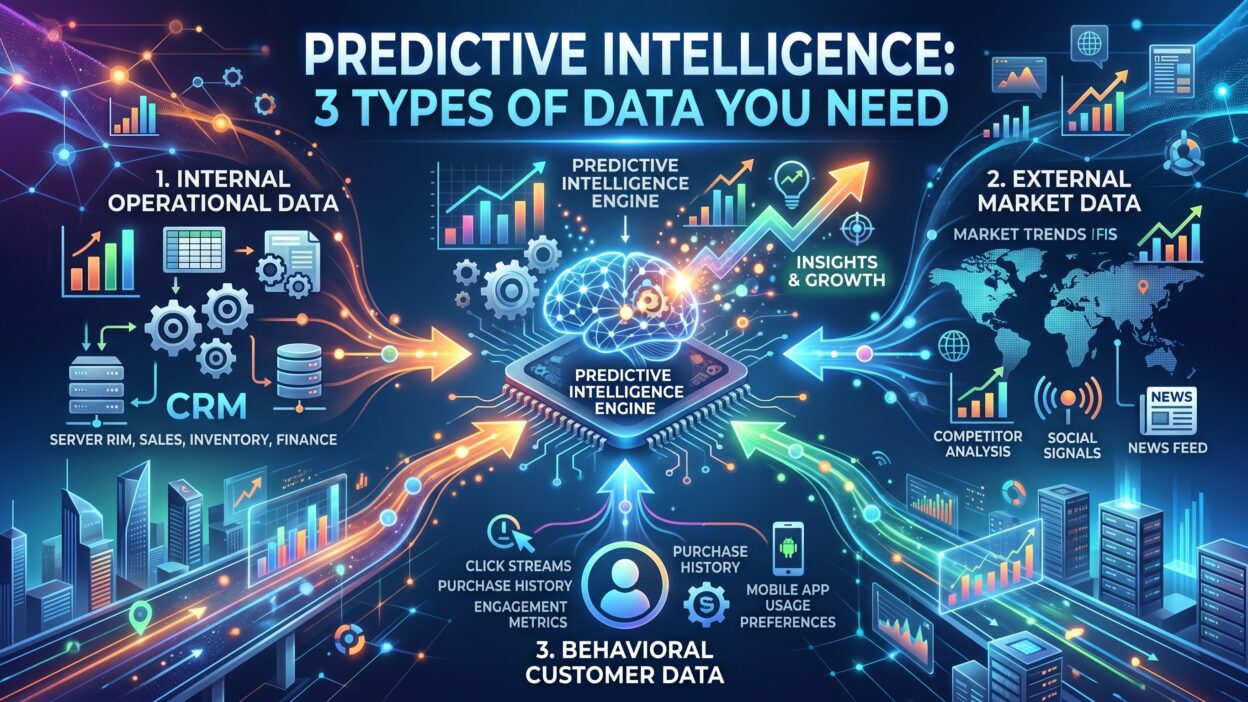
There are three foundational data types that predictive intelligence requires to function at the level that drives real commercial outcomes. The first is firmographic and technographic data. The second is behavioral and engagement data. The third is historical outcome data.
Each type answers a different question. Firmographic data tells the model who your ideal buyers are. Behavioral data tells the model what those buyers are doing right now. Historical data teaches the model what patterns actually lead to deals closing.
Remove any one of these three types from the equation and your predictive intelligence model becomes significantly less accurate. Remove two of them and you are back to educated guessing.
Together, all three give your AI system the complete picture it needs to surface the right insights at the right time. Understanding each type in depth is the first step toward building a data foundation that makes predictive intelligence genuinely powerful.
Data Type One — Firmographic and Technographic Data
What Firmographic Data Is and Why It Anchors the Model
Firmographic data is structured information about the companies in your market. It covers company size, industry classification, annual revenue, employee count, geographic location, organizational structure, and growth stage.
This is the foundational layer of predictive intelligence. It defines who your buyers are at a structural level. It gives the AI model the ability to identify which companies in your total addressable market share the characteristics of your best existing customers.
Think of firmographic data as the demographic profile of your ICP. Without it, your predictive model has no basis for identifying fit. It cannot distinguish between a company that looks exactly like your top ten customers and one that has never been a good fit for your solution.
High-quality firmographic data requires freshness and accuracy. Companies grow, shrink, pivot, and restructure constantly. A firmographic profile that was accurate eighteen months ago may no longer reflect the reality of that company today. Enrichment tools like ZoomInfo, Clearbit, and Dun and Bradstreet continuously update firmographic data to keep it current.
What Technographic Data Adds to the Picture
Technographic data tells you what technology stack a company runs. It reveals which software tools, platforms, and infrastructure a company currently uses or has recently adopted.
For predictive intelligence, technographic data is powerful for two reasons.
First, it reveals buying context. If a company recently adopted a new CRM, they may be in a period of broader technology investment — which makes them a better target for related solutions. If a company runs a specific ERP system that your product integrates with, they are a natural fit based on technical alignment.
Second, technographic data reveals competitive presence. Knowing which prospects currently use a competitor’s product tells your predictive model which accounts are actively in your space and may be open to switching or expanding their vendor portfolio.
Technographic data sources include BuiltWith, HG Insights, and Bombora. Combined with firmographic data, they give your predictive intelligence model a detailed structural profile of every company in your market.
How Firmographic and Technographic Data Shape Fit Scores
Most predictive intelligence platforms use firmographic and technographic data to calculate an Ideal Customer Profile fit score for each account.
The fit score answers one question: How closely does this company resemble the profile of our best historical customers?
High fit scores identify accounts worth prioritizing even before any buying signal appears. They give reps a starting list of high-probability targets based purely on structural similarity to proven wins. That structural fit is the foundation every other data layer builds on.
Data Type Two — Behavioral and Engagement Data
Why Behavioral Data Transforms Static Models into Dynamic Ones
Firmographic and technographic data tells you who a company is. Behavioral data tells you what they are doing right now.
This is where predictive intelligence shifts from descriptive to genuinely predictive. A company that fits your ICP perfectly is an interesting target. A company that fits your ICP perfectly and is actively researching solutions in your category is an urgent target.
Behavioral data captures the signals that reveal intent. It is the layer that adds timing to the fit equation — telling your team not just who to call, but when to call them.
First-Party Behavioral Data — What Your Own Systems Capture
First-party behavioral data comes from your own digital properties and sales interactions.
Website visit data reveals which pages a prospect has viewed, how often they return, and what content they engage with most deeply. A prospect who visits your pricing page three times in one week is signaling something different than one who reads a blog post once.
Email engagement data reveals which messages prospects open, what links they click, and how their engagement pattern changes over time. A prospect who was cold for three months and suddenly opens four consecutive emails deserves immediate follow-up.
CRM activity data captures every sales interaction — calls logged, meetings held, proposals sent, and deal stage changes. This data gives your predictive intelligence model visibility into where each prospect sits in their buying journey relative to your team’s activities.
Content consumption data from marketing automation platforms reveals which resources prospects download, which webinars they attend, and which comparison guides they read. These signals reveal where the prospect is in their decision process and what questions they are trying to answer.
First-party data is uniquely valuable because it reflects the prospect’s direct engagement with your brand. It is the most reliable behavioral signal you own.
Third-Party Intent Data — Signals from Across the Web
Third-party intent data captures prospect behavior happening outside your own properties.
Intent data providers like Bombora, G2, and TechTarget monitor content consumption across thousands of B2B websites, review platforms, and industry publications. When a company’s employees repeatedly consume content about a specific topic — say, sales forecasting or revenue operations — that pattern registers as a buying signal in your category.
This is powerful for predictive intelligence because it surfaces demand before a prospect ever interacts with your brand. You reach them earlier in the buying journey — before competitors do — because you can see the research they are conducting even when they have not yet visited your site.
Third-party intent data answers the question: Who in my market is actively in-market right now, even if they have not raised their hand to us yet?
Combined with first-party engagement data, it gives your predictive intelligence model a complete behavioral picture of every target account — both their research habits and their direct interactions with your brand.
Data Type Three — Historical Outcome Data
H3: Why Historical Data Is the Teacher Your Model Needs
Firmographic data defines who your buyers are. Behavioral data reveals what they are doing. Historical outcome data teaches your predictive intelligence model what all of that actually means.
Historical outcome data is the record of everything that has happened in your sales org — which deals closed, which churned, which expanded, which stalled, and why. It is the ground truth that your AI model learns from.
Without historical outcome data, predictive intelligence cannot distinguish between a pattern that predicts a win and a pattern that predicts a loss. It cannot learn which behavioral signals actually correlate with closed deals versus which ones look promising but lead nowhere.
Historical data gives the model its judgment. It is what makes predictions genuinely predictive rather than merely descriptive.
H3: What Historical Outcome Data Includes
Strong historical outcome data for predictive intelligence covers several dimensions.
Win and loss records should be tagged with the characteristics of each deal — company size, industry, deal size, sales cycle length, number of stakeholders, and the specific objections raised. This level of detail allows the model to identify which deal profiles actually close at the highest rates.
Churn and expansion records from your customer base are equally important. Which customer profiles churned within twelve months? Which ones expanded to three times their initial contract value? These patterns tell your predictive model which accounts represent high lifetime value and which ones are higher risk.
Activity records from closed deals reveal which sales behaviors correlate with wins. How many calls happened before a deal closed? How quickly did deals move from first meeting to proposal? What was the average time between follow-up touches on your fastest-closing deals? These behavioral patterns become the training signal that teaches your model what a healthy deal trajectory looks like.
The Danger of Sparse or Low-Quality Historical Data
Historical data only teaches good lessons if it is accurate and complete.
Deals closed without proper stage progression data leave gaps in the model’s understanding of deal velocity. Win and loss reasons logged inconsistently — or not logged at all — prevent the model from learning which objections are fatal versus which ones reps routinely overcome.
Churn records without root cause analysis teach the model nothing meaningful about which accounts are likely to leave.
The quality of your predictive intelligence output is directly proportional to the quality of your historical data input. This is why clean CRM hygiene is not just an administrative discipline. It is a prerequisite for accurate prediction. Every record logged accurately today trains a smarter model tomorrow.
How the Three Data Types Work Together
The Intersection Is Where Prediction Becomes Actionable
Each data type on its own provides useful information. All three working together is where predictive intelligence becomes genuinely powerful.
Consider a practical example. Your predictive model identifies an account that scores 92 out of 100 on firmographic fit — they match the profile of your best customers almost perfectly. That fit score alone justifies adding them to your prospecting list.
Now add behavioral data. That same account has been consuming intent data signals related to your category for six consecutive weeks. Three of their employees visited your website in the last ten days, including your pricing page. Two of them engaged with your last email campaign.
Now add historical data. Accounts with this exact fit profile, showing this level of engagement activity at this stage, have historically closed at a 40% higher rate than average — and they typically close within sixty days of first meaningful contact.
That combination of signals is what predictive intelligence delivers. It gives your rep specific, prioritized intelligence about exactly which account to call, why it matters, and what the historical probability of winning looks like. That is not gut feel. That is machine-learned precision.
Unified Data Is Non-Negotiable for Accurate Prediction
The three data types must live in a unified system to work together.
Firmographic data locked in an enrichment tool that does not connect to your CRM cannot inform your model’s predictions. Intent data sitting in a separate platform that your sales engagement tool cannot read is invisible to the rep at the moment of action. Historical outcome data in a finance system that never syncs to revenue operations produces no learning signal.
Predictive intelligence requires that all three data types flow into a single connected layer — whether that is a purpose-built revenue intelligence platform or a well-integrated CRM ecosystem. The data must be accessible together, not siloed separately.
Data unification is the operational work that makes prediction possible. It is not glamorous. But it is the difference between a model that works and one that does not.
Building the Data Foundation for Predictive Intelligence
Start with a Data Readiness Assessment
Before deploying any predictive intelligence tool or platform, assess where your data actually stands.
Look at your firmographic data first. What percentage of your account records have complete industry, size, revenue, and location data? What is your enrichment coverage? How recently were records updated?
Audit your behavioral data next. Is your website tracking properly configured to capture visit and page-level data by company? Are your email engagement metrics flowing into your CRM? Do you have intent data coverage for your key buying categories?
Examine your historical data last. How many closed-won and closed-lost deals have complete stage history, deal attributes, and outcome reasons logged? What is your churn and expansion record quality? Do your deal records include activity counts and engagement timestamps?
This assessment tells you which data gaps need to be closed before your predictive model can produce reliable outputs. Most organizations find meaningful gaps in at least two of the three data types. Finding them early prevents investing in a predictive intelligence platform that produces inaccurate results because the underlying data is not ready.
Invest in the Tools That Feed Each Data Layer
Building a strong data foundation for predictive intelligence requires the right tooling for each layer.
Firmographic and technographic data needs a continuous enrichment provider — ZoomInfo, Clearbit, or Apollo — that automatically updates account records as companies change.
Behavioral data needs connected marketing automation, website analytics, and intent data providers that push signals directly into your CRM or revenue intelligence platform.
Historical data needs disciplined CRM hygiene practices, mandatory fields for deal attributes and outcome reasons, and regular data quality audits to catch gaps before they become permanent blind spots.
No predictive intelligence platform compensates for weak underlying data. The tools are the amplifier. Your data foundation is the signal. Build the signal first.
Frequently Asked Questions About Predictive Intelligence
What is predictive intelligence, and how is it different from business intelligence?
Predictive intelligence uses historical data and real-time signals to forecast future outcomes — like which accounts are most likely to buy or which deals are most likely to slip. Business intelligence looks backward. It analyzes what has already happened to produce reports and dashboards. Predictive intelligence looks forward. It uses what has happened to identify what is most likely to happen next. For revenue teams, this distinction is critical. Business intelligence tells you how last quarter went. Predictive intelligence tells you how this quarter will go — and what to do about it now.
How much historical data do you need for predictive intelligence to work?
The general benchmark for training a meaningful predictive intelligence model is at least 200 to 300 closed deals with complete attribute and outcome data. Fewer data points produce less reliable patterns. More data produces more accurate predictions. If your organization is earlier stage and does not yet have that volume of historical data, some predictive intelligence platforms use industry benchmarks and anonymized peer data to supplement your own history. As your own data volume grows, the model shifts increasingly toward your specific patterns.
Can predictive intelligence work without third-party intent data?
Predictive intelligence can function without third-party intent data, but it operates with less precision on the timing dimension. Without external intent signals, the model can tell you which accounts fit your ICP and how they have engaged with your brand directly. It cannot tell you which accounts are actively researching solutions in your category right now across the broader web. Third-party intent data adds the timing layer that separates urgent opportunities from long-term targets. For most B2B organizations, the incremental accuracy it adds is worth the investment.
How long does it take to see results from predictive intelligence?
Most revenue teams see initial pipeline prioritization improvements within thirty to sixty days of deploying a predictive intelligence system with a strong data foundation. Forecasting accuracy improvements typically appear within ninety days as the model accumulates enough current-quarter data to calibrate its predictions. The model continues to improve over time as it learns from new outcomes. The organizations that see the fastest results are those that invested in data readiness before deployment — not those that rushed to the platform before their data was clean and connected.
What roles in a revenue organization benefit most from predictive intelligence?
Sales development representatives benefit from account prioritization and intent signal alerts that tell them which prospects to contact first. Account executives benefit from deal health scoring that surfaces at-risk opportunities before they slip. Sales managers benefit from forecast accuracy improvements that allow more confident pipeline reviews. Marketing benefits from segment prioritization and campaign targeting improvements. Revenue operations benefits from the data quality feedback loop that predictive intelligence creates — surfacing gaps and errors in CRM data that would otherwise go unnoticed. Predictive intelligence serves every function in the revenue organization — not just the sales team.
The Revenue Impact of Getting Predictive Intelligence Right
The Compounding Return on Better Prediction
Predictive intelligence does not just improve one metric. It improves every downstream metric that depends on prioritization, timing, and focus.
Better account prioritization means reps spend more time on accounts that actually buy. That drives higher average deal sizes and shorter sales cycles. Better deal health scoring means fewer surprises at the end of the quarter. That drives more accurate forecasting and more confident leadership decisions. Better churn prediction means customer success teams intervene earlier with at-risk accounts. That drives higher retention rates and more expansion revenue.
The improvements compound. A team working from precise predictive intelligence signals is more productive per rep hour, more efficient per marketing dollar, and more accurate per forecast than a team operating without it.
The Cost of Operating Without It
Teams that operate without predictive intelligence are not standing still — they are making allocation decisions every day based on incomplete information.
They are calling accounts that were never going to buy while missing accounts that are ready right now. They are protecting deals that are already lost while ignoring deals that need a single intervention to close. They are targeting market segments based on last year’s patterns while missing segments that are actively in-motion today.
That misallocation is invisible when no better alternative exists. It becomes painfully visible the moment a competitor equipped with predictive intelligence starts reaching your best-fit prospects before you do.
Read More:-Best AI Tools for Sales Meetings & Scheduling in 2026
Conclusion

The era of instinct-driven selling is over for teams that want to compete at scale.
Predictive intelligence is not a future technology. It is a present-day competitive advantage that the best revenue organizations are already deploying. The teams using it well are not just working harder. They are working on the right things — at the right time — with the right context.
But predictive intelligence only delivers on its promise when the three data types are in place and working together.
Firmographic and technographic data defines who your buyers are and what structural characteristics predict fit. Behavioral and engagement data reveals what those buyers are doing right now — both in your own ecosystem and across the broader market. Historical outcome data teaches your model what patterns actually lead to revenue.
Miss one of these three types and your model operates on a partial picture. Partial pictures produce partial predictions. Partial predictions produce mediocre outcomes.
The path forward is clear. Audit your current data assets across all three dimensions. Close the gaps. Unify the layers. Then deploy predictive intelligence on top of a foundation that can actually support it.
Your competitors are not waiting. Your buyers are not getting easier to reach. Your sales cycles are not getting shorter on their own.
Build the data foundation. Activate predictive intelligence. Let precision replace guesswork — and watch your pipeline and revenue follow.