Introduction
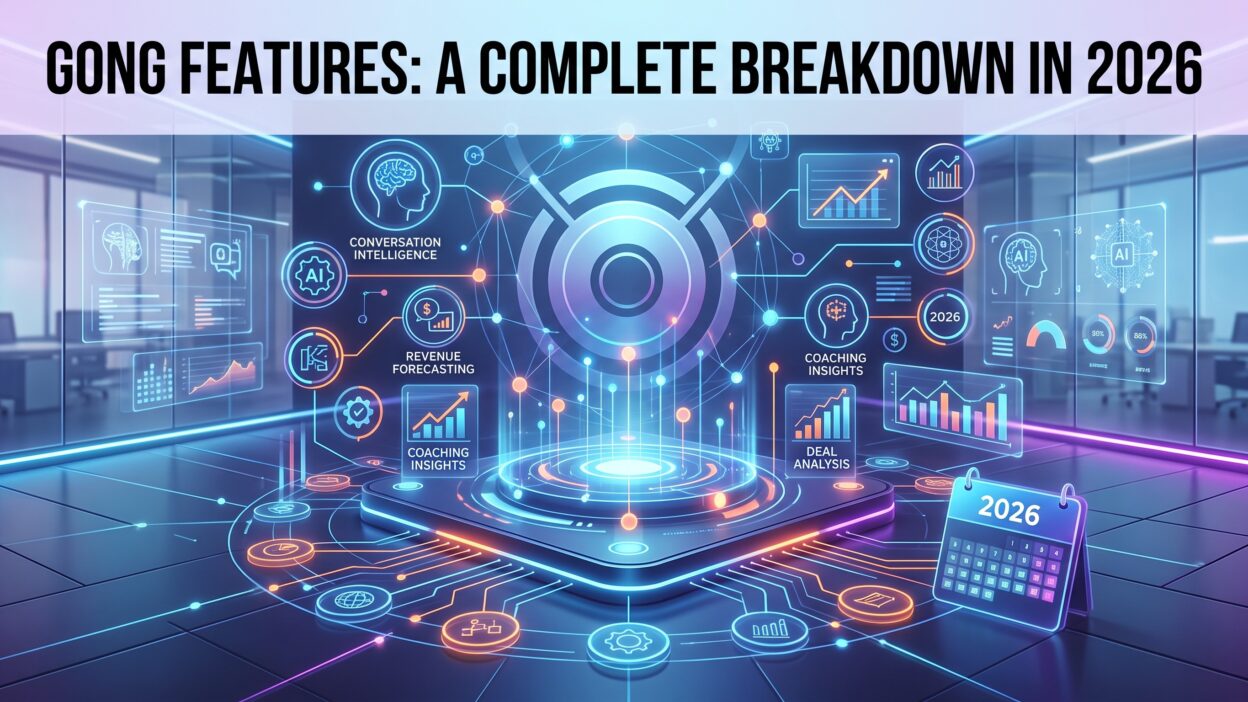
TL;DR Gong sits at the top of the revenue intelligence market in 2026. Sales teams use it to record calls, track deals, and coach reps at scale. This guide breaks down every major Gong feature in plain language. You get conversation intelligence, deal tracking, coaching tools, pricing context, and honest trade-offs. Read through before you sign a multi-year contract based on a sales demo alone.
Table of Contents
What Is Gong?
Gong is a revenue intelligence platform built for B2B sales teams. It captures every customer conversation your reps have, across calls, video meetings, and email. AI models trained on billions of real sales interactions turn that raw conversation data into structured insight.
The platform grew out of a simple idea. Sales managers cannot listen to every call their team runs. Gong listens instead, then surfaces patterns no human could track manually across hundreds of weekly conversations. Mid-market and enterprise sales organizations make up most of Gong’s customer base, especially teams selling complex, high-value deals.
Gong features work best once a team hits real scale. Vendors and independent reviewers both point to fifty or more reps as the sweet spot for justifying the cost. Smaller teams often look elsewhere, a point worth remembering as you read through every feature below.
Gong Features: Conversation Intelligence
Call Recording and Transcription
Gong records calls automatically once connected to your calling and video tools. Every recording turns into a searchable transcript within minutes. Speaker separation runs at roughly 85 to 90 percent accuracy across different accents and call qualities. In 2026, Gong sped up this processing significantly, cutting the wait time between a call ending and insights becoming ready by up to 70 percent.
Talk-Time Ratios and Sentiment Analysis
This Gong feature tracks how much a rep talks compared to a prospect during any given call. High talk-time ratios often signal a rep pitching too much instead of listening. Sentiment analysis layers on top, flagging shifts in tone across a conversation so managers spot frustration or genuine buying interest without replaying the full recording.
Topic and Keyword Tracking
Gong tags competitor mentions, objections, and buying signals automatically inside every transcript. Managers search across hundreds of calls for a single keyword and see every instance instantly. This tracking feature turns scattered conversations into a searchable library your whole revenue team can query at any time.
Conversation intelligence remains the strongest and most mature category among all Gong features. Independent reviewers consistently rank it as the reason most teams buy the platform in the first place, even when other modules see far less daily use.
Gong Features: Deal Intelligence and Forecasting
Deal Boards give managers a visual view of every open opportunity. Color-coded risk indicators show which deals need attention before a forecast call. Reps see exactly what steps move a stalled deal forward, based on patterns Gong pulls from past won and lost deals.
Forecasting sits inside this same feature set, though reviews stay mixed here. Some industry analysts rate Gong’s native forecasting relatively low compared to dedicated forecasting tools. A notable share of mid-market Gong customers stack a separate tool like Clari on top for forecasting they trust more heavily.
Deal scoring works by analyzing conversation patterns, email cadence, and stakeholder engagement across a deal’s full lifecycle. A deal with a single engaged stakeholder and long response gaps scores as high risk automatically. Reps get an early warning instead of discovering a stalled deal during a surprise quarter-end review.
This part of the Gong features lineup delivers real value for pipeline visibility, even though pure forecasting accuracy draws more criticism than the recording and transcription side of the platform.
Gong Features: Sales Coaching Tools
Coaching sits at the center of why many enablement teams choose Gong. Managers leave timestamped feedback directly on a call recording. Reps review that feedback next to the exact moment it applies to, rather than reading a vague note detached from context.
Gong’s AI also flags teachable moments automatically across a team’s calls. A rep who handles a tough objection well gets that clip surfaced for the whole team to study. A rep who struggles with a similar objection gets a targeted coaching nudge before their next similar call.
Call libraries let new hires study real, successful conversations during onboarding. This shortens ramp time significantly for teams that build a habit of reviewing top-performer calls regularly. Managers track individual rep trends over time, spotting a slow decline in call quality long before it shows up in a missed quota.
Among all Gong features built for people management rather than raw data, coaching earns some of the strongest praise from actual users. Teams that dedicate real time to reviewing flagged moments see the clearest return on this specific part of the platform.
Gong Features: CRM Integration
Gong connects natively to Salesforce, HubSpot, and several other major CRMs. Call activity, contact enrichment, and pipeline stage mapping all sync automatically once the integration runs correctly. Reps stop manually logging call notes inside two separate systems.
Full integration depth varies depending on which CRM your team runs and which Gong tier you purchase. Salesforce users generally get the deepest, most reliable sync. Smaller or less common CRMs sometimes need extra configuration work before data flows cleanly in both directions.
This integration layer matters because Gong’s real value comes from context, not isolated recordings. A call transcript means far more once it sits next to the actual deal stage, contact history, and account value inside your CRM. Among the more technical Gong features, CRM integration decides whether the rest of the platform actually fits into a rep’s daily workflow or sits ignored as a separate tool nobody opens.
Gong Features: Engage (Sales Engagement Module)
Engage handles sequencing and outreach cadences, positioning Gong against dedicated tools like Outreach and Salesloft. Reps build multi-step email and call sequences directly inside the platform.
Reviews for this specific module run notably weaker than the rest of Gong’s feature set. Verified user feedback points to missing task APIs and limited integration with parallel dialers. Teams expecting a full sequencing replacement for a dedicated engagement platform often end up disappointed.
Engage also forces a licensing quirk worth knowing before you buy. Every Engage seat requires a Foundations license for that same user, even if that rep only needs sequencing and never touches conversation intelligence. This bundling requirement raises the effective cost for SDR-heavy teams that only wanted the outreach piece.
Among all Gong features on this list, Engage draws the most consistent criticism. Teams considering this module should test it carefully during a trial period rather than assuming it matches the strength of Gong’s core conversation intelligence.
Gong Features: Forecast Module
Gong Forecast layers pipeline analytics, deal scoring, and signal-driven risk flags on top of the core platform. It pulls conversation data, email cadence, and stakeholder engagement into a single deal health score.
Industry analysts have rated this module lower than Gong’s flagship conversation intelligence features, and adoption numbers back that up. A meaningful share of mid-market customers pay for Clari separately rather than trusting Gong’s native forecast alone.
This gap matters for budgeting. Teams sometimes assume Forecast comes as a natural extension of strong conversation data, only to find the actual forecasting logic less reliable than expected. Among the weaker Gong features, Forecast still adds some value for pipeline visibility, just not enough to fully replace a dedicated forecasting tool for teams with complex, multi-stage deals.
Gong Features: Data Cloud and Reporting
Data Cloud pushes Gong-enriched conversation data into external data warehouses. This feature exists mainly because Gong’s standard API lacks robust bulk export options on its own.
RevOps teams building custom dashboards outside Gong rely on this module to pull raw data into tools like Snowflake or BigQuery. Reporting inside the native Gong dashboard covers standard metrics well, including talk ratios, deal risk, and rep activity trends over time.
Larger organizations with dedicated data teams get the most value from Data Cloud. Smaller teams without a data engineering function rarely touch this feature at all. It remains one of the more specialized Gong features, built for a narrow but real need among enterprise buyers running custom analytics stacks.
Gong Features: AI Capabilities in 2026
AI sits underneath nearly every Gong feature covered so far. Speech recognition and natural language processing models power transcription, sentiment detection, and topic tagging across every recorded call. Gong trained these models on billions of real sales conversations, giving the platform a real data advantage over smaller, general-purpose transcription tools.
2026 brought faster processing as the headline AI upgrade. Call insights now become available up to 70 percent quicker than in prior years, addressing a long-standing complaint about delays between a call ending and coaching feedback becoming ready. Detected objections, competitor mentions, and buying signals surface automatically without a manager reviewing a full transcript by hand.
Sentiment and emotion tracking round out the AI layer, flagging tone shifts a manager might miss during a quick skim of call notes. Together, these AI-driven Gong features form the technical backbone that separates the platform from simpler call-recording tools. The AI works best on English-language, voice-heavy sales calls, and accuracy dips somewhat on calls with heavy accents or significant background noise.
Gong Pricing and What It Means for Feature Access
Gong does not publish pricing publicly. Every deal runs through a custom sales process, and the final number often surprises buyers who expected a simpler per-seat rate. Foundation, the core conversation intelligence tier, typically costs $1,300 to $1,600 per user annually. Bundled packages with additional modules run closer to $2,880 to $3,000 per user annually.
A mandatory platform fee sits on top of per-seat pricing, commonly ranging from $5,000 to $50,000 a year depending on team size and negotiated terms. Implementation charges add another $7,500 to $65,000 in many deals. A twenty-person team often pays $40,000 to $60,000 in year one once every fee gets added together. A fifty-person team frequently pays $85,000 to $130,000 or more.
This pricing structure directly shapes which Gong features your team actually accesses. Engage requires a separate license stacked on top of Foundations for every user. Forecast and Data Cloud often sit behind additional add-on pricing beyond the core package. Buyers frequently discover mid-negotiation that the demo they saw included modules costing far more than the base quote suggested.
Negotiation timing genuinely affects the final price. Deals closed near quarter-end or year-end commonly land 10 to 20 percent lower than an initial quote, since Gong’s sales team works against internal quota pressure during those windows.
Who Should Use Gong Features
Gong fits mid-market and enterprise sales organizations with complex, high-value deals best. A team of fifty or more reps, backed by a dedicated RevOps or enablement function, justifies the cost far more easily than a small team ever could.
Teams selling long sales cycles with multiple stakeholders benefit the most from deal intelligence and coaching features working together. A rep juggling a six-month enterprise deal gains real value from Deal Boards flagging risk before a forecast call goes wrong.
Small teams selling lower-ticket deals rarely see the math work out. A ten-person team closing $20,000 deals often feels the platform fee and per-seat cost long before any measurable return shows up. Lighter alternatives usually serve that segment better, since much of Gong’s broader feature set sits unused without a dedicated team driving adoption. Matching your team size and deal complexity to Gong’s actual strengths matters more than the feature list alone when you decide whether to buy.
Gong Features: Pros and Cons
Gong delivers best-in-class call recording, transcription, and coaching tools that few competitors match at the same depth. Conversation intelligence surfaces real, actionable patterns across hundreds of calls without a manager reviewing each one manually. Deal Boards give genuine visibility into pipeline risk that many teams previously tracked through gut feeling alone.
Pricing opacity creates real friction for buyers trying to budget accurately before a full sales cycle. Mandatory platform fees and implementation charges push real costs well beyond the advertised per-seat number. Engage draws consistent criticism as a weak sequencing tool bundled awkwardly with stronger core features. Interface complexity leaves many teams using only a fraction of the full platform, since onboarding a whole revenue org takes real time and dedicated internal support.
Weigh these trade-offs honestly against your team size and budget. The strongest Gong features earn their reputation fairly. The weaker modules, particularly Engage and native Forecasting, deserve real scrutiny during any trial period before your team commits to a multi-year contract.
Gong Features vs Alternatives
Chorus, now part of ZoomInfo, offers similar core conversation intelligence at a lower overall cost. Fireflies.ai and tl;dv cover call recording and AI summaries well, though neither matches Gong’s depth in deal intelligence or coaching workflows.
Sybill positions itself as a lighter alternative, covering conversation intelligence, CRM autofill, and coaching around $79 per user monthly, without Gong’s mandatory platform fees or long lock-in contracts. Avoma serves a similar budget-conscious segment, appealing to smaller teams that need core Gong features without enterprise pricing.
Clari remains the common pairing rather than a direct replacement, since many mid-market Gong customers already run Clari for forecasting they trust more than Gong’s native module. Teams choosing between these options should map their actual daily workflow against each platform’s real strengths, rather than comparing feature checklists alone.
Gong still leads on raw conversation intelligence maturity and enterprise-grade coaching depth. Buyers prioritizing budget predictability and simpler contracts often find one of these lighter alternatives covers eighty percent of what most teams actually use inside Gong’s much larger feature set.
FAQs
What are the core Gong features every plan includes?
Call recording, transcription, keyword tracking, deal insights, and basic analytics make up Gong’s entry-level Foundation tier. These core Gong features cover most of what smaller teams need for coaching and deal visibility without additional add-on modules.
Does Gong offer a free trial to test its features?
Gong typically runs a guided demo and proof-of-concept process rather than a self-serve free trial. Expect a full sales cycle before you get hands-on access to test features against your own real call data.
Which Gong feature gets the most criticism from users?
Engage, the sales engagement and sequencing module, draws the most consistent negative feedback. Verified reviews point to missing task APIs and weak integration with dialers compared to dedicated sequencing tools like Outreach or Salesloft.
Is Gong worth the price for a small sales team?
Usually not. Small teams selling lower-ticket deals often struggle to justify the platform fee and per-seat cost. Lighter, cheaper alternatives frequently deliver enough value for teams under fifty reps.
How accurate is Gong’s AI transcription feature?
Gong’s transcription runs at roughly 85 to 90 percent accuracy across different accents and call conditions. Processing speed improved significantly in 2026, with insights now ready up to 70 percent faster than before.
Do all Gong features require the same license tier?
No. Engage requires a separate license stacked on top of the base Foundations plan. Forecast and Data Cloud often sit behind additional pricing too, so confirm exactly which modules your quote actually includes before signing.
Read More:-How to Bridge First-Party and Third-Party Data in Your Cloud Data Warehouse
Conclusion

Gong earns its reputation through genuinely strong conversation intelligence and coaching tools. Call recording, transcription, and deal visibility work well enough to justify the investment for the right kind of team. Weaker modules like Engage and native Forecasting deserve a harder look before you assume every feature matches that same quality bar.
Pricing opacity remains the biggest practical hurdle. Budget for platform fees and implementation costs on top of the per-seat rate you see during early conversations with sales. Negotiate near quarter-end or year-end if timing allows, since discounts tend to run deeper during those windows.
Match your team size and deal complexity honestly against what Gong actually does well. Enterprise teams running complex, high-value sales cycles get real, measurable value from the full feature set. Smaller teams often find a lighter alternative covers most of what they need at a fraction of the cost. Whichever direction you choose, understanding every Gong feature in detail beats walking into a sales negotiation with only a polished demo to go on.