Introduction
TL;DR Big deals do not close by accident. A buyer who spends two million dollars wants proof, safety, and a clear plan. Your reps carry that weight on every call. They need a map.
A strong enterprise sales strategy gives them that map. It tells your team who to target, how to engage, and when to ask for the deal. It turns a long and messy process into a repeatable system.
Complex B2B selling asks more of you than a simple sale. You sell to many people. You wait many months. You face legal reviews, security checks, and budget fights.
Table of Contents
What Is an Enterprise Sales Strategy?
An enterprise sales strategy is a plan for winning large, high-value deals from big organizations. It covers target accounts, messaging, team roles, deal stages, and success measures. It guides every action from the first research task to the signed contract.
Enterprise deals look different from small deals. A small business owner may buy in a week. A large company may take a year. The price tag runs high. The risk runs higher. Many people must agree before anyone signs.
How It Differs From Small Business Selling
Small business selling moves fast. One person decides. The pitch stays short. Reps close dozens of deals each quarter.
Enterprise selling moves slowly. Reps close a handful of deals each year. Each deal needs research, planning, and patience. A single rep may work one account for six months before a contract appears.
What a Typical Enterprise Deal Looks Like
Picture a software company selling to a global bank. The deal size reaches seven figures. The buyer group includes IT, finance, security, legal, and operations. The contract needs custom terms. The rollout takes months.
Your rep must guide all those people. The rep must answer hard questions on pricing, risk, and integration. The plan behind that work is your approach to the account. A clear plan lets the rep act with confidence.
Where the B2B Sales Strategy Fits
Your broader B2B sales strategy covers every customer segment you serve. The enterprise piece zooms in on the largest accounts. It uses different tactics, longer timelines, and bigger teams. Treat it as its own system.
Why Complex B2B Selling Needs a Different Approach
Complex selling breaks the rules of simple selling. Reps who succeed in fast sales often struggle here. They push too hard and too soon. They talk to one contact and ignore the rest. Understanding the differences protects your pipeline.
Long Sales Cycles
The enterprise sales cycle often runs six to eighteen months. Each stage brings new reviewers and new questions. Momentum fades without steady effort. Reps must keep deals alive through quiet weeks. A clear plan for each stage keeps the deal moving.
Large Buying Committees
A buying committee holds six to ten people in most enterprise deals. Each member cares about different things. The CFO watches cost. The CTO watches risk. The end user watches daily use. One no from any member can stop the deal.
Reps must win the whole group. That job needs a map of every person and every concern.
Custom Solutions and Pricing
Large buyers rarely accept a standard package. They ask for custom features, special terms, and volume discounts. Your team needs rules for how far to bend. Without rules, reps give away margin and slow every deal.
Procurement, Legal, and Security Hurdles
Large companies run formal reviews. Procurement compares vendors. Legal rewrites contracts. Security teams test your product. Each review adds weeks. Smart reps start these reviews early and track them like deal stages.
Higher Stakes for the Buyer
The buyer risks a reputation on your product. A failed rollout hurts careers. Buyers want references, case studies, and proof of results. Trust matters more than price in most enterprise decisions.
Core Pillars of a Winning Enterprise Sales Strategy
Every strong enterprise sales strategy rests on a few pillars. Build each one with care. Weak pillars crack under the weight of a large deal.
Pillar One: A Sharp Ideal Customer Profile
You cannot chase every large company. Time runs short. Choose the accounts that fit best. Study your top customers. Look at industry, size, tech stack, and pain points. Find the traits they share.
Write those traits into an ideal customer profile. Score target accounts against it. Focus on the highest scores. A tight profile saves months of wasted effort.
Pillar Two: Account-Based Selling
Account-based selling treats each target company as a market of one. The team researches the account deeply. Marketing and sales build custom campaigns for it. Messages speak to the exact goals of that business.
This approach beats broad outreach in enterprise deals. Buyers feel seen. They respond to messages that mention their real challenges. Reps open doors faster when they show they did their homework.
Pillar Three: Multi-Threading
Multi-threading means building relationships with many people inside one account. A rep who knows only one contact takes a big risk. That contact may leave the company. That contact may lose a budget fight.
Aim for a connection with every major role on the buying committee. Bring in your own executives when the deal grows large. Peer-level talks between leaders build trust that a rep cannot build alone.
Pillar Four: Value-Based Selling
Value-based selling focuses on business results. Buyers do not want features. They want lower costs, higher revenue, or reduced risk. Show the numbers.
Ask the buyer to name the cost of the problem. Build a model of the gain your product delivers. Put that model in writing. A strong business case gives your champion a tool to sell internally.
Pillar Five: Consultative Conversations
Enterprise buyers expect an expert partner. They do not want a script reader. Ask sharp questions. Listen closely. Share insights from similar customers. Offer ideas the buyer has not heard before.
Consultative selling builds credibility. The buyer sees you as an advisor and not a vendor. That shift moves you from the bid list to the trusted list.
Pillar Six: Executive Alignment
Large deals need executive sponsors on both sides. Find a senior leader at the buyer who owns the problem. Give that leader a clear path to a decision. Pair that leader with one of your executives.
Executive talks cut through red tape. They also speed approvals when a deal stalls.
How to Build Your Enterprise Sales Strategy Step by Step
A plan on paper means little without action. Follow a clear sequence. Each step feeds the one that follows. Treat this section as a working blueprint.
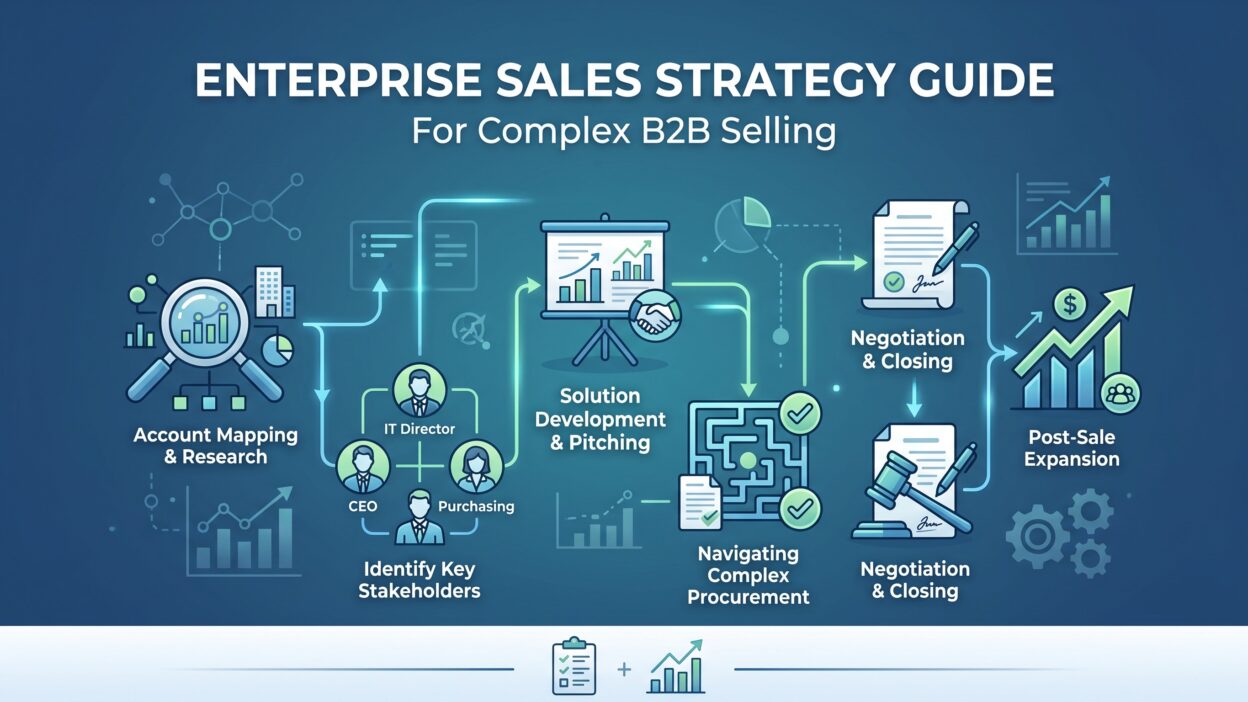
Step One: Research the Market and the Account
Start with the market. Learn which industries face the biggest pain around your product. Read analyst reports, earnings calls, and news. Pick a short list of target accounts.
Dig deeper on each account. Study the company goals for the year. Read the annual report. Find recent leadership changes. Look at the tools the team already uses. Your notes become the base for every message.
Step Two: Map the Buying Committee
List every person who may touch the decision. Note each title, each role, and each likely concern. Mark who supports you, who opposes you, and who sits on the fence.
Update the map after every call. Share it with your whole deal team. A live map shows gaps fast. A gap in the map signals a gap in the deal.
Step Three: Find and Grow a Champion
A champion is an insider who wants your solution to win. The champion knows the politics and the process. Look for someone with influence and a personal stake in the result.
Equip the champion with tools. Give them a short deck, a one-page summary, and a business case. Coach them on how to answer objections in meetings you cannot attend.
Step Four: Build the Business Case
Work with your champion to define the problem in dollars. Gather data on current costs. Model the improvement your product brings. Include a realistic timeline for payback.
Test the case with finance. A case that finance trusts carries real weight. A case that finance rejects dies in committee.
Step Five: Run a Proof of Value
Many enterprise buyers want a trial before a big commitment. A proof of value gives them evidence. Set clear goals before the trial starts. Agree on what success looks like in writing.
Keep the scope tight. A trial that drags on loses energy. Report results in plain numbers at the end.
Step Six: Navigate Procurement and Legal
Start these talks early. Ask your champion to explain the buyer process. Learn the steps, the owners, and the timelines. Send standard contract terms and security documents in advance.
Expect negotiation on price and terms. Know your walk-away points before the first call. Give your reps a clear approval path for discounts.
Step Seven: Close With a Mutual Action Plan
A mutual action plan lists every step from now to signature. It names owners and dates for both sides. Build it with your champion and share it often.
The plan keeps both teams accountable. It also exposes risk early. A missed date signals trouble before the deal slips a quarter.
Step Eight: Hand Off to Customer Success
The sale does not end at signature. Introduce the customer success team before the contract closes. Share every note from the sales cycle. Smooth handoffs protect renewals and open the door to expansion.
Structuring Your Enterprise Sales Team
Your enterprise sales strategy shapes how you build your team. Complex deals need specialists. One person cannot do every job well.
Account Executives
Account executives own the deal. They lead the relationship, run the process, and negotiate terms. Hire people with experience in long cycles. Look for patience, curiosity, and strong business sense.
Sales Development Reps
Sales development reps open doors. They research accounts and reach out to the right contacts. They book the first meetings. Their work feeds the pipeline that executives depend on.
Solutions Engineers
Solutions engineers handle the technical side. They run demos, answer security questions, and design the solution. A great engineer earns trust from technical buyers quickly.
Sales Leaders and Executives
Sales managers coach reps and review deals. Senior executives join key meetings. They open doors at the top of the buyer organization.
Customer Success and Marketing Partners
Customer success teams prove the product works after the sale. Marketing teams build account-based campaigns and gather case studies. Both groups support the sales cycle. Treat them as part of the deal team.
Tools and Technology That Support the Process
Technology supports your enterprise sales strategy. It does not replace it. Choose tools that save time and reveal insight.
CRM Systems
A CRM stores every account, contact, and deal. Reps log activity there. Leaders use it to forecast revenue. Keep the data clean. Poor data leads to poor decisions.
Sales Enablement Platforms
Sales enablement tools give reps the right content at the right time. They hold decks, case studies, battlecards, and training. Reps find what they need in seconds. Managers see which content helps close deals.
Conversation Intelligence
Conversation intelligence software records and analyzes calls. It shows what top reps say in tough moments. Managers coach with real examples. The platform also flags risks such as missing stakeholders.
Account Intelligence and Intent Data
Intent data shows which accounts research topics tied to your product. Account intelligence tools reveal org charts, tech stacks, and news. Reps reach out at the right moment with the right message.
Collaboration and Deal Rooms
Digital deal rooms give buyers one place to find documents, plans, and updates. They make the mutual action plan visible. Buyers share the room with their own team. Your champion gains an easy way to sell internally.
Metrics That Prove Your Enterprise Sales Strategy Works
Numbers show what works. Track a small set of metrics. Review them every month.
Pipeline Coverage
Pipeline coverage compares open pipeline to your revenue target. Most enterprise teams want three to four times coverage. Low coverage warns of a missed quarter.
Win Rate
Win rate shows the share of deals you close. Track it by segment, rep, and deal size. A falling win rate points to a problem in qualification or messaging.
Average Deal Size
Average deal size tells you whether you reach the right buyers. A rising number shows growing trust and broader solutions. A falling number may signal too much discounting.
Sales Cycle Length
Measure the time from first meeting to signature. Long cycles cost money. Look for stages where deals sit too long. Fix those stages first.
Stakeholder Coverage
Count how many committee members each rep has engaged. Deals with wide coverage close more often. Make this number visible on every deal review.
Net Revenue Retention
Enterprise customers can grow for years. Net revenue retention measures renewals and expansion. High retention proves you sold the right fit and delivered value.
Common Mistakes to Avoid
Teams repeat the same errors. Learn them now and save yourself pain.
Many teams rely on a single contact. That contact leaves, and the deal dies. Build relationships across the buying committee from the start.
Many reps chase deals that never fit. They waste months on accounts with no budget or no urgency. Qualify hard. A fast no beats a slow no.
Many teams pitch features. Buyers tune out. Talk about outcomes and numbers.
Many leaders ignore procurement until the end. Surprises appear and the quarter slips. Plan for legal and security reviews from day one.
Many companies give reps too little support. Reps need content, tools, and executive help. Weak support weakens any enterprise sales strategy.
Many teams forget the handoff. A rough start with customer success damages trust. Treat onboarding as the final stage of the sale.
Frequently Asked Questions
What is an enterprise sales strategy?
It is a plan for winning large deals from big organizations. It covers targeting, messaging, team roles, deal stages, and metrics. It fits long cycles and many decision makers.
How long does an enterprise sales cycle take?
Most cycles run six to eighteen months. Deal size, industry, and buyer process change the timeline. Complex security or legal reviews add more time.
What is the best enterprise sales strategy for long deals?
Combine account-based selling, multi-threading, and value-based selling. Build a champion early. Use a mutual action plan to keep both sides on schedule. Strong executive alignment helps in every case.
How many people are in an enterprise buying committee?
Most committees hold six to ten people. Some hold more. Each member brings a different concern. Reps must address all of them.
How do you find a champion?
Look for someone who feels the pain daily and holds respect inside the company. Ask questions about goals and challenges. A champion often volunteers help after a few honest talks.
What skills do enterprise reps need?
Reps need patience, business sense, and strong listening skills. They must manage many people and long timelines. Comfort with numbers helps when building business cases.
Which tools matter most?
A clean CRM matters most. Sales enablement platforms, conversation intelligence, and intent data add power. Pick tools your team will actually use.
Read More:-OptinMonster Features: A Complete Breakdown in 2026
Conclusion

Complex deals reward teams that plan. Buyers want proof, trust, and a clear path to a decision. A thoughtful enterprise sales strategy gives them all three.
Start with a sharp ideal customer profile. Research each account in depth. Map the buying committee and build a champion. Tie your offer to business results. Run a clear process from first call to handoff.
Support your reps with the right team, tools, and metrics. Avoid the common traps. Review your numbers each month and adjust.