Introduction
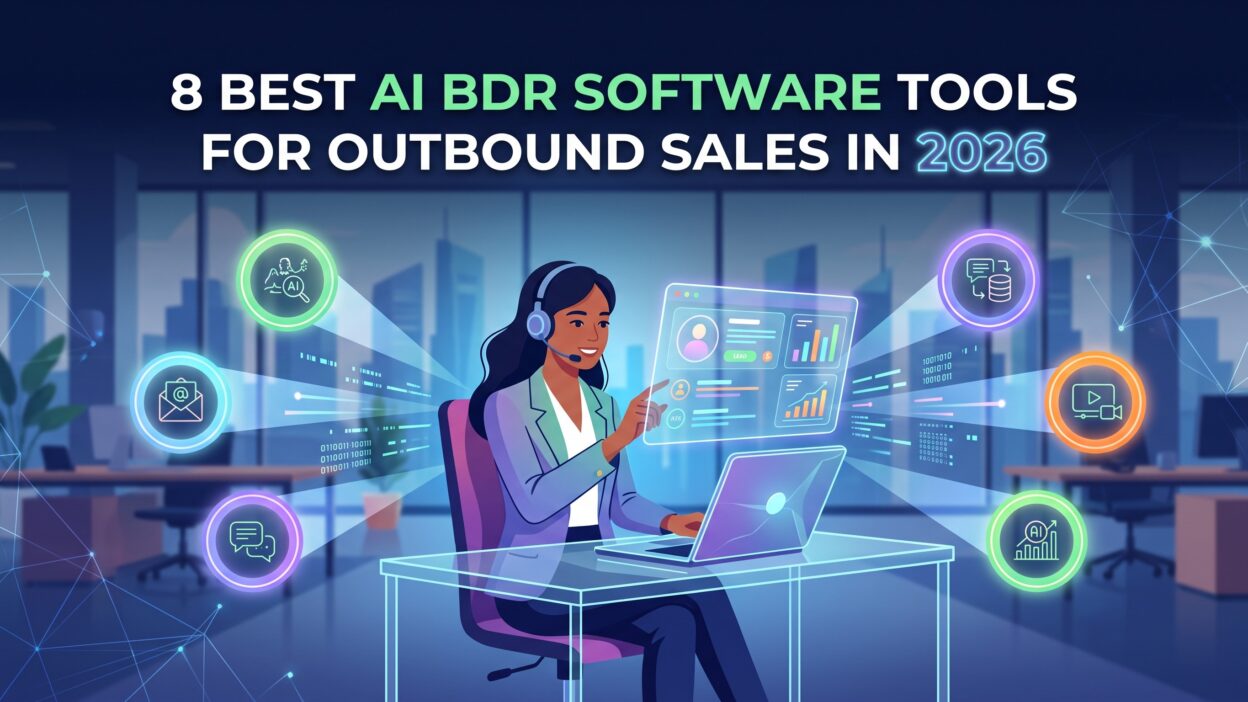
TL;DR Outbound sales looks nothing like it did five years ago. Reps used to spend most of their day on manual research and cold list building. The best AI BDR software tools now handle that work
Teams considering Artisan should plan for a real onboarding period. Feeding Ava a clear ideal customer profile and detailed messaging guidelines upfront makes a noticeable difference in output quality during the first few weeks of use. automatically, freeing reps to focus on actual conversations. This guide walks through the top platforms worth your attention this year.
Picking the right platform matters more than ever. <cite index=”1-1″>The AI BDR market is projected to reach $15 billion by 2030</antml:cite>, and new entrants launch every month. Not every tool delivers on its promises. Marketing pages tend to overstate autonomy and understate the setup work required. <cite index=”1-1″>While most sales teams now use some form of AI automation, only a fraction report hitting their expected return on investment</antml:cite>. This guide breaks down the best AI BDR software tools by actual use case, not just marketing claims. Instead of ranking by hype or funding round size, this guide focuses on what each platform actually does well and where it falls short.
Table of Contents
What Makes a Great AI BDR Software Tool?
Before ranking anything, it helps to define what separates a strong platform from a weak one. The best AI BDR software tools share a few common traits, and skipping this checklist leads to wasted budget.
Prospect Data Quality
A tool can write beautiful emails, but bad contact data ruins everything downstream. The best AI BDR software tools either include a verified contact database or integrate cleanly with one. Bounced emails hurt your domain reputation fast, and a damaged domain takes weeks to repair.
Personalization Depth
Generic AI copy gets ignored just as fast as a template email. Strong platforms pull real signals, like a recent funding round or a job change, into each message. <cite index=”5-1″>Signal-based outreach typically achieves response rates between five and fifteen percent, compared to just one or two percent for generic cold outbound</antml:cite>.
Multichannel Coverage
Email alone rarely closes the gap anymore. The best AI BDR software tools reach prospects across email, LinkedIn, and sometimes phone, all within a single coordinated sequence. This layered approach catches prospects wherever they actually pay attention.
Transparent Pricing and Realistic ROI
Vague enterprise pricing hides real cost until you’re already locked in. Look for platforms that show clear per-seat or per-credit pricing upfront, so you can calculate cost per meeting booked before committing budget.
CRM and Workflow Integration
A tool that lives outside your CRM creates extra manual work, not less. The best AI BDR software tools sync activity, replies, and contact updates directly into Salesforce or HubSpot without requiring a rep to copy anything by hand. This keeps your pipeline data accurate without adding a second system for reps to check every day. Ask any vendor for a live integration demo before signing, since marketing pages often overstate how deep a sync actually goes.
1. Artisan (Ava)
Artisan positions its product differently than most competitors on this list. Instead of calling Ava a feature, the company calls her a digital worker built to handle most of the outbound sales development process on her own.
Key Features
<cite index=”10-1″>Ava sources prospects from a database covering more than 300 million B2B contacts across 200-plus countries, then enriches each one with firmographic, technographic, and intent data</antml:cite>. <cite index=”10-1″>Artisan calls its personalization system a “Personalization Waterfall,” layering data points from social media, company websites, and funding news to write emails that feel specific to each recipient</antml:cite>. Ava also runs outreach across email and LinkedIn within the same workflow, so teams skip juggling a separate social selling tool.
Pricing and Best Fit
<cite index=”4-1″>Paid plans start around $3,000 per year</antml:cite>, with custom enterprise pricing above that tier. Artisan works best for teams ready to hand over most of the outbound motion to an autonomous agent, rather than teams looking for a lightweight copilot.
Suggested word count for this section: 350-400 words
2. 11x (Alice)
11x sits at the far end of the automation spectrum among the best AI BDR software tools available right now. Its AI agent, Alice, aims to replace human SDR capacity rather than simply assist a rep who’s already doing the work.
Key Features
Alice handles prospecting, outreach writing, and sequencing with minimal human input required day to day. The platform positions itself as a full-replacement option, appealing to companies scaling outbound without scaling headcount at the same pace.
Pricing and Best Fit
<cite index=”6-1″>Pricing runs on the higher end of the market, reportedly reaching $15,000 or more per month for full deployment</antml:cite>. This makes 11x a fit mainly for larger sales organizations with the budget to test an aggressive, mostly autonomous approach. Companies switching from a fully human SDR team often start with 11x as a pilot on one segment before expanding coverage further.
3. Apollo
Apollo remains one of the most widely adopted names among the best AI BDR software tools, largely because it combines a massive contact database with sequencing and dialing in one platform.
Key Features
<cite index=”1-1″>Apollo’s database covers more than 275 million contacts, paired with email sequences, LinkedIn outreach, and a built-in dialer</antml:cite>. <cite index=”1-1″>The platform’s AI features improved significantly this year, adding AI-written emails and smarter sequence suggestions</antml:cite>. Apollo works well for startups that need prospecting, data, and outreach without stitching together three separate tools.
Pricing and Best Fit
<cite index=”1-1″>Plans start around $49 per user per month</antml:cite>, making Apollo one of the more accessible entries on this list. Teams wanting an all-in-one starting point, rather than a specialized point solution, tend to land here first. Apollo also rolled out deeper AI research features this year, closing some of the gap with dedicated signal-based platforms.
4. Clay
Clay doesn’t fit neatly into a single category, but it earns its place among the best AI BDR software tools because of how much it strengthens every other tool on this list. It functions as a data enrichment and orchestration layer rather than a standalone sender.
Key Features
<cite index=”2-1″>Clay’s waterfall enrichment pulls from more than 75 data providers to build complete prospect profiles, while its Claygent AI researches companies and generates personalization details automatically</antml:cite>. Once enriched, that data flows into whichever outreach tool your team already uses, whether that’s Instantly, Outreach, or Salesloft.
Pricing and Best Fit
<cite index=”2-1″>Plans start at $185 a month, with a growth tier around $495 a month</antml:cite>. Clay fits RevOps teams building a more sophisticated stack, especially ones frustrated by generic, low-quality personalization coming out of other tools. Teams often pair Clay with a separate sender, since Clay itself focuses purely on the data and research layer rather than delivery.
5. Autobound AI
Autobound built its reputation around signal-driven personalization, which places it among the best AI BDR software tools for teams whose biggest gap sits in research and message relevance rather than raw sending volume.
Key Features
<cite index=”2-1″>Autobound expanded its signal categories to more than 35, pulling from sources like SEC Form D funding filings, federal contracts, Product Hunt launches, podcasts, Hacker News mentions, and conference activity</antml:cite>. This signal depth helps reps reference something genuinely current instead of a generic opening line.
Pricing and Best Fit
Autobound suits teams that already have decent sending infrastructure but struggle to make each message feel relevant. If weak personalization is your main bottleneck, this platform addresses that gap directly. Reps using Autobound often report spending less time hunting for a relevant opening line, since the signal data arrives pre-packaged inside each contact record.
6. Outreach
Outreach has served as sales engagement infrastructure for years, and its AI layer now makes it a reasonable entry among the best AI BDR software tools for teams with an already mature outbound motion.
Key Features
Outreach AI adds sequence recommendations, reply sentiment detection, and deal risk signals on top of its established sequencing and cadence engine. Teams already running complex, multi-step outbound campaigns benefit most from these additions, since the AI layer builds on infrastructure they already trust.
Pricing and Best Fit
Outreach runs on custom enterprise pricing, which usually favors larger sales organizations over early-stage startups. Teams that already invested in Outreach for sequencing get the most value by layering AI on top rather than switching platforms entirely. Outreach also integrates tightly with most major CRMs, which matters for RevOps teams tracking pipeline attribution closely.
7. Salesloft
Salesloft competes closely with Outreach and earns its spot among the best AI BDR software tools for similar reasons. It isn’t an AI-first product, but its AI features run deep enough that large sales organizations use it as their core BDR backbone.
Key Features
<cite index=”1-1″>Salesloft’s sequence and cadence builder ranks among the most mature on the market, giving teams fine control over multi-step, multichannel campaigns</antml:cite>. Its AI additions focus on suggesting next steps, flagging at-risk deals, and helping reps prioritize which accounts to touch first.
Pricing and Best Fit
<cite index=”1-1″>Custom enterprise pricing applies here too, with industry estimates landing around $100 to $150 per user per month</antml:cite>. Salesloft fits teams that already run a disciplined, structured outbound process and want AI layered carefully on top of it. Reps familiar with Salesloft’s existing workflow tend to adopt the new AI features faster than teams switching platforms from scratch.
8. Sybill
Sybill rounds out this list of the best AI BDR software tools by focusing on a different part of the funnel entirely. Instead of prospecting or first-touch outreach, Sybill handles what happens after a call ends.
Key Features
Sybill listens to sales calls and automatically generates summaries, updates CRM fields, and drafts follow-up emails based on what actually got discussed. This closes a gap many outbound tools ignore completely, since post-call admin work eats up hours that reps could spend on the next conversation.
Pricing and Best Fit
Sybill works best paired with a prospecting-focused tool from earlier on this list. Teams whose reps struggle with CRM hygiene and slow follow-up after calls see the clearest benefit here. Managers also use Sybill’s call summaries for faster deal reviews, since they no longer need to relisten to a full recording to catch key details.
How to Choose Between These Tools
With eight strong options on the table, narrowing down the best AI BDR software tools for your specific team comes down to a few practical questions.
What’s Your Actual Bottleneck?
If your reps struggle to find the right contacts, prioritize a strong database like Apollo or a data layer like Clay. If your team reaches the right people but gets ignored, personalization tools like Autobound or Artisan address that gap more directly. If your reps waste hours on admin after calls, Sybill solves a completely different problem.
What’s Your Team’s Appetite for Autonomy?
Some teams want AI to run most of the outbound motion with light oversight, which points toward Artisan or 11x. Other teams want AI as a copilot supporting reps who still drive the process, which points toward Outreach, Salesloft, or Apollo.
What Does Your Budget Actually Support?### How Fast Do You Need Results?
Autonomous platforms like Artisan and 11x need a real ramp period before hitting full stride, often several weeks. Lighter tools like Apollo or Clay can start producing usable output within days, which matters if leadership expects quick pipeline movement.
What Does Your Budget Actually Support?
Costs across the best AI BDR software tools vary wildly, from roughly fifty dollars a month per seat up to five figures monthly for full autonomous platforms. Factor in add-on costs too, like separate email infrastructure or data enrichment credits, since these often add several hundred dollars a month on top of the base subscription. <cite index=”6-1″>Budget around $300 to $500 per booked meeting as a realistic benchmark</antml:cite> when comparing total cost against expected pipeline output.
Common Mistakes When Adopting AI BDR Tools
Even the best AI BDR software tools fail when teams skip a few basic steps during rollout.
Buying a tool before fixing data quality wastes money fast. <cite index=”7-1″>Without accurate input data, AI can only hallucinate, no matter how advanced the underlying model looks on paper</antml:cite>. Clean your contact sources and verify emails before layering any AI tool on top.
Expecting full replacement of human reps sets unrealistic goals from day one. <cite index=”9-1″>A human BDR still handles nuance, objections, and relationship building better than any AI platform available in 2026</antml:cite>. The best AI BDR software tools work as multipliers for a human team, not full substitutes for one.
Ignoring deliverability limits causes real damage. <cite index=”9-1″>Sending thousands of AI-written emails a week from a single domain without warming it up properly lands you in spam quickly</antml:cite>. Ramp sending volume gradually and monitor inbox placement closely during the first few weeks. Track spam placement across major providers like Gmail and Outlook separately, since deliverability issues often hit one provider before spreading to others.
The ROI Case for AI BDR Tools
Leadership teams want numbers before approving new software spend, and the math behind the best AI BDR software tools holds up well against traditional hiring.
<cite index=”1-1″>A fully loaded human BDR costs between $75,000 and $95,000 a year and typically generates around $500,000 in qualified pipeline, landing at roughly a six-to-one return</antml:cite>. <cite index=”1-1″>An AI BDR tool running at a fraction of that cost can generate comparable pipeline for small and mid-market segments, pushing returns closer to thirty-three to one</antml:cite>. That gap doesn’t mean firing your existing team. <cite index=”1-1″>The strongest teams in 2026 run a hybrid model, where AI handles research and initial outreach while humans manage qualification calls and complex conversations</antml:cite>.
Frequently Asked Questions
What are the best AI BDR software tools for small teams?
Apollo and Clay work well for smaller teams due to accessible pricing and flexible setup. Both let you start small and scale spending as pipeline results justify the investment.
Can AI BDR tools fully replace human sales development reps?
No. The best AI BDR software tools handle repetitive top-of-funnel work like research and first-touch outreach. Live conversations, objection handling, and relationship building still need a human on the other end.
How much do AI BDR software tools typically cost?
Pricing spans a wide range. Entry-level platforms start around fifty dollars per seat monthly, while fully autonomous enterprise platforms can run into the thousands per month. Budget based on cost per booked meeting rather than sticker price alone.
Do these tools hurt email deliverability?
They can, if used carelessly. High-volume sending to unverified contacts damages domain reputation quickly. Verify your contact lists and warm up sending domains gradually to keep this risk low.
Which AI BDR tool works best for enterprise sales teams?
Outreach and Salesloft fit enterprise teams already running mature, structured outbound motions. Their AI layers build on sequencing infrastructure these teams already trust and use daily.
How long does it take to see results from AI BDR software?
Most teams need several weeks for proper domain warmup and data cleanup before campaigns hit full stride. Expect meaningful pipeline results within one to two months of a careful, well-planned rollout.
Read More:-HubSpot MCP: What It Is and How It Works
Conclusion

The best AI BDR software tools in 2026 cover very different jobs across the outbound funnel. Artisan and 11x push toward full autonomy. Apollo and Clay strengthen your data foundation. Autobound sharpens personalization. Outreach and Salesloft support teams with a mature, established motion. Sybill closes the loop after every call ends.
No single platform solves every problem on this list. The right choice depends on your actual bottleneck, not whichever tool has the loudest marketing. Start by identifying where your outbound process breaks down today, then match that gap to the platform built to solve it.
Budget matters just as much as features. Calculate cost per booked meeting before signing a contract, and resist the temptation to buy the most expensive, fully autonomous option just because it promises the most. The best AI BDR software tools earn their price through real pipeline results, not flashy demos. A short trial period on one segment tells you more about real fit than any sales deck ever will. Test one platform thoroughly before expanding your stack further. Give it a full quarter before judging results, since domain warmup and data cleanup both take real time to show their full impact on booked meetings.