Introduction
TL;DR Apple changed the email marketing world in 2021. The Apple Email Privacy Rules hit marketers hard. Many brands lost their grip on open rate data overnight. The shift did not slow down. Apple kept expanding its Mail Privacy Protection features. Marketers still feel the ripple effects today.
This blog walks you through what actually happened. It covers what Apple Email Privacy Rules mean for your strategy. It also gives you real, actionable steps to adapt. Whether you run a small newsletter or a large email program, this guide applies to you.
Understanding the Apple Email Privacy Rules
Apple launched Mail Privacy Protection (MPP) with iOS 15 in September 2021. The feature changed how email pixels work. Before MPP, a tiny invisible image in each email tracked when someone opened it. Apple Email Privacy Rules blocked that tracking method entirely.
Here is what Apple did. It started pre-fetching email content on its own servers. This means Apple loads your email images before the user even opens the message. Your open tracking pixel fires on Apple’s server, not on the user’s device. The result? You see an open that may not be real.
The Apple Email Privacy Rules apply to anyone using the default Apple Mail app. That includes iPhones, iPads, and Macs. It does not affect Gmail or Outlook apps on Apple devices. Users get a prompt asking if they want to protect their mail activity. Most users say yes.
Who Is Affected by These Rules?
Apple Mail users make up a huge share of global email opens. Studies show Apple Mail holds roughly 50–55% of all email client market share. That number fluctuates, but it remains dominant. Any marketer sending to a broad consumer list will feel the Apple Email Privacy Rules impact.
B2B marketers face the issue too. Many professionals use iPhones. Many use Apple Mail on their Mac. The Apple Email Privacy Rules do not spare enterprise email programs. Everyone sending bulk email must reckon with this reality.
What Data Gets Hidden?
Open rates are the big casualty. Apple hides whether a user actually opened your email. It also masks the user’s IP address. That means you lose location data. You lose device data tied to opens. You cannot tell if someone opened from a phone or desktop. The Apple Email Privacy Rules strip away granular behavioral data.
Click data stays intact. Link clicks still register accurately. That is one silver lining. If a subscriber clicks a link inside your email, you still capture that event. Deliverability data also remains reliable. Bounces and unsubscribes still function correctly.
The Business Impact of Apple Email Privacy Rules on Email Marketing
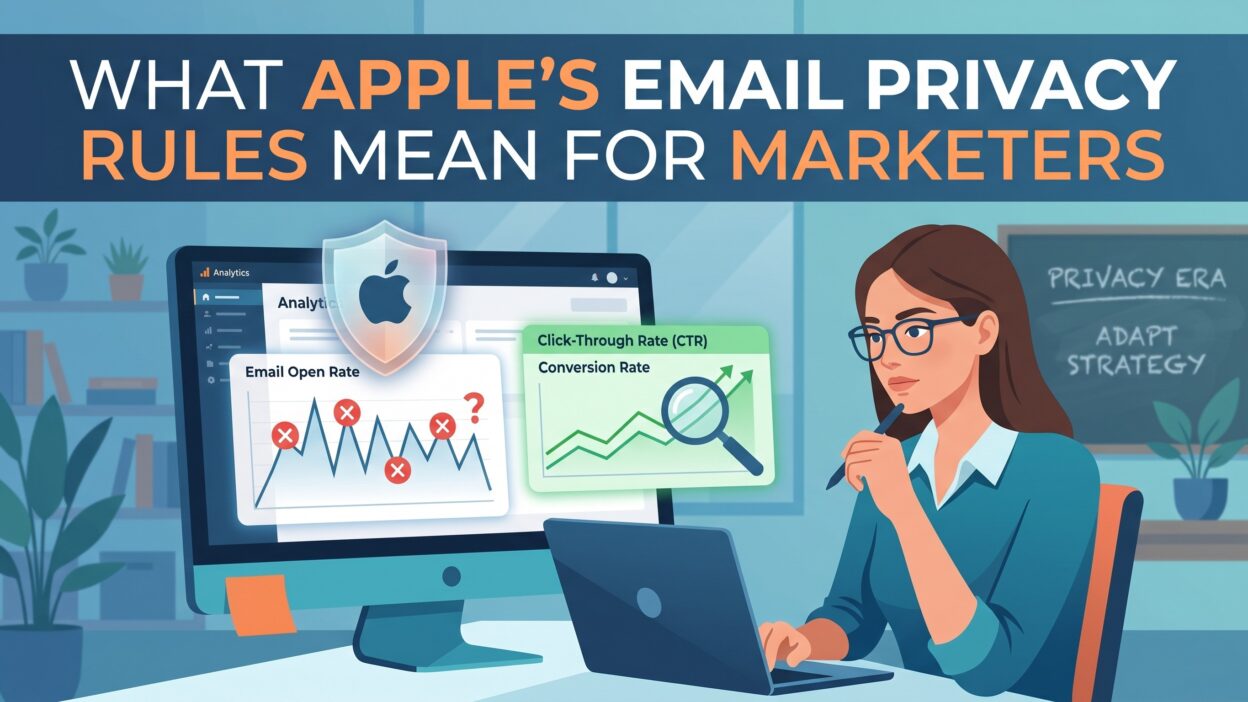
Open rate inflation is the most immediate problem. Apple pre-fetches emails. Your platform reports inflated opens. Some brands saw open rates jump from 20% to 60% overnight. That spike does not mean more people read your email. It means Apple loaded your tracking pixel. The Apple Email Privacy Rules created misleading performance data.
Engagement-based segmentation broke for many brands. Many email platforms let you segment subscribers by open behavior. You might send a win-back campaign to people who have not opened in 90 days. With Apple Email Privacy Rules in play, those people may appear active even when they are not.
Send-time optimization tools also suffered. These tools analyze when a subscriber opens emails. They then schedule future sends at that ideal time. Apple’s pre-fetching happens at random times. The open timestamp becomes unreliable. Send-time algorithms feed on bad data under the Apple Email Privacy Rules regime.
Revenue Attribution Challenges
Email revenue attribution relies on user behavior signals. Marketers use open data to judge which campaigns drove sales. That logic breaks under Apple Email Privacy Rules. A campaign might show a 70% open rate. But many of those opens are ghost opens from Apple’s server. Tying revenue to email performance becomes murky.
Click-to-revenue attribution remains the cleaner option. Focus on actual clicks that led to purchases. That chain of events still tracks properly. Smart marketers shifted their attribution models after Apple Email Privacy Rules launched.
Subscriber List Health Concerns
Inactive subscribers pollute your list. Normally, you would spot them by open inactivity. Apple Email Privacy Rules make that impossible for Apple Mail users. You might keep sending to a dead email address because it keeps appearing active. This hurts your sender reputation over time. High bounce rates and spam complaints damage deliverability.
Re-engagement campaigns need a new logic. Do not trigger re-engagement based on opens alone. Look at clicks. Look at purchase history. Look at website visits. Build a fuller behavioral picture outside the Apple ecosystem.
How Marketers Are Adapting to Apple Email Privacy Rules
Smart marketers did not panic. They adapted. The Apple Email Privacy Rules pushed the industry toward better practices. Overreliance on open rates was already a weak strategy. This change forced a healthier evolution.
Shifting Focus to Click-Through Rates and Conversions
Click-through rate (CTR) is now the primary engagement metric. CTR shows real intent. A subscriber who clicks is signaling interest. Open rates are noise. CTR is signal. Under the Apple Email Privacy Rules environment, CTR deserves top priority in your reporting dashboard.
Revenue per email is another powerful metric. Divide total email revenue by emails sent. This gives you a direct performance number. It does not depend on open tracking. It survives the Apple Email Privacy Rules disruption cleanly.
Using Zero-Party Data for Better Personalization
Zero-party data is information subscribers give you directly. Preference centers are a great tool here. Ask subscribers what topics interest them. Ask how often they want emails. Ask what products they care about. This data does not rely on tracking pixels. The Apple Email Privacy Rules cannot touch it.
Surveys and quizzes inside emails gather zero-party data well. A simple two-question survey can tell you a lot. Subscribers appreciate the direct ask. They feel respected when you use their stated preferences. Your personalization improves without needing hidden tracking.
Rebuilding Segmentation Without Open Data
Engagement scoring needs a rebuild for the Apple era. Use multiple signals. Factor in link clicks, website visits, purchase recency, and survey responses. Assign weight to each signal. Build a composite engagement score. This score works even when Apple Email Privacy Rules hide open data.
RFM modeling is another strong option. RFM stands for Recency, Frequency, and Monetary value. These three dimensions come from purchase behavior, not email opens. RFM works perfectly in a world shaped by Apple Email Privacy Rules. It helps you identify your best customers reliably.
Technical Adjustments Email Platforms Made After Apple Email Privacy Rules
Major email service providers (ESPs) moved fast to respond. Klaviyo, Mailchimp, HubSpot, and others added Apple MPP flags. These flags let you identify which opens likely came from Apple’s pre-fetch. You can then filter those opens out of your reporting.
Some platforms created a separate segment called MPP opens. You can see the split. You know how many opens are real versus Apple-generated. This transparency helps marketers make better decisions despite the Apple Email Privacy Rules environment.
New Deliverability Best Practices
Clean list hygiene matters more than ever. Remove hard bounces immediately. Suppress subscribers who show zero engagement across all channels. Do not rely on open activity to define engagement. The Apple Email Privacy Rules demand a multi-channel view.
Domain authentication must be solid. SPF, DKIM, and DMARC records protect your sender reputation. These technical foundations keep your emails landing in inboxes. They have nothing to do with Apple’s pixel blocking, but they matter enormously for deliverability in the post-Apple-MPP world.
Updating Automated Email Flows
Automation triggers based on opens need revisiting. A welcome series triggered by no open in 48 hours becomes unreliable. Apple Email Privacy Rules mean that open event may fire instantly from Apple’s server. Your trigger fires for the wrong reason.
Remap your automations to click-based triggers. Trigger a follow-up email when someone clicks a specific link. Trigger a cart abandonment flow based on website behavior, not email opens. This shift makes your automation more accurate and more resilient.
Apple Email Privacy Rules and the Broader Privacy Landscape
Apple did not act alone. The privacy movement is global. GDPR reshaped data collection in Europe. CCPA did the same in California. Apple Email Privacy Rules fit into this bigger pattern. Privacy is now a consumer expectation, not just a regulation.
Google announced changes to third-party cookies. These changes further restrict cross-site tracking. The ad tech world feels similar pressure. Email marketers face Apple Email Privacy Rules. Display advertisers face cookie deprecation. The direction is clear: tracking without consent is fading.
What This Means for First-Party Data Strategy
First-party data is your most valuable asset now. It lives in your CRM, your email list, your loyalty program. You own it. No platform can take it away. The Apple Email Privacy Rules accelerated the need to build strong first-party data systems.
Invest in data collection at every touchpoint. Your website, your checkout flow, your app, your store. Capture preferences explicitly. Build rich customer profiles from real interactions. This strategy does not depend on third-party tracking. It does not bow to Apple Email Privacy Rules limitations.
The Trust Dividend
Brands that respect privacy earn trust. Trust drives loyalty. Loyal customers buy more. They refer friends. They forgive mistakes. The Apple Email Privacy Rules may have taken your open data, but they gave you an opportunity. Show subscribers you respect their privacy. Make that a core part of your brand voice.
Privacy-forward messaging in your emails builds goodwill. Tell subscribers what data you collect. Tell them how you use it. Give them clear control. This transparency pays dividends that no open rate metric ever could.
FAQs About Apple Email Privacy Rules
Do Apple Email Privacy Rules Apply to All Email Clients?
No. The Apple Email Privacy Rules only apply to the default Apple Mail app. Gmail, Outlook, and other third-party email apps on Apple devices are not affected. Users who read your emails on Apple Mail with MPP enabled trigger the privacy protection. Users on other apps do not.
Can I Still Use Open Rates as a Metric?
Open rates still offer some value, but treat them with caution. Your absolute open rate number is inflated for any list with Apple Mail users. Use open rates as a directional trend, not a precise measure. Watch for large week-over-week changes rather than absolute percentages. Better yet, shift your primary KPIs to clicks and conversions.
Will Apple Expand These Privacy Rules Further?
Apple has shown a consistent pattern of strengthening user privacy across its ecosystem. It is reasonable to expect Apple Email Privacy Rules to expand or tighten further. Marketers should not build strategies that assume any rollback. Plan for a world where open tracking remains unreliable. Invest in channels and metrics that do not depend on Apple’s cooperation.
How Do I Identify Apple MPP Opens in My ESP?
Most major ESPs now flag MPP opens. In Klaviyo, you can filter by the machine open property. In HubSpot, look for the Apple Privacy filter in reporting. In Mailchimp, check for bot-filtered open data. Each platform handles it slightly differently. Check your ESP documentation for specifics. Filtering MPP opens gives you a cleaner read on actual engagement despite the Apple Email Privacy Rules impact.
Does Apple Email Privacy Affect SMS or Push Notifications?
No. Apple Email Privacy Rules specifically target email tracking through the Mail app. SMS marketing and push notifications operate through different channels. They use different tracking mechanisms. Apple’s MPP does not block SMS delivery reports or push notification open rates. Diversifying into SMS and push can help offset email data loss.
Read More:-What’s New: Brand Presence, WebSights, Enrich Premium+, Email Sync
Conclusion

The Apple Email Privacy Rules changed the rules of the game. That is not a bad thing. It forced marketers to grow up. Open rate obsession was never a solid foundation. Real engagement, real relationships, and real data always mattered more.
The brands winning today did not fight the Apple Email Privacy Rules. They adapted around them. They built better metrics. They gathered zero-party data. They created genuinely useful email experiences. They earned clicks because they earned trust.
Your email program can thrive in this environment. Focus on click rates, revenue per email, and direct subscriber feedback. Rebuild your segmentation on multi-channel signals. Invest in first-party data at every customer touchpoint. Make privacy a value, not a compliance checkbox.
The Apple Email Privacy Rules are here to stay. So is email marketing. The marketers who respect both will win. Start making those changes today. Your subscribers, and your results, will thank you.