Introduction
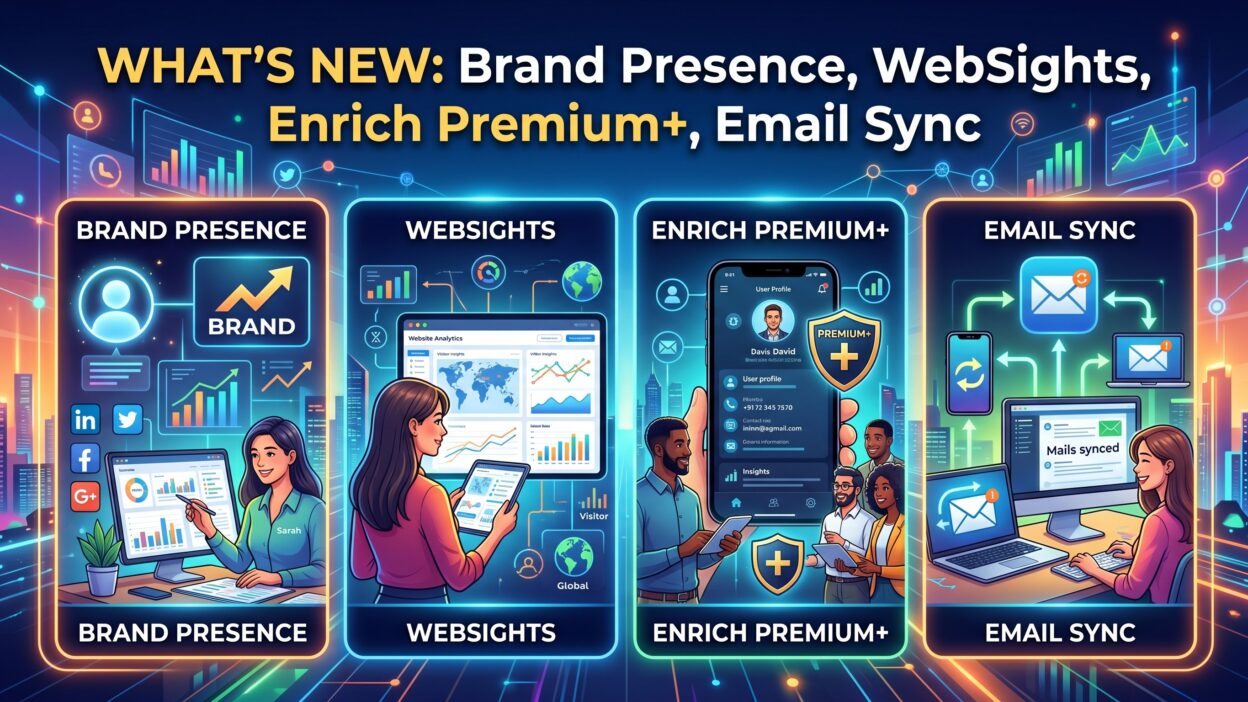
TL;DR Brand Presence has become the defining competitive advantage in modern B2B marketing. Every team wants to know how to show up in the right places at the right time. Four major product updates have just raised the bar significantly. Brand Presence tools, WebSights intelligence, Enrich Premium+, and Email Sync together form a complete system for understanding, reaching, and converting your ideal buyers. This blog walks through each update in detail. It explains what changed, why it matters, and how revenue teams can put each feature to immediate use. These updates work together. Understanding each one separately makes the combined impact much clearer.
Table of Contents
Brand Presence: The Flagship Update That Changes Everything
Brand Presence is the centerpiece of this product release. It gives B2B companies a structured way to measure, manage, and amplify how their brand appears across the channels that matter most to buyers. Before this update, brand visibility was largely anecdotal. Marketing teams relied on surveys, share of voice estimates, and social mentions to gauge their Brand Presence. Those methods gave partial pictures. This update delivers a data-driven view of Brand Presence that ties directly to pipeline performance.
The new Brand Presence dashboard centralizes brand performance metrics in one place. It shows how often your brand appears in relevant buyer searches. It tracks engagement rates across owned and earned media channels. It measures the quality of your Brand Presence by looking at what buyers do after encountering your brand. Do they visit your site? Do they read your content? Do they convert to a known lead? These signals were scattered across multiple tools. Brand Presence now unifies them.
Brand Presence scoring is a new feature within this update. Each account in your target list receives a score reflecting how much exposure they have had to your brand across digital touchpoints. A high Brand Presence score means a prospect has seen your ads, read your content, visited your website, and engaged with your social posts. A low score means they have had minimal contact with your brand. This scoring system helps sales and marketing teams prioritize outreach intelligently.
The ability to segment accounts by Brand Presence score changes how ABM programs operate. Marketing teams can direct budget toward accounts with low Brand Presence scores to build awareness. Sales teams can prioritize accounts with high Brand Presence scores for direct outreach because those buyers are already warm. This alignment between marketing spend and sales motion is a direct result of having clear Brand Presence data.
Brand Presence measurement now extends beyond your own channels. The update includes share of voice tracking within your specific competitive landscape. You can see how your Brand Presence compares to three or four key competitors across paid, organic, and social channels. This context turns Brand Presence from an internal vanity metric into a genuine competitive intelligence tool. Knowing where you lead and where you lag helps you allocate resources with precision.
The Brand Presence update integrates with downstream revenue data. You can now see whether accounts with high Brand Presence scores close faster, at higher deal values, or with shorter sales cycles than accounts with low scores. This attribution data builds the business case for brand investment. Marketing leaders have needed this proof for years. Brand Presence now delivers it.
WebSights: Turning Anonymous Website Traffic into Revenue Intelligence
WebSights has received a significant upgrade in this release. The core function of WebSights is identifying the companies behind anonymous website visits. Most B2B website visitors never fill out a form. They browse product pages, pricing sections, and case study libraries, then leave without identifying themselves. WebSights reveals which companies these visitors belong to. The new update makes this intelligence richer, faster, and more actionable than before.
The upgraded WebSights now provides session-level detail for each identified company visit. You can see which pages a company visited, in what order, and for how long. You can identify whether visitors focused on pricing, read competitive comparison content, or explored specific product feature pages. This behavioral context turns raw visitor data into genuine buying signal intelligence. A company that repeatedly visits your pricing page and reads three customer case studies in a single session is showing clear intent.
WebSights now connects directly to Brand Presence scoring. When a target account visits your website, that visit contributes to their Brand Presence score. The integration means that Brand Presence measurement now includes first-party website engagement data alongside third-party intent signals and paid media exposure. This creates a more complete and accurate picture of how deeply embedded your brand is with each target account.
The alert system within WebSights received a major upgrade. Sales reps can now set up real-time alerts for specific target accounts. When a high-priority account visits your site, the relevant sales rep gets an immediate notification. The notification includes which pages the visitor explored and how long they spent on each section. This timing intelligence allows sales reps to reach out while the buying intent is at its peak. Speed of response is one of the strongest predictors of B2B win rates.
WebSights now supports multi-contact mapping within identified accounts. When multiple individuals from the same company visit your website in a short timeframe, WebSights flags this as a buying committee signal. Multiple stakeholders researching your product simultaneously indicates active evaluation. This buying committee detection capability helps sales teams understand when an account is in active consideration mode versus casual browsing.
The WebSights update also improves match rate accuracy. Previous versions struggled with certain IP ranges and corporate VPN configurations. The new release includes an enhanced identification algorithm that improves match rates by a meaningful margin. More identified visitors mean more actionable data for both Brand Presence tracking and sales outreach prioritization. Data quality improvements at the foundation make every downstream insight more reliable.
Enrich Premium+: Next-Level Data Enrichment for Revenue Teams
What Enrich Premium+ Adds to Your Data Stack
Enrich Premium+ represents the most substantial upgrade to the data enrichment product line in several years. Standard enrichment fills in company firmographics and basic contact details. Enrich Premium+ goes several layers deeper. It adds technographic data showing which tools a company currently uses. It includes buying intent signals from across the web. It provides financial health indicators relevant to B2B purchasing decisions. This depth of data transforms how sales and marketing teams build their targeting models.
The technographic layer in Enrich Premium+ is particularly valuable for technology vendors. Knowing that a prospect currently uses a competitor’s product, an integration partner’s tool, or a legacy system helps sales reps craft highly relevant outreach. A rep who knows that a prospect runs Salesforce, uses HubSpot for marketing, and relies on a specific data warehouse can speak directly to their technology environment. This level of specificity dramatically improves cold outreach response rates. Combined with Brand Presence data, technographic enrichment creates hyper-targeted messaging opportunities.
Intent Data Integration Within Enrich Premium+
Enrich Premium+ now incorporates third-party intent data from a network of B2B content publishers and research platforms. When a company’s employees read articles about your product category, download reports related to your solution area, or search for comparisons between you and competitors, those signals flow into Enrich Premium+. This intent layer helps marketing teams identify accounts that are actively in research mode before those accounts ever contact your company.
The intent data within Enrich Premium+ works in concert with Brand Presence tracking. An account with high third-party intent scores but low Brand Presence scores represents a prime opportunity for brand awareness investment. That company is actively looking for solutions in your category but has not yet encountered your brand with enough frequency to build recognition. Directing targeted advertising spend toward these accounts closes the Brand Presence gap at exactly the right moment in the buyer journey.
Automated Enrichment Workflows
Enrich Premium+ introduces automated enrichment workflows that keep your CRM data fresh without manual effort. When a new account enters your CRM from any source, Enrich Premium+ automatically populates firmographic, technographic, and intent data within minutes. When existing records become stale, automated refresh cycles update the data based on configurable schedules. Clean, current data is the foundation of effective Brand Presence campaigns. Stale data leads to misdirected budget and irrelevant outreach. Enrich Premium+ eliminates data decay as a persistent operational problem.
Email Sync: Connecting Conversation Intelligence to Your Revenue Stack
Email Sync is the fourth major update in this release. It connects email activity data directly to account records, contact timelines, and Brand Presence scores within the platform. Before Email Sync, email interactions lived in isolation inside individual sales rep inboxes. Managers had limited visibility. Marketing teams could not see which email touchpoints preceded pipeline progression. Revenue operations lacked the full picture of account engagement. Email Sync solves all of these visibility gaps simultaneously.
Email Sync works by securely connecting to Google Workspace and Microsoft 365 environments. Once connected, it pulls email activity at the account and contact level without exposing private email content to unauthorized users. Sales managers can see that an account received five outreach emails over three weeks and responded to two. Marketing can see that content assets shared via email drove follow-up meetings. Revenue operations can correlate email engagement frequency with deal velocity. These insights were previously invisible without Email Sync.
The Brand Presence connection to Email Sync is direct and valuable. Email touchpoints now contribute to each account’s Brand Presence score alongside website visits, paid media impressions, and content engagement. This means Brand Presence scoring reflects the full spectrum of how a buyer has interacted with your company. An account that has received 12 emails, opened six, clicked three, and visited your website twice carries a materially different Brand Presence score than an account with no recorded touchpoints. This distinction drives smarter prioritization.
Email Sync includes deduplication logic that prevents double-counting engagement across multiple reps who may contact the same account. When two sales reps from the same team both email contacts at a target account, Email Sync aggregates those interactions at the account level while preserving individual attribution for performance reporting. Accurate aggregation prevents inflated engagement scores and keeps Brand Presence data honest.
Email Sync also supports reply detection and sentiment analysis. When a prospect replies to a sales email, the reply gets logged against the account record. Basic sentiment classification flags whether the reply was positive, negative, or neutral. This gives revenue leaders a qualitative layer on top of the quantitative email activity data. Accounts with positive reply sentiment but no scheduled meetings represent immediate follow-up opportunities for sales managers to flag and coach.
The Email Sync update includes privacy compliance controls built for global operations. GDPR compliance modes restrict data logging for European contacts based on configurable rules. CCPA compliance settings handle California-based contacts appropriately. Legal and compliance teams can audit the Email Sync configuration to confirm that data handling meets their organizational privacy standards. Compliance is built in, not bolted on.
How All Four Updates Work Together to Amplify Brand Presence
Each of these four updates delivers standalone value. The real power emerges when they operate as an integrated system. Brand Presence is the connective tissue that links WebSights, Enrich Premium+, and Email Sync into a unified revenue intelligence platform.
Consider a target account in your ICP. Enrich Premium+ fills in their firmographic and technographic profile and flags them as showing strong third-party intent for your product category. Their Brand Presence score starts low because they have had minimal contact with your brand. Marketing responds by activating a targeted display advertising campaign aimed at that company’s buying committee members.
Two weeks into the campaign, WebSights detects that three individuals from this company have visited your pricing page and one read two case studies. These visits raise the account’s Brand Presence score. Email Sync shows that a sales rep sent three emails to contacts at this account over the same period and received one positive reply. That reply contributes to the Brand Presence score as a direct engagement signal.
Within one month, the account’s Brand Presence score has moved from low to medium-high. The combined data from WebSights traffic, Enrich Premium+ intent signals, and Email Sync engagement tells a clear story. This account is aware of your brand, actively researching your product, and responding to sales outreach. The sales rep receives an alert recommending escalation to a more senior contact or a direct meeting request. The timing is based on data, not guesswork.
This integrated scenario reflects how modern revenue teams should operate. Isolated data in separate tools creates blind spots. Unified Brand Presence data across all touchpoints creates clarity. Marketing knows where to spend. Sales knows when to act. Revenue operations can model and forecast based on Brand Presence score progression. The four updates together make this vision operational, not theoretical.
Implementation Guide: Getting the Most From These Updates
Setting Up Brand Presence Scoring for Your ICP
Start by defining your ideal customer profile with precision. Brand Presence scoring is most valuable when it applies to a clearly defined target account list. Import your ICP accounts into the platform. Set your Brand Presence scoring weights based on which touchpoints matter most for your sales motion. If website visits are the strongest buying signal for your business, weight them accordingly. If content engagement drives more pipeline than paid ad exposure, reflect that in your scoring configuration. Customizable scoring weights ensure that Brand Presence data aligns with your specific revenue model.
Configuring WebSights Alerts for Sales Teams
Work with your sales leadership to define which accounts trigger real-time alerts. Not every website visit warrants an immediate notification. Set alert thresholds based on visit depth, page categories, and visit frequency. A prospect visiting your pricing page for the third time in two weeks should trigger an alert. A one-page visit to your blog homepage probably should not. Calibrated alert settings keep sales reps focused on the highest-intent signals without creating notification overload. Connect WebSights alerts to your CRM so that alert data flows directly into account activity timelines.
Activating Enrich Premium+ Automated Workflows
Map your CRM fields to Enrich Premium+ data categories before activating automated enrichment. Confirm field-level permissions with your CRM administrator. Test the enrichment workflow on a small batch of accounts before enabling it at full scale. Review the enriched records to confirm that data quality meets your standards. Schedule a recurring enrichment refresh at a cadence that matches your sales cycle length. For short sales cycles, monthly refreshes may be insufficient. For enterprise sales with 6-month cycles, quarterly refreshes may be adequate.
Rolling Out Email Sync Across Your Sales Organization
Email Sync adoption requires clear communication with your sales team about what data gets captured and how it gets used. Address privacy concerns directly and honestly. Explain that Email Sync logs activity data at the account level for performance reporting and Brand Presence scoring. It does not expose private email content to unauthorized users. Pilot Email Sync with a small group of reps first. Gather feedback on the data quality and alert relevance. Use pilot findings to refine your Email Sync configuration before full deployment. Change management drives adoption. Adoption drives data quality. Data quality drives Brand Presence accuracy.
Frequently Asked Questions About Brand Presence, WebSights, Enrich Premium+, and Email Sync
What exactly does Brand Presence measure and track?
Brand Presence measures how frequently and meaningfully target accounts encounter your brand across all digital touchpoints. It tracks paid media impressions, organic content engagement, website visits from WebSights, direct email interactions from Email Sync, and third-party intent signals from Enrich Premium+. Brand Presence scoring aggregates all these signals into a single account-level score. This score helps marketing and sales teams understand how aware a target account is of your brand and how ready they are for direct sales engagement.
How does WebSights identify anonymous website visitors?
WebSights uses IP-based company identification combined with a proprietary matching database that maps IP addresses to company records. When a visitor lands on your website, WebSights captures their IP address and matches it against this database to identify the company they belong to. The identification process does not expose individual user identities. It reveals the company behind the visit. Enhanced matching algorithms in the latest update improve accuracy for corporate IP ranges and common VPN configurations.
What data does Enrich Premium+ add that standard enrichment does not?
Standard enrichment provides firmographic data such as company size, industry, revenue range, and headquarters location. Enrich Premium+ adds technographic data showing current technology stack, third-party intent signals from publisher networks, financial health indicators relevant to purchasing decisions, and automated data refresh workflows. The combination of these additional data layers allows marketing teams to build much more precise targeting models and helps sales reps craft outreach that speaks directly to each prospect’s specific technology environment and current buying behavior.
Is Email Sync compliant with GDPR and CCPA regulations?
Yes. Email Sync includes built-in compliance controls for both GDPR and CCPA requirements. GDPR compliance modes restrict data capture and storage for contacts based in European Union countries based on configurable organizational policies. CCPA compliance settings handle California-based contacts according to current state privacy law requirements. Legal and compliance teams can audit the full Email Sync configuration through an administrative dashboard. The compliance controls are configurable to match organizational policies rather than applying a one-size-fits-all approach.
How does Email Sync contribute to Brand Presence scoring?
Email Sync logs email activity at the account and contact level and feeds that engagement data into Brand Presence scoring calculations. Every email sent to a target account contact, every reply received, and every positive sentiment response contributes to that account’s Brand Presence score. This means Brand Presence scoring reflects direct sales communication alongside marketing touchpoints. The result is a more complete and accurate representation of how deeply your brand has penetrated a specific target account across all engagement channels.
Strategic Impact: Why These Updates Matter for Revenue Growth
Product updates only matter if they drive business results. These four updates, centered on Brand Presence, are not features for features’ sake. They address real gaps that revenue teams face every day. Budget allocation without Brand Presence data is guesswork. Outreach timing without WebSights intelligence misses peak intent moments. Targeting without Enrich Premium+ depth produces irrelevant personalization. Pipeline tracking without Email Sync visibility leaves engagement data invisible to leaders who need it most.
The revenue impact of Brand Presence measurement is quantifiable. Organizations that use Brand Presence scoring to align marketing spend with sales outreach timing consistently see improvements in win rates, deal velocity, and average contract values. When buyers encounter a brand multiple times through multiple channels before a sales conversation starts, trust is already partially established. Sales cycles shorten when buyers arrive warm. Brand Presence data makes warmth measurable and actionable.
WebSights intelligence reduces the cost of sales development by prioritizing outreach toward accounts showing active buying behavior. Instead of spreading outreach evenly across a large account list, SDRs can focus on the accounts most likely to convert in the current period. This efficiency improvement reduces cost per opportunity and improves the quality of pipeline entering the sales funnel.
Enrich Premium+ reduces the research burden on sales reps. A rep who receives a fully enriched account record with technographic data, intent signals, and Brand Presence scoring can prepare for an outreach call in minutes instead of hours. Time saved on research is time reinvested in customer conversations. Customer conversations generate revenue. Research that machines can do should not occupy human selling time.
Email Sync gives revenue operations the visibility they need to coach effectively and forecast accurately. Manager visibility into email engagement patterns enables data-driven coaching conversations. Forecasting models that incorporate email engagement data alongside opportunity stage and Brand Presence scores produce more accurate revenue predictions. Accuracy in forecasting reduces business planning risk for leadership teams.
Read More:-Paid Search Bid Optimization: How to Maximize Your Budget
Conclusion

Brand Presence is no longer a soft marketing concept. It is a measurable, scoreable, and actionable revenue metric. This product release delivers the tools to make Brand Presence data central to every major revenue decision your organization makes.
WebSights tells you who is visiting your website and what they care about. Enrich Premium+ tells you who your ideal buyers are, what technology they use, and whether they are actively researching solutions. Email Sync tells you how your sales team’s direct communication contributes to account engagement. Brand Presence ties all three together into a unified picture of how deeply each target account knows and trusts your company.
The companies that win in B2B markets are not always the ones with the best products. They are the ones buyers think of first when a problem arises. They are the ones whose Brand Presence is so consistent and credible that they earn consideration before the sales process ever starts. These four updates give your team the data and tools to build that kind of Brand Presence deliberately and measurably.
Implement these features thoughtfully. Configure Brand Presence scoring to reflect your specific ICP and sales motion. Set up WebSights alerts that keep your sales team focused on high-intent signals. Activate Enrich Premium+ workflows to keep your CRM data fresh and deep. Roll out Email Sync with clear communication and strong change management. Do all four well and your revenue team will operate with a level of clarity and coordination that most competitors cannot match.
Brand Presence is the foundation. These updates are the tools. Your execution is what turns both into revenue.