Introduction
TL;DR Small business owners run this exact search every week. ActiveCampaign vs Ontraport comes up in nearly every marketing automation shortlist for 2026. Both platforms promise to replace a pile of separate tools with one dashboard. Both platforms charge real money for that promise.
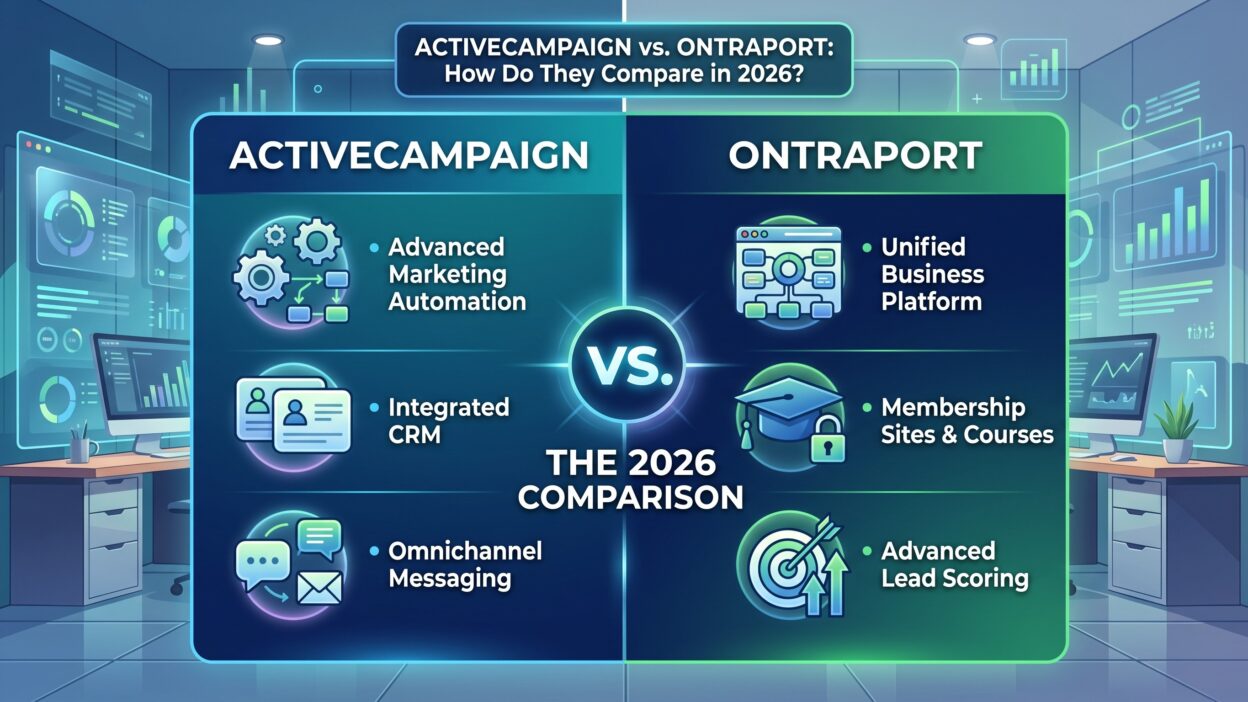
ActiveCampaign built its name on marketing automation and AI-driven email. Ontraport built its name on an all-in-one business system with native payments and a full CRM. The ActiveCampaign vs Ontraport decision comes down to what your business actually runs on today.
This guide breaks down every major category in the ActiveCampaign vs Ontraport comparison. You will see pricing, automation depth, CRM strength, payment tools and AI features side by side. We pulled data from G2, Capterra and current 2026 pricing pages to keep this accurate.
Read through each section and match the details against your own workflow. The right answer in the ActiveCampaign vs Ontraport debate depends on your business model, not on which tool has more five-star reviews.
Table of Contents
ActiveCampaign vs Ontraport: Quick Overview
ActiveCampaign positions itself as an AI-powered marketing automation platform. The company built its reputation on segmentation, email deliverability and a large integration marketplace. Small teams and mid-market companies make up most of its customer base, with over 14,000 reviews on G2 alone.
Ontraport takes a different path. The platform bundles marketing automation, a full CRM, native payment processing and a no-code CMS into one subscription. Business owners who refuse to juggle five separate tools often land here instead.
Both platforms hold a 4.5 out of 5 rating on G2 in 2026. That similar score hides real differences underneath. ActiveCampaign wins on integration depth and platform infrastructure. Ontraport wins on reporting, dashboards and native payment functionality.
The ActiveCampaign vs Ontraport choice often comes down to one question. Does your business need best-in-class email automation, or does it need one system that also handles subscriptions, affiliate tracking and membership content? That single question filters out most of the noise in this comparison.
Pricing structure adds another layer to the ActiveCampaign vs Ontraport decision. ActiveCampaign starts cheaper but climbs fast as your contact list grows. Ontraport starts higher but holds a flatter pricing curve as your list scales up over time.
Marketing Automation Compared
ActiveCampaign’s Automation Engine
ActiveCampaign built its core product around automation maps. Marketers drag conditions, goals and actions onto a visual canvas and build journeys triggered by real customer behavior. A single automation can branch based on email opens, site visits, purchase history or CRM deal stage.
Active Intelligence sits on top of this engine as an AI layer. The system builds full campaigns from a plain-language prompt, adjusts send times per subscriber and suggests audience segments a human might miss. This AI layer gives ActiveCampaign a real edge in the ActiveCampaign vs Ontraport comparison for teams that want automation built for them, not just by them.
The learning curve grows steep once you move past basic automations. New users build simple welcome sequences within a day. Complex, multi-branch journeys with CRM triggers take real practice to master.
Ontraport’s Automation Approach
Ontraport builds automation around its Campaign Builder, a visual tool similar in spirit to ActiveCampaign’s map. Triggers include form submissions, purchase events, tag changes and custom object updates tied to your CRM data.
Ontraport’s automation ties tightly into its native CRM objects. A campaign can update a deal stage, trigger a payment plan reminder or add a contact to a membership site automatically. This deep CRM connection separates Ontraport from platforms that treat automation and sales data as two disconnected systems.
Setup overhead runs lower relative to automation depth, according to real user feedback. Teams report a smoother ramp-up period compared to ActiveCampaign’s steeper learning curve for advanced workflows. This difference matters a lot for small teams without a dedicated marketing operations hire evaluating ActiveCampaign vs Ontraport side by side.
CRM and Sales Tools Compared
ActiveCampaign CRM
ActiveCampaign ships a built-in CRM designed as a marketing companion, not a standalone sales system. Sales reps get pipeline stages, deal tracking and task reminders tied directly to marketing automation data. This connection lets marketing and sales teams work from one shared contact record.
The CRM covers basic pipeline needs well. Teams running complex, multi-stage enterprise sales cycles often find the tool too light and pair ActiveCampaign with a dedicated CRM like HubSpot or Salesforce instead.
Ontraport CRM
Ontraport offers a full CRM with custom objects and flexible pipeline structures built into the core platform. Businesses selling coaching programs, courses or subscription services configure the CRM around their exact sales process, not a generic template.
This CRM depth gives Ontraport a real advantage in the ActiveCampaign vs Ontraport comparison for service-based businesses. Custom objects let a business track memberships, contracts or client onboarding stages without a third-party tool bolted on the side.
TrustRadius data backs this up directly. Ontraport scores 9.3 on reporting and analytics against ActiveCampaign’s 6.6 in the same category. Dashboards and custom reports score especially high for Ontraport among verified users.
Email, SMS and Channel Coverage
ActiveCampaign covers more channels out of the box. The platform sends email, SMS and WhatsApp messages natively, without a third-party connector. This channel breadth matters for brands running conversational marketing through WhatsApp alongside traditional email campaigns.
Deliverability stands out as one of ActiveCampaign’s strongest selling points. Ninety-three percent of surveyed customers rate ActiveCampaign’s deliverability better than competing platforms. Strong inbox placement directly affects revenue for any email-driven business, which makes this stat a real factor in the ActiveCampaign vs Ontraport decision.
Ontraport covers email and SMS as its two primary channels. WhatsApp support does not currently exist inside the native platform. Businesses that rely heavily on WhatsApp for customer communication should weigh this gap carefully before choosing between ActiveCampaign vs Ontraport.
Email editor quality flips the script slightly. Ontraport’s WYSIWYG editor scores 8.2 on TrustRadius against ActiveCampaign’s 5.5 in the same review data. Users building visually complex emails without code sometimes find Ontraport’s editor more intuitive day to day.
Landing page tools exist on both platforms, though Ontraport extends further into full websites and membership portals through its native CMS. ActiveCampaign keeps landing pages simpler and more focused on lead capture alone.
Payments, Ecommerce and Membership Sites
This category creates the clearest split in the ActiveCampaign vs Ontraport comparison. Ontraport processes payments natively inside the platform. Subscriptions, payment plans, failed-payment recovery and affiliate tracking all run without a separate tool.
A coaching business or course creator gains real value from this setup. One dashboard handles the marketing email, the sales pipeline, the payment collection and the affiliate commission tracking. No separate Stripe dashboard, no separate affiliate platform, no manual reconciliation between systems.
ActiveCampaign does not process payments natively. Teams connect Stripe, PayPal or another payment processor through an integration instead. This approach works fine for businesses that already run a dedicated ecommerce platform like Shopify. It creates extra setup work for businesses that want payments built directly into their marketing tool.
Ontraport’s no-code CMS extends this advantage further. Business owners build full membership sites, customer portals and gated content areas without a developer. Course creators and subscription businesses often choose Ontraport specifically for this single feature.
ActiveCampaign focuses its ecommerce features on integration depth instead. Shopify, WooCommerce and BigCommerce connections feed purchase data straight into automation triggers and segmentation rules. A retail brand running Shopify often prefers this integration-first approach over a built-in but less flexible payment system.
AI Features and Integrations
ActiveCampaign holds a clear lead on integration count. Over one thousand app connections give teams flexibility to build a stack around nearly any existing tool. Ontraport ships closer to eighty native integrations, a far smaller number that still covers most common marketing and sales tools.
AI capability separates the two platforms sharply in 2026. ActiveCampaign’s Active Intelligence includes more than a dozen specialized AI agents that write campaigns, optimize send times and surface audience insights automatically. Ontraport offers a more basic AI assistant as an add-on feature, without the same depth of autonomous agent behavior.
This gap matters more each year as AI becomes a bigger part of daily marketing work. Teams that want AI to build first drafts and suggest strategy lean toward ActiveCampaign in the ActiveCampaign vs Ontraport comparison. Teams that care more about built-in payments and CRM depth may not weigh this AI gap as heavily.
API access also favors ActiveCampaign according to TrustRadius data, scoring 8.5 against Ontraport’s 3.0 in the same category. Developers building custom integrations on top of either platform will find ActiveCampaign’s API documentation and flexibility considerably stronger.
Pricing Compared
Pricing structure creates one of the biggest differences in the ActiveCampaign vs Ontraport comparison. ActiveCampaign starts at fifteen dollars a month on its Starter plan. That low entry price attracts small businesses and solo marketers looking for an affordable starting point.
The catch shows up as your contact list grows. ActiveCampaign’s pricing scales steeply with contact volume. A list around fourteen thousand contacts runs close to three hundred fifty dollars a month on the Pro plan. Businesses with large, low-engagement lists pay a real premium relative to how often they actually email those contacts.
Ontraport starts higher, with plans beginning around twenty nine dollars a month and stated pricing on other tiers closer to seventy nine dollars for the first one thousand contacts. The pricing curve stays flatter as your list grows compared to ActiveCampaign’s steeper scaling model. Businesses with large, segmented lists sometimes find Ontraport more predictable over a multi-year budget.
Unlimited email sending comes included across Ontraport’s pricing tiers. ActiveCampaign also allows generous sending limits, though the core cost driver remains contact count rather than email volume sent.
| Plan Factor | ActiveCampaign | Ontraport |
|---|---|---|
| Starting price | $15/month | $29/month |
| Pricing driver | Contact volume | Contact volume, flatter curve |
| Free trial | Yes | Yes (14 days) |
| Native payments | No | Yes |
| Integrations | 1,000+ | 80+ |
Run your actual contact count through both pricing calculators before you commit. The ActiveCampaign vs Ontraport pricing gap can flip in either direction depending on your list size and growth rate.
Which One Should You Choose?
Pick ActiveCampaign if email marketing sits at the center of your growth strategy. Strong deliverability, deep segmentation and a large integration library make it the stronger pure marketing automation tool. Teams that already run a separate CRM or ecommerce payment system get the most value here.
Pick Ontraport if your business runs on subscriptions, coaching programs or membership content. Native payment processing, custom CRM objects and a built-in CMS remove the need for three or four separate subscriptions running side by side.
Consider your team’s technical comfort level too. ActiveCampaign rewards teams willing to learn a steeper automation builder in exchange for AI-powered campaign creation. Ontraport rewards teams that want one dashboard covering marketing, sales and payments without stitching tools together themselves.
Budget planning matters just as much as feature comparison. Run your current contact count and expected growth rate through both pricing pages. A fast-growing list favors Ontraport’s flatter pricing curve. A smaller, high-engagement list often keeps ActiveCampaign’s starting price attractive for longer.
Neither platform wins the ActiveCampaign vs Ontraport debate outright. Your specific business model decides the winner. A SaaS company selling through Shopify leans toward ActiveCampaign. A coaching business selling course access and payment plans leans toward Ontraport.
Frequently Asked Questions
Is ActiveCampaign cheaper than Ontraport?
ActiveCampaign starts cheaper at fifteen dollars a month against Ontraport’s twenty nine dollar starting price. ActiveCampaign’s pricing scales more steeply as your contact list grows, so the cheaper option can flip once your list passes a few thousand contacts.
Which platform has a better CRM, ActiveCampaign or Ontraport?
Ontraport offers a deeper native CRM with custom objects and flexible pipeline structures. ActiveCampaign’s CRM works well as a lightweight marketing companion but lacks the same depth for complex sales processes.
Does Ontraport support WhatsApp marketing?
No. Ontraport currently supports email and SMS as its native channels. ActiveCampaign supports email, SMS and WhatsApp natively, which gives it broader channel coverage in the ActiveCampaign vs Ontraport comparison.
Can Ontraport process payments directly?
Yes. Ontraport handles subscriptions, payment plans, failed-payment recovery and affiliate tracking natively inside the platform. ActiveCampaign requires a third-party payment processor connected through an integration instead.
Which tool has stronger AI features in 2026?
ActiveCampaign leads here through its Active Intelligence system, which includes over a dozen AI agents for campaign building, send-time optimization and segment suggestions. Ontraport offers a more basic AI assistant as an add-on feature.
Is ActiveCampaign or Ontraport easier to learn?
Both platforms score similarly on ease of use in G2 reviews, close to eight out of ten. Ontraport users report a smoother setup relative to automation depth, while ActiveCampaign’s learning curve grows steeper as automations become more complex.
Which platform fits course creators and coaches better?
Ontraport fits this use case well through its native CMS, membership site tools and built-in payment plans. Course creators avoid stitching together separate tools for content, payments and email when they choose Ontraport over ActiveCampaign.
Do both platforms offer a free trial?
Yes. Both ActiveCampaign and Ontraport offer a free trial period, giving teams a real chance to test automation depth and CRM fit before they commit to a paid plan.
Read More:-HoneyBook vs. Pipedrive: Pricing Comparison
Conclusion

The ActiveCampaign vs Ontraport comparison comes down to one core tradeoff. ActiveCampaign delivers stronger email marketing, deeper AI automation and a massive integration library. Ontraport delivers a true all-in-one system with native payments, a full CRM and a no-code content platform.
Neither tool sits above the other across every category. ActiveCampaign wins on deliverability, AI capability and platform flexibility. Ontraport wins on reporting depth, payment processing and CRM customization for service-based businesses.
Match your choice to your actual business model, not just to a feature checklist. A product-led SaaS company built around email nurture sequences fits ActiveCampaign well. A coaching or membership business built around recurring payments and gated content fits Ontraport well.
Run a real trial with your own contact list before you commit either way. Test the automation builder, check the CRM against your sales process and confirm the pricing against your growth plan. That hands-on test settles the ActiveCampaign vs Ontraport question far better than any comparison chart alone.