Introduction
TL:DR Adobe Experience Platform powers real-time customer profiles for some of the largest brands in the world. The platform also carries a heavy price tag. Implementation often takes six to eighteen months. Gartner moved Adobe Experience Platform from Leader to Visionary in its 2025 CDP Magic Quadrant. This shift pushed a lot of teams to search for Adobe Experience Platform alternatives that fit their budget and their timeline better.
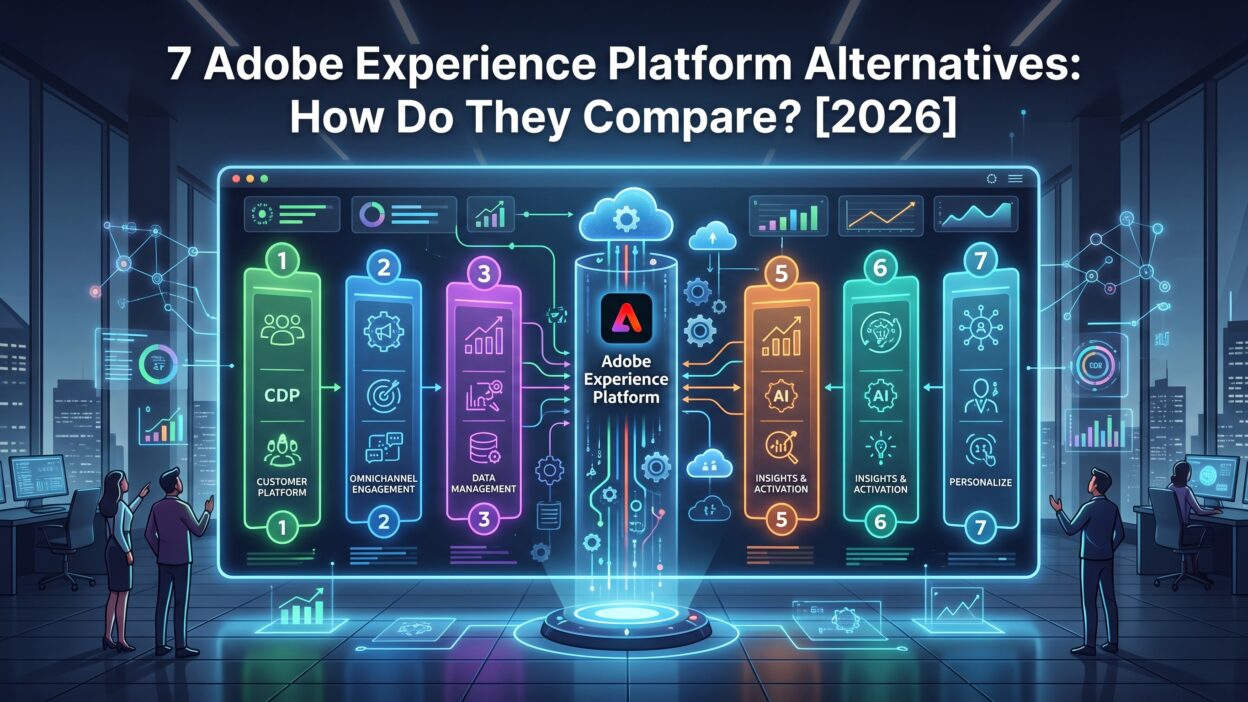
This guide covers seven Adobe Experience Platform alternatives worth a real look in 2026. Each tool solves a different problem. Some Adobe Experience Platform alternatives focus on B2B prospecting. Others focus on warehouse-native data activation or open-source flexibility. A few work best for teams already deep inside Salesforce.
You will not find a single “best” answer here. You will find the right Adobe Experience Platform alternative for your data stack, your team size and your budget. Read through each pick and match it against your own priorities before you commit to a new vendor.
Table of Contents
Why Teams Look for Adobe Experience Platform Alternatives
Adobe Experience Platform demands deep commitment to the Adobe ecosystem. Teams get the strongest value when they also run Adobe Analytics, Adobe Target and Adobe Journey Optimizer together. A team outside that stack pays a premium for features it barely uses. This gap sends a lot of buyers toward Adobe Experience Platform alternatives built for a mixed martech environment.
Pricing scales with profile volume. Costs climb fast as your customer base grows. Many teams sign a contract at one price point and renegotiate a much higher number two years later. Adobe Experience Platform alternatives with transparent, usage-based pricing solve this problem for budget-conscious teams.
Implementation timelines create real friction too. Adobe Experience Platform relies on XDM schema design, a process that needs dedicated engineering time. Teams without a large technical staff often wait months before they see real value. Faster Adobe Experience Platform alternatives get a working pipeline live within days, not quarters.
Vendor lock-in worries a growing number of data teams. Adobe Experience Platform stores your customer data inside its own proprietary structure. Moving that data out later becomes a hard project. Open and warehouse-native Adobe Experience Platform alternatives let your team keep ownership of the underlying data from day one.
What to Look for in Adobe Experience Platform Alternatives
Start with your existing tech stack. A team already running Salesforce gets more value from a native Salesforce tool than from a separate platform layered on top. A team with a strong data warehouse should prioritize tools that activate data in place, not tools that copy it into a new silo.
Check identity resolution quality closely. Strong Adobe Experience Platform alternatives merge customer records across devices and channels without heavy manual mapping work. Weak identity resolution creates duplicate profiles and broken personalization.
Pricing transparency separates the good options from the frustrating ones. Some Adobe Experience Platform alternatives publish clear, usage-based pricing on their website. Others require a lengthy sales process before you see real numbers. Ask for a price range early and save your team weeks of back-and-forth.
Schema enforcement matters for teams with strict data quality needs. A platform that validates events at the point of collection catches errors before they spread through your reports. This feature saves engineering teams real debugging time down the line.
Deployment flexibility rounds out the list. Some teams need a fully managed cloud platform. Others need an open-source tool they can host and customize themselves. Match this choice to your engineering capacity before you sign any contract.
The 7 Best Adobe Experience Platform Alternatives [2026]
We reviewed pricing, integrations and real user feedback for each tool on this list. Every pick here solves a specific gap that Adobe Experience Platform leaves open. Read each section and weigh the tradeoffs against your own data architecture.
1. ZoomInfo
ZoomInfo takes a different angle than most Adobe Experience Platform alternatives on this list. It focuses on B2B go-to-market data rather than consumer-facing personalization. Sales and marketing teams use ZoomInfo to find prospects, enrich contact records and track buying signals across target accounts.
Adobe Experience Platform was built for consumer brands with high transaction volume. A B2B company selling complex software gets little value from that architecture. ZoomInfo fills this gap with intent data, org charts and direct contact details pulled from a massive proprietary database.
Sales teams pair ZoomInfo with their CRM to prioritize outreach based on real buying signals. Marketing teams use the same data to build tighter account-based campaigns. This dual use case makes ZoomInfo a strong pick among Adobe Experience Platform alternatives for B2B-first organizations.
Pricing runs on a custom quote model based on seat count and data volume. Expect a sales conversation before you see exact numbers, similar to most enterprise-grade tools in this category.
ZoomInfo does not replace a full customer data platform for consumer brands. Teams that need real-time behavioral event tracking across millions of consumer profiles should look at Snowplow or Segment instead. ZoomInfo shines specifically for B2B prospecting and account intelligence.
Integration support covers Salesforce, HubSpot and most major CRM platforms out of the box. Sales reps get enriched contact data inside tools they already use daily, without a separate login or dashboard.
Choose ZoomInfo if your team runs B2B go-to-market motions and needs prospecting data more than consumer personalization. It stands apart from other Adobe Experience Platform alternatives built for B2C use cases.
2. Salesforce Data Cloud
Salesforce Data Cloud serves one clear audience. It works best for teams already running deep inside the Salesforce ecosystem. The platform unifies customer data from Sales Cloud, Service Cloud and Marketing Cloud into a single real-time profile, without a parallel system running alongside it.
Teams that once ran Adobe Experience Platform next to Salesforce often found themselves maintaining two separate customer views. Salesforce Data Cloud removes that duplication for organizations built around the Salesforce stack. Data flows directly between sales, service and marketing teams without custom integration work.
Identity resolution runs natively across every Salesforce cloud product. A support ticket, a sales opportunity and an email click all map back to the same customer record automatically. Few Adobe Experience Platform alternatives match this level of native integration for Salesforce-first companies.
Pricing follows Salesforce’s typical enterprise model, based on data volume and user count. Teams already paying for multiple Salesforce clouds may find bundled pricing more favorable than building a separate CDP contract elsewhere.
Salesforce Data Cloud offers less flexibility for teams outside the Salesforce ecosystem. A company running HubSpot or a custom-built CRM gains less value here compared to a vendor-neutral option like Tealium.
AI features run through Salesforce Einstein, giving marketing teams predictive scoring and next-best-action recommendations built directly into existing workflows. This tight product integration keeps teams inside one interface instead of switching between platforms all day.
Choose Salesforce Data Cloud if your organization already runs its sales, service and marketing operations through Salesforce. It ranks among the strongest Adobe Experience Platform alternatives for that specific setup.
3. Tealium
Tealium built its reputation on one core idea. Customer data should move freely between vendors, not get trapped inside one company’s ecosystem. This vendor-neutral approach makes Tealium a top pick among Adobe Experience Platform alternatives for teams running a mixed martech stack.
The platform routes real-time data across hundreds of destinations, from analytics tools to ad platforms to email providers. A team running Google Analytics, Braze and Meta Ads together can send clean, consistent data to all three at once through Tealium’s tag management and data layer.
Adobe Experience Platform works best when every tool in your stack carries the Adobe label. Tealium takes the opposite stance. It treats every vendor equally and focuses purely on clean data collection and distribution.
Server-side tagging gives Tealium an edge on page speed and data accuracy. Client-side tracking breaks more often as browsers restrict third-party cookies. Tealium’s server-side approach keeps data flowing even as privacy rules tighten across the industry.
Pricing scales with data volume and the number of connected destinations. Mid-market and enterprise teams make up most of Tealium’s customer base, though smaller teams with complex integration needs also find value here.
Setup requires real technical investment upfront. Teams need to map their data layer and configure destinations correctly before they see full value. This work pays off through cleaner, more reliable data across every connected tool.
Choose Tealium if vendor neutrality and multi-tool data routing matter more to your team than deep integration with any single ecosystem.
4. Segment
Segment built its name on speed and simplicity. Twilio-owned Segment gets a working customer data pipeline live in days, not months. This fast setup time places Segment near the top of any list of Adobe Experience Platform alternatives for teams that need quick wins.
Over four hundred pre-built integrations connect Segment to nearly every major marketing, analytics and sales tool on the market. A team can send clean event data to Google Analytics, Salesforce and an email platform all at once, without custom engineering work for each connection.
Segment Protocols adds schema governance on top of this integration layer. Teams define a tracking plan upfront and Segment flags events that break the rules before bad data spreads into dashboards and reports. This feature reduces the data cleanup work that eats so much analyst time elsewhere.
Unify, Segment’s identity resolution engine, merges customer records across devices into one profile. This matches core Adobe Experience Platform functionality at a fraction of the setup time and cost for most mid-market teams.
Pricing includes a free tier for small data volumes, with paid plans scaling based on monthly tracked users. This transparent, self-serve model stands in sharp contrast to Adobe’s custom enterprise quotes.
Segment fits growing companies that need reliable data infrastructure without a long implementation project. Very large enterprises with complex governance needs sometimes outgrow Segment and move toward Tealium or Salesforce Data Cloud instead.
Choose Segment if fast setup and broad integration support top your priority list among Adobe Experience Platform alternatives.
5. Snowplow
Snowplow takes data quality seriously from the very first click. The platform enforces schema validation at the point of collection, catching malformed events before they ever reach your warehouse. This approach makes Snowplow a strong pick among Adobe Experience Platform alternatives for teams that live and die by clean behavioral data.
Mobile-first tracking sits at the core of Snowplow’s design. Apps generate messy, high-volume event streams, and Snowplow handles that volume without dropping data or letting bad events slip through unnoticed. Product and engineering teams rely on this precision for accurate analytics.
Snowplow sends data directly into your own cloud data warehouse, whether that’s Snowflake, BigQuery or Redshift. Your team owns the raw event data from day one, unlike platforms that lock data inside a proprietary store.
Setup demands real engineering resources. Snowplow rewards teams with strong data engineering support and asks more from teams without that skill set. This tradeoff separates Snowplow from simpler, more marketer-friendly tools like Segment.
Pricing follows a usage-based model tied to event volume, with both cloud and self-hosted deployment options available. Teams that need full control over their infrastructure often choose the self-hosted route.
Snowplow shines for product analytics and detailed behavioral tracking rather than out-of-the-box marketing campaign tools. Teams that need built-in email or ad activation should pair Snowplow with a downstream activation tool.
Choose Snowplow if data accuracy and mobile event tracking matter more than a quick, marketer-friendly setup.
6. Hightouch
Hightouch flips the traditional CDP model on its head. Instead of copying your customer data into a new proprietary database, Hightouch activates data directly from your existing warehouse. This warehouse-native approach makes Hightouch a standout among Adobe Experience Platform alternatives for data-mature teams.
Reverse ETL sits at the heart of Hightouch’s product. Your team builds customer models inside Snowflake, BigQuery or Databricks, and Hightouch syncs those models straight into marketing, sales and support tools. No duplicate data store to maintain, no sync delays to troubleshoot across two separate systems.
This approach solves a problem that Adobe Experience Platform creates for many teams. Adobe requires you to move data into its own structure before you can activate it. Hightouch skips that step entirely and treats your warehouse as the single source of truth.
Marketing teams get audience segments built from real, governed warehouse data rather than a simplified marketing-only dataset. This accuracy improvement shows up directly in campaign performance and reporting consistency across departments.
Pricing scales with the number of synced destinations and rows processed. Teams with a mature data stack and a dedicated analytics engineering function get the most value from this model.
Hightouch requires a working data warehouse before it delivers real value. Teams without warehouse infrastructure should build that foundation first or choose a more self-contained platform like Segment.
Choose Hightouch if your organization already invests in a data warehouse and wants to activate that data without building a second system.
7. RudderStack
RudderStack gives teams full ownership over their customer data infrastructure. The platform ships as open source, which means engineering teams can host it themselves, inspect the code and customize behavior in ways closed platforms never allow. This flexibility places RudderStack firmly among the more technical Adobe Experience Platform alternatives.
Deployment options include a fully managed cloud version and a self-hosted version teams run inside their own infrastructure. Companies with strict data residency or compliance requirements often lean toward self-hosting to keep every byte of customer data under their own control.
RudderStack integrates with the same broad set of downstream marketing and analytics tools that competitors like Segment support. The real difference shows up in ownership. Your team controls the pipeline code, the deployment environment and the data retention rules from end to end.
Warehouse-first architecture runs through RudderStack’s design as well. Event data lands directly in your chosen warehouse, giving your analytics team a single, trusted source for reporting and machine learning work.
Pricing includes a generous free tier for smaller event volumes, with paid and enterprise plans scaling from there. The open-source core remains free regardless of scale, which appeals strongly to engineering-led organizations watching their software budget closely.
RudderStack asks more from your team than a fully managed SaaS platform. Companies without a dedicated engineering function may struggle to unlock its full value.
Choose RudderStack if open-source flexibility and full data ownership matter more than a hands-off, fully managed experience.
How to Choose the Right Adobe Experience Platform Alternative
Map your current tech stack before you evaluate any vendor. A Salesforce-heavy organization gains more from Salesforce Data Cloud than from a standalone tool built for a mixed environment. A team running a modern data warehouse should look hard at Hightouch or Snowplow before anything else.
Weigh your engineering capacity honestly. Snowplow and RudderStack reward teams with strong technical resources. Segment and ZoomInfo ask far less from engineering and get teams moving faster with a smaller technical footprint.
Define your primary use case early in the process. B2B teams chasing pipeline growth need ZoomInfo more than a full consumer CDP. B2C brands running high-volume personalization need real-time identity resolution more than prospecting data.
Test data quality directly during your trial period. Send real event data through each platform and check how it handles edge cases, duplicate records and malformed payloads. This hands-on test reveals far more than any vendor sales deck.
Compare pricing models against your growth trajectory. A platform priced by profile volume can turn expensive fast as your customer base scales. A usage-based or warehouse-native model often grows more predictably alongside your business.
Ask every vendor about migration support if you plan to move away from Adobe Experience Platform entirely. A smooth data migration plan reduces risk and shortens your overall implementation timeline significantly.
Talk to your data and engineering teams before you make a final call. The best Adobe Experience Platform alternative fits the people who will use it every day, not just the feature list on a comparison page.
Adobe Experience Platform Alternatives Pricing Comparison
Pricing models differ sharply across this category. Some vendors publish clear, usage-based rates. Others require a custom quote tied to your specific data volume and integration needs.
| Tool | Best For | Pricing Model |
|---|---|---|
| ZoomInfo | B2B prospecting and intent data | Custom quote, seat-based |
| Salesforce Data Cloud | Salesforce-native customer data | Custom, volume-based |
| Tealium | Vendor-neutral data routing | Custom, based on data volume |
| Segment | Fast setup, broad integrations | Free tier, then usage-based |
| Snowplow | Behavioral event accuracy | Usage-based, cloud or self-hosted |
| Hightouch | Warehouse-native activation | Usage-based, per destination |
| RudderStack | Open-source data ownership | Free tier, paid plans scale up |
Match this table against your projected growth before you sign a long-term contract with any vendor on this list.
Frequently Asked Questions
Why are companies moving away from Adobe Experience Platform?
High enterprise pricing, long implementation timelines and deep ecosystem dependency push many teams toward Adobe Experience Platform alternatives. Gartner’s shift of Adobe from Leader to Visionary status in its 2025 CDP rankings added further momentum to this trend.
What is the best Adobe Experience Platform alternative for small teams?
Segment offers the fastest setup and a free tier for smaller data volumes. Small teams without heavy engineering resources often start here before they consider more technical options like Snowplow or RudderStack.
Which Adobe Experience Platform alternative works best for B2B companies?
ZoomInfo stands out for B2B go-to-market teams that need prospecting data and buying signals rather than consumer-facing personalization tools.
Can I use an open-source Adobe Experience Platform alternative?
Yes. RudderStack ships as open source and supports both self-hosted and managed cloud deployment. This option suits engineering-led teams that want full control over their data infrastructure.
Do Adobe Experience Platform alternatives support real-time personalization?
Several do. Salesforce Data Cloud and Segment both support real-time identity resolution and audience activation. Snowplow focuses more on data collection accuracy than built-in personalization tools.
Is it possible to run an Adobe Experience Platform alternative alongside Adobe’s other products?
Many teams keep Adobe Analytics or Adobe Target while replacing only the customer data platform layer. Tealium works especially well in this kind of mixed-vendor setup, since it treats every connected tool equally.
How long does it take to switch from Adobe Experience Platform to a new tool?
Timelines vary by platform and data volume. Segment and Hightouch often get a working pipeline live within a few weeks. Snowplow and RudderStack take longer due to their engineering-heavy setup process.
Read More:-7 Best Kompyte Alternatives [2026]
Conclusion

Adobe Experience Platform remains a capable tool for large, Adobe-native enterprises with deep technical resources. Many teams need something faster, cheaper or better suited to their existing stack. The seven Adobe Experience Platform alternatives in this guide cover the most common gaps teams run into today.
Choose ZoomInfo for B2B prospecting and pipeline growth. Choose Salesforce Data Cloud if your operations already run through Salesforce. Choose Tealium for vendor-neutral data routing across a mixed martech stack. Choose Segment for the fastest path to a working data pipeline. Choose Snowplow for precise, schema-enforced behavioral tracking. Choose Hightouch to activate your warehouse data without duplication. Choose RudderStack for full, open-source ownership of your data infrastructure.
Test two or three options from this list before you commit to any single vendor. A short trial with real data reveals far more than any feature comparison ever will. The right Adobe Experience Platform alternative matches your team, your stack and your budget, not just the longest list of features on a pricing page.