Introduction
TL;DR B2B teams run on data every single day. Sales reps chase leads based on data. Marketing teams build campaigns based on data. Finance teams forecast revenue based on data. Poor data quality quietly breaks every one of these processes. Most teams underestimate the real cost until a deal falls through or a campaign flops. This guide breaks down the true cost of poor data quality for B2B teams. You will see where poor data quality hides, how it drains revenue, and what steps fix it for good.
Table of Contents
What Poor Data Quality Really Means
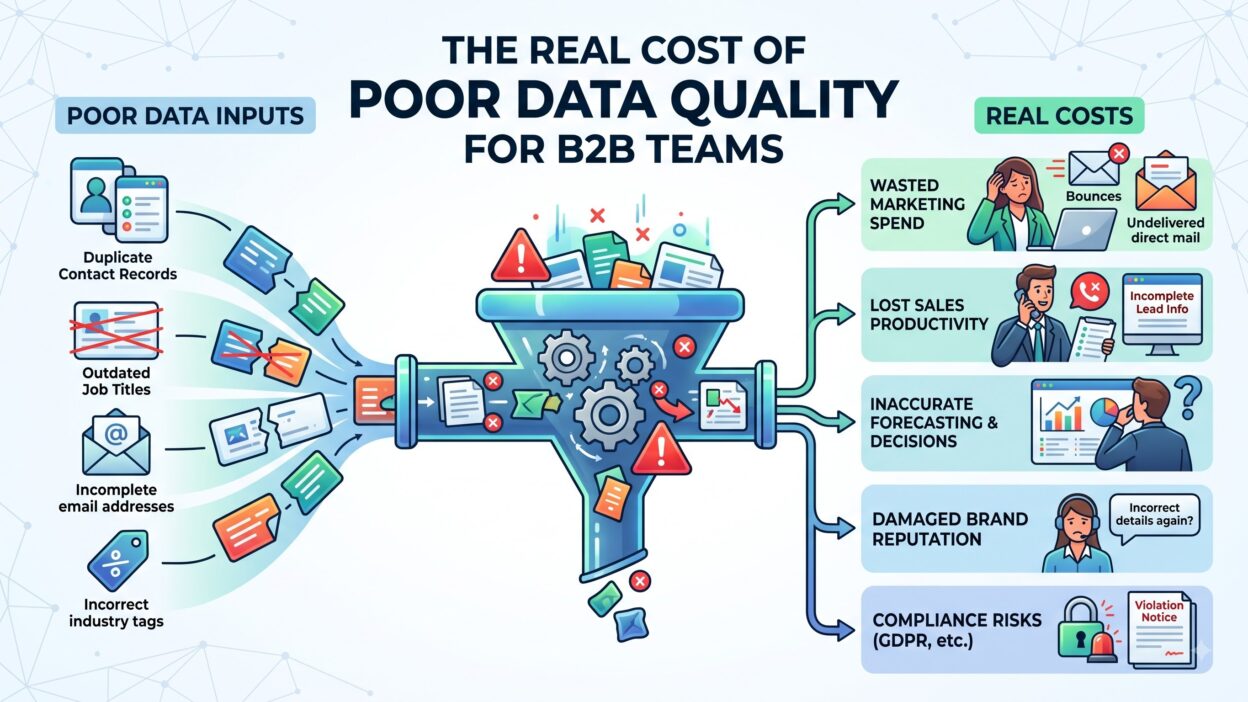
Poor data quality covers many problems at once. A record might have a missing field, a wrong email, or an outdated job title. A record might duplicate another record already in the system. A record might contain data entered by hand with typos. Poor data quality is not just one bad record here or there. It becomes a pattern that spreads across a whole database over time.
B2B teams often store data across many systems, like a CRM, a marketing platform, and a finance tool. Poor data quality in one system spreads to the others through syncs and integrations. A single wrong field can multiply into hundreds of wrong records within weeks.
Why Poor Data Quality Happens
Manual Data Entry Errors
Sales reps enter data quickly during busy weeks. Typos happen often under this kind of pressure. A wrong digit in a phone number breaks an entire outreach sequence. Manual entry remains one of the biggest sources of poor data quality across B2B teams today.
Outdated Records Over Time
People change jobs constantly in the business world. Companies merge, rebrand, or shut down without warning. A contact record accurate last year might be completely wrong today. Teams that never refresh their database build up poor data quality month after month.
Disconnected Systems and Tools
Many B2B teams use separate tools for sales, marketing, and support. These tools rarely sync perfectly with each other. A lead updated in one system stays outdated in another system. This disconnect creates poor data quality even when each individual team enters clean data on their end.
The Hidden Cost of Poor Data Quality in Sales
Sales teams feel the sting of poor data quality daily, often without realizing the root cause. A rep calls a wrong number and wastes ten minutes. A rep emails an old contact who left the company months ago. These small losses add up across a whole team fast.
Poor data quality also damages lead scoring models. A scoring model trained on messy data ranks bad leads above good ones. Reps waste hours chasing leads that never convert. Meanwhile strong leads sit ignored near the bottom of the list. Pipeline forecasts built on poor data quality mislead leadership too, since revenue predictions rely on accurate contact and deal data underneath them.
The Hidden Cost of Poor Data Quality in Marketing
Marketing teams suffer from poor data quality in different ways. Email campaigns sent to outdated addresses bounce and hurt sender reputation. A damaged sender reputation lands future emails in spam folders, even for genuinely interested prospects. Personalization also breaks down when data quality slips. A campaign addressing someone by the wrong name or wrong job title feels careless to the reader.
Segmentation depends heavily on accurate data too. Poor data quality scrambles audience segments, sending the wrong message to the wrong group. Budget gets wasted on ads targeting people who no longer fit the ideal customer profile. Marketing teams often blame low campaign performance on strategy, when poor data quality sits at the true root of the problem.
The Hidden Cost of Poor Data Quality in Customer Support
Support teams need accurate customer records to solve problems quickly. Poor data quality slows down every support interaction. An agent pulls up the wrong account and gives the wrong answer. A customer repeats their issue multiple times because notes never synced correctly.
Frustrated customers churn faster when support feels disorganized. Poor data quality behind the scenes creates a poor experience up front, even when agents work hard and mean well. Support teams end up spending extra time verifying basic details that should already sit correctly in the system.
The Financial Cost of Poor Data Quality
Poor data quality carries a direct financial cost, though many companies never calculate it clearly. Wasted sales hours cost money through lost productivity. Bounced email campaigns waste marketing budget on wrong or dead addresses. Missed renewals from outdated contact data cost real revenue when a customer slips through the cracks.
Industry research consistently shows poor data quality costs companies a significant percentage of their annual revenue. Beyond direct costs, poor data quality also creates hidden costs like rework. Teams spend hours cleaning spreadsheets instead of doing revenue-generating work. Leadership makes decisions based on flawed reports, which can lead to poor strategic choices across an entire quarter or year.
How Poor Data Quality Affects Decision Making
Executives rely on dashboards and reports built from company data. Poor data quality quietly corrupts these reports without any obvious warning sign. A revenue forecast built on duplicate deals overstates real pipeline value. A churn report missing accurate customer data understates real risk to the business.
Leaders trust these numbers to make big decisions, like hiring plans or budget allocation. Poor data quality behind a report can push a company toward a wrong decision confidently. This risk grows larger as a company scales, since more teams pull from the same flawed data sources across the organization.
Signs Your B2B Team Has a Poor Data Quality Problem
Duplicate records piling up in your CRM signal a poor data quality problem early. High email bounce rates point to outdated or incorrect contact data. Sales reps complaining about bad leads often reveal a deeper data quality issue upstream. Reports that never quite match between teams also point to inconsistent or poor data quality across systems.
Frequent manual corrections by your team signal that the root data needs fixing, not just constant patching. If your team spends more time verifying data than using it, poor data quality has likely become a serious drag on productivity already.
How to Fix Poor Data Quality for B2B Teams
Standardize Data Entry Rules
Clear rules reduce poor data quality at the source. Teams should agree on formats for phone numbers, company names, and job titles. Dropdown fields prevent typos better than free text fields. Training reps on these rules early prevents bad habits from forming.
Run Regular Data Audits
Scheduled audits catch poor data quality before it spreads too far. A monthly or quarterly review can flag duplicates, missing fields, and outdated records. Automated tools can flag likely errors, but a human review still catches context that automation misses.
Use Verification and Enrichment Tools
Verification tools check email addresses and phone numbers instantly during entry. Enrichment tools fill in missing fields with verified data from trusted sources. Together these tools stop poor data quality from ever entering the system in the first place, rather than cleaning it up later.
Assign Clear Data Ownership
Someone on the team should own data quality directly. Without clear ownership, poor data quality becomes everyone’s problem and nobody’s responsibility at the same time. A dedicated owner tracks metrics, runs audits, and pushes fixes across every connected system.
Building a Long-Term Data Quality Strategy
Fixing poor data quality once is not enough for lasting results. Teams need an ongoing strategy, not a one-time cleanup project. Regular audits, clear ownership, and verification tools work together as a system rather than separate fixes. Leadership support matters too, since data quality initiatives often lose funding when they lack visible short-term wins.
Teams should track data quality metrics the same way they track revenue or pipeline. A dashboard showing duplicate rates, bounce rates, and missing field percentages keeps the problem visible. Poor data quality creeps back quickly without this kind of ongoing attention from the whole organization.
Real World Examples of Poor Data Quality Costs
A mid-size software company found thousands of duplicate leads in their CRM after a merger between two sales teams. Reps had wasted months chasing the same prospects twice under different records. A marketing agency saw its email bounce rate spike after a year without any data cleanup, damaging their sender reputation across every client account.
A logistics company lost a major renewal because outdated contact data routed a renewal notice to a former employee who never forwarded it. Each of these cases shows how poor data quality creates real, measurable damage across very different parts of a business.
Frequently Asked Questions
How much does poor data quality actually cost a company? Costs vary by company size and industry, but studies consistently show poor data quality drains a meaningful share of annual revenue through wasted effort, lost deals, and damaged campaigns.
What causes poor data quality most often in B2B teams? Manual entry errors, outdated records, and disconnected systems cause most poor data quality problems. Teams using multiple tools without proper syncing face this issue more often than teams with unified systems.
Can poor data quality be fixed permanently? Not permanently, but it can stay under control with ongoing effort. Regular audits, clear ownership, and verification tools keep poor data quality from creeping back into a clean system over time.
How does poor data quality affect sales forecasting? Poor data quality skews forecasts by inflating pipeline value with duplicate or stale deals. This gives leadership a false sense of revenue, which can lead to poor planning decisions later.
What tools help fix poor data quality quickly? Verification tools, enrichment platforms, and deduplication software all help address poor data quality at different stages, from new entry to ongoing database cleanup.
Who should own data quality on a B2B team? A dedicated owner, often within revenue operations or data operations, should track and manage data quality. Shared responsibility without a clear owner usually leads to poor data quality returning quickly.
Read More:-6 Benefits Of A Social Media Strategy For Your Go-To-Market Strategy
Conclusion

Poor data quality costs B2B teams far more than most leaders realize. It drains sales productivity, weakens marketing performance, and frustrates customers through avoidable support errors. It quietly corrupts the reports executives trust for major decisions. Fixing poor data quality takes more than a one-time cleanup. It needs clear ownership, regular audits, and the right verification tools working together consistently. Teams that treat data quality as an ongoing priority protect their revenue and their reputation. Teams that ignore it keep paying a hidden cost every single day until they finally address the root problem directly.