Introduction
TL;DR Businesses collect huge amounts of raw data every day. Raw data alone rarely drives good decisions. Teams need context, accuracy, and depth behind every record. AI data enrichment solves this problem. It adds missing details to customer records, leads, and transactions using automated models. This guide covers AI data enrichment in full depth. You will learn how it works, why accuracy matters, and how to keep it reliable at scale. You will also see real use cases, common risks, and practical fixes for common problems.
Table of Contents
What Is AI Data Enrichment
AI data enrichment means using artificial intelligence to add value to existing data. A basic record might include a name and an email address. An enrichment model can add a job title, a company name, or a location. AI data enrichment goes further than traditional lookup tools. It can read unstructured text, infer missing details, and match records across multiple sources. Sales teams use this data to prioritize leads. Marketing teams use this data to personalize campaigns. Support teams use this data to solve tickets faster. AI data enrichment turns thin records into full customer profiles.
Why Accuracy Matters in AI Data Enrichment
Accuracy sits at the center of every enrichment project. Wrong data leads to wrong decisions. A sales team chasing a lead with a fake job title wastes time. A marketing team sending the wrong offer loses trust. AI data enrichment models pull from many sources, and each source carries its own error rate. A single mismatch can spread across thousands of records if nobody catches it early.
Good accuracy builds confidence across every team that touches the data. Bad accuracy creates doubt, and doubt slows down adoption of any new tool. Companies that measure accuracy regularly catch problems before they spread. Companies that skip this step often discover errors only after damage occurs, like a failed campaign or a lost deal.
How AI Data Enrichment Works
Data Collection and Source Matching
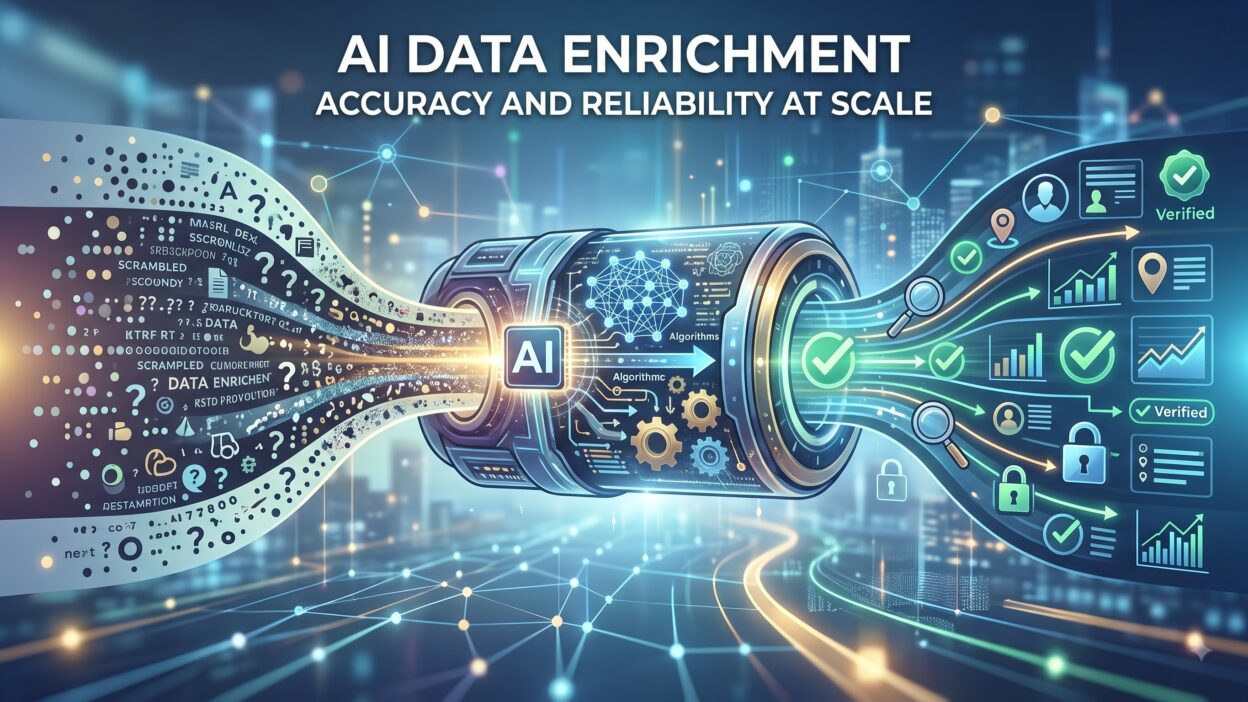
AI data enrichment starts with raw input, often a name, email, or phone number. The system searches multiple sources for matching records. These sources include public databases, business directories, and licensed data providers. The model compares fields across sources to find the strongest match. A poor match at this stage creates errors downstream, so this step needs careful design.
Model Processing and Field Prediction
Once the system finds a match, the model fills in missing fields. Machine learning models predict values based on patterns learned from training data. A model might predict a company’s industry from its name and website content. This step relies heavily on model quality. Strong models trained on clean data produce fewer errors. Weak models trained on messy data produce more mistakes.
Validation and Confidence Scoring
Good AI data enrichment tools attach a confidence score to each field. A high score means strong evidence supports that value. A low score means the model guessed with limited evidence. Teams can filter out low-confidence data before it reaches critical systems. This validation step protects reliability at scale, especially when processing millions of records at once.
Reliability Challenges at Scale
Scaling AI data enrichment brings new challenges beyond a small pilot project. A model that performs well on a thousand records might struggle with ten million records. Data sources update constantly, and a model trained on old data drifts away from current reality over time. Duplicate records multiply as volume grows, and duplicates confuse matching logic badly.
Latency also becomes a real concern at scale. Real-time enrichment for a live chat needs fast responses, while batch enrichment for a large database can tolerate slower processing. Teams need to design their pipeline around the right speed for each use case. Infrastructure costs rise with volume too, and teams must balance accuracy gains against processing costs carefully.
Common Sources of Errors in AI Data Enrichment
Outdated source data causes many enrichment errors. A person changes jobs, but an old database still lists their previous employer. Duplicate entries cause confusion when a model merges two different people into one profile by mistake. Ambiguous names create mismatches too, since many people share the same name across different companies and cities.
Poor training data weakens any enrichment model over time. A model trained mostly on data from one region often performs worse on data from other regions. Bias in training data leads to skewed predictions for certain groups of people or companies. Teams should audit training data regularly to catch these gaps early, before they affect real business decisions.
Best Practices for Accurate AI Data Enrichment
Strong data enrichment starts with clean source data. Teams should audit their data sources regularly and drop sources with high error rates. Cross-referencing multiple sources improves match accuracy significantly, since agreement across sources signals a stronger result.
Confidence thresholds help teams control quality directly. A team can set a rule that blocks any field below a chosen confidence score. Human review adds another layer of protection for high-stakes decisions, like large sales deals or fraud investigations. Automated systems handle bulk work well, but a human check catches edge cases that models miss.
Regular model retraining keeps accuracy high as source data changes. A model trained once and left untouched slowly loses accuracy as the world changes around it. Teams should schedule retraining cycles based on how fast their industry changes. Fast-moving industries like tech need more frequent updates than slower industries like manufacturing..
AI Data Enrichment for Real-Time Use Cases
Real-time AI data enrichment powers live chat support, fraud checks, and instant lead scoring. A support agent needs a customer’s order history the moment a chat begins. A fraud team needs a risk score before a transaction completes. These use cases demand speed without sacrificing accuracy.
Real-time systems often use cached data alongside live lookups to balance speed and freshness. Cached data loads instantly, while live lookups confirm accuracy for critical fields. This hybrid approach keeps response times low while protecting data quality. Teams building real-time AI data enrichment should monitor both speed and accuracy together, since a fast wrong answer causes more harm than a slightly slower correct one.
AI Data Enrichment for Batch Processing
Batch processing suits large-scale enrichment projects like enriching an entire customer database overnight. This approach processes thousands or millions of records in one run. Batch jobs allow deeper validation steps since speed matters less than accuracy in this context.
Teams running batch AI data enrichment can afford heavier cross-referencing across multiple sources. They can also run duplicate detection across the full dataset instead of checking records one at a time. This thorough approach produces higher accuracy overall, though it takes longer to complete. Companies often run batch enrichment on a weekly or monthly schedule to keep records fresh without constant processing costs.
Measuring Accuracy and Reliability
Teams need clear metrics to track AI data enrichment performance over time. Match rate shows how often the system finds a matching record at all. Accuracy rate shows how often the enriched fields turn out correct after verification. Confidence score distribution shows how much of the data falls into high-confidence versus low-confidence buckets.
Regular sampling helps teams verify accuracy without checking every single record manually. A team might pull a random sample of five hundred records each month and verify them by hand. This sample gives a reliable accuracy estimate for the full dataset. Tracking these metrics over time reveals whether a system improves or degrades, which guides decisions about retraining or switching data sources.
Security and Compliance in AI Data Enrichment
AI data enrichment often touches personal information, so compliance matters greatly. Regulations like GDPR and CCPA set clear rules for handling personal data. Companies must know where their enrichment data comes from and how long they store it. Consent matters too, especially when enrichment pulls data from public or third-party sources.
Strong security practices protect enriched data from breaches. Encryption in transit and at rest keeps data safe during processing and storage. Access controls limit who can view sensitive enriched fields within a company. Regular audits catch compliance gaps before they become legal problems. Teams should treat enriched data with the same care as any other sensitive customer information.
Real World Examples of AI Data Enrichment
A B2B software company enriches every new lead with company size, industry, and revenue data within seconds of form submission. This speeds up lead routing and helps sales reps prioritize their outreach immediately. A fraud prevention team enriches transaction data with device history and location patterns to catch suspicious activity in real time.
An e-commerce brand enriches its customer database monthly to update shipping addresses and contact details. This batch process keeps marketing campaigns accurate and reduces bounced emails. A recruitment platform enriches resumes with verified employment history and skill data, helping recruiters match candidates faster. Each example shows how accuracy and reliability directly affect business outcomes.
Choosing the Right AI Data Enrichment Tool
Companies should evaluate a few key factors before choosing a tool. Data source coverage matters first, since a tool pulling from more reliable sources produces better matches. Accuracy guarantees or published error rates give a sense of real-world performance. Integration ease matters too, since a tool that fits existing systems saves engineering time.
Pricing models vary widely across providers, so teams should calculate cost per enriched record based on their expected volume. Support quality also matters, especially during initial setup and troubleshooting. Teams should run a small pilot test before committing to a full rollout, comparing accuracy and speed against their current process.
Frequently Asked Questions
How accurate is AI data enrichment today? Accuracy varies by provider and data type. Strong tools reach high accuracy rates for common fields like company name or job title, while harder fields like personal income remain less reliable across the industry.
Can AI data enrichment work in real time? Yes. Many modern tools support real-time AI data enrichment for chat support, fraud checks, and instant lead scoring. Real-time systems balance speed with accuracy through cached data and live lookups together.
What causes errors in AI data enrichment? Outdated sources, duplicate records, and ambiguous names cause most errors. Poor training data and bias in models also reduce accuracy, especially for underrepresented groups or regions.
How often should companies retrain their AI data enrichment models? This depends on how fast the industry changes. Fast-moving sectors like technology need frequent retraining, while stable sectors can retrain less often without losing much accuracy.
Is AI data enrichment safe for compliance-heavy industries? Yes, with the right safeguards. Companies need clear data source records, strong encryption, and defined consent processes to stay compliant with regulations like GDPR and CCPA.
How can teams measure AI data enrichment reliability? Teams should track match rate, accuracy rate, and confidence score distribution. Regular manual sampling also helps verify that automated systems stay reliable as data volume grows.
Read More:-The Long Road to Data Privacy Compliance
Conclusion

AI data enrichment turns raw records into valuable, actionable data. Accuracy and reliability decide whether this data helps a business or misleads it. Strong source matching, confidence scoring, and regular validation keep enrichment trustworthy at any scale. Real-time systems need speed without losing accuracy, while batch systems can afford deeper checks for stronger results. Companies that measure their enrichment performance regularly catch problems early and build lasting trust across every team that relies on the data. Choose your AI data enrichment approach based on your specific volume, speed needs, and compliance requirements, and test any new tool before a full rollout.