Introduction
TL;DR Data enrichment shapes how businesses understand their customers. Every company today collects raw data. Raw data alone rarely tells a full story. Teams need extra context, extra signals, and extra accuracy. This is where enrichment tools come in. Two major approaches lead this space: MCP and API integration. This guide compares MCP vs API for data enrichment in full detail. You will learn how each method works. You will learn when each method fits your project. You will also see real examples, cost factors, and security notes.
Table of Contents
What Is Data Enrichment
Data enrichment means adding extra details to existing data. A company might have a customer’s email address. Enrichment tools can add a job title, company size, or location. This extra data helps sales teams target better. It helps marketing teams personalize messages. It helps support teams solve problems faster. Data enrichment turns basic records into useful profiles. Businesses use enrichment for leads, for fraud checks, and for customer support. Both MCP and API methods handle this task differently. Understanding the difference matters before you pick a tool.
What Is an API in Data Enrichment
An API, or Application Programming Interface, connects two systems. A data enrichment API sends a request and receives a response. Your app asks for details about a phone number. The API server sends back a name, carrier, or location. This exchange happens through fixed endpoints. Each endpoint expects specific input. Each endpoint returns a specific output format, usually JSON. APIs have powered data enrichment for over a decade. Most CRM tools, marketing platforms, and fraud systems rely on API integration today.
How APIs Work for Data Enrichment
An API call starts with a request. The request includes an API key for authentication. The request also includes the data you want enriched. The server processes this request. The server checks its database or a third-party source. The server returns a structured response. Developers write code to send these requests. Developers also write code to parse the responses. This process repeats for every single enrichment task. Large volumes need batch processing or queue systems. API rate limits often control how many requests you send per minute.
Common Use Cases for API-Based Enrichment
Sales teams use APIs to enrich lead lists. Marketing teams use APIs to verify email addresses. Fraud teams use APIs to check IP addresses and device fingerprints. E-commerce platforms use APIs to validate shipping addresses. Recruitment platforms use APIs to pull candidate details from public profiles. Each use case needs a stable, well-documented API. Good documentation reduces integration time. Poor documentation slows down developers and increases errors.
What Is MCP in Data Enrichment
MCP stands for Model Context Protocol. MCP is a newer standard built for AI models. MCP data enrichment lets an AI assistant pull live data during a conversation. Instead of a rigid API call, MCP gives the model direct access to tools and data sources. The model decides what data it needs. The model then requests that data through an MCP server. This approach fits naturally into AI-driven workflows. Many teams now compare MCP vs API for data enrichment because AI agents need dynamic, on-demand data access.
How MCP Works
An MCP server exposes tools to an AI model. These tools might pull data from a CRM, a spreadsheet, or a third-party enrichment source. The model reads the user’s question. The model picks the right tool. The model sends a structured request to the MCP server. The server executes the task and returns results. The model then uses these results in its response. This loop happens automatically during a conversation. Developers do not need to write custom logic for every single data request. The model handles the reasoning step.
Common Use Cases for MCP-Based Enrichment
Customer support bots use MCP to pull order history in real time. Sales assistants use MCP to enrich prospect data during a live chat. Research assistants use MCP to combine multiple data sources instantly. Internal tools use MCP to connect AI agents with company databases. MCP shines in conversational, agent-based systems. Traditional dashboards and batch jobs still favor plain API calls.
MCP vs API for Data Enrichment: Key Differences
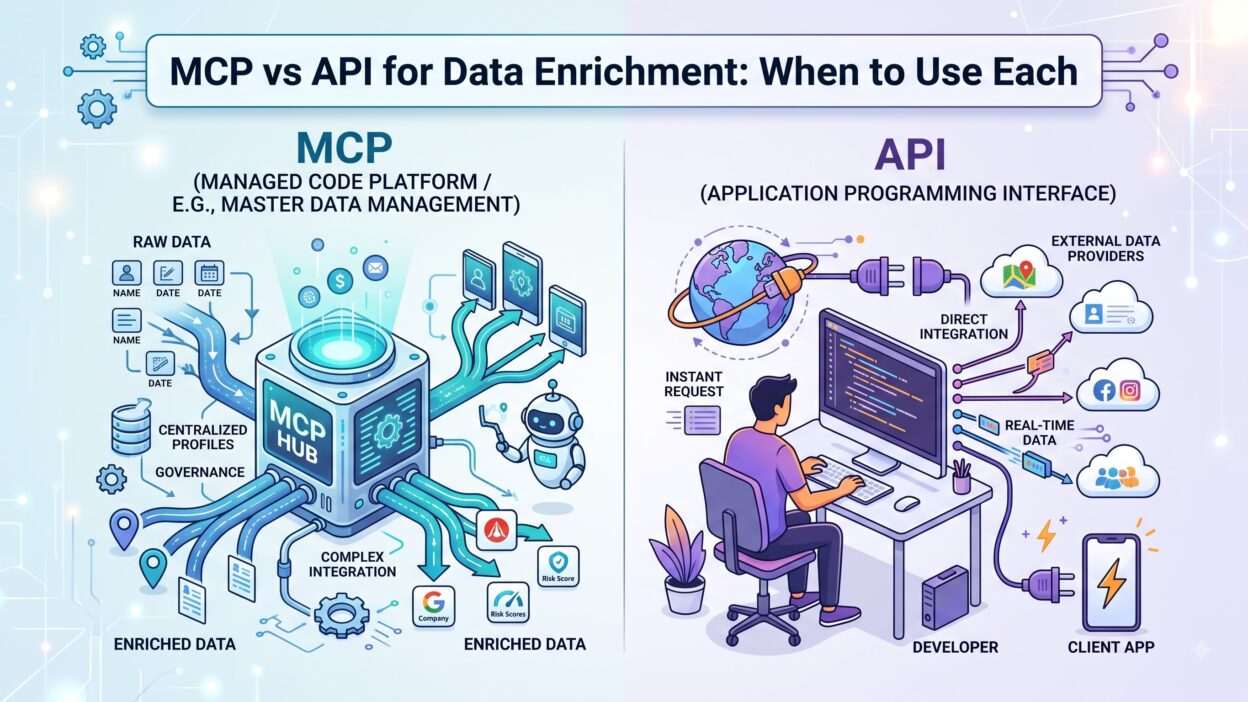
The core difference sits in control and flexibility. An API call follows a fixed script. A developer decides exactly what data to request and when. MCP gives an AI model the freedom to decide. The model picks tools based on context. This makes MCP data enrichment more adaptive. It also makes MCP less predictable in some cases.
APIs work best for structured, repeatable tasks. MCP works best for open-ended, conversational tasks. APIs need explicit code for every new data source. MCP can add new tools without rewriting the entire integration. APIs return raw data. MCP often returns data already shaped for the model’s response.
| Factor | API | MCP |
|---|---|---|
| Control | Developer-defined | Model-defined |
| Best fit | Batch and structured tasks | Conversational and agent tasks |
| Setup | Fixed endpoints | Dynamic tool access |
| Flexibility | Lower | Higher |
| Maturity | Well established | Newer standard |
This table highlights why the MCP vs API for data enrichment debate matters for planning. Your project type decides the right choice. A batch job to enrich ten thousand leads fits API integration. A live chat assistant fits MCP.
When to Use API for Data Enrichment
Choose API integration for bulk enrichment tasks. Choose API integration when your workflow follows a fixed pattern. A marketing team enriching a CSV file of five thousand contacts needs speed and predictability. An API handles this job well. APIs also fit systems without an AI model in the loop. A simple backend script can call an API and store results in a database. This setup runs reliably without extra complexity.
API-based data enrichment also suits compliance-heavy industries. Banks and insurance companies need clear audit trails. Every API call logs a specific request and response. This log supports compliance reviews. APIs also offer mature security tools like OAuth and API key rotation. Teams with existing API infrastructure save time by extending that same infrastructure for enrichment.
Choose API integration when you need predictable costs. Most API providers charge per call or per record. This pricing model makes budgeting simple. Finance teams often prefer this clarity over usage that scales unpredictably.
When to Use MCP for Data Enrichment
Choose MCP data enrichment for AI-driven products. A customer support chatbot benefits from MCP because it needs live, contextual data. The bot might need order details one moment and shipping status the next. MCP handles this shifting need without constant code changes.
MCP also fits teams building AI agents that combine multiple data sources. An agent researching a company might need firmographic data, news mentions, and social profiles together. MCP lets the model pull each piece as needed. This reduces the manual work of chaining multiple API calls together.
Startups building new AI products often choose MCP early. MCP reduces the engineering overhead of connecting every tool manually. Product teams move faster because the model handles routing decisions. MCP also suits internal tools where employees interact with data through natural language instead of dashboards.
MCP vs API for Data Enrichment: Performance and Scalability
Performance depends on your workload type. APIs handle high-volume, repetitive tasks efficiently. A well-optimized API can process millions of records through batch calls. Caching and parallel requests improve speed further. Most enterprise data enrichment API providers support this scale today.
MCP performance depends on the model’s reasoning speed. Each tool call inside an MCP workflow adds latency. The model must decide which tool to use before it calls that tool. This decision step takes time. For a single conversation, this delay feels small. For massive batch jobs, this delay adds up quickly. Teams needing millions of enrichment calls per day usually still lean on direct APIs for the heavy lifting, even inside an MCP-powered product.
Scalability also depends on infrastructure. APIs scale through standard cloud tools like load balancers and queues. MCP scales through server capacity and model throughput. Both approaches can handle enterprise workloads with the right setup. The right choice depends on where the bottleneck sits in your specific system.
MCP vs API for Data Enrichment: Security Considerations
Security matters in every data enrichment workflow. APIs use established security patterns. API keys, OAuth tokens, and IP allowlists protect API endpoints. Years of industry practice back these methods. Most compliance frameworks already include clear guidance for API security.
MCP security is newer and still evolving. MCP servers need careful permission scoping. A model should only access the tools it truly needs. Overly broad permissions create risk. A poorly configured MCP server might expose sensitive customer data to unintended requests. Teams adopting MCP should audit tool permissions regularly. Teams should also log every tool call for review, similar to API logging practices.
Both methods need encryption in transit. Both methods need strict access control. The difference lies in maturity. API security practices feel battle-tested. MCP security practices are still forming best practices as adoption grows across the industry.
MCP vs API for Data Enrichment: Cost Comparison
Cost structures differ between these two approaches. Most API providers charge based on call volume or record count. This model suits predictable, high-volume enrichment tasks. Teams can forecast monthly spend with reasonable accuracy.
MCP costs often include model usage on top of tool costs. Every conversation that triggers a tool call adds token costs for the model itself. This layered cost structure can surprise teams new to MCP. A single enrichment request through MCP might cost more than the same request through a direct API, because the model reasoning step adds expense.
Teams building high-volume batch systems usually find APIs cheaper. Teams building conversational AI products often accept the extra MCP cost for the flexibility it provides. Budgeting for MCP data enrichment needs careful monitoring of both tool costs and model costs together.
Real World Examples
A SaaS company enriching new sign-ups uses a data enrichment API to pull company size and industry instantly after signup. This runs as a background job. No AI model sits in this loop. Speed and reliability matter most here.
A fintech company building a fraud detection chatbot uses MCP to pull transaction history, device data, and risk scores during a live investigation. The support agent asks the AI assistant questions in plain language. The assistant decides which data source to check based on the question. This flexible setup fits MCP perfectly.
A recruitment platform enriching thousands of resumes weekly relies on batch API calls. A recruiting AI assistant answering hiring manager questions in real time relies on MCP. Many companies now run both approaches side by side, matching each tool to the right job.
Best Practices for Choosing Between MCP and API
Start by mapping your workflow type. Batch and repetitive tasks favor API integration. Conversational and dynamic tasks favor MCP. Check your team’s existing infrastructure next. Teams with strong API pipelines already may extend those pipelines instead of rebuilding with MCP.
Review your data volume needs. High-volume enrichment favors direct API calls for cost and speed. Lower-volume, context-heavy tasks favor MCP for flexibility. Consider your security requirements carefully. Regulated industries may need the mature audit trails that APIs already provide.
Test both approaches on a small project before committing fully. Measure latency, cost, and accuracy for each method. Many successful data enrichment strategies combine MCP and API together, using each where it performs best. This hybrid approach often delivers the strongest results for growing companies.
Frequently Asked Questions
Is MCP a replacement for APIs in data enrichment? No. MCP works alongside APIs in most systems. MCP often calls APIs behind the scenes to fetch data. Think of MCP as a smarter layer sitting above traditional API integration, not a full replacement.
Which is cheaper, MCP or API for data enrichment? API integration usually costs less for high-volume, repetitive tasks. MCP adds model reasoning costs on top of data costs, which raises the price for large-scale batch jobs.
Can small businesses use MCP for data enrichment? Yes. Small businesses building AI-powered support tools or sales assistants can benefit from MCP. The setup cost is often manageable with modern MCP server tools now available.
Does MCP support real-time data enrichment? Yes. MCP excels at real-time data enrichment during live conversations. The model requests fresh data the moment it needs that data, making MCP a strong fit for chat-based products.
What skills does a team need to build MCP data enrichment tools? Teams need experience with AI model integration, API development, and secure server configuration. Familiarity with existing data enrichment API providers also helps speed up the build process.
Is API integration still relevant with MCP available now? Yes, very much so. Most MCP servers rely on APIs internally. Direct API integration remains the backbone for high-volume, structured enrichment tasks across nearly every industry today.
Read More:-Does Social Media Really Generate Revenue?
Conclusion

Choosing between MCP vs API for data enrichment depends on your specific workflow. APIs suit structured, high-volume, and predictable tasks. MCP suits conversational, dynamic, and AI-driven products. Cost, security maturity, and scalability all shift the decision one way or another. Many strong systems today blend both methods together. A batch job might run through a traditional API. A live support assistant might run through MCP. Study your use case first. Test a small pilot before scaling either approach. The right data enrichment strategy matches the tool to the task, not the other way around.