Introduction
TL;DR Every hiring manager faces this question at some point. Should a job posting require a degree, or does that requirement block strong candidates without one? Companies across many industries now rethink this old rule. A job posting written decades ago often listed a degree without much thought behind it. Today, skills and real experience carry more weight for many roles. This guide walks through both sides of this decision. You will learn when a degree requirement makes sense, when it hurts your hiring, and how to write a job posting that attracts the right talent either way.
Table of Contents
Why Degree Requirements Became Standard in Job Postings
Degree requirements crept into job postings for a mix of reasons over the decades. A degree once served as an easy filter for large applicant pools. Recruiters used it to narrow down hundreds of resumes quickly. Some roles genuinely need the technical training a degree provides, like engineering or medicine.
Many companies also copied competitor job postings without questioning the requirement. A degree line felt safe to include, even for roles where it added little real value. This habit spread across industries and stuck around long after the reasoning behind it faded.
The Case for Requiring a Degree in a Job Posting
Roles With Legal or Technical Requirements
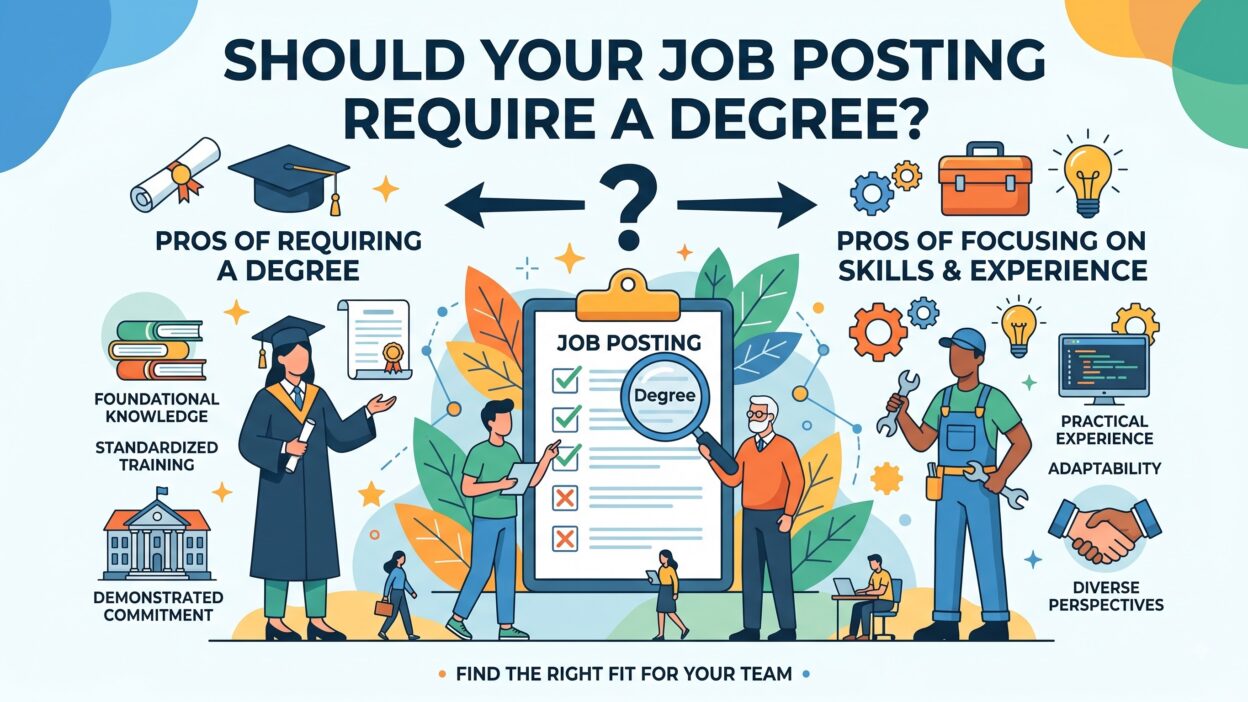
Some positions need a degree by law or by industry standard. A job posting for a licensed engineer or a registered nurse must include this requirement, since the role cannot legally operate without proper credentials. Skipping this requirement in these cases creates real compliance risk for a company.
Signaling a Baseline of Structured Learning
A degree can signal exposure to structured learning and long-term commitment. For certain research-heavy or highly technical roles, this background matters. A job posting for a data scientist role might reasonably value formal statistical training that a degree program provides consistently.
Simplifying Large-Scale Hiring
Large companies hiring at scale sometimes use a degree requirement to manage huge applicant volume. A job posting attracting thousands of applicants needs some filter to stay manageable. A degree requirement, while imperfect, gives recruiters one clear line to sort through a massive pool quickly.
The Case Against Requiring a Degree in a Job Posting
Blocking Skilled Candidates Without Credentials
Many skilled workers never finished a degree for personal or financial reasons. A job posting requiring one automatically excludes this group, even when their actual skills match the role perfectly. Companies lose access to a large, capable talent pool by keeping this requirement in place unnecessarily.
Widening Gaps in Diversity and Access
Degree requirements disproportionately affect candidates from lower-income backgrounds and underrepresented groups. A job posting that leans on this requirement can quietly narrow diversity within an applicant pool. Companies focused on building diverse teams often review this requirement first when auditing their hiring process.
Missing Out on Self-Taught Talent
Fields like software development and digital marketing now attract many self-taught professionals. A job posting demanding a degree ignores portfolios, certifications, and real project work that often prove more relevant than a diploma. Skilled self-taught candidates frequently outperform degree holders in fast-changing technical fields.
How to Decide If Your Job Posting Needs a Degree Requirement
Start by asking what the role actually needs day to day. A job posting should reflect real tasks, not outdated assumptions carried over from years ago. List the specific skills the role demands, then check whether a degree teaches those skills directly or whether experience teaches them just as well.
Talk to people already succeeding in similar roles within your company. Many perform well without the exact degree listed in their original job posting. This internal check often reveals that the requirement adds little real value beyond tradition. Legal or safety-critical roles remain the clear exception where a degree requirement stays necessary and appropriate.
Alternatives to a Degree Requirement in a Job Posting
Skills-Based Assessments
A skills test lets candidates prove ability directly, without needing a specific educational background. A job posting can replace a degree line with a request for a portfolio, a coding challenge, or a writing sample relevant to the role. This approach often reveals stronger signals than a diploma alone.
Years of Relevant Experience
Listing required years of experience instead of a degree keeps a job posting open to candidates who built skills through work rather than school. This approach values proven, applied experience over formal credentials, which fits many operational and technical roles well.
Certifications and Specialized Training
Certain certifications prove specific competence just as clearly as a degree does, sometimes more directly. A job posting can list an accepted certification as an alternative path, giving candidates flexibility while still confirming a baseline of relevant knowledge for the role.
Writing a Job Posting That Attracts the Right Candidates Without a Degree Requirement
A strong job posting focuses on outcomes and skills rather than credentials alone. Describe the actual work clearly, including the tools, tasks, and goals tied to the role. List required skills specifically instead of relying on a vague education line to filter candidates.
Mention that relevant experience or equivalent training counts alongside formal education, if you choose to keep a degree as one option among several. This phrasing widens your applicant pool without lowering your actual hiring bar. A well-written job posting built around real requirements attracts stronger, more relevant candidates than one built around outdated assumptions.
Industries Rethinking Degree Requirements in Job Postings
Technology companies lead this shift, with many major employers dropping degree requirements for numerous technical roles over recent years. Retail and logistics companies have followed a similar path for management positions, valuing hands-on experience over formal education. Government agencies in some regions have also begun removing degree requirements from job postings for roles where skills matter more than credentials.
This shift reflects a broader recognition that a degree does not always predict job performance accurately. Companies making this change often report a larger, more diverse applicant pool without any drop in overall hiring quality across their teams.
Risks of Removing a Degree Requirement Too Quickly
Removing a degree requirement without a clear alternative can create confusion during screening. A job posting needs some other clear filter, like a skills test or defined experience level, to replace the old requirement effectively. Without this replacement, recruiters may struggle to compare candidates fairly.
Certain regulated industries also carry legal risk if a job posting drops a required credential without proper review. Companies should confirm legal requirements before making changes to any job posting tied to licensed or regulated positions. A rushed change without a solid plan can create more hiring problems than it solves.
How Degree Requirements Affect Your Talent Pool Size
A degree requirement in a job posting shrinks the pool of eligible applicants significantly, often more than hiring teams expect. Many capable candidates get filtered out before a recruiter ever sees their resume. Removing or softening this requirement can increase applicant volume substantially for many roles.
A larger pool does mean more resumes to review, which requires stronger screening tools elsewhere in the process. Skills assessments and structured interviews help manage this larger volume effectively. The tradeoff often favors quality gains, since a wider pool increases the odds of finding a truly strong fit for the role.
Real World Examples of Job Postings Without Degree Requirements
A logistics company removed the degree requirement from its warehouse supervisor job posting and saw a noticeable increase in qualified applicants within months. A tech startup replaced its degree requirement with a coding challenge for developer roles, resulting in stronger technical hires overall. A retail chain shifted its management job posting language toward experience and leadership skills, widening its candidate pool considerably.
Each of these companies reported similar results: more applicants, more diversity, and no meaningful drop in performance among new hires. These examples show how a thoughtful change to a job posting can genuinely improve hiring outcomes across different industries.
Frequently Asked Questions
Does removing a degree requirement lower hiring standards? Not necessarily. A job posting can maintain high standards by replacing a degree requirement with clear skills tests or defined experience levels, keeping quality high while widening the applicant pool.
Which roles should always require a degree in a job posting? Roles with legal or licensing requirements, like medicine, law, or certain engineering positions, should keep the degree requirement. These fields carry compliance obligations that a job posting cannot ethically ignore.
How can a company test skills without a degree requirement? Skills assessments, portfolio reviews, and structured interviews all help evaluate real ability. A job posting can list these methods clearly, giving candidates a fair path to prove their capability directly.
Will removing a degree requirement increase the number of applicants? Usually yes. A job posting without a degree requirement typically attracts a larger and more diverse pool of applicants, since it removes a common barrier that filters out many capable candidates early.
Does a degree still matter for entry-level roles? It depends on the role. Some entry-level positions benefit from foundational knowledge a degree provides, while others rely more on trainable skills that a job posting can screen for directly instead.
How should a company update an old job posting with an outdated degree requirement? Start by reviewing what the role truly needs today. Replace vague education requirements with specific skills or experience levels, and consult legal guidance if the role falls under regulated industry rules.
Read More:-UnboundB2B: Data Accuracy Drives Switch from Low-Cost Competitor
Conclusion

Deciding whether a job posting should require a degree depends on the real demands of the role, not old habits. Some positions genuinely need the training a degree provides, especially in regulated or highly technical fields. Many others benefit more from skills-based hiring, which opens the door to a wider, more diverse group of capable candidates. A thoughtful job posting reflects actual job requirements clearly, whether that includes a degree or not. Companies willing to rethink this old default often find stronger candidates hiding just outside the traditional path, ready to prove their value through skills instead of a diploma alone.