Introduction
TL;DR Every business collects data today. Every business also faces a hard question. How do you protect that data the right way? Data privacy compliance is not a trend anymore. It is a requirement. Companies across every industry now build entire teams around data privacy compliance. Customers demand it. Regulators enforce it. Courts punish those who skip it.
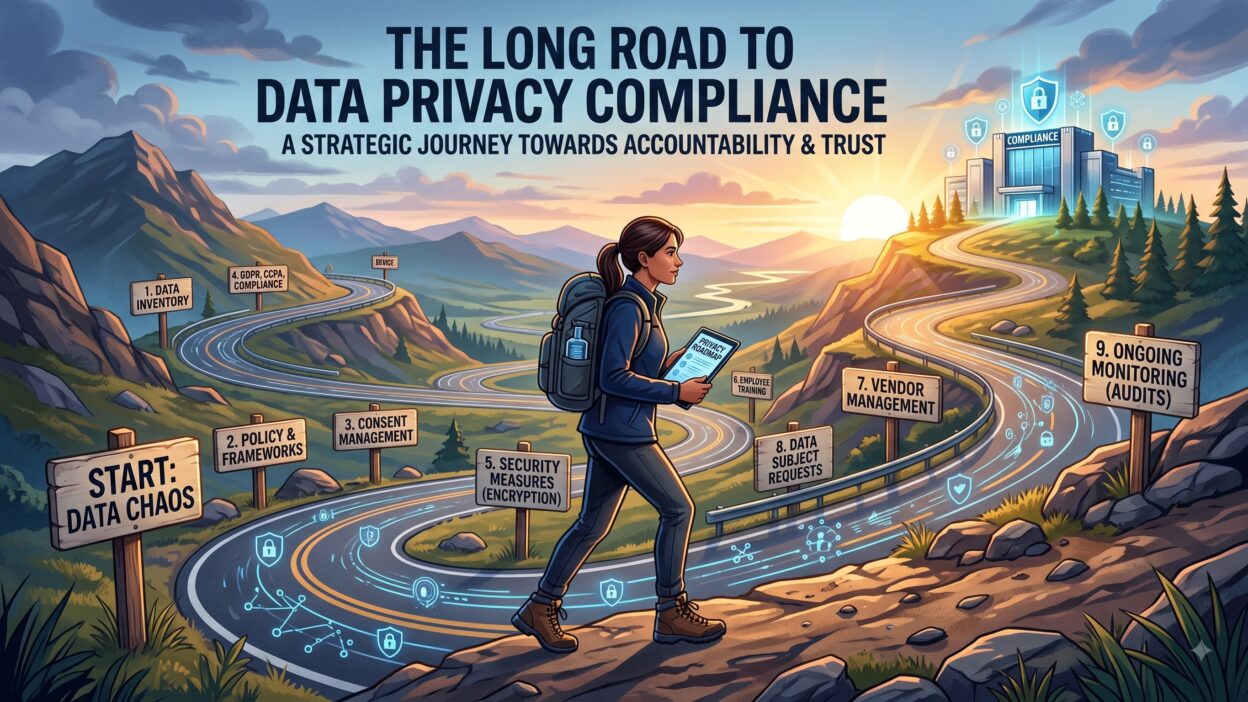
This guide walks through the full journey toward data privacy compliance. You will learn why it matters. You will learn where it started. You will learn how to build a real strategy for data privacy compliance inside your own company. The road is long. The road is also necessary. Let’s start at the beginning.
Table of Contents
What Data Privacy Compliance Really Means
Data privacy compliance means one simple thing at its core. A company follows the rules set for handling personal data. Those rules cover collection. They cover storage. They cover sharing and deletion too. A company cannot just say it cares about privacy. It must prove that care through action.
Personal data includes names, emails, and phone numbers. It also includes location data, browsing habits, and health records. Any piece of information tied to a real person counts. Data privacy compliance protects that information from misuse. It stops companies from selling data without permission. It stops hackers from walking away with sensitive files.
The Core Principles Behind Compliance
Every data privacy compliance framework rests on a few shared ideas. Consent sits at the top of that list. A company must ask before it collects personal data. Transparency comes next. Users deserve to know what happens to their information. Minimization matters too. Companies should only collect data they actually need.
Accountability closes the loop. A business must show proof of its data privacy compliance efforts. Regulators expect documentation. They expect policies. They expect real evidence, not empty promises.
Why Businesses Cannot Ignore It Anymore
Data breaches hit the news every single week. Customers read those stories. They grow cautious about who gets their data. A single leak can destroy years of trust in days. Data privacy compliance protects a brand’s reputation just as much as it protects user data.
Regulators also watch closely now. Fines reach millions of dollars for serious violations. Small businesses face real risk too. No company sits too small to attract an audit. Data privacy compliance stopped being optional the moment lawmakers started writing real penalties into law.
The History and Evolution of Privacy Laws
Privacy law did not appear overnight. It grew slowly across many decades. Early rules focused mostly on government records. Banks and hospitals faced narrow requirements too. The internet changed everything. Data started moving across borders in seconds. Old laws could not keep pace with that speed.
From Early Regulations to GDPR
Europe took the first major step toward modern data privacy compliance. The General Data Protection Regulation, known as GDPR, arrived in 2018. It reshaped how companies around the world treat personal data. GDPR gave users clear rights. They could access their data. They could ask for deletion. They could refuse tracking outright.
GDPR also introduced serious fines. Companies faced penalties reaching four percent of global revenue. That number got everyone’s attention fast. Businesses outside Europe started paying attention too. Any company serving European customers had to meet GDPR compliance standards, regardless of where its headquarters sat.
The Rise of CCPA and Other State Laws
The United States followed a different path. Instead of one federal law, individual states wrote their own rules. California led the way with the California Consumer Privacy Act, known as CCPA. It gave residents control over their personal data. Businesses had to disclose what they collected. They had to offer an opt out option for data sales.
Other states joined soon after. Virginia, Colorado, and Connecticut all passed their own privacy laws. Each law carries slightly different rules. This patchwork approach makes data privacy compliance harder for companies operating nationwide. A business must track dozens of separate requirements at once. The compliance map keeps growing every single year.
Key Data Privacy Regulations Around the World
Data privacy compliance looks different depending on the region. Companies operating globally must study each law separately. No single rulebook covers every market.
GDPR in Europe
GDPR remains the strictest privacy law in the world. It applies to any company that handles data from European residents. This rule holds true even if the company sits outside Europe entirely. GDPR compliance requires a data protection officer for many organizations. It also requires breach notification within seventy two hours.
Consent under GDPR must be clear and specific. Pre-checked boxes do not count as valid consent. Users must take an active step to agree. This single rule forced thousands of websites to rebuild their cookie banners.
CCPA and US State Laws
CCPA compliance focuses heavily on transparency and choice. California residents can request a full list of collected data. They can also demand deletion of that data. Businesses earning over twenty five million dollars in revenue must comply. Smaller companies handling large amounts of data must comply too.
Other American states copied parts of the CCPA model. Some added stricter rules around sensitive data like biometric information. Health data and genetic data now carry extra protection in several states. Data privacy compliance teams must track each new law as it passes.
Other Global Frameworks
Brazil passed its own law called LGPD. It mirrors many GDPR principles closely. Canada enforces PIPEDA, a law focused on consent and accountability. India introduced its Digital Personal Data Protection Act to cover its massive user base. China enforces the Personal Information Protection Law with strict rules on cross border data transfer.
Each country builds its own version of data privacy compliance. The core ideas repeat across borders. Consent matters everywhere. Transparency matters everywhere. Strong security matters everywhere too.
Common Challenges Businesses Face on the Compliance Journey
The road toward data privacy compliance rarely runs smooth. Companies hit real obstacles at every stage. Some challenges come from technology. Others come from budget limits or plain confusion about the rules.
Data Mapping and Inventory Issues
A company cannot protect data it cannot find. Many businesses store information across dozens of systems. Old spreadsheets sit next to modern databases. Cloud storage sits next to physical file cabinets. Mapping all of this takes real time and effort.
Without a clear map, data privacy compliance becomes guesswork. A company might miss an entire database during an audit. That gap can lead to a major violation later. Full visibility forms the foundation of any real compliance program.
Cross Border Data Transfer Problems
Global companies move data across countries every day. Each transfer must follow strict rules. Europe requires specific legal mechanisms before data leaves the region. The United States lacks one unified federal law, which creates confusion for international partners.
A single customer’s data might travel through three different countries. Each stop introduces new legal requirements. Data privacy compliance teams must track every hop in that journey. Mistakes here carry heavy fines and long legal battles.
Limited Budget and Resources
Small businesses often lack a dedicated privacy team. One person might handle legal, security, and compliance duties together. That workload creates gaps. Important tasks slip through the cracks during busy periods.
Compliance software costs money too. Legal counsel costs money. Employee training costs money. Many companies delay these investments until a breach forces their hand. By then, the damage already happened. Building data privacy compliance into the budget early saves money down the road.
Building a Strong Data Privacy Compliance Strategy
A real strategy turns data privacy compliance from a burden into a habit. It requires planning, clear ownership, and steady follow through.
Conducting a Privacy Audit
Every strategy starts with an honest audit. A company must list every place it stores personal data. It must list every vendor that touches that data too. This audit reveals gaps fast. It shows which systems need better security. It shows which policies need a rewrite.
Audits should happen on a regular schedule. Annual reviews work well for most businesses. Companies handling sensitive data might need quarterly checks instead. Data privacy compliance stays strong only through consistent review.
Creating Clear Data Policies
Policies turn good intentions into daily practice. A strong privacy policy tells users exactly what data a company collects. It explains why the company needs that data. It explains how long the company keeps it. Vague language creates confusion and legal risk.
Internal policies matter just as much as public ones. Employees need clear rules about data handling. They need to know who can access sensitive files. They need to know how to report a suspected breach. Data privacy compliance depends on policies that everyone actually reads and follows.
Training Employees on Privacy Practices
Technology alone cannot protect data. People make mistakes. A single careless email can expose thousands of records. Regular training cuts that risk significantly.
New hires should learn privacy basics during onboarding. Existing staff should refresh that knowledge every year. Real world examples help the lessons stick. A short story about a phishing attack teaches more than a dense policy document. Data privacy compliance becomes part of company culture once training becomes routine instead of a one time event.
Strong training also builds a reporting culture. Employees should feel safe flagging a mistake early. Early reports limit damage. Silence and fear only make breaches worse.
The Role of Technology in Data Privacy Compliance
Technology now plays a central role in any privacy program. Manual tracking cannot keep pace with modern data volumes.
Automation Tools for Compliance Management
Compliance software scans systems for personal data automatically. It flags outdated records for deletion. It tracks consent across every touchpoint. These tools save countless hours compared to manual spreadsheets.
Automated tools also help during audits. They generate reports instantly. They show regulators exactly what data a company holds and why. Data privacy compliance moves much faster once automation handles the repetitive work.
Encryption and Data Security Measures
Strong encryption protects data even during a breach. Hackers cannot read encrypted files without the right key. Companies should encrypt data both at rest and during transfer. This single step blocks many common attacks.
Access controls matter too. Not every employee needs access to every file. Limiting access reduces the damage from a single compromised account. Multi factor authentication adds another strong layer of defense. Together, these tools form the technical backbone of data privacy compliance.
The Cost of Non Compliance
Skipping data privacy compliance carries a steep price. The costs go far beyond a single fine.
Financial Penalties
Regulators do not hesitate to punish violations. GDPR fines have reached hundreds of millions of dollars for major companies. CCPA penalties add up quickly too, especially for repeated violations. Legal fees stack on top of those fines. Lawsuits from affected users add even more cost.
Smaller companies feel this pain just as hard. A fine that barely dents a large corporation can bankrupt a small business. Data privacy compliance costs far less than the price of a violation.
Reputation Damage
Money represents only part of the loss. Trust takes years to build and moments to destroy. Customers leave brands that mishandle their data. News of a breach spreads fast across social media. Competitors gladly welcome those departing customers.
Investors also watch compliance records closely now. A poor privacy track record can scare away funding. Partners may cancel contracts over compliance concerns. Data privacy compliance protects far more than a balance sheet. It protects the entire relationship between a brand and its customers.
The Future of Data Privacy Compliance
Privacy law keeps evolving. Companies must watch these shifts closely to stay ahead.
Emerging Trends and Predictions
More countries will pass comprehensive privacy laws in the coming years. The patchwork of state and national rules will likely grow before it simplifies. Global businesses should expect more overlap between regulations, not less. Data privacy compliance will demand broader thinking rather than narrow, country specific fixes.
Users will keep demanding more control too. Expect stronger rights around data portability. Expect clearer rules about automated decision making. Companies that adapt early will hold a real advantage over slower competitors.
The Growing Role of AI Regulation
Artificial intelligence adds a new layer to this story. AI systems process massive amounts of personal data. Lawmakers now write rules specifically targeting AI decision making. The European Union already passed the AI Act, which overlaps heavily with existing privacy law.
Companies using AI tools must fold this new layer into their existing programs. Data privacy compliance and AI governance will merge into a single discipline over the next few years. Businesses that treat them as separate issues will fall behind.
Frequently Asked Questions on Data Privacy Compliance
What is data privacy compliance in simple terms?
Data privacy compliance means following the legal rules for collecting, storing, and sharing personal data. It protects users and shields companies from fines.
Which law applies to my business?
The answer depends on your customers’ location. A company serving European residents must follow GDPR. A company serving California residents must follow CCPA. Many businesses must follow several laws at once.
How often should a company review its privacy policy?
Most experts recommend a review every year. Companies handling sensitive data should review policies more often, ideally every quarter.
What happens during a data breach?
A company must notify affected users quickly. Many laws require notification within a strict window, often seventy two hours. Delayed reporting can lead to extra fines.
Can a small business ignore data privacy compliance?
No business can safely ignore it. Regulators fine companies of every size. A small business often lacks the resources to survive a major fine, which makes early compliance even more important.
Does encryption alone guarantee compliance?
Encryption helps a great deal, but it does not cover every requirement. Data privacy compliance also needs clear policies, employee training, and proper consent management.
Read More:-Digging Into Customer Churn Data: A Guide to Better Retention
Conclusion

Data privacy compliance takes real effort. It demands strong policies. It demands the right technology. It demands a workforce that understands why the rules matter. The road feels long because it truly is long. Laws keep changing. Threats keep evolving. Customer expectations keep rising too.
Companies that treat data privacy compliance as a core value, not a checkbox, build stronger relationships with their customers. They avoid costly fines. They protect their reputation for years to come. The businesses that start this journey today will face far less risk tomorrow. Data privacy compliance is not a destination. It stays a constant, ongoing commitment.