Introduction
TL;DR Large companies juggle thousands of customer relationships at once. A simple spreadsheet cannot handle that load. A basic CRM tool often struggles too. Enterprise CRM steps in to solve this exact problem. It gives big organizations the power to manage massive amounts of customer data without losing control.
This guide explains enterprise CRM in plain language. It covers core features, real benefits, and the top platforms on the market today. By the end, you will understand exactly what enterprise CRM offers and how to choose the right one for your organization.
Table of Contents
What Is Enterprise CRM?
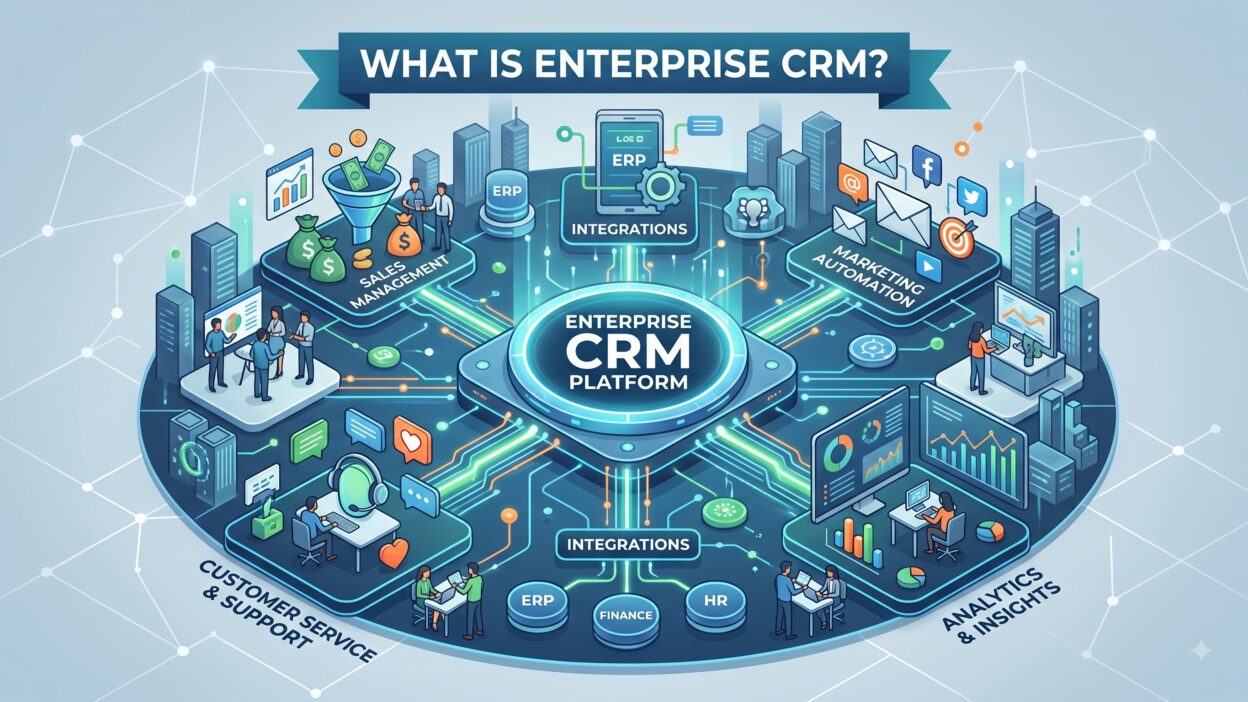
Enterprise CRM is a customer relationship management system built for large, complex organizations. It handles massive data volumes across many departments at once. Sales, marketing, and support teams all pull from the same central system. This shared access keeps everyone working from accurate, current customer information.
Standard CRM tools work fine for small teams with simple needs. Enterprise CRM handles far more complexity. It supports thousands of users at the same time. It connects with dozens of other business systems too, from accounting software to supply chain tools.
A Simple Definition
Enterprise CRM centralizes every customer interaction into one platform. A sales rep can see past purchases instantly. A support agent can see open tickets from any department. Marketing teams can track campaign performance against real sales data. This connected view eliminates the silos that slow down large organizations.
How It Differs From Standard CRM
Standard CRM tools focus on core sales tracking. They handle contacts, deals, and basic reporting well. Enterprise CRM goes much further. It adds advanced customization, deeper analytics, and stronger security controls. It also supports far larger user counts without slowing down.
A small business might run smoothly on a basic CRM for years. A global enterprise needs the extra power that enterprise CRM provides from day one.
Core Features Of Enterprise CRM
Enterprise CRM platforms share a common set of powerful features. These features separate them clearly from lighter, small business tools.
Advanced Customization Options
Every large organization runs differently. Enterprise CRM allows deep customization to match those unique workflows. Custom fields, custom dashboards, and custom automation rules all adjust to fit a specific business. A manufacturing company can build workflows completely different from a financial services firm, all within the same underlying platform.
Multi Department Integration
Large companies rarely operate through sales alone. Enterprise CRM connects sales, marketing, support, and finance into one shared system. A finance team can see contract values directly tied to active deals. A support team can see purchase history without asking a separate department. This integration removes the friction that slows down cross team collaboration.
Enterprise Grade Security
Data breaches cost large companies far more than small ones, both financially and reputationally. Enterprise CRM includes strong security features built for this higher stakes environment. Role based access controls limit who can see sensitive data. Encryption protects information both in storage and during transfer. Detailed audit logs track every change made inside the system.
Why Large Companies Need Enterprise CRM
Small business tools simply cannot keep pace with enterprise level demands. Large companies face unique challenges that require a stronger system.
Managing Complex Sales Pipelines
Enterprise sales cycles often stretch across many months. Multiple stakeholders get involved in a single deal. Enterprise CRM tracks every touchpoint across that long, complex journey. It shows which decision makers engaged, which proposals went out, and which steps still remain. This visibility keeps large sales teams organized and aligned.
Supporting Global Teams
Many enterprises operate across multiple countries and time zones. Enterprise CRM supports this global structure through multi language interfaces and regional data compliance settings. A sales team in Tokyo and a support team in London can both work inside the same platform, using data that stays perfectly synchronized in real time.
Key Benefits Of Enterprise CRM
Enterprise CRM delivers real, measurable value once fully implemented across an organization.
Better Data Visibility Across Teams
Scattered data creates blind spots. Enterprise CRM pulls every customer interaction into one unified view. A manager can see performance across every region instantly. This visibility helps leadership make faster, better informed decisions across the entire business.
Stronger Customer Relationships
Customers expect a consistent experience, no matter which department they contact. Enterprise CRM makes this consistency possible. A support agent can see a customer’s full history before answering a single question. This context builds trust and shortens resolution times significantly.
Improved Forecasting And Reporting
Enterprise CRM platforms include powerful reporting tools built for large data sets. Sales leaders can forecast revenue with far greater accuracy. Marketing teams can measure campaign return on investment down to the individual lead. These insights help large organizations plan budgets and strategy with real confidence.
Enterprise CRM vs Small Business CRM
Understanding the difference helps a company avoid choosing the wrong tool for its size.
Scale And User Capacity
Small business CRM tools often cap out around a few hundred users. Enterprise CRM supports thousands of users without performance loss. Data storage limits also scale far higher, which matters greatly for companies handling millions of customer records.
Pricing And Implementation Time
Small business CRM tools launch quickly, often within days. Enterprise CRM requires much longer implementation, sometimes stretching across several months. Pricing reflects that difference too. Enterprise CRM contracts often include custom pricing based on user count, feature needs, and integration complexity.
Popular Enterprise CRM Platforms
Several major vendors dominate the enterprise CRM market today. Each platform brings distinct strengths.
Salesforce
Salesforce remains one of the most widely used enterprise CRM platforms in the world. It offers deep customization through its App Exchange marketplace. Large companies favor Salesforce for its flexibility and massive third party integration library.
Microsoft Dynamics 365
Microsoft Dynamics 365 appeals strongly to companies already using Microsoft’s broader software ecosystem. It connects smoothly with tools like Outlook, Teams, and Excel. This tight integration makes daily adoption easier for teams already familiar with Microsoft products.
SAP And Oracle Solutions
SAP and Oracle both offer enterprise CRM solutions built for companies already running their broader enterprise resource planning systems. These platforms shine in industries with complex supply chains, since customer data connects directly with inventory and logistics systems.
How To Choose The Right Enterprise CRM
Selecting the right platform takes careful planning. A rushed decision often leads to costly problems down the road.
Assessing Business Needs First
Every enterprise CRM search should start with a clear list of business needs. A company should map out its sales process, support workflow, and reporting requirements before evaluating any vendor. This clarity prevents a team from choosing a platform based on flashy features that do not actually solve real problems.
Planning For Integration
Enterprise CRM rarely operates alone. It must connect with existing tools like accounting software, marketing platforms, and inventory systems. A company should confirm integration compatibility early in the evaluation process. Poor integration planning causes major delays during implementation.
Evaluating Vendor Support
Enterprise CRM implementation involves real complexity, and strong vendor support matters greatly during that process. A company should ask about training resources, response times, and dedicated account management before signing any contract. Weak support during rollout often leads to slow adoption across the organization.
Common Challenges During Enterprise CRM Implementation
Even the best enterprise CRM platform can run into trouble during rollout. Planning ahead helps a company avoid these common pitfalls.
Data Migration Issues
Moving years of customer data into a new system carries real risk. Duplicate records, missing fields, and formatting errors all commonly appear during migration. A company should clean its existing data before migration begins, which saves significant time and prevents costly errors later.
User Adoption Resistance
Employees often resist new systems, especially after years of using familiar tools. Enterprise CRM only delivers value once teams actually use it consistently. Strong training programs and clear communication about the benefits help ease this transition. Leadership support also plays a major role in driving adoption across every department.
Frequently Asked Questions on Enterprise CRM
What makes enterprise CRM different from regular CRM software?
Enterprise CRM supports far larger user counts, deeper customization, and stronger security. It also integrates across more departments than a standard small business CRM tool.
How long does enterprise CRM implementation usually take?
Implementation often takes three to twelve months, depending on company size and data complexity. Larger organizations with more integrations usually see longer timelines.
Is enterprise CRM worth the higher cost?
For large organizations managing complex sales and support operations, enterprise CRM often pays for itself through better efficiency and stronger customer retention.
Which enterprise CRM platform works best for global companies?
Salesforce and Microsoft Dynamics 365 both offer strong support for global operations, including multi language interfaces and regional compliance features.
Can a growing mid size company use enterprise CRM?
Yes, many mid size companies adopt enterprise CRM when they anticipate rapid growth. Choosing a scalable platform early can prevent a costly migration later.
Read More:-Data Decay & Your B2B Database
Conclusion

Enterprise CRM gives large organizations the power to manage customer relationships at real scale. It connects departments, strengthens security, and delivers insights that smaller tools simply cannot match. The right platform depends heavily on a company’s specific needs, existing systems, and growth plans.
Choosing enterprise CRM takes careful research and honest planning. Companies that invest that time upfront see stronger adoption and faster returns. Enterprise CRM is not just software. It becomes the backbone of how a large organization understands and serves its customers every single day.