Introduction
TL;DR Trade shows cost real money. Booth space, travel, staff time, and printed materials add up fast. A booth that only collects business cards wastes that entire budget. Strong lead generation ideas turn a crowded show floor into a real pipeline of qualified prospects your sales team can actually work.
This guide walks through practical lead generation ideas for every stage of an event, from the weeks before doors open to the follow-up that happens after everyone flies home. You get tactics for trade show booths and tactics built specifically for corporate events like conferences and private summits. You also get common mistakes to avoid and answers to the questions event marketers ask most.
Companies that plan their lead generation ideas early walk away with a real list of qualified contacts. Companies that wing it walk away with a stack of business cards nobody follows up on. This guide shows you exactly how to avoid that outcome.
Table of Contents
Why Trade Shows and Corporate Events Need Fresh Lead Generation Ideas
Attendees walk past hundreds of booths at a typical trade show. A generic table with brochures and a candy bowl blends into the background within seconds. Fresh lead generation ideas make your booth memorable enough to earn a real conversation instead of a quick glance.
Corporate events carry different pressure. Attendees already paid for a ticket or accepted an invite, so they expect real value from every session and every interaction. Lead generation ideas built for this setting need to feel helpful, not pushy, or attendees disengage fast.
Budget scrutiny plays a role too. Event marketing often faces tough questions from finance about return on investment. Strong lead generation ideas give your team a clear story about how many qualified leads a show produced and how that pipeline turned into closed revenue later.
Sales teams also expect better handoffs than a spreadsheet of scanned badges. Lead generation ideas that capture real context, like what a prospect asked about or which product interested them most, give reps something useful to work with on the first follow-up call.
Event marketing also competes for budget against digital channels that offer cleaner tracking and faster reporting. A trade show that produces vague results loses out to a paid campaign with a clear dashboard, even if the trade show actually drove better long term relationships. Sharp lead generation ideas give event marketers the same kind of clear story digital channels already provide, which protects the budget for future shows.
Marketing leaders also use this data to decide which shows deserve a bigger presence next year. A show that produces a steady stream of qualified leads earns a larger booth and a bigger team the following season. A show that produces weak results, tracked honestly, gets cut from the calendar entirely. Strong lead generation ideas give leadership the evidence needed to make these calls with confidence instead of gut feeling alone.
Pre-Event Lead Generation Ideas
The strongest lead generation ideas start weeks before the event, not on the morning the doors open. A little preparation drives real booth traffic and books meetings before your team even packs a bag.
Build Buzz With Pre-Show Email Campaigns
Send a series of emails to your existing contact list announcing your presence at the show. Mention your booth number and tease anything special happening there, like a giveaway or a guest speaker. A simple three-email sequence spread across a few weeks keeps the event on people’s radar without feeling like spam.
Segment this campaign by account type when possible. Current customers might care about a product roadmap session, while prospects care more about a live demo. Tailored messaging drives higher open rates and stronger booth turnout from people who already know your brand.
Use Social Media Teasers to Drive Booth Traffic
Post short teasers on LinkedIn and other channels leading up to the show. Show a sneak peek of your booth design or tease a new feature launch happening on the floor. Tag the event’s official account to tap into their audience and expand your reach beyond your own followers.
Encourage your team members attending the show to post as well. Personal posts from employees often reach a wider, more engaged audience than a single company account post. This grassroots visibility works as one of the simplest lead generation ideas available to any team, regardless of budget.
Book Meetings Before the Event Starts
Reach out directly to target accounts already registered for the show and ask for a short meeting slot. A pre-booked fifteen-minute conversation beats a hopeful walk-by every time. Sales development reps often own this outreach, working through a list of accounts pulled from the event’s attendee directory.
This tactic works especially well for corporate events with a smaller, more curated guest list. A private summit with two hundred attendees gives your team a real shot at booking meaningful time with most of the people who matter most to your pipeline.
Offer Early Access or Exclusive Previews
Give your email list a reason to stop by beyond curiosity. Offer early access to a new product feature or a private demo slot only available to people who register ahead of time. Exclusivity drives action better than a generic invitation ever does.
This idea also works well for gated content tied to the event. A research report or industry benchmark released exclusively to attendees gives people a reason to visit your booth and provide their contact details in exchange for the material.
On-Site Lead Generation Ideas
Once the show floor opens, execution matters more than planning. These lead generation ideas focus on capturing attention and collecting real contact information without feeling intrusive.
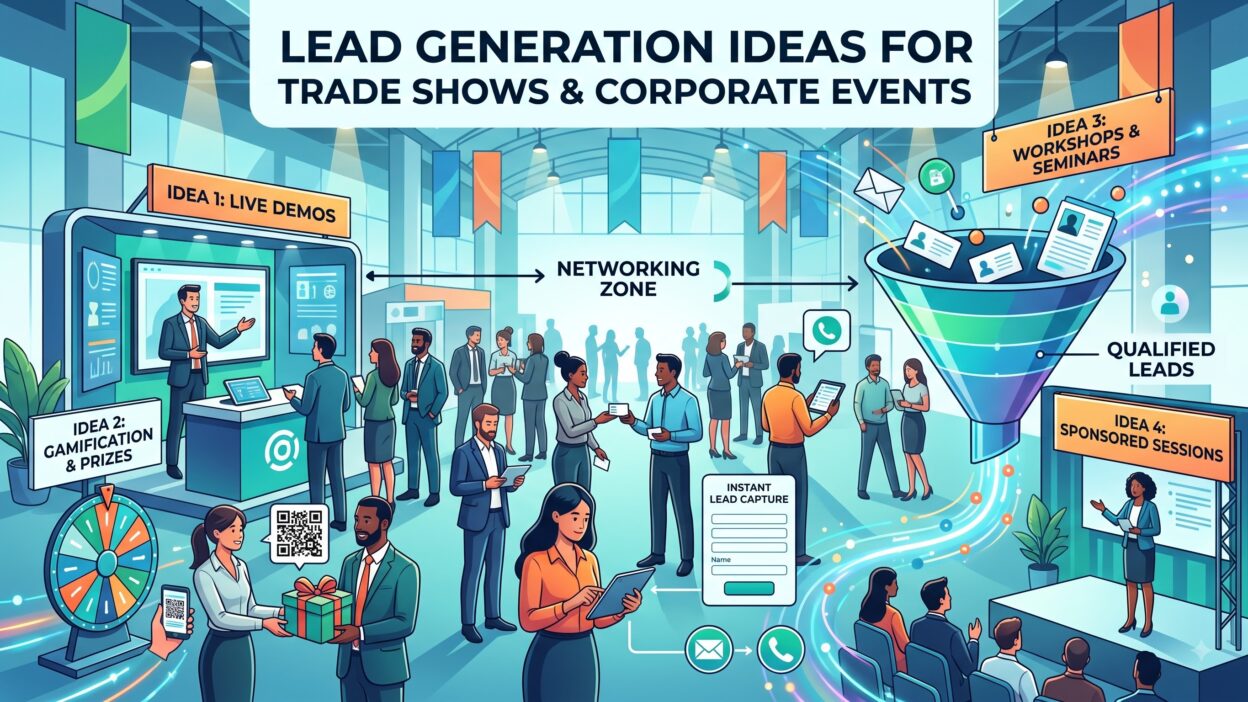
Interactive Booth Experiences
A booth that invites people to touch, try, or interact with something outperforms a booth built only for browsing. This might mean a live product sandbox, a quick assessment tool, or a physical activity tied loosely to your brand message. Interaction keeps people at your booth longer, which gives your team more time for a real conversation.
Design the experience so it naturally leads into a conversation about your product. A fun activity with no connection to your business entertains people but rarely produces a qualified lead. The best lead generation ideas blend engagement with genuine relevance to what you sell.
Gamification and Contests
A simple contest, like a prize wheel or a short trivia game, draws a crowd and creates a natural reason to collect contact information. Keep the entry process quick so it does not feel like a chore standing between someone and a prize. A quick badge scan or a short form works well here.
Tie the contest questions to your product or industry when possible. A trivia question about a common industry challenge opens a natural door for your team to ask a qualifying follow-up question right at the booth.
Live Demos and Product Trials
Scheduled demo slots throughout the day give attendees a reason to plan their visit around your booth instead of wandering by randomly. Promote these time slots on a visible sign or screen so people know when to stop back. A packed demo session also creates social proof, drawing in passersby curious about the crowd.
Hands-on trials work even better than a scripted demo in many cases. Letting a prospect try the product themselves, even briefly, builds stronger interest than watching a rep click through slides. This remains one of the most effective lead generation ideas for technical or software products.
Badge Scanning and Digital Lead Capture
Most trade shows provide badge scanners that capture attendee contact details instantly. Use this tool at every meaningful interaction, not just formal sign-ups. A quick scan during a casual conversation still counts as a captured lead worth following up on later.
Pair the scan with a note field whenever your system allows it. A short note like “asked about integrations” or “competitor of X” gives your sales team real context during follow-up. Raw contact data without context turns into a weak lead generation idea that reps struggle to act on quickly.
Speaking Slots and Panel Presence
Securing a speaking slot at the event puts your brand in front of an engaged audience without the noise of a crowded show floor. Attendees who sit through a session already show interest in the topic, which makes them a naturally qualified lead once the talk ends.
Promote your session ahead of time and collect contact information from attendees through a sign-up sheet or a QR code shown during the talk. A strong session builds credibility that a booth alone cannot match, and it ranks among the most valuable lead generation ideas for thought leadership focused teams.
Post-Event Lead Generation Ideas
The event ends, but the real work of turning contacts into pipeline starts right after. These lead generation ideas focus on fast, relevant follow-up that keeps momentum alive.
Fast Follow-Up Emails
Send a follow-up email within twenty-four to forty-eight hours of the event closing. Attendees meet dozens of vendors during a busy show, and memories fade fast once they return to their regular workload. A quick note referencing your specific conversation keeps you top of mind while the details still feel fresh.
Avoid a generic mass email sent to every scanned badge. A tailored note that references what someone asked about at your booth performs far better than a templated thank-you message with no personal detail attached.
Personalized Outreach Based on Booth Conversations
Sales reps should review their booth notes before making follow-up calls. A prospect who asked about pricing needs a different conversation than one who asked about a specific integration. Personalized outreach built on real context converts at a much higher rate than a generic call script.
This step relies heavily on the notes captured during badge scanning at the event itself. Teams that skip note-taking on the show floor lose this advantage entirely and end up working leads blind during the follow-up window.
Retargeting Ads for Booth Visitors
Upload your list of booth visitors into your ad platform and run a short retargeting campaign in the weeks after the event. Seeing a familiar ad reinforces the connection made on the show floor and keeps your brand visible while a prospect continues their research elsewhere.
Keep the messaging specific to the event when possible, referencing the show by name. This context reminds people exactly where the connection started and adds credibility that a generic ad lacks.
Nurture Sequences for Long Sales Cycles
Not every lead converts within the first few weeks after an event, especially in industries with longer buying cycles. Build a nurture sequence that delivers useful content over several months instead of pushing for a sale too early. This keeps leads warm until they reach a point where they are ready to talk seriously.
This approach works well alongside the other lead generation ideas covered here, since it captures value from contacts who need more time before a real conversation makes sense.
Corporate Event Specific Lead Generation Ideas
Corporate events like private conferences, user summits, and executive dinners call for a different approach than a public trade show floor. Attendees already invested time to attend, so the bar for value sits higher than at a walk-by booth interaction.
Host a small breakout session focused on a specific challenge your audience faces. A focused, practical session earns more trust than a broad sales pitch dressed up as content. Attendees who show up for this kind of session already signal real interest in the topic your product solves.
Use structured networking to your advantage during these events. A round table discussion or a curated dinner with a handful of target accounts creates space for deeper conversation than a crowded show floor ever allows. These smaller settings often produce stronger, more qualified leads than a high traffic booth.
Collect feedback through a short survey at the end of a session or the full event. This gives you a natural reason to gather contact information while also learning what topics resonate most with your audience. A well-timed survey ranks among the more underused lead generation ideas at corporate events, since most teams skip this simple step entirely.
Executive attendees at corporate events respond well to direct, low-pressure invitations rather than a hard sales pitch. A quiet one-on-one conversation over coffee often produces a stronger connection than a formal pitch delivered in front of a group.
Common Mistakes Teams Make With Trade Show Lead Generation
Many teams focus all their energy on the event itself and skip pre-show outreach entirely. Without early promotion, booth traffic depends entirely on random foot traffic, which wastes the most valuable lead generation ideas available before the show even starts.
Another common mistake involves collecting contact information without any context attached. A badge scan with no notes turns into a cold lead that a sales rep has to work from scratch. Context captured in the moment makes every follow-up conversation stronger and faster.
Some teams also treat every scanned badge as an equal lead, regardless of engagement level. A person who spent thirty seconds grabbing a pen deserves a different follow-up than someone who sat through a full demo. Segmenting leads by engagement level right after the event saves your sales team from wasted effort chasing weak contacts.
Slow follow-up causes real damage too. Waiting two or three weeks after a show to send a first email lets interest fade completely. Attendees meet many vendors during a busy event, and a delayed message often gets ignored or forgotten by the time it arrives.
Finally, some teams never measure which lead generation ideas actually produced pipeline after the show. Without tracking source data through the CRM, teams repeat the same booth strategy year after year without knowing what truly worked and what wasted budget.
Tools That Support Lead Generation at Events
A CRM sits at the center of any event lead generation strategy, since every contact captured needs a home where sales can follow up. Platforms like Salesforce and HubSpot let teams tag leads by event source and track how each one moves through the pipeline afterward.
Badge scanning apps speed up on-site data capture and often sync directly with a CRM in real time. Many of these tools also let reps add quick notes right after a conversation, preserving context that would otherwise disappear by the end of the day.
Event management platforms handle registration, session sign-ups, and attendee communication before and after the show. These platforms often include built-in analytics showing which sessions or booth activities drove the strongest engagement.
Marketing automation tools power the follow-up sequences and nurture campaigns that turn a raw contact list into warm pipeline. Automated workflows triggered by event attendance save your team hours of manual outreach while keeping messaging timely and relevant.
The right stack depends on your event size and internal resources available for setup. Smaller teams often start with a CRM and a simple badge scanner, adding automation tools as their event program grows and their lead generation ideas become more advanced.
Analytics dashboards tie everything together once the event ends and the data settles. A dashboard showing lead volume, conversion rate, and pipeline value by event lets marketing leaders compare shows side by side. This comparison shapes next year’s event calendar and budget allocation far better than a gut instinct about which show felt busiest on the floor.
QR codes deserve a mention too, since they bridge the gap between physical booth materials and digital capture forms. A printed sign with a QR code linking to a short form or a content download gives attendees a low-friction way to opt in without waiting in line at a scanner. This small addition often becomes one of the easiest lead generation ideas to implement, since it requires almost no technical setup beyond a printed code.
Frequently Asked Questions
What are the best lead generation ideas for a small trade show budget?
Focus on pre-show email outreach and social media teasers, since both cost little beyond staff time. A simple interactive activity at the booth, like a short quiz tied to your product, also drives engagement without requiring expensive booth design or giveaways.
How many leads should a trade show booth generate?
This depends heavily on booth traffic, event size, and how aggressive your team’s engagement tactics are during the show. A better benchmark than raw lead count is the percentage of captured leads that convert into a real sales conversation within thirty days.
What is the best way to follow up after a trade show?
Send a personalized email within forty-eight hours referencing the specific conversation you had at the booth. Avoid a generic thank-you template sent to every scanned badge, since personalized outreach converts at a much higher rate than a mass message.
How do corporate events differ from trade shows for lead generation?
Corporate events involve a smaller, more curated audience that already invested time to attend. Lead generation ideas here focus more on deep engagement through breakout sessions and structured networking, rather than high volume booth traffic tactics used at large trade shows.
Should we prioritize quantity or quality when capturing leads at events?
Quality wins in almost every case for B2B events. A smaller list of well-qualified, properly contextualized leads produces more pipeline than a large list of badge scans with no follow-up context attached to them.
How do we measure ROI from our trade show lead generation ideas?
Tag every lead in your CRM with the event source and track how many convert into pipeline and closed revenue over the following months. Compare this revenue against total event cost, including booth space, travel, and staff time, to calculate a real return figure.
Read More:-Sales Capacity Planning: How to Model the Team Your Revenue Target Needs
Conclusion

Strong lead generation ideas turn an expensive trade show or corporate event into a real, measurable source of pipeline. Pre-event outreach builds anticipation and books meetings before the doors even open. On-site tactics like interactive experiences and live demos capture attention and real contact details. Post-event follow-up turns those contacts into warm conversations before interest fades.
Corporate events call for a slightly different approach, favoring deeper engagement over high volume booth traffic. Small breakout sessions, structured networking, and quick surveys often produce more qualified leads than a crowded show floor ever could on its own.
Avoid the common mistakes that drain value from an event budget, like skipping pre-show promotion or following up too slowly. Track every lead back to its source so your team knows which lead generation ideas actually deliver revenue. Plan well, execute with intention, and your next event turns into a real pipeline engine instead of a stack of forgotten business cards.