Introduction
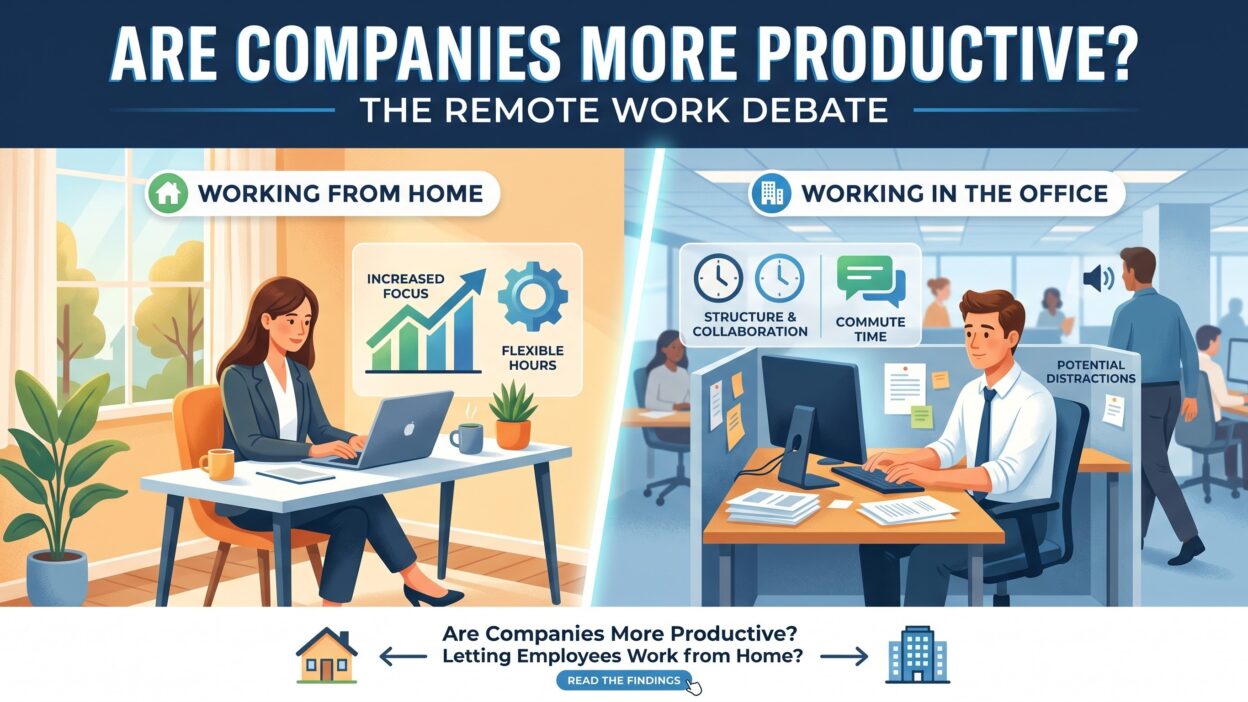
TL;DR The debate over work from home has not settled, even years after the pandemic forced the shift. Some executives push hard for a full return to the office. Others build their entire hiring strategy around remote flexibility. Both sides point to real data, which makes this question harder to answer than it first appears.
This guide walks through what the research actually shows about work from home and company output. You get the strongest arguments on both sides, a look at what large studies from Stanford and other institutions found, and a breakdown of which factors decide whether remote work helps or hurts a specific team. You also get answers to the questions business leaders ask most about this topic.
Companies that get this decision right build a real advantage in hiring and retention. Companies that get it wrong either force a return that drives away talent or maintain a remote setup that quietly damages collaboration. This guide gives you the evidence to make that call for your own organization.
Table of Contents
What Work from Home Actually Means Today
Work from home no longer describes one single arrangement. Some companies run fully remote, with employees scattered across cities or countries and no central office at all. Others run hybrid schedules, where staff split their week between home and a shared workspace. A smaller group still requires five days in the office every week.
This distinction matters more than most headlines suggest. A study that measures fully remote output tells you little about hybrid arrangements, and a hybrid result rarely applies to a fully distributed team. Business leaders need to separate these models before drawing conclusions about whether work from home helps or hurts their specific business.
The type of role also shapes what work from home looks like in practice. A software engineer writing code alone benefits from a quiet home office in a very different way than a sales rep who needs constant coordination with teammates. Any honest conversation about productivity needs to account for this variation instead of treating every job the same.
The Case For Work from Home Boosting Productivity
Supporters of work from home point to real, measurable gains across several areas. These arguments carry weight because they come from actual workplace data, not just employee preference surveys.
Fewer Interruptions and Deeper Focus
Open offices generate constant interruptions from conversations, meetings, and foot traffic throughout the day. A home office removes most of this noise, giving employees longer stretches of uninterrupted focus time. Deep, complex work often benefits the most from this quiet environment, especially for roles centered on writing, coding, or analysis.
Employees frequently report finishing focused tasks faster at home than in a busy office setting. This does not mean every task improves under this setup, but tasks that require concentration rather than constant collaboration often see a real boost from work from home arrangements.
Lower Commute Time and Fatigue
A daily commute eats into both time and energy before the workday even starts. Work from home removes this drain entirely, and employees often redirect at least some of that recovered time toward actual work output. Reduced fatigue also means employees show up to their first meeting of the day less depleted.
Some of this recovered time goes toward rest and personal tasks instead of extra work hours, and that tradeoff matters for a full picture. Even so, employees arrive at their desks less worn down, which supports steadier performance throughout a long workday.
Access to a Wider Talent Pool
Companies that embrace work from home hire outside their immediate city, opening the door to stronger candidates who would never consider relocating. This wider pool often means a better skills match for specialized roles that are hard to fill locally. A better fit between a role and a candidate’s actual strengths tends to produce stronger output over time.
This advantage compounds over several hiring cycles. A company drawing from a national or global pool builds a stronger team than one limited to commuting distance from a single office, and that stronger team shows up in the quality of the work produced.
The Case Against Full Work from Home
Critics of fully remote work raise concerns backed by their own set of data points. These concerns center mostly on what happens to teams over time, not on any single employee’s daily output.
Weaker Collaboration and Innovation
Spontaneous conversations near a desk or in a hallway often spark ideas that a scheduled video call rarely replicates. Research on innovation inside companies has found that new idea generation slows during fully remote and even hybrid periods, largely because collaboration becomes more deliberate and less accidental. These chance interactions matter more than many executives initially expected.
Complex problem-solving that requires real-time back-and-forth between several people also suffers in a fully remote setting more than routine individual tasks do. Teams working through a difficult technical challenge or a creative brainstorm often move faster in person, where ideas bounce quickly between people without the friction of scheduling a call.
Slower Onboarding for New Employees
New hires learn as much from watching colleagues work and asking quick questions as they do from formal training sessions. Fully remote onboarding strips away much of this informal learning, and some workplace research has found that new employees in remote-only environments take meaningfully longer to reach full productivity compared to those with some in-person exposure early on.
This gap shrinks once an employee builds enough context and relationships to work independently. The early months matter most, though, and a company hiring aggressively into a fully remote model needs a deliberate onboarding plan to close this gap instead of hoping it resolves on its own.
Manager Perception Gaps
A large share of business leaders say they struggle to trust that remote employees stay productive throughout the day, even when output data suggests otherwise. This gap between manager perception and actual performance creates real friction inside organizations, sometimes leading to policies built more on anxiety than evidence.
Employees, on the other hand, overwhelmingly report feeling productive while working from home. This disconnect points to a measurement problem more than a performance problem in many companies, since managers often lack clear visibility into output and default to worrying about visible activity instead.
What the Research Actually Shows
The strongest evidence on this topic comes from large, controlled studies rather than opinion surveys. A widely cited randomized trial led by Stanford economist Nicholas Bloom studied thousands of employees at a major travel company, comparing those working in the office five days a week against those on a hybrid schedule of three office days and two remote days. The study found essentially no difference in productivity between the two groups, while quit rates dropped sharply among the hybrid group.
This same research found that managers who initially expected hybrid work to hurt performance changed their minds once they saw the actual results play out over months. The financial upside from lower turnover alone made the hybrid arrangement highly profitable for the company, even before counting any productivity effects.
Fully remote work tells a more mixed story than hybrid arrangements do. Research examining IT professionals during an extended remote period found that output declined modestly, driven mainly by higher coordination costs and fewer informal interactions with colleagues and supervisors. Hours worked actually increased in this study, but total output still slipped, suggesting the extra hours went toward coordination rather than actual production.
Broader economic data adds more nuance to the picture. National labor statistics analyses have found a positive link between remote-capable industries and overall productivity growth across the wider economy, even as individual company studies show mixed results depending on role type and team structure. This gap between macro trends and individual firm data explains much of the ongoing disagreement among executives and researchers alike.
Hybrid Work as the Middle Ground
Given this mixed evidence, many companies now land on a hybrid schedule instead of choosing a fully remote or fully in-office model. This approach tries to capture the focus benefits of work from home while preserving enough in-person time for collaboration and mentorship.
The research on hybrid arrangements looks more favorable than the research on fully remote setups in most cases. Employees still get meaningful heads-down time at home, while scheduled office days protect the spontaneous interactions that support innovation and faster onboarding. This balance explains why hybrid models now cover a majority of remote-capable roles across large employers.
Getting the balance right still takes real effort from leadership. A hybrid schedule with no clear structure, where different employees choose random days, loses much of the collaboration benefit since teams rarely overlap in the office at the same time. Companies that coordinate in-office days across teams see stronger results than companies that leave the schedule entirely up to individual preference.
The Cost Side of Work from Home
Productivity numbers only tell part of the story, since company leaders also weigh cost when they decide on a work from home policy. Office space represents one of the largest fixed expenses many companies carry, and a smaller in-person footprint frees up real budget that can move toward hiring, tools, or salary increases instead.
Companies that shift toward work from home often shrink their office lease or move to a smaller shared space that fits a rotating hybrid schedule. This adjustment alone can save a company a meaningful percentage of its annual real estate budget, and that savings shows up directly on a balance sheet even before anyone measures a single productivity metric.
Turnover costs matter just as much, and they connect directly back to work from home policy. Replacing a skilled employee costs a company far more than most executives initially estimate, once recruiting time, training, and lost productivity during the transition all get counted together. Studies on hybrid arrangements consistently show lower quit rates among employees given some remote flexibility, and that retention effect alone often justifies the policy on financial grounds even before counting any output gains.
Equipment and setup costs shift under a work from home model too, though not always in an obvious direction. Some companies save on desks, parking, and office utilities. Other companies take on new costs, like a stipend for home office equipment or software that supports remote collaboration. Leaders need to weigh both sides of this ledger honestly instead of assuming remote work always costs less overall.
Factors That Determine Whether Work from Home Works
No single answer fits every company, and several factors shape whether work from home helps or hurts a specific organization.
Type of Role
Roles built around individual, focused output, like writing, coding, or data analysis, tend to hold up well or even improve under work from home arrangements. Roles that depend heavily on real-time coordination, like sales, customer support, or creative collaboration, often suffer more without regular in-person contact. Matching the work arrangement to the actual nature of the role matters more than applying one blanket policy across an entire company.
Company Culture and Communication Habits
Companies with strong documentation habits and clear asynchronous communication tools adapt to work from home far more smoothly than companies that rely on informal, in-person updates. A team that already writes things down and tracks decisions in a shared system loses less when people work from different locations. A team that relies on quick hallway conversations to stay aligned struggles far more once that option disappears.
Employee Experience Level
Senior employees with established relationships and deep institutional knowledge often thrive under work from home, since they already know who to ask and how things work. Junior employees, especially those new to the workforce, benefit more from in-person exposure during their early months. A blended approach that gives experienced staff more flexibility while keeping newer hires closer to the office often produces the strongest overall results.
How Companies Measure Work from Home Productivity
Measuring output accurately matters more than any policy decision on its own. Companies that rely only on hours logged or activity trackers often mistake visible busyness for real productivity, missing what actually matters to the business.
Outcome-based metrics work better across most roles. Task completion rates, project delivery timelines, and quality scores give a clearer picture of whether work from home helps or hurts a specific team than any activity monitoring software ever could. These metrics also reduce the trust gap between managers and remote employees, since both sides can point to the same concrete numbers.
Regular check-ins still matter, even in a fully outcome-focused system. A manager who only looks at quarterly numbers misses early signs of disengagement or confusion that a quick weekly conversation would catch immediately. The best measurement systems combine clear output metrics with consistent, lightweight communication instead of leaning entirely on one or the other.
What Employees Say About Work from Home
Employee sentiment adds an important layer to this conversation, even though it does not settle the productivity debate on its own. Surveys consistently show that most employees who work from home report feeling more productive, more satisfied, and less stressed than they did under a strict in-office schedule. This feeling matters for retention, even when it does not perfectly match objective output data.
Work-life balance shows up as one of the most cited benefits among employees with any work from home flexibility. Parents especially value the ability to handle a school pickup or a doctor’s appointment without burning a full vacation day. This flexibility reduces daily stress in ways that show up indirectly in performance, even though it rarely appears in a straightforward productivity chart.
Not every employee prefers this arrangement, though, and leaders should avoid assuming universal enthusiasm. Some employees miss the social connection of an office and report feeling isolated after extended periods of remote work. Younger employees early in their careers often express a stronger preference for in-person time, since they value the mentorship and relationship building that comes more naturally in a shared space. Listening to this range of preferences helps a company design a work from home policy that fits its actual workforce instead of a one-size-fits-all assumption borrowed from another industry.
Common Mistakes Companies Make With Work from Home Policies
Many companies swing too hard in one direction without testing a middle ground first. A full return-to-office mandate issued without any pilot data often drives away strong performers who valued the flexibility, even when the underlying productivity concern was valid. A company that skips this testing phase risks losing talent over a policy built on assumption rather than evidence.
Other companies go fully remote without building the infrastructure that supports it. Skipping strong documentation practices, clear communication norms, or a deliberate onboarding plan sets remote teams up to struggle, then leadership blames the work from home model instead of the missing infrastructure underneath it.
Some companies also apply one policy across every department without considering role differences. A blanket mandate ignores the reality that a finance team and a design team collaborate in very different ways, and forcing identical schedules onto both groups wastes the flexibility that could have helped each team in its own way.
Frequently Asked Questions
Does work from home actually increase productivity?
The answer depends heavily on the specific arrangement and role. Hybrid work from home schedules show little to no negative effect on productivity in large controlled studies, while fully remote setups show more mixed results depending on how much coordination a role requires.
Is hybrid work better than fully remote work for productivity?
Most current research suggests hybrid arrangements perform better than fully remote setups for team-based work, since they preserve some in-person collaboration time while still offering focus benefits at home. Fully remote work often performs just as well for highly independent roles with little need for real-time coordination.
Why do some companies force employees back to the office?
Some leaders cite concerns about collaboration, culture, and innovation that research has linked to fully remote arrangements. Others act on personal preference or a general discomfort with managing people they cannot see directly, which reflects a trust and measurement gap more than solid productivity evidence.
How does work from home affect new employee onboarding?
New employees often take longer to reach full productivity in fully remote settings, since they miss the informal learning that happens from watching and quickly asking colleagues questions. Companies can close this gap with structured onboarding programs and deliberate early mentorship instead of assuming remote hires will catch up naturally.
What industries benefit most from work from home arrangements?
Industries built around individual, computer-based work, like software development, writing, and financial analysis, tend to benefit most from work from home flexibility. Industries that depend on physical presence or constant real-time coordination, like manufacturing or in-person client service, see far less benefit from remote arrangements.
Read More:-Product-Led GTM: How the Motion Works and When It Pays Off
Conclusion

The evidence on work from home does not point to one simple answer. Hybrid arrangements show strong results across large, controlled studies, with little productivity loss and real gains in retention. Fully remote setups show more mixed outcomes, helping focused individual work while creating real friction around collaboration, onboarding, and innovation.
The right answer for any company depends on the type of work involved, the strength of internal communication habits, and the experience level of the team. A thoughtful, role-based approach to work from home beats a single company-wide mandate applied without any real testing or evidence behind it.
Companies willing to measure results honestly, rather than relying on gut feeling or manager anxiety, put themselves in the strongest position. Work from home is not a simple yes or no question. It is a design problem, and the companies that solve it well build a real, lasting advantage in both output and talent retention.
The debate will likely continue as new studies arrive and as workplace norms keep shifting year over year. What stays constant is the need for evidence over assumption. A company that tests its own work from home policy against real output data, rather than copying a competitor’s approach wholesale, ends up with a system built for its own people and its own kind of work.