Introduction
TL;DR Buyers don’t wait for a sales call anymore. They sign up, poke around a product, and decide in minutes if it solves their problem. This shift built the case for product-led GTM.
Product-led GTM puts the product at the center of acquisition, conversion, and expansion. The product does the selling. The sales team steps in only when the signals say a deal is ready.
This guide breaks down how product-led GTM works in practice. You’ll see the core mechanics, the real benefits, the honest tradeoffs, and the exact conditions where this motion pays off. You’ll also get a step-by-step build plan and the metrics that matter.
If you run a SaaS company, lead growth, or sit on a product team, this article gives you a clear map. No fluff. No vague theory. Just how product-led GTM works and when it’s worth betting on.
Table of Contents
What Is Product-Led GTM?
Product-led GTM is a go-to-market strategy where the product drives customer acquisition and expansion. Users try the product first. They experience value before anyone from sales talks to them.
This model flips the traditional order. Sales-led companies pitch first and prove value later. Product-led GTM proves value first and lets the pitch happen naturally, often inside the product itself.
The Core Idea Behind Product-Led GTM
The core idea is simple. Let the user find value on their own. A free trial, a freemium tier, or a demo sandbox gives them hands-on access. Usage data then tells the company who’s ready to buy or upgrade.
Product-led GTM works because modern buyers trust their own experience more than a sales pitch. They want proof, not promises. The product becomes the proof.
Product-Led GTM vs Sales-Led GTM
Sales-led GTM depends on outbound calls, demos, and long sales cycles. A rep qualifies the lead, builds the relationship, and closes the deal. This works well for complex, high-cost enterprise software.
Product-led GTM skips most of that friction. Users self-qualify by signing up and using the product. Sales gets involved later, usually when usage crosses a certain threshold.
Most mature companies today blend both. They start product-led and layer in sales-led motions for bigger accounts. This hybrid approach captures the speed of product-led GTM and the deal size of sales-led GTM.
How Product-Led GTM Works
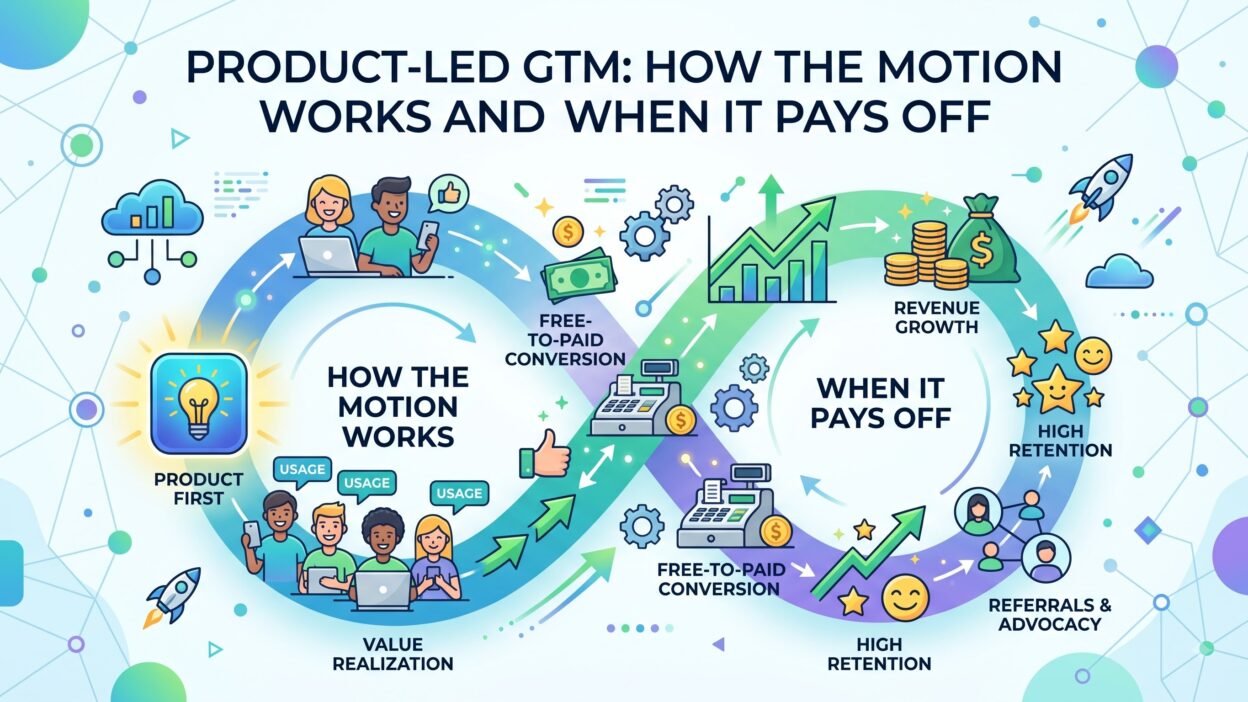
Product-led GTM runs on a loop. A user discovers the product, tries it, gets value, and either upgrades or invites others. Each step feeds the next.
The Self-Serve Funnel
The funnel starts with signup, not a sales call. A visitor lands on the website, creates an account, and enters the product within minutes. No forms to book a demo. No waiting on a rep.
Inside the product, onboarding guides the user toward a first win. This is often called the “aha moment.” Once a user hits it, they’re far more likely to stick around and pay.
Product Qualified Leads (PQLs)
A product qualified lead is a user who has shown real intent through product usage. Maybe they hit a usage cap. Maybe they invited teammates. Maybe they used a premium feature during a trial.
PQLs replace the old marketing qualified lead model. Instead of guessing intent from a form fill, product-led GTM tracks actual behavior inside the app. This behavior predicts revenue far better than a downloaded whitepaper ever could.
Sales teams prioritize PQLs first. These users already understand the product. A sales conversation with a PQL moves faster and closes at a higher rate.
The Role of Free Trials and Freemium Models
Free trials and freemium tiers are the entry point for most product-led GTM strategies. A free trial gives full access for a limited time. A freemium model gives limited access forever, with paid tiers unlocking more.
Both approaches let users test the product without financial risk. This lowers the barrier to entry and speeds up the decision cycle. Product-led GTM depends on this low-friction entry point to work at scale.
The choice between trial and freemium depends on the product. Complex products with a long learning curve often do better with trials, since users need guided time to reach value. Simple, high-frequency tools often thrive on freemium, since word of mouth spreads faster with zero cost.
Key Components of a Product-Led GTM Motion
A working product-led GTM motion needs more than a free signup page. It needs a system that turns usage into revenue.
Onboarding
Onboarding sets the tone for everything after it. A confusing first session kills momentum. A clear, guided first session builds trust fast.
Good onboarding shows the user one clear path to value. It skips unnecessary steps. It uses checklists, tooltips, or short walkthroughs to keep the user moving without overwhelming them.
Companies that get onboarding right see stronger activation rates. Activation is the single biggest lever in any product-led GTM strategy, because a user who never activates never converts.
In-Product Signals
In-product signals are the data points that show intent. Feature usage, login frequency, team invites, and API calls all count. These signals feed the PQL model and tell sales teams who to contact.
Strong product-led GTM programs build a scoring system around these signals. A high score triggers an automated email, an in-app prompt, or a sales outreach. A low score triggers a nurture sequence instead.
Without clean in-product signals, product-led GTM turns into guesswork. Data quality matters as much as the product itself.
Pricing and Packaging
Pricing shapes how fast users move through the funnel. Usage-based pricing aligns cost with value, which fits naturally with a product-led GTM model. Users pay more as they get more value, not before.
Packaging also matters. Clear tiers with obvious upgrade triggers make the next step easy to see. A user who hits a limit should immediately understand what upgrading unlocks.
Confusing pricing pages slow everything down. Product-led GTM works best when the path from free to paid feels obvious, not like a puzzle.
Benefits of Product-Led GTM
Product-led GTM isn’t just a trend. It delivers measurable business advantages when it fits the product.
Lower Customer Acquisition Cost
Self-serve signups cost far less than a full sales cycle. There’s no rep salary, no long demo process, and no lengthy negotiation for smaller accounts. Product-led GTM shifts acquisition cost from headcount to product investment.
This doesn’t mean product-led GTM is free. Companies still spend on infrastructure, support, and marketing. But the cost per acquired customer usually drops compared to a pure sales-led model.
Faster Time to Value
Users experience the product immediately instead of waiting for a demo slot. This speed builds trust early. A fast first win increases the odds of long-term retention.
Product-led GTM shortens the gap between curiosity and value. That gap is where most potential customers drop off in traditional sales cycles.
Organic Growth Loops
Product-led GTM creates natural growth loops. A user invites a teammate. That teammate signs up and invites another. Usage compounds without extra marketing spend.
Collaboration features, shareable outputs, and team-based pricing all strengthen this loop. The product itself becomes a distribution channel, which is one of the biggest advantages of product-led GTM over traditional outbound sales.
Challenges of Product-Led GTM
Product-led GTM isn’t a shortcut. It comes with real tradeoffs that teams need to plan for.
Monetization Complexity
Turning free users into paying customers takes careful design. Too generous a free tier, and users never feel pressure to upgrade. Too restrictive, and users leave before they see value.
Product-led GTM requires constant testing of limits, triggers, and pricing tiers. Getting this balance wrong stalls revenue growth even when signups look healthy.
Enterprise Sales Friction
Large enterprise deals rarely close through self-serve alone. Procurement, security reviews, and multi-stakeholder approval processes need human involvement. Product-led GTM can bring in the lead, but sales still has to close the bigger accounts.
Companies that rely only on product-led GTM often struggle to move upmarket. A hybrid model, where sales supports PQLs on larger accounts, solves this gap.
Data and Tooling Requirements
Tracking product usage at scale takes real infrastructure. Companies need analytics tools, event tracking, and scoring systems to identify PQLs accurately. Without this setup, product-led GTM runs blind.
Smaller teams sometimes underestimate this cost. Product-led GTM looks lean on the surface, but the data layer behind it takes real investment to build and maintain.
When Does Product-Led GTM Pay Off?
Product-led GTM doesn’t fit every business. It pays off under specific conditions.
Right Product Type
Products with a short learning curve and fast time to value fit product-led GTM well. Tools people can understand within a single session convert best through self-serve.
Complex enterprise systems with heavy customization often struggle here. These products usually need guided implementation, which favors a sales-led or hybrid motion instead.
Right Market
Markets with high user familiarity respond well to product-led GTM. If buyers already understand the category, they need less hand-holding before they try a product.
New or unfamiliar categories often need more education upfront. In these cases, marketing and sales carry more weight before product-led GTM signals become reliable.
Right Team Structure
Product-led GTM needs strong alignment between product, marketing, and sales. Product teams must build with growth in mind, not just features. Sales teams must trust PQL data instead of insisting on manual qualification.
Companies without this alignment often see product-led GTM stall. The strategy depends on cross-team trust as much as it depends on good product design.
Product-led GTM tends to pay off fastest for horizontal SaaS tools, developer tools, and collaboration software. It pays off slower for heavily regulated industries or products that require deep customization before use.
Product-Led GTM Examples
Several well-known SaaS companies built their growth on product-led GTM. Slack let teams start using the product before any sales conversation happened. Dropbox grew through simple sharing and referral loops built into the product itself. Zoom let users join calls without creating an account first, which removed nearly all friction from initial usage.
These companies share a pattern. Each one made the first experience nearly effortless. Each one turned everyday usage into a growth engine. None of them depended on cold outbound calls to drive early adoption.
Their success shows the ceiling of product-led GTM when the product truly earns its own distribution. It also shows why this motion works best for tools people use daily, not tools bought once and rarely touched.
How to Build a Product-Led GTM Strategy
Building product-led GTM takes a clear sequence, not a single launch decision.
Map the User Journey
Start by mapping every step from signup to first value. Identify where users drop off and why. This map becomes the foundation for every onboarding and activation decision that follows.
Talk to real users during this stage. Their friction points reveal more than any dashboard.
Define PQL Criteria
Decide which behaviors signal buying intent. This might include feature usage, team size, or frequency of logins. Set clear thresholds so sales knows exactly when to step in.
Review this criteria often. Product-led GTM data shifts as the product evolves, so static rules become outdated fast.
Align Sales and Product Teams
Get sales and product teams working from the same data. Sales needs visibility into usage patterns. Product needs feedback on which signals actually convert into revenue.
Regular syncs between these teams keep product-led GTM sharp. Without this alignment, PQL data sits unused and opportunities slip away.
Once these three steps are in place, test pricing tiers, onboarding flows, and upgrade triggers continuously. Product-led GTM is never a one-time setup. It’s an ongoing loop of measurement and adjustment.
Product-Led GTM Metrics to Track
Tracking the right metrics keeps product-led GTM honest. Vanity numbers like total signups mean little without context.
Activation rate shows how many users reach real value after signing up. This is often the strongest early predictor of long-term revenue.
Time to value measures how fast a new user hits their first meaningful outcome. Shorter time to value usually means stronger retention later.
Free-to-paid conversion rate shows how well the product turns trial or freemium users into paying customers. This number tells you if your pricing and packaging actually work.
Expansion revenue, often called net revenue retention, shows how much existing customers grow their spend over time. Strong product-led GTM programs often earn more from expansion than from new signups.
PQL-to-customer conversion rate shows how accurately your scoring model predicts real buyers. A low rate means your PQL criteria needs adjustment.
Together, these metrics give a full picture of how product-led GTM performs at every stage, not just at signup.
FAQs on Product-Led GTM
What does product-led GTM mean? Product-led GTM means the product itself drives acquisition, conversion, and expansion. Users try the product first and buy based on real experience, not just a sales pitch.
How is product-led GTM different from product-led growth? Product-led growth is a broader company strategy built around the product as the main driver of the business. Product-led GTM is the specific go-to-market motion built on top of that strategy.
Does product-led GTM work for enterprise software? It can work as part of a hybrid model. Pure self-serve rarely closes large enterprise deals alone, but product-led GTM can generate strong leads that sales then closes.
What is a PQL in product-led GTM? A PQL, or product qualified lead, is a user whose in-product behavior signals strong buying intent. This might include hitting usage limits or inviting teammates.
Is freemium required for product-led GTM? No. Free trials work just as well, depending on the product. The right choice depends on how long it takes users to reach value.
What industries benefit most from product-led GTM? Horizontal SaaS, developer tools, and collaboration software tend to benefit the most. Products with a short learning curve fit this motion best.
How long does it take to see results from product-led GTM? Most companies need several months of testing before seeing consistent conversion patterns. Product-led GTM improves through ongoing adjustment, not a single launch.
Read More:-Getting Back to the Office: Return To Work Survey Results
Conclusion

Product-led GTM changes how companies earn customers. Instead of pitching first, the product proves its own value. Users try, experience real results, and convert on their own terms.
This motion isn’t automatic revenue. It takes strong onboarding, clean usage data, and real alignment between product and sales teams. Get these pieces right, and product-led GTM lowers acquisition cost while speeding up growth.
Get them wrong, and the strategy stalls no matter how good the product looks on paper.
The companies that win with product-led GTM treat it as a system, not a one-time launch. They test constantly. They watch usage signals closely. They keep refining pricing, onboarding, and PQL criteria as the product and market shift.
If your product delivers fast, clear value, product-led GTM deserves serious consideration. It won’t replace every sales conversation, but it can carry a large share of your growth with far less friction than a traditional sales-led approach.