Introduction
TL;DR Marketing teams run dozens of campaigns every quarter. Some campaigns clearly drive pipeline. Others quietly waste budget without anyone noticing for months. B2B marketing attribution solves this problem. It shows you exactly which touchpoints move a buyer toward a closed deal, so your team stops guessing and starts investing in what actually works.
This guide covers everything you need to build a working attribution model from scratch. You get clear definitions, every major model explained in plain language, and real steps for connecting marketing activity to revenue. You also get common mistakes to avoid and answers to the questions marketing teams ask most.
Companies that use B2B marketing attribution spend budget with real confidence. They double down on channels that drive pipeline and cut spend on channels that only look good on a vanity report. This guide shows you exactly how to build that clarity for your own team.
Table of Contents
What Is B2B Marketing Attribution
B2B marketing attribution is the practice of assigning credit for a closed deal to the marketing touchpoints that influenced the buyer along the way. A buyer might read a blog post, download a whitepaper, attend a webinar, and click an email before they ever talk to a sales rep. Attribution tracks each of these steps and connects them to real revenue.
Without attribution, marketing reports stay shallow. A team might know a campaign generated a thousand clicks, but they have no idea if those clicks turned into paying customers. B2B marketing attribution closes this gap. It shows the full path a buyer took, not just the last click before a form submission.
This practice matters most in B2B because the buying journey runs long and touches many channels. A single deal might involve six months of research, three stakeholders, and a dozen separate marketing touches. Attribution untangles this complexity and shows marketing leaders which efforts actually moved the deal forward.
B2B Marketing Attribution vs B2C Attribution
Attribution looks different depending on the buying journey behind it. B2C purchases often happen in a single session, sometimes within minutes of seeing an ad. A shopper clicks a social ad, lands on a product page, and checks out before lunch. Attribution in this world tracks a short, simple path.
B2B marketing attribution deals with a much longer and messier journey. A single account might include five or six people researching a solution over several months. Each person interacts with different content at different times, often across different devices. Attribution needs to stitch these separate paths back together into one account-level view.
The sales cycle also complicates B2B attribution in ways B2C rarely faces. A deal might sit in a sales pipeline for weeks after marketing hands it off, and revenue only counts once the contract gets signed. B2B marketing attribution has to bridge this gap between marketing activity and a sales outcome that happens much later.
Why B2B Marketing Attribution Matters
Marketing budgets face real scrutiny from finance and leadership every quarter. B2B marketing attribution gives marketing teams a clear, defensible story about where budget goes and what it returns. Without this story, marketing risks losing budget to channels that simply feel more measurable, even when they perform worse.
Attribution also sharpens campaign strategy over time. A team that sees which content drives real pipeline builds more of that content and less of what never converts. This shifts marketing from a volume game into a precision game focused on outcomes instead of raw activity.
Sales and marketing alignment improves once attribution enters the picture too. Sales reps trust marketing leads more when they see the research behind a lead’s journey. Marketing teams gain credibility when they show a direct line between a campaign and a closed deal sitting in the CRM.
Attribution also helps teams justify new investment. A marketing leader asking for budget on a new channel has a much stronger case when past attribution data backs up the request. B2B marketing attribution turns marketing from a cost center into a function leadership can measure with real numbers.
Types of B2B Marketing Attribution Models
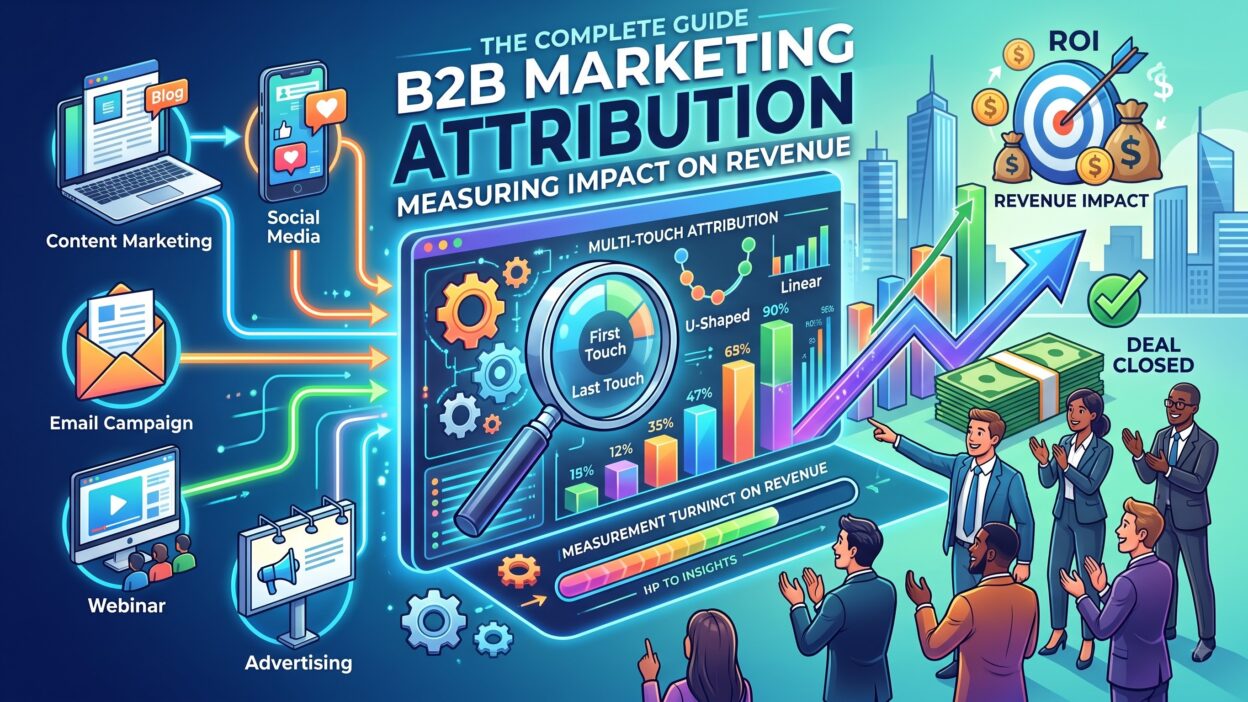
Several models exist for assigning credit across the buyer journey. Each one weighs touchpoints differently, and the right choice depends on your sales cycle and your data maturity. Here is a breakdown of the models most B2B teams choose between.
First Touch Attribution
First touch attribution gives full credit to the very first interaction a buyer had with your brand. If a prospect first found you through a search ad, that ad gets all the credit for the eventual deal. This model works well for teams that want to understand which channels bring in new demand.
The downside shows up quickly once a deal involves many touchpoints. First touch ignores everything that happened after that initial click, even if a later webinar sealed the deal. Teams that rely only on this model often overinvest in top of funnel awareness channels and underinvest in the content that actually closes deals.
Last Touch Attribution
Last touch attribution gives full credit to the final interaction before a deal closes or a form gets submitted. Many CRMs default to this model because it is simple to track and easy to explain to leadership. A demo request often gets full credit under this approach, even if five other touchpoints built the interest that led there.
This model undervalues early awareness content in a serious way. A blog post that started the buyer’s research gets zero credit, even though it planted the seed for the entire deal. Teams that lean too heavily on last touch attribution often cut valuable top of funnel content by mistake.
Linear Attribution
Linear attribution spreads credit evenly across every touchpoint in the buyer journey. A deal with eight touchpoints gives each one an equal share of the credit, regardless of timing or impact. This model gives a more balanced view than single-touch models and avoids ignoring any part of the journey.
The weakness here comes from treating every touch as equally important, which rarely reflects reality. A single high-value webinar probably influenced the deal more than a passive newsletter open. Linear attribution smooths over these differences and can hide which specific touchpoints truly moved the needle.
Time Decay Attribution
Time decay attribution gives more credit to touchpoints that happened closer to the deal closing. Early touches still count, but their weight shrinks the further back in time they sit. This model reflects a real pattern in most B2B deals, where recent activity often signals stronger buying intent.
This approach works well for sales cycles with a clear, gradual build toward a decision. It can undervalue an important early touch, though, especially one that introduced a completely new buyer to your brand. Teams need to weigh this tradeoff against their specific sales motion before adopting time decay as their main model.
U-Shaped Attribution
U-shaped attribution splits most of the credit between the first touch and the touch that generated a qualified lead, often a form fill or demo request. The remaining touchpoints share a smaller portion of the credit between them. This model highlights both the channel that created awareness and the one that converted interest into a real lead.
Many B2B teams like this model because it balances two of the most important moments in the funnel. It still underweights everything that happens between those two key touches, including content that nurtured the lead through a long evaluation process. B2B marketing attribution built around a U-shape works best for teams with a clear, trackable lead conversion moment.
W-Shaped Attribution
W-shaped attribution adds a third major credit point on top of the U-shape: the moment a lead becomes a sales opportunity. This model recognizes three critical milestones instead of two, giving credit to first touch, lead conversion, and opportunity creation. The rest of the touchpoints split the remaining credit evenly.
This model fits complex B2B sales cycles with a clear handoff from marketing to sales. It takes more setup than simpler models, since it requires clean tracking across three separate milestones in the CRM. Teams with mature marketing operations often move toward this model once basic attribution proves its value.
Algorithmic and Data-Driven Attribution
Algorithmic attribution uses machine learning to assign credit based on real patterns in historical deal data. Instead of a fixed rule like first touch or linear, this model learns which touchpoints actually correlate with closed deals across thousands of past accounts. It adjusts weighting dynamically as new data comes in.
This model gives the most accurate picture of what drives revenue, but it needs a large volume of data to work well. Smaller companies with fewer closed deals often lack enough data for the algorithm to find reliable patterns. Larger B2B organizations with mature pipelines get the most value from this advanced approach to marketing attribution.
How to Build a B2B Marketing Attribution Model
Building a working attribution model takes more than picking a formula from a list. It requires clean data, clear goals, and the right tools connected across your sales and marketing stack. Here is a practical path for building your own model from the ground up.
Define Your Revenue Goals
Start by deciding what success actually looks like for your marketing team. Some teams focus purely on pipeline generated. Others focus on closed revenue or customer lifetime value tied back to specific campaigns. This decision shapes every choice you make later in the process.
Loop in sales and finance leadership during this step, not just marketing. They bring a different view of what counts as real revenue impact versus a vanity metric. Aligning on goals early prevents disputes over attribution results months down the road.
Map the Buyer Journey
Write out every stage a buyer moves through, from first awareness to signed contract. Include every channel your team uses, such as paid ads, organic content, email, and events. This map becomes the backbone of your B2B marketing attribution model and shows where tracking gaps might exist.
Talk to your sales team about what they hear from buyers during calls. Buyers often mention touchpoints that never show up cleanly in your analytics tools, like a colleague’s recommendation or a conference conversation. This qualitative input rounds out a model built only from digital tracking data.
Connect Your Data Sources
Pull together data from your CRM, marketing automation platform, website analytics, and any ad platforms you use regularly. Each of these tools holds a piece of the buyer journey, and none of them tells the full story alone. Integration between these systems makes accurate attribution possible in the first place.
Clean your data carefully before you build any model on top of it. Duplicate contact records and mismatched company names create broken attribution paths that mislead your whole team. A little cleanup work early saves major headaches once reporting starts flowing to leadership.
Choose Your Attribution Model
Pick a model that matches your sales cycle length and your current data maturity. A shorter sales cycle with fewer touchpoints might work fine with last touch or linear attribution. A longer, more complex cycle usually benefits from time decay, U-shaped, or W-shaped models instead.
Start simple if your team is new to attribution work. A basic model implemented well beats a complex model built on shaky data every time. You can always move toward a more advanced approach once your team trusts the foundation you built first.
Test and Refine
Run your chosen model against a set of recent closed deals to see if the results make intuitive sense to your team. If a channel your team knows drives real value shows almost no credit, something in your tracking likely needs a fix. Adjust the model based on these real world checks before you roll it out company wide.
Review your B2B marketing attribution model every quarter as your channels and sales process evolve. A model built for last year’s funnel might miss new touchpoints your team added since then, like a new webinar series or a paid social channel. Regular review keeps the model useful instead of stale.
Common Mistakes Teams Make With B2B Marketing Attribution
Many teams pick the easiest model to set up instead of the one that fits their actual sales cycle. Last touch attribution feels simple because most CRMs track it by default, but it often tells an incomplete story. Choosing a model based on setup ease instead of accuracy leads to bad budget decisions down the line.
Another common mistake involves ignoring offline touchpoints entirely. Conference conversations, referrals, and sales calls influence deals just as much as digital content in many industries. A model built only from website and email tracking data misses a meaningful chunk of the real buyer journey.
Some teams treat attribution as a one time setup project instead of an ongoing practice. Channels change, buyer behavior shifts, and new content types enter the mix constantly. A B2B marketing attribution model left untouched for two years slowly drifts away from how buyers actually behave today.
Poor data hygiene causes quiet damage too. Duplicate leads, mismatched account records, and broken tracking pixels all corrupt attribution data without anyone noticing right away. Teams need a regular data audit process to keep their attribution reporting trustworthy over time.
Finally, some teams share attribution reports with leadership without context about the model’s limitations. Every attribution model makes tradeoffs, and presenting results as absolute truth sets up unrealistic expectations. Explaining the model alongside the numbers builds more trust than the numbers alone ever could.
Tools That Support B2B Marketing Attribution
A CRM sits at the center of most attribution setups, since it holds the record of every closed deal and its value. Platforms like Salesforce and HubSpot let teams tie campaign data directly to revenue outcomes inside a single system. This connection turns raw marketing activity into a real, trackable revenue story.
Marketing automation platforms track individual touchpoints like email opens, form fills, and content downloads across a buyer’s journey. These platforms often integrate directly with a CRM, passing touchpoint data along so attribution models have enough detail to work with accurately.
Dedicated attribution software like Bizible or Dreamdata builds more advanced models on top of this connected data. These tools handle multi-touch models like U-shaped or algorithmic attribution without requiring a data science team to build everything from scratch in house.
Analytics platforms track website behavior and ad performance across every channel your team runs campaigns on. This data feeds directly into your attribution model and shows which content and channels drive the strongest engagement before a lead ever reaches your CRM.
The right stack depends on your budget and your team’s technical resources available for setup and maintenance. Small teams often start with CRM-native attribution features and add dedicated tools as their B2B marketing attribution needs grow more sophisticated over time.
Frequently Asked Questions
What is B2B marketing attribution?
B2B marketing attribution is the practice of assigning credit for closed deals to the marketing touchpoints that influenced a buyer along their journey. It helps teams understand which channels and content actually drive revenue instead of just clicks or website traffic.
Which attribution model is best for B2B companies?
There is no single best model for every company or sales cycle. Many B2B teams start with a simple model like last touch and move toward multi-touch models like U-shaped or time decay as their data matures and their sales cycle grows more complex.
How is B2B marketing attribution different from lead scoring?
Lead scoring ranks how likely a specific lead is to convert based on their profile and behavior. B2B marketing attribution looks backward at closed deals and shows which touchpoints actually contributed to that outcome. The two practices work well together but answer different questions.
Can small B2B companies use marketing attribution effectively?
Yes, small companies can start with a simple model like first touch or last touch using data already inside their CRM. As deal volume grows and more channels enter the mix, teams can move toward multi-touch models that give a fuller picture of the buyer journey.
How long does it take to see results from an attribution model?
Results depend heavily on your sales cycle length and how much historical deal data you already have. Teams with a shorter cycle and clean CRM data often see useful patterns within a single quarter. Longer B2B sales cycles may need two or three quarters of data before clear trends emerge.
What data do I need before I start building an attribution model?
Start with clean CRM records showing closed deal values and dates. Add marketing automation data showing email, content, and campaign touchpoints tied to each contact. Website analytics and ad platform data round out the picture once the core CRM and marketing data connect properly.
Read More:-Cold Email Outreach: A Complete Guide to Getting More Replies in 2026
Conclusion

B2B marketing attribution turns scattered campaign activity into a clear, connected story about what actually drives revenue. First touch, last touch, linear, time decay, U-shaped, W-shaped, and algorithmic models each offer a different lens on the buyer journey. The right choice depends on your sales cycle, your data maturity, and the questions your leadership team needs answered.
Building a working model takes clean data, clear goals, and tools that connect marketing activity to real closed deals in your CRM. Skip this work and marketing keeps guessing which campaigns matter, often defending budget with weak evidence. Build it well and marketing earns a real seat at the revenue table alongside sales.
Start with a simple model if your team is new to this practice. Map your buyer journey honestly, connect your data sources, and test the results against deals you already understand well. A thoughtful B2B marketing attribution model does not just prove marketing’s value in a single quarter. It builds a foundation for smarter budget decisions your whole company can rely on for years to come.