Introduction
TL;DR Every deal follows a path. Some paths are clear. Some are messy and hard to repeat. A strong B2B sales process turns that chaos into a system your whole team can follow. This guide breaks the process into seven stages. You get a working flowchart in your head by the end of this post. You also get practical steps for each stage, common mistakes to avoid, and answers to the questions sales teams ask most.
A B2B sales process is not a rigid script. It is a map. Your reps still bring judgment and personality to every call. The map just keeps everyone moving in the same direction. Companies that document this process close more deals and lose fewer prospects along the way. Companies that skip this step rely on guesswork. Guesswork does not scale past a handful of reps.
This post walks through the full sales cycle from first contact to renewal. Read it once for the big picture. Bookmark it and come back when you build your own flowchart.
Table of Contents
What Is a B2B Sales Process
A B2B sales process is a defined sequence of steps a sales team follows to turn a prospect into a paying customer. Business buyers behave differently than individual consumers. They involve multiple stakeholders. They compare vendors carefully. They ask for proposals and negotiate contract terms before they sign anything.
Without a clear B2B sales process, reps improvise their own version of the job. One rep skips qualification and burns hours on a bad-fit lead. Another rep jumps straight to pricing before the buyer understands the value on offer. A documented sales process removes this guesswork from the equation. Every rep follows the same stages. Every deal gets tracked the same way. Managers get accurate forecasts because the pipeline reflects real stages, not gut feelings pulled from memory.
Think of a defined sales process as a shared language for your revenue team. When a rep says a deal sits in stage four, everyone on the call knows exactly what that means and what happens next.
Why Your Team Needs a Sales Process Flowchart
A flowchart turns an abstract process into something visual and easy to scan. Reps glance at it and know their next move without checking a manual. New hires ramp up faster because they see the entire B2B sales process laid out on one page instead of reading pages of text.
A flowchart also exposes weak points in your pipeline. Maybe deals stall between discovery and proposal. Maybe objections show up late and catch reps off guard. A visual map makes these gaps obvious to spot. You fix what you can actually see in front of you.
Sales managers use a flowchart to coach reps with more precision. They point to a stage and ask what happened there during the call. This turns vague feedback into specific, actionable coaching. Reps improve faster when feedback ties to a clear stage in their sales process rather than a general note about tone.
Marketing teams benefit from this map too. They see where leads enter the funnel and where interest drops off along the way. This shapes sharper campaigns and cleaner handoffs between marketing and sales.
A flowchart keeps a B2B sales process consistent even as your headcount grows. Ten reps following the same map close deals more predictably than ten reps working from memory and habit.
The 7 Stages of a B2B Sales Process
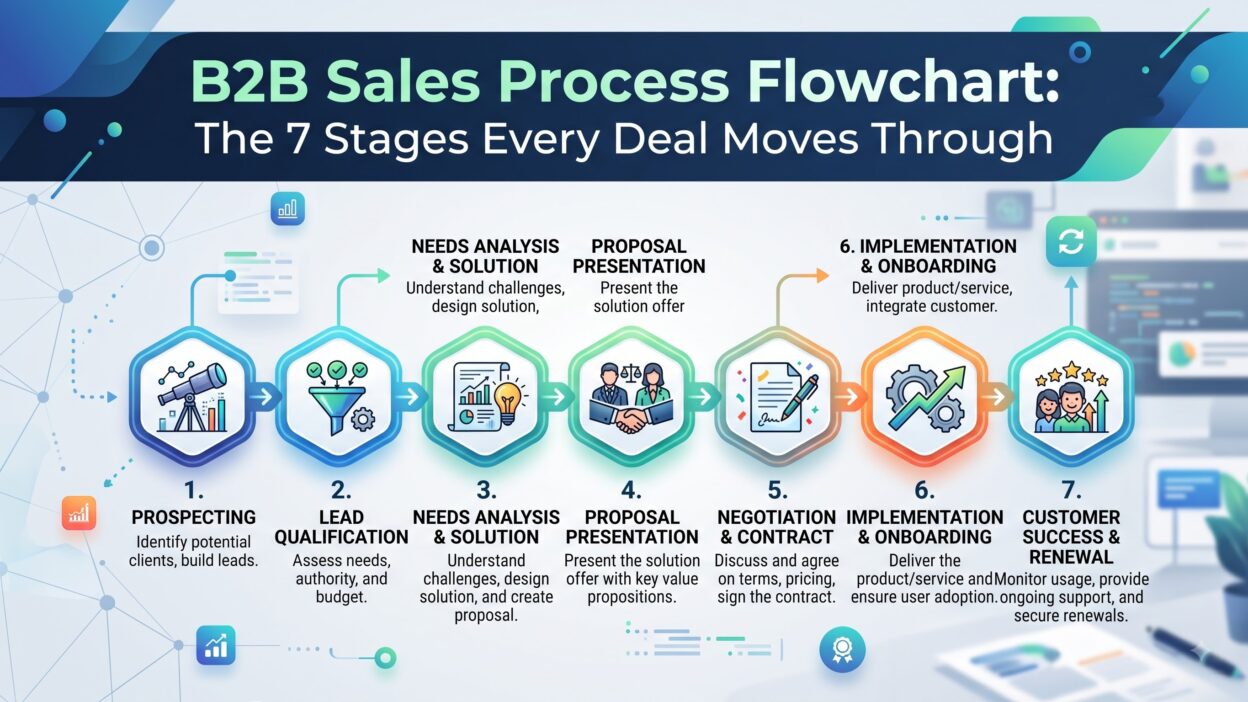
Every sales cycle, no matter the industry, moves through seven core stages. Some companies add extra sub-steps for their own workflow. The core logic stays the same across most B2B companies. Prospecting comes first. A signed deal and a growing account come last. Here is the full breakdown of each stage.
Stage 1: Prospecting and Lead Generation
Prospecting opens the entire sales cycle. Reps identify companies that match their ideal customer profile. They pull lists from LinkedIn, industry databases, and referral networks built over time. Marketing teams feed in leads from content downloads, webinars, and paid campaigns running in parallel.
A strong prospecting stage focuses on fit over raw volume. Ten well-matched leads beat a hundred random contacts pulled from a purchased list. Reps research each company before reaching out to anyone. They check company size, industry, and recent news tied to the account. This research shapes a sharper first message.
Outreach happens through email, phone calls, and social channels like LinkedIn. Cold outreach works best when it references something specific about the buyer’s business or recent activity. Generic templates get ignored within seconds. Personalized messages earn replies and open real conversations.
This early stage feeds every later part of the pipeline. Weak prospecting means a thin pipeline. Strong prospecting gives reps a steady stream of qualified conversations to work through each week.
Stage 2: Lead Qualification
Not every prospect deserves a rep’s full attention. Qualification filters out poor fits early in the cycle. Reps ask about budget, authority, need, and timeline during a short opening call. This framework goes by the name BANT across many sales organizations.
A qualified lead has a real problem your product solves today. They have budget or clear access to budget. They have a rough timeline for solving the problem at hand. They have someone in the conversation who can approve a purchase decision. Skip any one of these checks and the deal risks stalling much later.
Reps use short discovery calls to qualify leads quickly. A fifteen minute conversation answers most of these questions without dragging on. Reps who skip this step waste hours building demos for buyers who never had budget in the first place.
Qualification keeps the whole sales process efficient from start to finish. It protects rep time and speeds up the entire pipeline. Deals that pass this checkpoint move forward with real, measurable momentum.
Stage 3: Discovery and Needs Analysis
Discovery digs deeper than a quick qualification call. Reps learn the buyer’s specific pain points, current workflow, and business goals. They ask open questions and listen more than they talk during this stage. A strong discovery call uncovers the real reason a buyer started looking for a new solution in the first place.
Reps map the buyer’s internal process during this conversation. They learn who else influences the final decision. They learn what tools the buyer currently relies on day to day. They learn what success actually looks like from the buyer’s own point of view, not just from a feature list.
This stage shapes everything that comes after it. A rep who skips discovery pitches generic features that miss the mark. A rep who nails discovery builds a proposal around the buyer’s exact problem and priorities. That proposal lands harder and faces fewer objections down the line.
Discovery also builds trust between both sides of the table. Buyers open up when they feel genuinely heard. This trust carries through the rest of the sales cycle and makes later conversations far easier to navigate.
Stage 4: Proposal and Presentation
Reps present a tailored solution during this stage of the process. They connect specific product features directly to the pain points uncovered during discovery. A generic pitch deck rarely works well here. Buyers want to see their own problem addressed head on, not a broad overview.
Pricing enters the conversation at this point too. Reps present clear packages and explain exactly what each tier includes. Transparent pricing builds trust with the buying committee. Vague pricing creates friction and adds unnecessary delay to the timeline.
Live demos often run alongside the written proposal. A demo built around the buyer’s actual use case beats a generic product tour nearly every time. Reps who customize the demo see stronger engagement from every stakeholder in the room.
This stage of the B2B sales process determines whether a deal moves toward a close or quietly stalls out. A sharp, relevant proposal keeps momentum alive. A generic one loses it fast.
Stage 5: Handling Objections
Objections show up in almost every sales cycle at some point. Buyers raise concerns about price, timing, integration, or internal buy-in from other departments. This stage tests a rep’s product knowledge and listening skills under pressure.
Strong reps treat objections as questions rather than rejections. They ask clarifying questions before responding with an answer. A buyer who says the price feels high might actually feel unsure about the return on investment. A rep who understands the real concern behind the words gives a far better answer.
Common objections include tight budgets, competing internal priorities, and a need for more approval from leadership. Reps prepare responses for these ahead of time, before the call even starts. They also loop in case studies or customer references when a buyer needs extra proof.
This stage separates strong reps from average ones across any sales team. Handling objections well moves a deal steadily toward close. Handling them poorly kills a deal that had real potential just moments earlier.
Stage 6: Negotiation and Closing
Both sides work out final terms during this stage of the cycle. Price, contract length, and implementation timeline all get finalized here. Buyers may push back on certain terms before they agree. Reps balance flexibility with protecting margin on every deal.
Legal and procurement teams often enter the conversation at this point on the buyer’s side. This can slow the timeline down considerably. Reps who stay proactive during this stretch keep momentum alive by scheduling clear next steps and following up on any outstanding questions right away.
A signed contract marks the formal end of this stage. Reps confirm start dates, onboarding contacts, and payment terms before they celebrate the win. A rushed close without clear next steps creates confusion during onboarding later on.
This stage of the B2B sales process feels like the finish line to most reps. It actually opens the door to the next and often longest stage of the relationship.
Stage 7: Post Sale Follow Up and Account Growth
The sales process does not end the moment a contract gets signed. Post sale follow up determines whether a customer renews, expands, or eventually churns. Reps or customer success teams check in during onboarding to confirm the product delivers on its original promise.
Regular check-ins catch small problems early, before they grow. A customer struggling quietly with setup rarely raises their hand on their own. Proactive outreach during this stage prevents minor frustrations from turning into real reasons to leave.
Account growth also happens here, often quietly at first. Happy customers buy more seats, add new features, or refer other companies in their network. This final stage turns a single sale into a long term revenue stream worth protecting. Companies that treat this stage as optional lose renewal revenue they could have easily kept.
A complete B2B sales process treats this last stage with the same care as the very first prospecting call. The relationship keeps generating value long after the ink dries on the contract.
How to Build Your Own Sales Process Flowchart
Building a flowchart starts with mapping your current process honestly, without skipping the messy parts. Talk to your best reps about their real routine. Ask them what actually happens at each stage of a live deal. Their real behavior often differs from the official playbook sitting in a shared drive somewhere.
Map Each Stage Clearly
Write out every stage from first contact through renewal. Keep the labels simple and specific. Use verbs that describe the action itself, not vague terms borrowed from a template. Each stage needs a clear entry point and a clear exit point. A rep should always know exactly which stage a deal sits in.
Add Decision Points
Real deals branch in different directions. A lead might fail to qualify and exit the pipeline entirely. A proposal might need a full revision before it reaches negotiation. Add these decision points directly to your flowchart. This keeps the map realistic instead of an oversimplified straight line that ignores reality.
Assign Owners for Each Step
Every stage needs a clear owner. Sometimes that owner is the sales rep handling the account. Sometimes ownership shifts to a sales engineer, a customer success manager, or someone on the legal team. Clear ownership prevents deals from stalling simply because nobody knew whose turn it was to act next.
Once you draft your flowchart, test it against a handful of live deals already in motion. Adjust the map based on what actually happens on those calls. A flowchart that only lives on paper does nothing for your team. A flowchart your reps actually use transforms how deals move through the entire pipeline.
Common Mistakes Teams Make With Their Sales Process
Many teams build a B2B sales process once and never revisit it again. Buyer behavior shifts steadily over time. A process built two years ago might miss new objections or new competitors that entered the market since then. Review your process every few months and update it based on real deal data, not assumptions.
Another common mistake involves skipping qualification just to hit activity targets. Reps chase demo counts instead of deal quality, filling the calendar without filling the pipeline with real fits. This clutters the funnel with weak leads that never close. A strong sales process protects qualification as a non-negotiable checkpoint, not an optional nice to have.
Some teams also over-engineer their process with too many stages crammed into one flowchart. Ten or twelve stages confuse reps more than they help anyone. Seven core stages give enough detail without drowning the team in unnecessary complexity.
Poor handoffs cause real damage too, often at the worst possible moment. When a deal moves from sales into onboarding without a clear handoff, the new customer feels that friction immediately. Build handoff checkpoints directly into your flowchart to close this gap before it opens.
Finally, some teams ignore the data their own CRM already hands them for free. Win rates by stage, average time spent in each stage, and drop-off points all point straight to weak spots in the B2B sales process. Ignoring this data means repeating the same avoidable mistakes deal after deal.
Tools That Support a B2B Sales Process
A CRM sits at the center of most sales process tools used today. Platforms like HubSpot, Salesforce, and Pipedrive let teams track deals by stage and pull reports on conversion rates without manual spreadsheets. A CRM turns your flowchart into a living, trackable system your whole team can trust.
Sales engagement platforms help reps manage outreach during prospecting and follow up. They automate email sequences and track opens and replies, all without losing the personal touch a good rep brings to every message.
Proposal software speeds up stage four by letting reps build tailored documents in minutes rather than hours. Buyers get a polished proposal instead of a generic PDF pulled from an old folder, and reps save real time on formatting.
Customer success platforms support the final stage of the process directly. They track usage data and flag accounts at risk of churn before a problem becomes obvious. This closes the loop on the full B2B sales process and protects revenue long after the initial sale closes.
The right stack depends heavily on team size and available budget. Small teams often start with a simple CRM and grow their stack gradually as the sales process matures alongside the business.
Frequently Asked Questions
What are the 7 stages of a B2B sales process?
The seven stages are prospecting, qualification, discovery, proposal, objection handling, negotiation and closing, and post sale follow up. Each stage moves a buyer closer to a decision and, after signature, closer to renewal and account growth over time.
How long does a typical B2B sales process take?
Timelines vary widely by industry and deal size. Small deals close in a few weeks with minimal friction. Enterprise deals with multiple stakeholders can take several months to reach signature. The number of stages stays the same even when the timeline stretches far longer than expected.
What is the difference between a sales process and a sales pipeline?
A sales process describes the steps a rep follows on every deal. A sales pipeline shows where each individual deal currently sits within those steps at any given moment. The process works as the map. The pipeline shows the live status of every trip currently on that map.
Why do B2B deals stall between proposal and closing?
Deals often stall because internal stakeholders on the buyer’s side have not fully aligned yet on the decision. Procurement or legal reviews can also slow things down considerably during this window. Reps who stay proactive during this stretch keep the deal moving instead of losing it to silence.
Should every company use the same sales process?
The core seven stages apply broadly across most B2B companies selling to businesses. The specific actions within each stage should reflect your product, price point, and buyer type closely. A high-touch enterprise sale needs far more discovery time than a low-cost self-serve product does.
How do I know if my sales process needs improvement?
Watch your conversion rate between each stage closely over a few months. A big drop at any single stage points directly to a problem sitting right there. Long average time spent in one stage also signals real friction that a clearer flowchart or better rep training can usually fix.
Read More:-AI Data Enrichment: Accuracy and Reliability at Scale
Conclusion

A clear B2B sales process turns unpredictable selling into a repeatable system your whole team can trust. Seven stages carry a buyer from first contact through a signed contract and straight into a growing account relationship. Each stage builds on the one right before it. Skip a step and the whole deal weakens from that point forward.
A flowchart makes this process visible for your entire team, not just your top performers. New reps ramp up faster with a clear map in front of them. Managers coach with far more precision during every one-on-one. Leadership forecasts revenue with real confidence instead of rough guesses. Review your sales process regularly and adjust it as your buyers and market shift over time.
Start by mapping your current stages honestly, gaps and all. Add decision points where deals actually branch in practice. Assign clear owners so nothing falls through the cracks between teams. A strong B2B sales process does not just close more deals in the short term. It builds a foundation your entire revenue team can rely on for years to come.