Introduction
TL;DR Not every account deserves the same amount of attention. Some accounts bring real revenue and stay loyal for years. Others drain your team’s time and never convert into paying customers. B2B customer segmentation solves this problem. It groups your accounts by traits that actually matter, so your sales and marketing teams stop treating every lead the same way.
This guide covers everything you need to build a working segmentation model from the ground up. You get clear definitions, proven frameworks, and real steps for grouping your accounts effectively. You also get common mistakes to avoid and answers to the questions teams ask most about this topic.
Companies that use B2B customer segmentation close deals faster than companies that treat every lead the same. They spend budget on accounts likely to buy instead of chasing every lead that fills out a form on the website. This guide shows you exactly how to build that system for your own business, step by step.
Table of Contents
What Is B2B Customer Segmentation
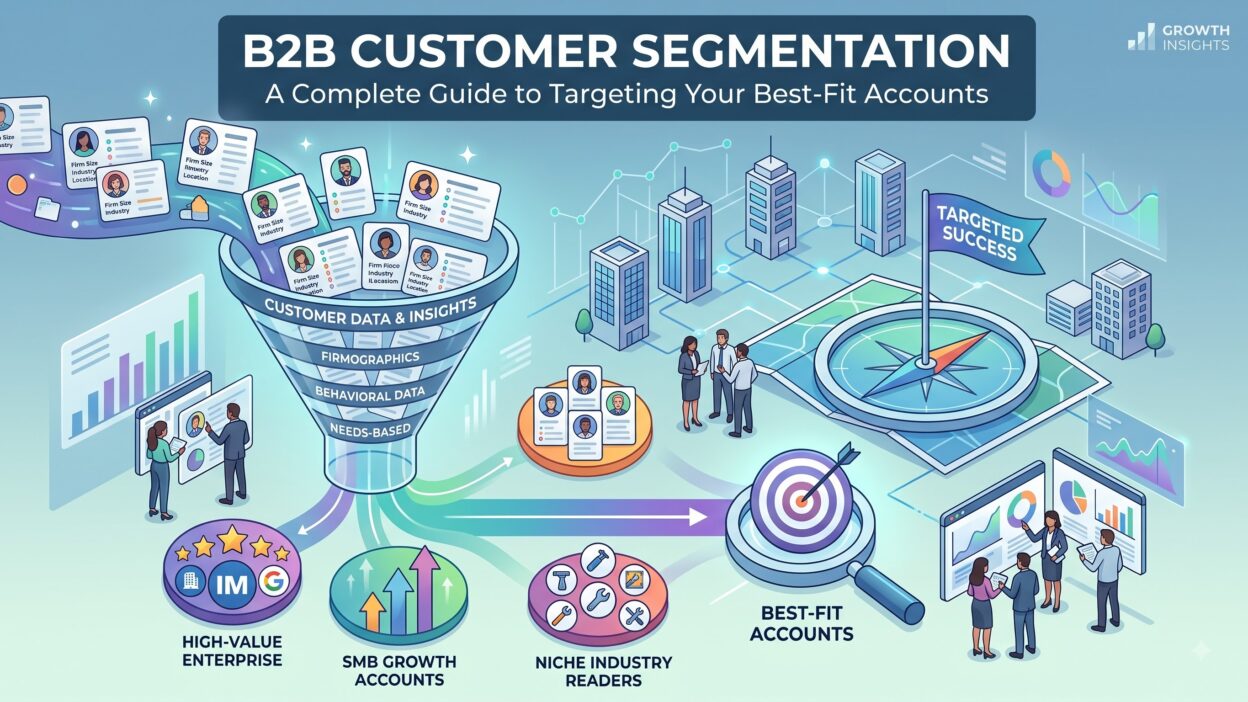
B2B customer segmentation is the process of dividing your target market into smaller groups based on shared traits. These traits include company size, industry, revenue, location, and buying behavior. Instead of treating every account the same, your team tailors messaging and outreach to each specific group.
Consumer segmentation often relies on age, gender, or personal interests to shape a campaign. B2B customer segmentation works differently at nearly every level. Business buyers care about return on investment, integration with existing tools, and internal approval from other stakeholders. Your segments need to reflect these business realities instead of personal preferences borrowed from consumer marketing playbooks.
A strong segmentation model turns a broad market into manageable, targeted groups your team can act on daily. Sales reps know exactly who they talk to and why that account matters. Marketing teams build campaigns that speak directly to a defined audience instead of a generic crowd scattered across industries. This clarity saves time and drives stronger results across every department that touches the customer.
B2B Customer Segmentation vs B2C Segmentation
Many marketers move between B2B and B2C roles during their career, and the shift in thinking catches people off guard. B2C segmentation groups people by lifestyle, age range, and personal spending habits. A single person makes the buying decision in most cases, often within minutes.
B2B customer segmentation deals with a longer, more complex buying journey involving several decision makers. A single account might include a champion, a budget holder, and a technical evaluator, each with different priorities. Your segments need to account for this complexity instead of collapsing every buyer into one profile.
The sales cycle also runs much longer in B2B than in most consumer purchases. This gives your team more touchpoints to gather data and refine which segment an account truly belongs to. B2C segmentation often relies on broad demographic buckets. B2B customer segmentation relies on firmographic and behavioral signals gathered over weeks or months of engagement.
Why B2B Customer Segmentation Matters
Generic outreach rarely works in business sales anymore. Buyers ignore messages that feel mass produced and impersonal, deleting them within seconds of opening an inbox. B2B customer segmentation lets your team send relevant messages to the right group at the right time in their buying journey. Relevant messages get more replies and build trust faster than a broad blast ever could.
Segmentation also protects your marketing and sales budget. Spend goes further when it targets accounts with a real chance of converting into paying customers. Sales reps stop wasting hours on leads that never fit your product in the first place, freeing up time for accounts worth pursuing. Every dollar and every hour works harder once your accounts sit in the right group.
Product teams benefit from segmentation too, even though they sit further from the sales conversation. They see which groups request which features most often, and this pattern shapes a stronger roadmap. Decisions get grounded in real account needs instead of guesses pulled from a single loud customer who happens to email the CEO directly.
Customer success teams use segments to spot risk early in the relationship. A group with a history of low engagement signals churn risk well before a cancellation request arrives. Proactive outreach to that group protects renewal revenue that might otherwise slip away quietly over a few slow months.
B2B customer segmentation touches every part of the revenue engine, not just the marketing team’s dashboard. It shapes sales strategy, product decisions, pricing conversations, and long term account health across the whole business.
Types of B2B Customer Segmentation
Several models exist for grouping business accounts, and no single model works for every company. Most teams blend a few of these approaches to build something that fits their own market and product. Here is a breakdown of the most common types teams rely on today.
Firmographic Segmentation
Firmographic segmentation groups accounts by company traits like industry, size, and revenue. A software company might segment by employee count because product needs shift dramatically as a company grows from ten people to a thousand. A logistics company might segment by shipping volume instead.
This model works as a strong starting point for most B2B teams building their first segmentation strategy. It relies on data that is easy to find through public records, company websites, and directories like LinkedIn. Sales teams often use firmographic segmentation first, then layer other models on top for more precision later.
Behavioral Segmentation
Behavioral segmentation groups accounts by how they interact with your brand over time. This includes website visits, content downloads, product usage, and email engagement across every channel. A prospect who visits your pricing page three times in a week shows different intent than one who only read a blog post once and left.
This model captures buying signals that firmographic data misses entirely on its own. Two companies of the same size and industry might behave in completely different ways during their research phase. Behavioral segmentation catches this difference and helps reps prioritize the right accounts first, instead of working leads in the order they arrived.
Needs-Based Segmentation
Needs-based segmentation groups accounts by the specific problem they need solved right now. Two companies in the same industry might buy your product for entirely different reasons. One needs better reporting for their board meetings. Another needs faster onboarding for a wave of new hires.
This model requires deeper research through interviews, surveys, or sales call notes gathered over time. It pays off with sharper messaging that speaks directly to a buyer’s real pain point instead of a generic feature list. Segmentation built around needs tends to convert better than segmentation built on size alone, because it speaks to motivation rather than just company profile.
Value-Based Segmentation
Value-based segmentation groups accounts by their revenue potential and lifetime value to the business. High value accounts get more attention from sales and dedicated account management resources. Lower value accounts get efficient, often automated touchpoints instead, which still keeps them engaged without draining rep time.
This model helps teams allocate limited resources wisely across a growing customer base. Not every account deserves a dedicated rep or a fully custom proposal built from scratch. Value-based groups keep your best resources focused on the accounts that move revenue the most, while smaller accounts still get consistent, useful attention.
Technographic Segmentation
Technographic segmentation groups accounts by the technology stack they already use. A company running a specific CRM or cloud platform might need a product that integrates smoothly with that existing setup. This data comes from tools that scan a company’s website and public job postings for clues about their stack.
This model works especially well for software companies selling integrations or add-ons. Knowing a prospect already uses a compatible tool shortens the sales conversation considerably. Reps skip basic compatibility questions and move straight into value and pricing discussions instead.
Buying Stage Segmentation
Buying stage segmentation groups accounts by where they sit in the purchase journey. Some accounts are just starting to research a problem. Others already compare vendors and request pricing. Messaging that fits an early stage buyer falls flat with someone ready to sign a contract.
This model works closely with behavioral data gathered from your website and email campaigns. Marketing automation tools track these signals and move accounts between stages automatically as engagement changes. Sales reps then know exactly how ready an account feels before they pick up the phone.
How to Build a B2B Customer Segmentation Model
Building a working model takes more than picking a few categories at random from a template. It requires real data, clear criteria, and ongoing review as your market shifts around you. Here is a practical path for building your own segmentation model from scratch.
Step 1: Define Your Ideal Customer Profile
Start by defining what your best current customers actually look like today. Pull data on your highest value, longest retained accounts from your CRM. Look for shared traits across industry, size, and use case among that group. This profile becomes the foundation for every segment you build afterward.
Talk to your sales and customer success teams during this step, not just your data team. They know which accounts renew easily and which ones struggle from day one of onboarding. Their input adds context that raw data alone cannot capture on its own, no matter how clean the spreadsheet looks.
Step 2: Choose Your Segmentation Criteria
Pick the traits that matter most for your specific product and market position. A company selling enterprise software might prioritize firmographic data first, since deal size often tracks with company headcount. A company selling a usage-based tool might prioritize behavioral data instead, since usage patterns predict expansion revenue.
Avoid picking too many criteria at once when you first build the model. Three or four strong variables work better than ten weak ones stacked together into a confusing matrix. Focused criteria keep your segments clear and easy for reps to apply during daily outreach and prospecting.
Step 3: Gather and Organize Your Data
Pull data from your CRM, website analytics, and any survey tools you already use across the business. Clean this data before you build segments on top of it, removing duplicates and outdated records. Messy data creates messy groups that mislead your whole team down the line, sometimes for months before anyone notices.
Many teams use a CRM or a dedicated segmentation tool to organize this data automatically instead of relying on manual spreadsheets. Automation saves hours once your criteria and data sources stay consistent across the pipeline and across every rep entering new records.
Step 4: Create and Test Your Segments
Group your accounts based on the criteria you chose earlier in the process. Give each segment a clear name your whole team understands immediately, without needing a glossary to decode it. Test messaging against each group and track how each one responds over a few campaigns before drawing conclusions.
Adjust your segments based on real results, not assumptions made at a desk far from the customer. A segment that looked promising on paper might underperform once real campaigns run against it in the market. Let the data guide changes to your model over time instead of locking it in permanently after the first pass.
Step 5: Apply Segments Across Sales and Marketing
Share your finished segments with every team that touches the customer journey, not just marketing leadership. Sales reps should know which segment an account belongs to before their first call, right inside the CRM record. Marketing should build campaigns tailored to each group instead of sending one message for everyone on the list.
This step turns segmentation from a spreadsheet exercise into a system your whole company actually uses every day. B2B customer segmentation only creates value once it shapes real decisions across sales, marketing, and product teams working together toward the same goals.
Common Mistakes Teams Make With B2B Customer Segmentation
Many teams build segments once and never update them again after the initial project wraps up. Markets shift and buyer needs change constantly over time. A segment built two years ago might miss new competitors or new buying patterns that emerged since then. Review your segmentation model every few months and adjust it based on fresh data pulled from recent deals.
Another common mistake involves picking too many segments at once during the early build phase. Twenty narrow groups confuse reps more than they help anyone trying to prioritize their day. Five to seven clear segments give enough precision without drowning your team in complexity they cannot realistically track.
Some teams rely only on firmographic data and skip behavioral signals entirely, treating company size as the whole story. This creates broad groups that miss real buying intent hiding underneath the surface of a simple size chart. A blended model catches signals that a single data type misses on its own, giving reps a fuller picture.
Poor communication across teams causes damage too, even when the segmentation model itself looks solid on paper. When marketing builds segments that sales never sees or trusts, the whole effort falls apart quickly during handoff. Share segmentation criteria openly so every team works from the same shared map instead of guessing at definitions.
Finally, some teams treat B2B customer segmentation as a one time project instead of an ongoing process woven into daily operations. Buyer behavior evolves constantly, and your segments need to evolve alongside it or risk falling out of step with the market. A model that stays static for years slowly loses its value and its accuracy, even if nobody notices right away.
Tools That Support B2B Customer Segmentation
A CRM sits at the center of most segmentation efforts today, holding the core account data your model depends on. Platforms like HubSpot, Salesforce, and Zoho let teams tag accounts by segment and track performance by group over time. A CRM turns your segmentation model into a living system your whole team can reference daily during calls and campaign planning.
Marketing automation platforms help teams send tailored campaigns to each segment without heavy manual work behind the scenes. These tools trigger different email sequences based on which group an account falls into, saving hours of repetitive setup for every new campaign launch.
Data enrichment tools fill gaps in your firmographic data automatically, pulling from public sources you would never have time to research by hand. They pull company size, industry, and revenue details from public sources, so your segments stay accurate without constant manual research from your team.
Analytics platforms track behavioral signals across your website and product in real time. They show which segments engage most and which ones need a different message entirely to break through the noise. This data closes the loop and keeps your B2B customer segmentation model grounded in real account behavior instead of stale assumptions.
The right stack depends on your team size and available budget for new software. Small teams often start with a CRM alone and add specialized tools as their segmentation model grows more advanced over time.
Frequently Asked Questions
What is B2B customer segmentation?
B2B customer segmentation is the practice of dividing business accounts into smaller groups based on shared traits like industry, size, behavior, or needs. It helps sales and marketing teams target the right accounts with the right message at the right time in the buying journey.
What is the best segmentation model for B2B companies?
There is no single best model that fits every company or industry. Most successful teams blend firmographic, behavioral, and needs-based segmentation together into one working model. The right mix depends on your product, your market, and the data you already have access to internally.
How often should we update our segmentation model?
Review your model every few months at minimum, even if nothing feels obviously broken. Markets shift, new competitors enter, and buyer priorities change over time in ways that are easy to miss. Regular review keeps your B2B customer segmentation model accurate and useful instead of stale and disconnected from reality.
What data do I need to start segmenting my accounts?
Start with basic firmographic data like industry, company size, and location pulled from your CRM. Add behavioral data from your website and product once that foundation sits in place and feels reliable. Survey data and sales call notes add even deeper context over time as your team gathers more direct feedback.
How does segmentation improve sales conversion rates?
Segmentation lets reps tailor their pitch to a buyer’s actual situation instead of reading from a generic script. Relevant messaging builds trust faster and moves deals through the pipeline with less friction at every stage. Accounts that fit your ideal profile also convert at a noticeably higher rate than accounts pulled in at random.
Can small B2B companies use customer segmentation too?
Yes, segmentation works at any company size, even for a team of five people wearing multiple hats. Small teams can start with two or three broad segments based on firmographic data alone, without heavy tooling. As the business grows, the model can expand to include behavioral and needs-based groups for sharper targeting down the road.
What is the difference between market segmentation and customer segmentation?
Market segmentation looks at the entire addressable market, including companies that have never engaged with your brand. Customer segmentation focuses specifically on accounts already in your pipeline or customer base. B2B customer segmentation often blends both views, using market data to find new accounts and customer data to refine existing groups.
Read More:-Should You Quit Your Job? Here’s What the Data Says
Conclusion

B2B customer segmentation turns a broad, unfocused market into clear, targeted groups your whole team can act on with confidence. Firmographic, behavioral, needs-based, value-based, technographic, and buying stage models each offer a different lens on your accounts. Most strong segmentation strategies blend several of these approaches together for the sharpest results across every team.
Building a working model takes real data, clear criteria, and regular review as your market shifts underneath you. Skip this process and your team wastes time chasing accounts that were never a strong fit in the first place. Apply it well and every team, from sales to product, works from the same clear picture of your best-fit accounts across the business.
Start small if you need to and expand as your data improves. Define your ideal customer profile first, then layer in more precise criteria as your team gathers deeper insight over time. A thoughtful B2B customer segmentation model does not just improve conversion rates in the short term. It builds a sharper, more efficient revenue engine your whole company can rely on for years to come.