Introduction
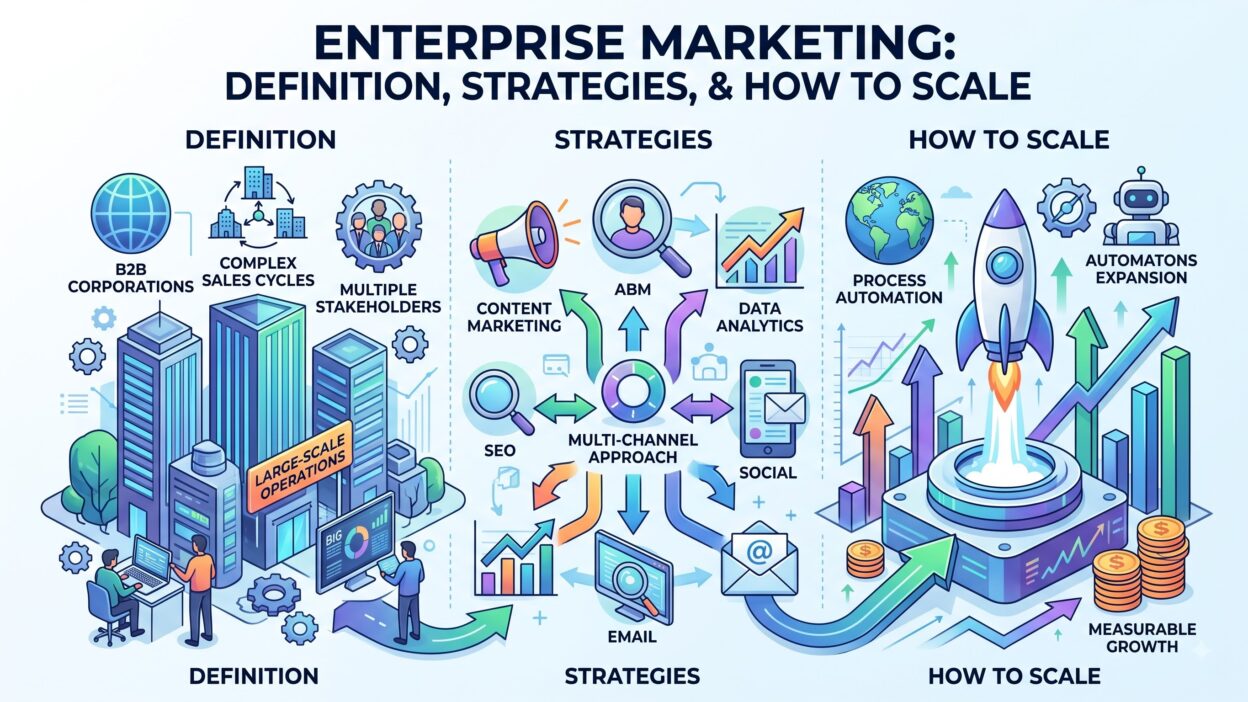
TL;DR Running marketing at a large company is a different job than running marketing at a small one. The stakes are higher. The teams are bigger. The buyers take longer to say yes. Enterprise marketing is the discipline built around these realities, and it deserves its own playbook. This guide explains what it means, why it matters, and how to grow a program without losing quality along the way.
Table of Contents
What Is Enterprise Marketing?
Enterprise marketing is the practice of promoting products or services at large organizations with complex structures. Some people also call it large-account marketing or corporate marketing, but the core idea stays the same across every name. These companies often have thousands of employees. They sell to other businesses, to large consumer bases, or to both at once. The practice covers everything from brand strategy to demand generation to customer retention.
The buying process at this scale looks nothing like a typical small-business purchase. Deals involve longer sales cycles. They also involve multiple decision makers. A single opportunity can pull in five or ten stakeholders, and each one wants different proof points before they sign off. Legal wants contract terms. Finance wants pricing clarity. The end user just wants the product to work. Coordinating all of this turns marketing into a project management challenge as much as a creative one.
Teams working at this level rarely operate alone. Sales, product, and customer success all play a role in the final result. The marketing group sets the direction and the message. Other departments help carry that message forward. This structure only works when everyone agrees on the same goals from the start.
How Enterprise Marketing Differs From Small Business Marketing
Small businesses move fast. A founder tests an idea today and launches a campaign tomorrow. Large organizations rarely work this way. Every campaign passes through layers of review. Legal checks the copy for compliance risk. The brand team checks the design against guidelines. Regional offices check the messaging against local norms.
This slower pace exists for a reason. A large company has more to lose from a bad campaign than a small shop does. One misstep can reach millions of people within hours. Teams at this scale build approval processes specifically to catch problems before they go public, not to slow creativity down for its own sake.
Budgets tell a similar story. A small business might spend a few thousand dollars a month on ads and content. Programs at large companies often run into millions of dollars a year across channels, agencies, and headcount. That kind of spend demands careful planning. It also demands clear, defensible reporting on return on investment, since every dollar gets scrutinized by finance.
Why Enterprise Marketing Matters
Growth at scale depends on getting this discipline right. A strong program builds trust with large buyers long before a sales rep ever picks up the phone. It also keeps the brand consistent across every market the company serves, which matters more than most teams realize until it breaks down.
Large companies compete in crowded categories. Buyers see dozens of similar products pitched the same way. A well-run program helps a company stand apart from that noise. It tells a clear story about why the product matters and who it actually helps, instead of repeating generic claims that every competitor also makes.
The work does not stop once a deal closes, either. Enterprise deals bring years of relationship management with them. Customers need onboarding support, renewal conversations, and expansion opportunities. Marketing plays a real role at each of these later stages, not just at the top of the funnel. Teams that treat the customer relationship as ongoing keep accounts engaged long after the contract gets signed.
Enterprise Marketing and Brand Trust
Trust drives buying decisions at this level more than almost anything else. Large companies research vendors for weeks or months before committing to anything. They read case studies. They talk to current customers off the record. They check analyst reports and review sites before a single meeting gets booked.
Consistent messaging builds this trust over time. A buyer should see the same voice on the website, in emails, and at industry events. Consistency signals reliability, and buyers naturally trust companies that show up the same way every single time they interact with them.
Case studies carry unusual weight in this world. A detailed, specific case study shows real results from a real customer, and that kind of proof beats almost any other content format. Teams should invest heavily here, because a strong story from an existing client often does more to close a deal than a dozen product pages ever could.
Core Components of Enterprise Marketing
An enterprise marketing program includes several moving parts, and each one supports the others. Skip one and the whole system starts to weaken.
Brand Strategy
Brand strategy sets the foundation for everything else. It defines the company’s voice, values, and visual identity across every channel. Every piece of content should reflect this strategy, whether it comes from headquarters or a regional office three time zones away.
Large companies often struggle to keep this consistent as they grow. Different regions and product lines start to drift from the original guidelines. A central brand hub solves much of this problem. It should cover tone, color use, logo placement, and the core messaging pillars everyone can reference.
Content Marketing
Content fuels the buyer journey at every stage of a large-scale program. Blog posts, whitepapers, and videos educate buyers early, while they are still defining the problem they need to solve. Case studies and detailed product guides support buyers who are closer to a final decision.
Content at this level needs real depth. Buyers at large companies do serious research before they ever talk to sales. They want data behind every claim. They want proof, not adjectives. Thin, generic content rarely convinces a buyer to spend six or seven figures on a new vendor relationship.
Account-Based Approaches
Account-based marketing, often shortened to ABM, targets specific high-value accounts by name instead of casting a wide net across an entire industry. Teams build custom campaigns for each target company, often researching that company’s specific challenges before writing a single word.
This approach works well because deal sizes are large enough to justify the extra effort. A single closed account can repay weeks of custom content and personalized outreach many times over. Sales and marketing plan these campaigns together from day one, since the target list usually comes straight from the sales pipeline.
Marketing Technology
Large programs run on technology stacks built for scale. Teams need reliable tools for email, analytics, content management, and customer relationship tracking, and those tools need to share data cleanly with each other.
A messy stack slows everything down. Data gets stuck in silos between departments. Reports that should take minutes end up taking days to assemble by hand. Choosing the right platforms early, and auditing them regularly, saves enormous amounts of time later on.
Enterprise Marketing Strategies That Actually Work
Strategy separates strong enterprise marketing programs from average ones. These approaches consistently deliver results across large organizations.
Build a Unified Team
Programs work best with clearly defined roles. Some team members focus on brand. Others focus on demand generation. Others focus purely on content production. Each role should connect back to one shared goal instead of running its own separate agenda.
Silos hurt results more than almost anything else. A brand team that never talks to the demand generation team ends up creating disconnected campaigns that confuse buyers. Regular cross-team meetings and shared dashboards keep everyone pointed in the same direction.
Let Data Guide Decisions
Large-scale programs generate huge amounts of data every day. Website visits, email opens, and ad clicks all tell a story about what works and what does not. Teams that ignore this data end up wasting real budget on campaigns that never had a chance.
Strong teams review performance data weekly, not quarterly. They track which channels bring in qualified leads and which ones just generate noise. Then they shift spending away from underperforming channels quickly, before those channels drain the annual budget.
Personalize at Scale
Buyers expect relevant content built around their specific situation. A generic email rarely gets a reply from a busy executive with a full inbox. Segmentation lets teams send the right message to the right person without writing a completely custom email for every single contact.
Personalization at this size does not mean handwriting every message. It means grouping buyers by industry, role, or company size, then building content that speaks directly to each group’s specific challenges and language.
Align Sales and Marketing Closely
Sales and marketing often operate in separate worlds inside large companies, and that gap creates real problems. Leads fall through the cracks between systems. Messaging drifts apart until customers hear two different stories from the same company.
Strong programs set shared goals with the sales organization from the very start. Both teams agree on what actually counts as a qualified lead before any campaign launches. Both teams review pipeline data together on a regular cadence. This kind of alignment shortens the sales cycle noticeably over time.
Common Challenges in Enterprise Marketing
Real challenges come with operating an enterprise marketing program this large. Teams that plan for them ahead of time avoid the most expensive mistakes.
Managing Multiple Teams and Regions
Large companies often operate across dozens of countries at once. Each region carries its own language, culture, and competitive landscape. Programs need to balance global consistency with genuine local relevance, and that balance is harder than it sounds.
A campaign that works well in one country can fail completely in another. Regional teams need some freedom to adjust messaging for their own market. At the same time, the core brand identity should stay recognizable no matter where a buyer encounters it.
Keeping the Brand Consistent
Consistency gets harder as teams grow larger. New hires join every quarter. New agencies get added to handle overflow work. Without clear, accessible guidelines, the brand starts to look different depending on who produced the content.
A central hub of templates, style guides, and pre-approved assets keeps every contributor on the same page. Leaders should audit consistency across channels on a regular schedule, catching drift before it becomes the new normal.
How to Scale Enterprise Marketing Without Losing Quality
Scaling enterprise marketing means doing more work without sacrificing the quality that built trust in the first place. These steps help teams grow steadily instead of breaking what already works.
Automate the Repetitive Work
Manual tasks slow down even the best teams. Email scheduling, lead scoring, and routine reporting can all run through automation instead of eating up hours every week. That freed-up time goes toward strategy and creative work that actually needs a human touch.
Automation also cuts down on simple human error. A scheduled campaign runs the exact same way every single time it fires. Teams can trust the process instead of manually checking each step before it goes live.
Invest in Tools Built to Grow
Platforms should scale alongside the company using them. A tool that handles a fifty-person team smoothly might completely break down once that team grows to five hundred people. Choosing platforms built for scale from the beginning avoids a painful migration later.
The right tools also connect data cleanly across departments. Sales sees the same lead history that marketing sees. Customer success sees the same account timeline everyone else does. That shared visibility improves decisions at every level of the organization.
Train the Team Continuously
Scaling requires skilled people just as much as it requires good software. New tools and new strategies mean very little without a team that actually knows how to use them well. Regular training keeps everyone’s skills sharp as the landscape shifts.
The field changes quickly. New channels appear almost every year. Buyer behavior shifts as new generations move into decision-making roles. Teams that invest in ongoing education tend to stay ahead of competitors who treat training as optional.
Measure the Numbers That Matter
Growth without measurement is really just a guess dressed up as a plan. Teams should track pipeline generated, cost per lead, and customer lifetime value above almost everything else. These numbers show whether scaling efforts are actually paying off.
Vanity metrics like raw page views feel satisfying but rarely tell the full story. Focus on numbers that connect directly to revenue instead. That discipline keeps the entire program accountable to the business it serves.
Best Practices Worth Adopting
A handful of habits separate the strongest programs from the rest. Keep messaging consistent across every single channel a buyer might encounter. Base every major decision on real data instead of opinion or internal politics. Meet with sales teams often enough that goals never drift apart. Review the technology stack once a year and remove tools that no longer earn their cost. Document processes clearly so new hires ramp up in weeks instead of months.
Customer feedback loops matter just as much as internal process. Talk to customers directly and ask what content actually helped them decide to buy. Use those honest answers to shape the next round of campaigns, rather than guessing at what worked.
Trends Worth Watching
Artificial intelligence now plays a growing role in how large teams operate day to day. Many use it to draft first versions of content, analyze large datasets, and predict which leads are most likely to convert. This technology speeds up work that used to take an entire team days to finish.
Video continues to grow in importance as well. Buyers increasingly prefer short videos over long written documents when they are short on time. Product demos, customer testimonials, and executive interviews all tend to perform well in this format.
Privacy regulation is reshaping strategy across every region. Companies now collect far less third-party data than they once did. Teams are shifting toward first-party data collected directly through their own websites, products, and customer relationships instead.
Enterprise Marketing Examples Worth Studying
Looking at real examples helps teams understand what strong execution actually looks like. A global software vendor might run a single enterprise marketing campaign across ten countries, then adjust the imagery and case studies for each region while keeping the core message the same. A financial services company might build an entire content library around one flagship report, then repurpose that report into webinars, sales one-pagers, and executive briefings.
Manufacturing companies often take a different route. They lean heavily on trade shows and in-person events, since their buyers still value face-to-face conversations before signing large contracts. Their enterprise marketing teams spend months preparing booth materials, product demos, and executive talking points for a single event.
Healthcare and technology companies tend to lead with data. Their marketing teams publish research reports and benchmark studies, then use that original data to earn press coverage and inbound interest from buyers who trust numbers over sales pitches. Each of these examples solves the same underlying problem in a way that fits its own industry.
Enterprise Marketing Metrics and KPIs
Numbers keep an enterprise marketing program honest. Marketing qualified leads show how many prospects show real buying intent. Sales accepted leads show how many of those prospects actually meet the bar sales agreed on ahead of time. Pipeline value shows the total dollar amount sitting in active deals tied back to marketing efforts.
Customer acquisition cost matters just as much. This number shows how much the company spends to win one new customer, and it should drop over time as a program matures. Customer lifetime value works alongside it, showing how much revenue one account brings in across the full relationship, not just the first sale.
Brand awareness metrics round out the picture. Website traffic, share of voice, and branded search volume all show whether the market recognizes the company without being prompted. None of these numbers matter in isolation. Enterprise marketing leaders should review them together every month to get an honest read on program health.
FAQs
What is the main goal of a program like this? The main goal is sustainable growth at scale. It builds brand trust, generates qualified leads, and supports long customer relationships across a large organization.
How does this differ from general B2B marketing? It sits inside the broader B2B category but focuses specifically on large companies with complex buying processes and bigger budgets. General B2B work can also include much smaller business buyers.
What tools do these teams typically use? Teams usually rely on customer relationship management platforms, marketing automation software, analytics tools, and content management systems. Many also use dedicated account-based platforms for targeted campaigns.
How long does a typical sales cycle take? Sales cycles at this level often run six months to over a year. Multiple stakeholders review every decision, which stretches the timeline well beyond what a smaller business deal would take.
How do teams measure success? Success gets measured through pipeline generated, cost per lead, deal size, and customer lifetime value. These metrics tie every effort directly back to revenue outcomes the business cares about.
Can a small team run a program like this? A small team can absolutely take this on with the right tools and a tight focus. Automation and account-based strategies help smaller teams compete for large accounts without a massive headcount.
Read More:-Connect Claude to Your CRM: Setup, Actions, and Verified Data
Conclusion

Enterprise marketing rewards patience, structure, and the right set of tools. It rewards teams that align sales and marketing around shared goals instead of separate scorecards. It rewards teams that trust real data over guesswork and internal opinion. Large companies that invest seriously in this discipline build lasting trust with their buyers, and that trust becomes the foundation for years of steady growth. Start with a clear strategy, measure what actually matters, and scale one deliberate step at a time.