Introduction
TL;DR Role-playing games never get old. Dungeons & Dragons has captured imaginations for decades. Now, artificial intelligence makes the game experience richer, more dynamic, and genuinely unpredictable.
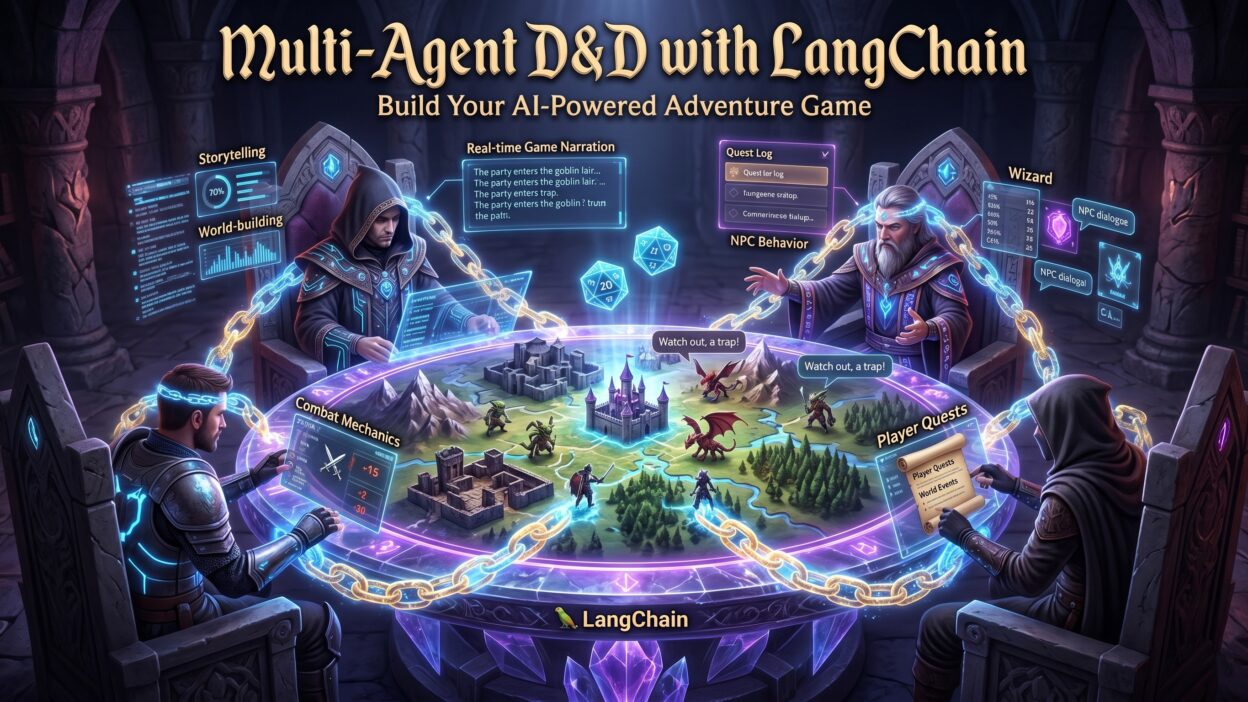
Building a Multi-Agent Dungeons & Dragons Game with LangChain gives you something remarkable. You create a living, breathing game world run entirely by specialized AI agents. Each agent handles a different role. One runs the narrative. One controls combat. One manages inventory. One tracks the world state.
This is not a chatbot with a fantasy skin. This is a proper multi-agent system where autonomous AI characters collaborate, make decisions, and react to player actions in real time.
LangChain makes this architecture accessible. Its agent framework, tool system, memory modules, and graph-based orchestration layer give you everything you need to build this kind of application without starting from scratch.
This blog walks you through the full conceptual and technical blueprint. You will understand how to design the agent roles, connect them through LangGraph, give each one tools and memory, and wire everything into a playable game loop.
Every section builds on the last. Read it in order and you will finish with a clear path forward.
Table of Contents
Why LangChain Is the Right Framework for This Project
Many developers reach for raw API calls when they first experiment with LLM applications. That approach works for simple use cases. It breaks down fast when your system needs multiple coordinating agents, persistent memory, tool access, and dynamic routing logic.
LangChain solves exactly these problems. It provides a modular, composable framework where each component serves a clear purpose. Agents, tools, memory stores, prompt templates, and output parsers each slot into a coherent system architecture.
Building a Multi-Agent Dungeons & Dragons Game with LangChain benefits from several specific framework features that make this project significantly easier to implement well.
LangGraph Handles Agent Orchestration
LangGraph is LangChain’s graph-based orchestration layer. You define nodes and edges. Each node represents an agent or a processing step. Each edge defines the conditions under which control passes from one node to another.
In a D&D context, this maps perfectly onto the game’s natural flow. The Dungeon Master agent receives the player’s action. It decides whether the action triggers a combat sequence, a skill check, a social encounter, or a narrative response. LangGraph routes control to the correct specialized agent based on that decision.
This conditional routing is powerful. Earlier LangChain architectures used linear chains that could not branch dynamically. LangGraph eliminates that limitation entirely.
Tools Give Agents Real Capabilities
LangChain tools extend what agents can do beyond pure text generation. Tools let agents query databases, perform calculations, read and write files, call external APIs, and execute code.
For a D&D game, tools handle dice rolling, character sheet lookup, inventory management, and world state persistence. The agent calls the tool, gets a structured result, and incorporates that result into its narrative response.
This distinction matters. Without tools, an agent only generates text. With tools, it performs real actions that change the state of the game world. That is what makes Building a Multi-Agent Dungeons & Dragons Game with LangChain genuinely interactive rather than just conversational.
Designing the Agent Architecture
The architecture defines everything. Get this right and the rest of the implementation follows naturally. Get it wrong and you spend weeks debugging emergent conflicts between agents that were never designed to work together.
A well-designed Multi-Agent Dungeons & Dragons Game with LangChain uses five distinct specialized agents. Each one owns a specific domain of game responsibility. No two agents overlap in their core function.
The Dungeon Master Agent
The Dungeon Master (DM) agent is the central orchestrator. It receives every player input first. It interprets the player’s intent. It decides what kind of game event the action triggers. It routes control to the appropriate specialized agent for processing.
The DM agent also generates the final narrative response. Specialized agents do their work — rolling dice, checking inventory, updating world state — and return structured data to the DM agent. The DM agent weaves that data into a compelling story beat delivered to the player.
This agent needs a rich system prompt. It must embody a specific narration style, maintain story consistency, remember established world lore, and balance player agency against narrative coherence.
The Combat Agent
The Combat agent activates during battle sequences. It manages initiative order, calculates attack rolls and damage, tracks hit points for all combatants, and determines enemy tactics.
This agent relies heavily on tools. Dice roll tools handle the randomness of combat. Character stat lookup tools provide attack bonuses and armor class values. Enemy behavior tools define how different monster types prioritize targets and use special abilities.
The Combat agent returns structured combat outcomes to the DM agent. The DM agent narrates those outcomes dramatically. This separation keeps the math clean and the storytelling expressive.
The World State Agent
The World State agent is the game’s persistent memory system. It tracks the physical location of the player, the state of every visited location, the status of NPCs the player has encountered, and the current time within the game world.
Every significant player action potentially changes world state. The player unlocks a door — the World State agent records it as unlocked. The player forms an alliance with a merchant — the World State agent records the relationship status.
This agent queries and updates a persistent data store. It uses tools to read from and write to a structured world state database. Other agents query it constantly to maintain narrative consistency.
The Inventory and Economy Agent
The Inventory agent manages everything the player carries. It tracks item acquisition, consumption, weight limits, gold balances, and merchant transaction outcomes.
This agent prevents narrative inconsistencies. A player cannot use a health potion they never acquired. A player cannot buy an item they cannot afford. The Inventory agent enforces these constraints cleanly and returns clear structured responses that the DM agent incorporates into the narrative.
The NPC Personality Agent
The NPC Personality agent gives individual characters their own voice and memory. When the player speaks with a specific NPC, this agent activates. It maintains that character’s personality profile, relationship history with the player, and knowledge of game events.
This agent makes the world feel alive. NPCs remember previous conversations. They hold grudges. They warm up over time. They reveal information based on trust levels the player has established. Building a Multi-Agent Dungeons & Dragons Game with LangChain becomes genuinely immersive when NPCs behave with this level of contextual memory.
Setting Up LangChain and LangGraph
Before you write any agent logic, you need a working development environment. The setup is straightforward for any developer comfortable with Python.
Start by creating a fresh virtual environment. This keeps your project dependencies isolated from other Python projects on your machine. Use Python 3.10 or higher. LangGraph requires modern Python features that earlier versions do not support cleanly.
Install the core dependencies. You need langchain, langgraph, langchain-openai, and langchain-community as your foundation packages. Add pydantic for data validation, python-dotenv for environment variable management, and a database library like sqlite3 or chromadb depending on your memory architecture choices.
pip install langchain langgraph langchain-openai langchain-community pydantic python-dotenv chromadb
Set your API key in a .env file. Never hardcode API keys directly in your source files. Load them at runtime using dotenv.
Structuring Your Project Files
A clean file structure prevents chaos as the project grows. Organize your project with a clear separation of concerns. Keep agent definitions in an agents folder. Keep tool definitions in a tools folder. Keep memory and state management in a state folder. Keep prompt templates in a prompts folder.
This structure makes the system easier to debug, extend, and test. When a combat mechanic breaks, you look in the tools folder and the combat agent file. When narrative consistency drifts, you check the DM agent prompt and the World State agent logic.
A well-structured project file layout is one of the most practical insights in any guide to Building a Multi-Agent Dungeons & Dragons Game with LangChain. Most tutorials skip this step. They show working code in a single file. That approach does not scale.
Building the Tools Layer
Tools are the hands of your agents. They perform discrete, well-defined actions and return structured results. Every tool in this system maps to a specific game mechanic.
The Dice Rolling Tool
The dice rolling tool is fundamental to D&D. It accepts a dice notation string as input. A string like “2d6+3” means roll two six-sided dice and add three to the result. The tool parses this notation, generates random numbers within the correct range, applies modifiers, and returns the total.
from langchain.tools import tool
import random

@tool
def roll_dice(notation: str) -> dict:
    """Roll dice using standard D&D notation like 1d20, 2d6+3, etc."""
    # Parse notation, roll dice, return structured result
    parts = notation.lower().split('d')
    num_dice = int(parts[0]) if parts[0] else 1
    rest = parts[1].split('+')
    die_size = int(rest[0])
    modifier = int(rest[1]) if len(rest) > 1 else 0
    rolls = [random.randint(1, die_size) for _ in range(num_dice)]
    total = sum(rolls) + modifier
    return {"rolls": rolls, "modifier": modifier, "total": total}
This tool returns a dictionary rather than a string. Structured return types give the calling agent clean data it can reason about programmatically rather than parsing text output.
The Character Sheet Tool
The character sheet tool reads and updates player statistics. It accepts a character name and an optional field name. It returns the current values for that character’s abilities, skills, hit points, and saving throws.
Store character data in a simple SQLite database or a JSON file during development. The tool abstracts away the storage layer. Agents call the tool — they do not interact with the database directly.
The World State Read and Write Tools
These two tools handle world state persistence. The read tool accepts a location or entity identifier and returns its current state. The write tool accepts an identifier and a state update and commits the change to persistent storage.
Keeping read and write operations as separate tools gives you cleaner agent reasoning. An agent explicitly calls the write tool when it intends to change world state. This intentionality prevents accidental state mutations from sloppy agent reasoning.
Every serious implementation of a Multi-Agent Dungeons & Dragons Game with LangChain treats tool design with this level of deliberateness. Sloppy tools produce unpredictable agent behavior. Precise tools produce reliable, consistent game mechanics.
Implementing Memory for Each Agent
Memory separates reactive chatbots from genuine AI agents. Each agent in this system needs a different kind of memory suited to its specific responsibilities.
Conversation Buffer Memory for the DM Agent
The DM agent needs access to the recent conversation history. It must maintain narrative coherence across the current session. LangChain’s ConversationBufferMemory stores the full exchange and injects it into each new prompt.
For longer sessions, ConversationSummaryMemory compresses earlier exchanges into a summary. This keeps the context window manageable while preserving the most important narrative context from earlier in the session.
Vector Store Memory for the NPC Agent
The NPC Personality agent needs semantic memory. It must retrieve relevant memories about a specific character based on the content of the current conversation, not just recent exchanges.
ChromaDB or FAISS work well here. Each NPC has its own collection of memory documents. When the player speaks with a character, the agent retrieves the most semantically relevant memories using similarity search. This gives NPCs a nuanced, contextually appropriate recall system.
Persistent State for the World State Agent
The World State agent does not use conversational memory at all. It uses structured persistent storage. SQLite provides a simple, file-based option for development. PostgreSQL scales better for production deployments.
The agent writes state changes immediately. It reads state on demand. Consistency is critical here. A player who killed a bandit last session should not encounter that same bandit alive and well in their next session.
Proper memory architecture is what elevates Building a Multi-Agent Dungeons & Dragons Game with LangChain from an impressive demo to a genuinely playable, consistent game experience. Invest time in getting this layer right before you build the agent logic on top of it.
Wiring Agents Together with LangGraph
LangGraph turns your collection of independent agents into a coordinated system. You define a state graph where each node is an agent or processing step and each edge is a routing condition.
Defining the State Schema
Start by defining a shared state object. This is a typed dictionary or Pydantic model that every agent reads from and writes to as control passes through the graph.
from typing import TypedDict, List

class GameState(TypedDict):
    player_input: str
    current_location: str
    active_combat: bool
    inventory: List[str]
    npc_context: str
    narrative_response: str
    game_log: List[str]
Every agent receives the full GameState. Each agent updates only the fields relevant to its domain. The DM agent updates narrative_response. The Combat agent updates active_combat and logs combat results. The World State agent updates current_location.
Defining Routing Logic
The router function examines the current state and the DM agent’s intent classification. It returns the name of the next node to activate.
def route_action(state: GameState) -> str:
    if state["active_combat"]:
        return "combat_agent"
    if "talk" in state["player_input"].lower():
        return "npc_agent"
    if "buy" in state["player_input"].lower() or "sell" in state["player_input"].lower():
        return "inventory_agent"
    return "dm_agent"
Real routing logic uses the DM agent’s structured output classification rather than keyword matching. This example illustrates the concept at its simplest form.
Compiling and Running the Graph
LangGraph’s StateGraph class accepts node definitions and edge definitions. You compile the graph and invoke it with an initial state. The framework handles control flow, state updates, and agent sequencing automatically.
This orchestration layer is the architectural heart of Building a Multi-Agent Dungeons & Dragons Game with LangChain. It transforms a collection of smart individual agents into a coherent, collaborative game system.
Crafting Effective Agent Prompts
System prompts define each agent’s identity, responsibilities, and behavioral constraints. Weak prompts produce inconsistent, unreliable agents. Strong prompts produce agents that stay in role and deliver high-quality outputs consistently.
The DM Agent System Prompt
The DM agent prompt establishes the narrative voice, world setting, and routing responsibilities simultaneously.
A strong DM prompt opens with the world setting. It names the campaign world, describes the tone — dark fantasy, heroic adventure, political intrigue — and establishes the narrative style. It then defines the agent’s routing responsibilities. It explains that the agent must classify every player action and return a structured classification alongside its narrative response.
The prompt should explicitly list the available specialized agents and the conditions that trigger each one. This prevents the DM agent from attempting to handle combat resolution or inventory management itself.
The Combat Agent System Prompt
The Combat agent prompt reads more like a referee’s rulebook than a narrative guide. It instructs the agent to prioritize accuracy over style. It lists the tools available for combat resolution and defines the output format the DM agent expects.
The prompt should include example combat scenarios with correct tool usage patterns. Few-shot examples inside system prompts significantly improve agent reliability for structured tasks like combat resolution.
Iteration Is Part of the Process
Expect to revise agent prompts repeatedly. Your first version will reveal edge cases you did not anticipate. Log every agent interaction during development. Review the logs after each test session. Identify where agents drifted from intended behavior and refine the relevant prompt.
Prompt engineering is the most important ongoing skill in Building a Multi-Agent Dungeons & Dragons Game with LangChain. The framework handles the infrastructure. Your prompts determine the quality of the experience.
Testing and Debugging Your Multi-Agent System
Multi-agent systems introduce debugging complexity that single-agent applications do not face. Problems can originate in any individual agent, in the routing logic, in the tool layer, or in the state management system.
Develop a systematic testing approach from the beginning. Do not wait until the full system is assembled to start testing. Test each agent in isolation first. Verify that the DM agent classifies actions correctly across a wide range of player inputs. Verify that the Combat agent resolves encounters accurately using correct D&D mechanics. Verify that the World State agent reads and writes state without data loss or corruption.
Using LangSmith for Observability
LangSmith is LangChain’s built-in tracing and observability platform. Enable it during development. Every agent invocation gets logged with full input, output, intermediate steps, and tool calls visible.
This visibility is invaluable when debugging complex multi-agent interactions. You can trace exactly which agent received which input, which tools it called, what those tools returned, and what the agent ultimately produced. Tracking this manually through print statements is inefficient and error-prone.
Simulating Edge Cases Deliberately
Write a test script that drives your game system through deliberately difficult edge cases. Test what happens when a player attempts an impossible action. Test combat encounters where all combatants die simultaneously. Test NPC interactions where the player attempts manipulation or deception.
Edge case testing reveals the seams in your agent coordination logic. Fix those seams before you consider the system ready for actual play. A robust Multi-Agent Dungeons & Dragons Game with LangChain handles the unexpected as gracefully as the expected.
Extending the System with Advanced Features
A working base system opens the door to genuinely exciting extensions. Once your five core agents coordinate reliably, you can add layers that make the game experience richer and more dynamic.
Procedural World Generation
Add a World Generation agent that creates new locations on demand. When the player moves into unmapped territory, this agent generates location descriptions, populates them with appropriate NPCs and encounters, and seeds them with relevant loot. The World State agent stores the generated content for consistency on return visits.
Dynamic Quest Generation
A Quest agent analyzes the current world state and the player’s history to generate contextually appropriate quest hooks. It surfaces quests that connect to the player’s established relationships, their current location, and the overarching narrative threads the DM agent has been developing.
This kind of emergent storytelling is one of the most compelling aspects of Building a Multi-Agent Dungeons & Dragons Game with LangChain. The system generates content that feels tailored to the player’s specific journey rather than pulled from a static quest database.
Voice Interface Integration
Adding a voice interface transforms the experience. Connect a speech-to-text layer on the input side and a text-to-speech layer on the output side. The player speaks their actions aloud. The DM agent responds in a synthesized voice.
Different NPCs can use different voice profiles. The party merchant sounds nothing like the ancient dragon the player just woke from slumber. This level of immersion takes the experience from impressive technical demo to genuinely memorable game session.
Frequently Asked Questions
Q: Do I need deep machine learning knowledge to build a Multi-Agent Dungeons & Dragons Game with LangChain?
No. LangChain abstracts the underlying model complexity. You work at the level of agents, tools, prompts, and graphs. Solid Python skills and a clear understanding of how LLM APIs work are the primary prerequisites. Deep ML knowledge becomes relevant only if you plan to fine-tune custom models for specific roles.
Q: Which LLM works best for this type of game system?
GPT-4o and Claude 3.5 Sonnet both perform well for narrative agents. They follow complex system prompt instructions reliably and produce high-quality creative text. For combat and inventory agents that focus on structured output, GPT-4o-mini offers excellent cost efficiency without sacrificing accuracy on constrained tasks.
Q: How do I prevent agents from contradicting each other?
Centralize world state authority in a single World State agent. All other agents read state before generating responses. All state-changing actions route through the World State agent before the DM agent narrates the outcome. This single-source-of-truth architecture prevents contradictions at the architectural level.
Q: How much does it cost to run this system per game session?
Cost depends heavily on the models you choose and the length of your sessions. An hour of active play with GPT-4o across five agents typically consumes between 50,000 and 200,000 tokens depending on prompt length and response verbosity. Using GPT-4o-mini for less narrative-critical agents reduces costs significantly.
Q: Can I run this system locally without API costs?
Yes. LangChain supports local models through Ollama. Models like Llama 3.1 or Mistral run locally on consumer hardware. Narrative quality is lower than frontier models but entirely serviceable for development and testing purposes. Many developers build and test locally and deploy with paid API access for actual gameplay.
Q: How do I add multiplayer support?
Multiplayer requires a session management layer above the agent system. Each player gets their own character sheet and inventory state. The DM agent handles multiple players’ inputs within a shared world state. LangGraph’s async support enables concurrent agent invocations for multiple players within the same game session.
Read More:-Architecture and Orchestration of Memory Systems in AI Agents
Conclusion

Building a Multi-Agent Dungeons & Dragons Game with LangChain is one of the most rewarding AI development projects you can undertake. It combines creative world-building with rigorous systems architecture. Every design decision carries visible consequences in the gameplay experience.
The five-agent architecture gives you a scalable foundation. The DM, Combat, World State, Inventory, and NPC agents each own their domain cleanly. LangGraph connects them into a coherent game loop that routes control intelligently based on player actions and game conditions.
The tools layer grounds the agents in real game mechanics. Memory gives them the contextual awareness to maintain consistency across a full campaign. Strong system prompts define each agent’s identity and ensure reliable, high-quality behavior across thousands of interactions.
Start with the core architecture. Get the DM agent and World State agent working first. Add Combat and Inventory next. Layer in NPC personality last. Test each component in isolation before integrating into the full graph.
The system you build through this approach is genuinely impressive. It produces game experiences that feel coherent, reactive, and alive in ways that pre-scripted game systems simply cannot match.
Building a Multi-Agent Dungeons & Dragons Game with LangChain is complex. It is also completely within reach. Start building today.