Introduction
TL;DR Getting past an Applicant Tracking System is the hardest part of job hunting today. Most resumes never reach a human recruiter. They get rejected by software before anyone reads a single word. I decided to solve this problem myself. I built a complete AI resume with 90+ ATS Score from scratch. It worked. I want to show you exactly what I did, what tools I used, and what made the biggest difference. You can replicate this process and get similar results.
Table of Contents
Why ATS Scores Matter More Than Ever in 2025
Companies receive hundreds of applications for every job posting. Recruiters do not have time to read all of them manually. They use ATS software to filter and rank candidates automatically. A low ATS score means your resume gets eliminated immediately. You never get a chance to speak with anyone. The job market in 2025 is more competitive than it has ever been. AI tools have made it easier to apply for jobs at scale. This means more applications land in every hiring queue. Recruiters rely on ATS systems more heavily to manage the volume. Your resume must score high to survive the first filter. This is why building an AI resume with 90+ ATS score is no longer optional. It is a basic requirement for serious job seekers.
What Is an ATS Score and How Is It Calculated?
An ATS score is a number that ranks your resume against a specific job description. The system scans your document and compares it to the job posting. It looks for matching keywords, skills, job titles, and formatting. Every match adds points to your score. Missing keywords lower your score. Formatting errors can make the system skip sections entirely. A score above 80 is generally considered competitive. A score above 90 places you at the top of the applicant pool. Most job seekers score between 40 and 60. That range almost guarantees rejection at the screening stage.
The Tools I Used to Build My AI Resume with 90+ ATS Score
Building an AI resume with 90+ ATS score requires the right set of tools. I did not rely on guesswork. I used specific software designed to analyze, write, and optimize resumes for ATS systems. Each tool served a clear purpose in my workflow. Using them together produced results I could not achieve manually.
AI Writing Assistants for Resume Content
I used Claude and ChatGPT to draft and refine resume content. These tools helped me write achievement-based statements that were clear and precise. I gave each tool the job description and my work history. The AI generated bullet points that matched the language of the posting. I reviewed every suggestion critically. I kept what was accurate and removed anything that felt generic. The goal was precise language that reflected real experience. AI writing tools speed up the drafting process significantly. They also help you use keywords naturally without stuffing them awkwardly.
ATS Scanning and Score Testing Tools
I used Jobscan and Resumeworded to test my resume score before sending it anywhere. These platforms simulate how real ATS systems evaluate your document. You upload your resume and paste the job description. The tool gives you a match score and lists missing keywords. I repeated this process multiple times. Each round of feedback improved my score. By the fifth revision, my AI resume with 90+ ATS score was consistent across multiple job descriptions in my target field. Testing tools are essential. Without them, you are optimizing blindly.
Step-by-Step Process I Followed to Achieve 90+ ATS Score
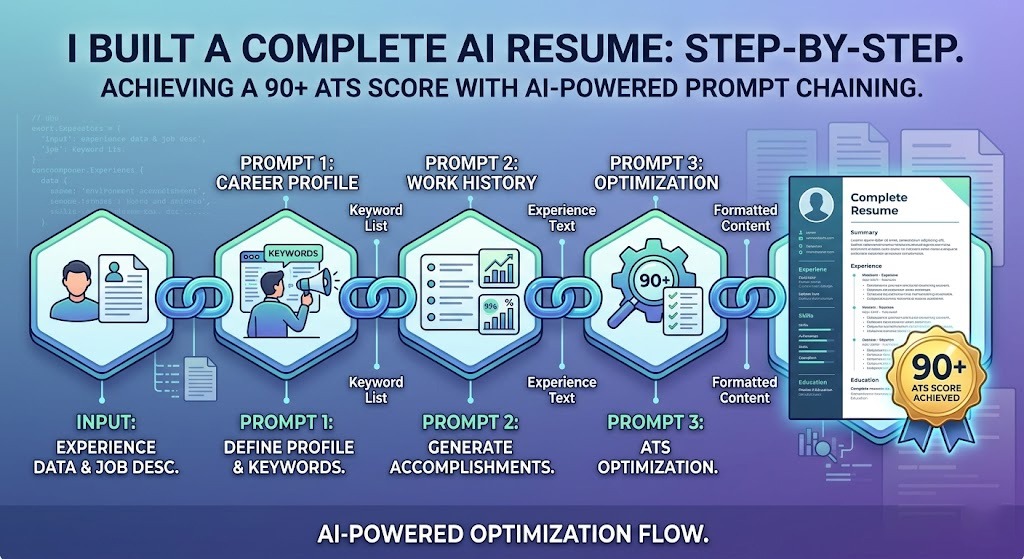
There was no magic involved in building my AI resume with 90+ ATS score. It was a structured process. Each step built on the previous one. I will walk you through exactly what I did so you can replicate it.
Collect and Analyze Target Job Descriptions
I gathered ten job descriptions for the same type of role I wanted. I read through all of them carefully. I highlighted recurring keywords, skills, and phrases. I paid attention to required qualifications versus preferred qualifications. The words that appeared across multiple postings were the most important. These became the foundation of my keyword strategy. ATS systems prioritize terms that match the job description exactly. Analyzing multiple postings gives you a clear picture of what employers look for consistently.
Structure the Resume for ATS Compatibility
ATS systems struggle with complex formatting. I kept my layout simple and clean. I used a single-column format with standard section headers. I used headers like Work Experience, Skills, Education, and Certifications. I avoided tables, graphics, text boxes, and multi-column layouts. These elements break ATS parsing. The system cannot read content inside them correctly. I saved my final document as a plain .docx file. PDF files can cause parsing issues depending on the ATS platform. Simple formatting is not boring. It is strategic.
Write Achievement-Based Content with AI Assistance
I gave Claude the job description and my raw work history. I asked it to rewrite my experience section using achievement-based language. The AI produced strong sentences with quantifiable results. I used prompts like: “Write a resume bullet for a project manager who reduced delivery time by 25%.” The output was precise and keyword-rich. I customized each line to reflect my actual experience. Generic bullet points do not impress recruiters or ATS systems. Specific achievements with numbers perform significantly better in both areas.
Insert Keywords Strategically Throughout the Resume
Keyword placement is critical for building an AI resume with 90+ ATS score. I placed important keywords in multiple sections of my resume. They appeared in the summary, skills section, and experience descriptions. I did not repeat them awkwardly. Each placement felt natural within the sentence. I used both full terms and common abbreviations where relevant. For example, I wrote “Search Engine Optimization (SEO)” in the summary and then used “SEO” in the skills section. ATS systems recognize both versions. Spreading keywords across sections signals strong relevance to the job.
Test, Score, and Revise Repeatedly
I ran my resume through Jobscan after each revision. My first score was 61. I identified the missing keywords from the report. I worked them into the appropriate sections naturally. My second test returned a score of 74. I continued refining. By the fourth revision, I reached 88. One more round of targeted edits pushed it above 90. This iterative approach is the most reliable way to build an AI resume with 90+ ATS score. Do not settle for your first draft. Each revision brings measurable improvement.
Key Sections That Boosted My ATS Score the Most
Not all resume sections carry equal weight in ATS scoring. Some sections have a much bigger impact on your total score. I focused my optimization efforts where they mattered most.
The Professional Summary Section
The summary sits at the top of the resume. ATS systems scan it first. A strong summary packed with relevant keywords raises your score immediately. Mine was four sentences long. Every sentence included at least one primary keyword from the job description. I also stated my years of experience, my core specialty, and a key achievement. Recruiters who eventually read your resume also see the summary first. It must work for both the machine and the human reader. Striking that balance is the mark of a truly optimized AI resume with 90+ ATS score.
The Skills Section
The skills section is a pure keyword goldmine. I listed both hard skills and soft skills from the job descriptions I analyzed. I used the exact terminology employers used in their postings. If a job said “data visualization” I used that exact phrase, not “creating charts.” Exact matches score higher. I organized skills into logical clusters. This made the section readable for humans while feeding precise keywords to ATS scanners. I updated this section for every application. Tailoring the skills section alone can push your score up by 10 to 15 points.
The Work Experience Section
This section carries the most weight in ATS scoring. I rewrote every bullet point using the CAR method: Challenge, Action, Result. Each statement started with a strong action verb. Each statement included a measurable outcome wherever possible. I embedded keywords naturally within each achievement description. I avoided vague language like “responsible for” or “helped with.” Employers want to see what you achieved, not what your job duties were. My AI resume with 90+ ATS score reflected genuine accomplishments in every single role listed.
Common Mistakes That Kill Your ATS Score
Many job seekers work hard on their resumes and still score poorly. They make avoidable mistakes that hurt their ATS score without realizing it. I studied these mistakes before I started and avoided all of them.
Using a fancy resume template with graphics or icons is a major error. ATS software cannot read images. All that visual content becomes invisible to the scanner. Your skills and contact information may not get parsed at all. Submitting a two-page resume when the job asks for one page is another common problem. It signals poor communication skills and ignores instructions. Using headers like “My Journey” instead of “Work Experience” confuses the ATS. The system looks for standard labels. Anything unusual gets skipped. Using the same resume for every application without customizing it is the most expensive mistake. Each job description is different. Your resume needs to reflect that difference precisely.
How to Tailor Your AI Resume with 90+ ATS Score for Each Application
A single resume cannot achieve an AI resume with 90+ ATS score across different job postings. Each application needs a customized version. This does not mean rewriting from scratch every time. It means making targeted adjustments to match each specific job description.
Start with a master resume that contains all your experience, skills, and accomplishments. Think of it as your complete library of content. For each application, copy the master resume. Paste the job description into your ATS testing tool. Identify the keywords your current version is missing. Add those keywords naturally to the relevant sections. Adjust your professional summary to highlight the most relevant experience for that specific role. Run another test to confirm your score is above 90. This tailoring process takes 20 to 30 minutes per application. That investment pays off in higher response rates.
Results I Got After Sending My Optimized Resume
The results were measurable and clear. Before optimization, I sent 40 applications and received two callbacks. My resume scored between 50 and 65 on ATS tools during that period. After building my AI resume with 90+ ATS score, the outcome changed dramatically. I sent 20 applications. I received nine interview requests. That is a 45 percent callback rate compared to 5 percent before. The quality of opportunities also improved. Recruiters reached out from companies I had previously not heard back from. One recruiter mentioned that my resume was one of the strongest they had seen for that role. The optimization made a real difference.
Frequently Asked Questions About AI Resume with 90+ ATS Score
Can any job seeker build an AI resume with 90+ ATS score?
Yes. The process is accessible to anyone willing to invest time and effort. You do not need technical skills. You need access to free or affordable AI writing tools and ATS scanning platforms. Many of these tools offer free tiers that are sufficient for basic optimization. The most important requirement is following the structured process consistently.
Does a high ATS score guarantee a job interview?
A high ATS score guarantees your resume reaches a human recruiter. It does not guarantee an interview. Once a human reads your resume, other factors come into play. The quality of your experience, your communication skills, and your overall profile matter at that stage. ATS optimization gets you through the first door. You still need a strong overall application to walk through it.
How often should I update my AI resume with 90+ ATS score?
Update your master resume every time you gain a new skill, complete a project, or receive a promotion. Customize it for every single application you submit. Job descriptions change frequently. The keywords employers prioritize shift with industry trends. Staying current with your optimization ensures your AI resume with 90+ ATS score remains competitive across every application cycle.
Is keyword stuffing in a resume a good strategy?
Keyword stuffing is not a good strategy. Forcing keywords into sentences where they do not belong reads as unnatural to both ATS systems and human recruiters. Modern ATS software is sophisticated enough to detect unnatural usage patterns. Place keywords where they fit logically and contextually. Your resume must be readable and coherent. Balance is the key. Optimization means strategic placement, not excessive repetition.
What file format should I use for an ATS-optimized resume?
Use .docx format in most cases. This format is universally compatible with major ATS platforms. Some systems handle PDF well, but others struggle with parsing PDF text accurately. When the job posting does not specify a format, .docx is the safer choice. Avoid Google Docs links, image files, or any format that requires conversion by the recruiter. Submit the file type that requires no extra steps on their end.
Secondary Keywords and Topics That Support ATS Optimization
Building an AI resume with 90+ ATS score involves understanding related concepts and terms. Recruiters and ATS systems look for clusters of related terms, not isolated keywords. Resume SEO, applicant tracking system optimization, keyword matching, resume parsing, and job description analysis are all connected concepts. Understanding them makes your optimization more strategic. Resume SEO means treating your resume the way a web page handles search ranking. The job description is your keyword research tool. Your resume is the content you are optimizing. This mental model helps you approach the process with clarity and purpose.
Job title alignment is another critical factor. ATS systems compare your current and previous job titles to the role you are applying for. If your title history matches or closely resembles the target role, your score increases. When your titles differ significantly, use your summary and experience descriptions to bridge that gap. Describe your responsibilities using the language of the target job. This contextual alignment helps the ATS understand your relevance even when your title does not match perfectly.
Certifications and education sections also contribute to your overall ATS score. List every relevant certification using its official full name. Include the issuing organization and the year completed. For education, include degree type, major, institution name, and graduation year. ATS systems scan these fields for matching credentials listed in the job requirements. Missing or improperly formatted credentials are a common source of lost points. Include them completely and accurately every time.
Read More:-Building a Multi-Agent Dungeons & Dragons Game with LangChain
Conclusion

Building an AI resume with 90+ ATS score changed my job search completely. The process is clear, repeatable, and accessible to every professional. Start by analyzing multiple job descriptions in your target field. Structure your resume for ATS compatibility using simple, clean formatting. Use AI writing tools to craft achievement-based content with strategic keyword placement. Test your resume with ATS scanning platforms and revise until your score exceeds 90. Tailor your resume for every application you submit. My callback rate jumped from 5 percent to 45 percent after following this process. The effort you invest in optimization pays back immediately in interview opportunities. Your resume is your first impression. Make it count. An AI resume with 90+ ATS score ensures your experience reaches the decision-makers who can move your career forward.