Introduction
TL;DR The AI landscape moves fast. New models drop every few weeks. Most of them promise the world but deliver mediocre results.
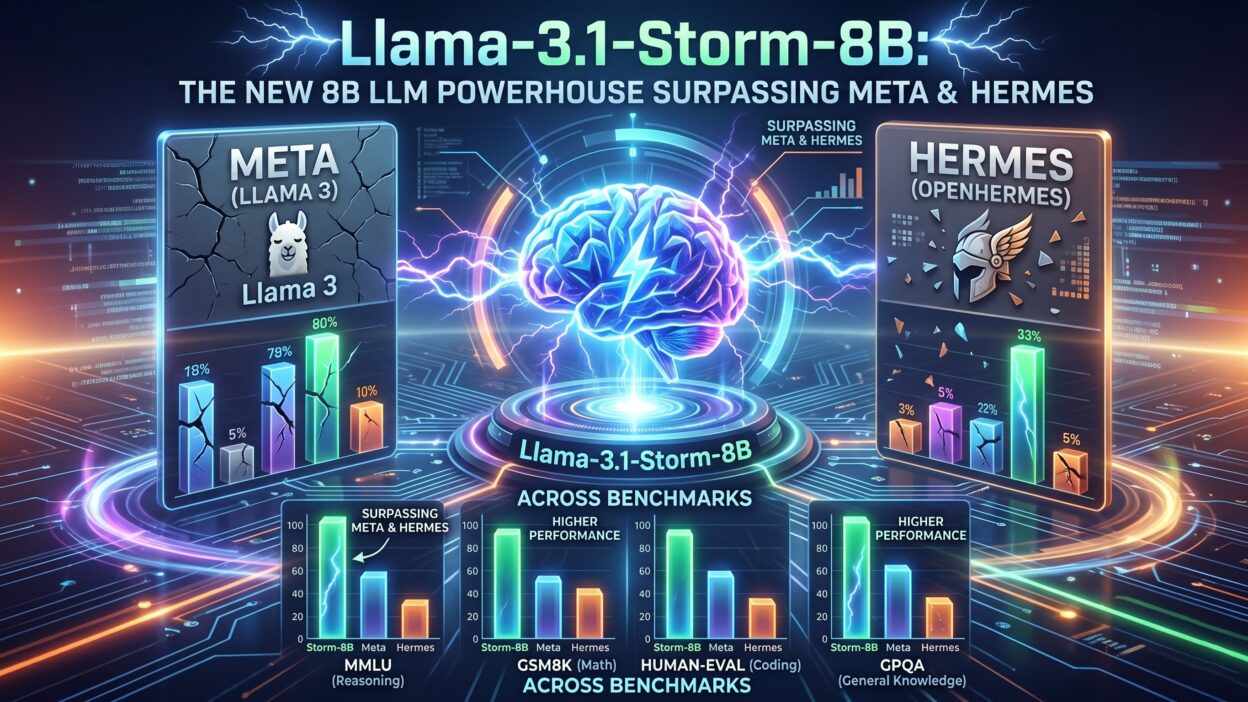
Then comes Llama-3.1-Storm-8B. This model is different. It punches way above its weight class. It beats larger models on multiple benchmarks. It challenges well-known names like Meta’s Llama and Hermes.
This blog breaks down everything you need to know. We will cover its architecture, benchmark results, real-world use cases, and why developers love it. Whether you are a researcher, developer, or AI enthusiast, this deep-dive is for you.
Table of Contents
What Is Llama-3.1-Storm-8B?
Llama-3.1-Storm-8B is a fine-tuned large language model. It builds on Meta’s Llama 3.1 8B base. The team behind it applied aggressive optimization techniques. The goal was to squeeze maximum performance from an 8-billion parameter model.
The model was developed by Nous Research. They are known for creating high-quality fine-tunes. Their Hermes series gained serious popularity. Llama-3.1-Storm-8B represents their next evolution.
The name “Storm” signals its aggressive capability profile. It storms through tasks that typically require larger models. It does this with 8 billion parameters. That is a remarkable engineering achievement.
The Base Model Foundation
Meta’s Llama 3.1 8B is already a strong base model. It has a 128K context window. It supports multilingual tasks. It ships with strong instruction-following capabilities.
Llama-3.1-Storm-8B takes that foundation and goes further. The fine-tuning process added domain-specific knowledge. It sharpened the model’s reasoning abilities. It also improved code generation and logical thinking.
Who Built It and Why Does That Matter?
Nous Research built Llama-3.1-Storm-8B with a clear objective. They wanted to create the best possible 8B model. They gathered diverse, high-quality training data. They applied direct preference optimization (DPO). They used advanced RLHF techniques.
Their track record matters. Their Hermes models set benchmarks repeatedly. Llama-3.1-Storm-8B extends that legacy with sharper performance across new evaluation suites.
Benchmark Performance: Where Llama-3.1-Storm-8B Shines
Numbers tell the real story. Llama-3.1-Storm-8B scores above Meta’s own Llama 3.1 8B Instruct on many standard evaluations. It also beats Hermes-3 Llama 3.1 8B on multiple tests.
That is not a minor difference. Beating the base model’s instruction-tuned version is significant. Beating a respected competitor like Hermes is even more impressive.
MT-Bench Results
MT-Bench tests conversational ability. It evaluates multi-turn dialogue quality. Llama-3.1-Storm-8B scores exceptionally here. It handles long conversations with coherence. It maintains context across many turns.
Most 8B models struggle with multi-turn consistency. Llama-3.1-Storm-8B handles it differently. The fine-tuning process specifically improved this capability.
IFEval and Instruction Following
IFEval measures how well a model follows instructions. This is critical for real-world deployment. Llama-3.1-Storm-8B ranks among the top 8B models on this benchmark.
It follows complex, multi-part instructions accurately. It respects formatting requirements. It handles conditional instructions with precision.
MMLU and Knowledge Benchmarks
MMLU tests broad knowledge across 57 subjects. Llama-3.1-Storm-8B scores competitively here. Its fine-tuning preserved and enhanced the base model’s knowledge base.
Many fine-tuned models sacrifice raw knowledge for alignment improvements. Llama-3.1-Storm-8B avoided this tradeoff. It maintained strong factual accuracy while improving conversational quality.
Coding Benchmarks
HumanEval and MBPP measure code generation ability. Llama-3.1-Storm-8B performs strongly on both. It generates syntactically correct code at a high rate. It solves algorithmic problems with solid accuracy.
For developers building coding assistants, this matters enormously. Llama-3.1-Storm-8B competes with models twice its size in this domain.
How Llama-3.1-Storm-8B Compares to Competitors
The 8B model category is competitive. Many strong models exist here. Llama-3.1-Storm-8B stands out for specific reasons.
Versus Meta Llama 3.1 8B Instruct
Meta’s official instruction-tuned 8B model is the baseline here. It is a solid model. Meta invested heavily in its alignment process. The model performs well across standard benchmarks.
Llama-3.1-Storm-8B beats it on MT-Bench. It also edges ahead on IFEval. The difference reflects more focused fine-tuning. Nous Research optimized specifically for instruction quality. Meta optimized for broad usability.
That specialization pays off. Llama-3.1-Storm-8B is the better choice for applications needing precise instruction following.
Versus Hermes 3 Llama 3.1 8B
Hermes 3 is a beloved model. The Hermes series built a loyal developer community. It excelled at agentic tasks. It handled function calling well. Developers relied on it for production applications.
Llama-3.1-Storm-8B improves on Hermes 3 in several areas. It scores higher on MT-Bench. It shows better multi-turn coherence. It demonstrates stronger reasoning on complex prompts.
This is a direct generational improvement. Nous Research learned from Hermes feedback. They applied those lessons when building Llama-3.1-Storm-8B.
Versus Mistral and Other 8B Models
Mistral 7B and Mistral 8x7B are strong competitors. They have excellent benchmark scores. They are efficient models with dedicated communities.
Llama-3.1-Storm-8B competes directly with the 7B/8B Mistral variants. On instruction-following benchmarks, it holds its own. On knowledge tasks, it often edges ahead. On code generation, results vary by task type.
The key differentiator is the 128K context window. Mistral’s base models have shorter contexts. Llama-3.1-Storm-8B handles much longer documents natively.
Fine-Tuning Techniques Behind Llama-3.1-Storm-8B
Performance does not happen by accident. The training process behind Llama-3.1-Storm-8B reflects careful engineering decisions.
Data Curation and Quality
Nous Research curated a diverse, high-quality dataset for fine-tuning. They sourced data from multiple domains. They filtered aggressively for quality. Low-quality data corrupts model behavior. High-quality data improves it.
The training mix included code, reasoning tasks, instruction-following examples, and general knowledge. This broad coverage explains the model’s versatility.
Direct Preference Optimization and RLHF
DPO (Direct Preference Optimization) is a powerful alignment technique. It teaches the model human preferences directly. The model learns to prefer better responses over worse ones.
Nous Research combined DPO with RLHF (Reinforcement Learning from Human Feedback). This combination produced a well-aligned, high-performing model. Llama-3.1-Storm-8B shows the results of this careful alignment work.
Synthetic Data Generation
Synthetic data plays a growing role in LLM training. Nous Research used synthetic generation to expand their training set. They used stronger models to generate high-quality examples.
This approach scales data availability beyond what humans can label manually. It also allows targeted generation of specific skill types. The results speak in Llama-3.1-Storm-8B’s benchmark scores.
Real-World Use Cases for Llama-3.1-Storm-8B
Benchmarks are important. Real-world performance matters more. Llama-3.1-Storm-8B excels across several practical applications.
Chatbots and Conversational AI
Conversational AI needs coherent multi-turn reasoning. Llama-3.1-Storm-8B handles this well. It maintains context across long conversations. It gives relevant, focused replies.
Customer service bots built on Llama-3.1-Storm-8B perform reliably. They handle complex queries. They follow instructions precisely. They reduce hallucinations compared to weaker models.
Code Assistants and Developer Tools
Developers building coding tools find Llama-3.1-Storm-8B highly capable. It generates accurate code. It explains code clearly. It debugs logical errors.
Its performance on HumanEval makes it a solid choice for coding assistants. The 128K context window is a bonus. It can analyze entire codebases at once.
Research Assistance and Document Summarization
Long-context understanding is a standout feature. Llama-3.1-Storm-8B handles documents up to 128K tokens. Researchers can feed in long papers, reports, or datasets.
It summarizes accurately. It extracts key information. It answers specific questions about document content. Academic and enterprise research teams find it especially useful.
Agentic Workflows and Tool Use
Agentic AI systems need models that follow multi-step instructions reliably. Llama-3.1-Storm-8B fits this role well. It understands tool-use schemas. It executes multi-step plans accurately.
Developers building AI agents choose it for its instruction-following precision. Its strong IFEval performance translates directly to agentic reliability.
Why Developers Are Switching to Llama-3.1-Storm-8B
Developer adoption signals real-world quality. Llama-3.1-Storm-8B has gained significant traction. Let’s look at the reasons.
Efficiency at Scale
8B models run cheaply. They fit on consumer GPUs. They deploy affordably on cloud infrastructure. Llama-3.1-Storm-8B gives you top-tier performance at 8B parameter cost.
Many production applications need cost-efficiency. Running a 70B model is expensive. Running Llama-3.1-Storm-8B delivers comparable results at a fraction of the cost. That math appeals to engineering teams.
Open Weights and Community Access
Llama-3.1-Storm-8B is publicly available. The model weights are accessible on Hugging Face. Anyone can download and deploy it. This openness accelerates adoption and community development.
Open-source LLMs empower smaller teams. Startups, researchers, and independent developers can all leverage Llama-3.1-Storm-8B. No enterprise contracts needed. No API rate limits.
Strong Community and Ecosystem Support
Nous Research has a passionate community. They actively share fine-tuning recipes, evaluation results, and deployment tips. This community support accelerates learning for new adopters.
Llama-3.1-Storm-8B benefits from this ecosystem directly. Integration with popular frameworks like LangChain, LlamaIndex, and Ollama makes deployment straightforward.
How to Deploy Llama-3.1-Storm-8B: Practical Guide
Getting started with Llama-3.1-Storm-8B is straightforward. Here is a practical overview for developers.
Hardware Requirements
The model requires approximately 16GB VRAM in full precision. With 4-bit quantization, it runs on 8GB VRAM. That means consumer-grade GPUs like the RTX 3080 or 4070 work fine.
For production workloads, 24GB VRAM gives comfortable headroom. Cloud deployments using A10G or A100 instances work well. The model is not demanding by current standards.
Quantization Options
Multiple quantization formats exist. GGUF format works with llama.cpp. GPTQ and AWQ formats work with popular Python inference libraries. Each format trades some quality for reduced memory usage.
For most production uses, 4-bit quantization offers the best balance. Performance drops are minimal. Memory savings are significant. Llama-3.1-Storm-8B handles quantization well without major degradation.
Framework Integration
The model integrates with Hugging Face Transformers natively. Use the standard AutoModelForCausalLM class to load it. The chat template follows the Llama 3 format. Apply it correctly for best results.
Ollama users can pull Llama-3.1-Storm-8B directly from the registry. LangChain and LlamaIndex users can wrap it with standard LLM adapters. The ecosystem support is excellent.
Limitations of Llama-3.1-Storm-8B to Know Before Deploying
No model is perfect. Llama-3.1-Storm-8B has limitations worth understanding before deployment.
It is still an 8B model. Very complex reasoning tasks challenge it. Tasks requiring deep domain expertise may need a larger model. It can still hallucinate, especially on obscure topics. Always validate outputs in high-stakes applications.
The model also lacks real-time knowledge. Its training data has a cutoff date. For current events or live data, augment it with retrieval-augmented generation (RAG).
Multilingual performance is solid but uneven. English tasks work best. Performance on less-common languages may disappoint. Test thoroughly before multilingual deployment.
Frequently Asked Questions About Llama-3.1-Storm-8B
Is Llama-3.1-Storm-8B free to use?
Yes. Llama-3.1-Storm-8B is publicly available on Hugging Face. You can download and use it freely. Check the Llama 3 license for commercial use terms. Most commercial applications are permitted.
How does Llama-3.1-Storm-8B compare to GPT-4o?
GPT-4o is a much larger closed model. It outperforms Llama-3.1-Storm-8B on complex reasoning tasks. For cost-sensitive or privacy-conscious deployments, Llama-3.1-Storm-8B offers outstanding value at the 8B scale.
Can I fine-tune Llama-3.1-Storm-8B further?
Yes. The open weights allow further fine-tuning. Use LoRA or QLoRA for efficient fine-tuning on consumer hardware. Many teams fine-tune it for domain-specific applications with strong results.
Does Llama-3.1-Storm-8B support function calling?
Yes. The model supports structured function calling. This makes it suitable for agentic frameworks and tool-use applications. Test your specific schema to ensure compatibility with your toolchain.
What is the context length of Llama-3.1-Storm-8B?
The context length is 128K tokens. This is one of its strongest features. It allows processing of long documents, codebases, and extended conversations in a single pass.
Where can I find Llama-3.1-Storm-8B benchmarks?
Official benchmark results appear on the Hugging Face model card. The Nous Research team publishes detailed evaluations there. You can also run your own evaluations using the lm-evaluation-harness library.
The Future of 8B Models and Where Llama-3.1-Storm-8B Fits
The 8B model category keeps improving. Every few months, new state-of-the-art models emerge. Llama-3.1-Storm-8B represents the current peak of this category.
The trend toward smaller, more capable models is accelerating. Techniques like DPO, synthetic data, and better architectures keep closing the gap with larger models. Llama-3.1-Storm-8B is a prime example of this trend.
Edge deployment is also growing. Models need to run on devices with limited compute. 8B models are ideal for this purpose. Llama-3.1-Storm-8B’s efficiency makes it a strong candidate for edge AI applications.
As hardware improves and training techniques mature, models like Llama-3.1-Storm-8B will keep pushing boundaries. Today’s 8B performance will look modest in two years. Right now, it leads the pack.
Read More:-Gemma 4 Tool Calling Explained: Build AI Agents with Function Calling (Step-by-Step Guide)
Conclusion

Llama-3.1-Storm-8B is not just another fine-tune. It is a carefully engineered model that beats well-established competitors. It outperforms Meta’s own instruction-tuned model on key benchmarks. It surpasses Hermes 3 in multiple evaluations.
Its 128K context window sets it apart. Its instruction-following precision makes it reliable. Its open weights make it accessible. Its efficiency makes it affordable.
For developers building production AI applications, Llama-3.1-Storm-8B deserves serious consideration. It delivers big-model performance at small-model cost. That combination is rare and valuable.
Nous Research has delivered something special. Llama-3.1-Storm-8B raises the bar for what an 8B model can achieve. Download it, test it, and see the results for yourself.
The AI community is paying attention to Llama-3.1-Storm-8B. You should too.