Introduction
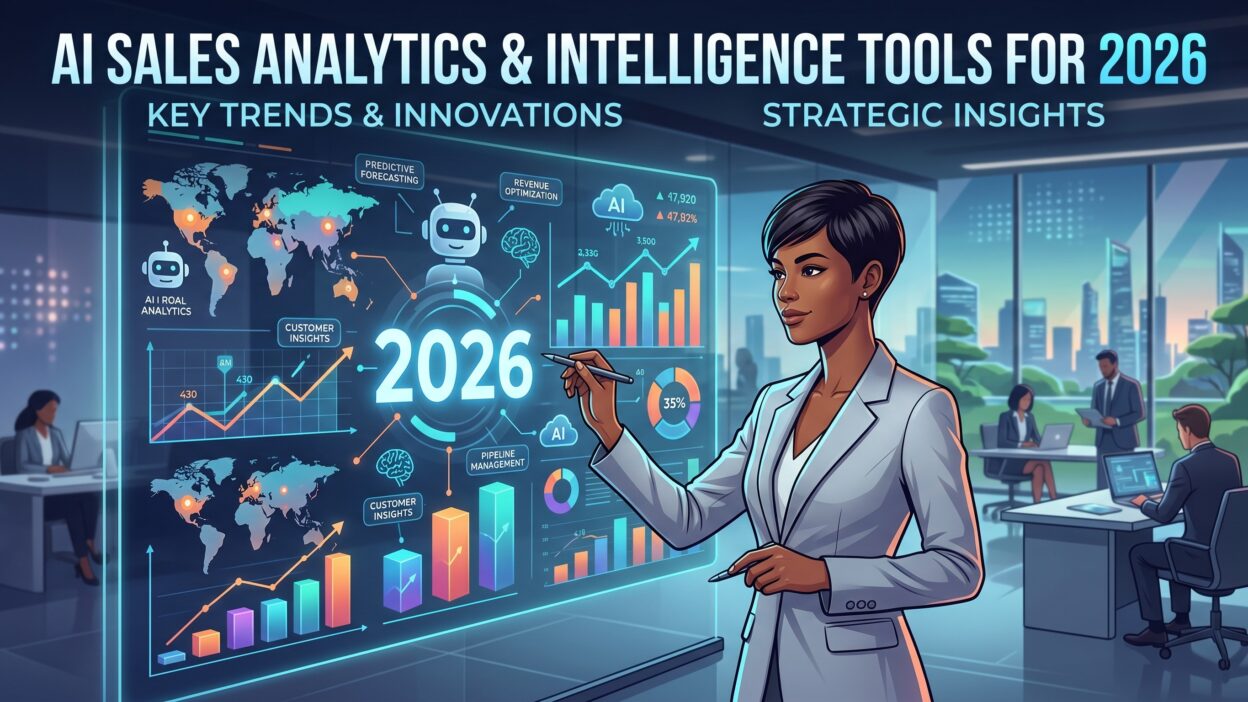
TL;DR Sales leaders no longer guess their way to revenue goals. Data drives every smart decision now AI sales analytics tools changed how teams understand their pipeline, predict revenue, and coach reps. In 2026, these platforms do far more than generate reports. They find patterns humans miss. They flag risks before deals collapse. They tell you exactly where your revenue is leaking.
This blog covers what AI sales analytics tools do, which ones lead the market, and how your team can use them to sell smarter. Whether you run a ten-person startup sales team or a 500-rep enterprise org, this guide gives you a clear picture of what matters most.
Table of Contents
What Are AI Sales Analytics Tools?
AI sales analytics tools are software platforms that collect, process, and interpret sales data automatically. They pull data from CRMs, email platforms, call recordings, and marketing systems. Then they use machine learning to surface patterns, trends, and predictions.
Traditional sales reporting required a data analyst, a spreadsheet, and three days of work. Modern AI sales analytics tools deliver the same insights in real time. No analyst required.
These platforms track rep performance, deal health, forecast accuracy, and customer behavior. They identify which activities lead to closed deals. They also flag which reps, deals, or territories need attention right now.
The shift from manual reporting to AI-driven analytics represents one of the biggest productivity leaps in sales history. Teams that adopt AI sales analytics tools gain a measurable edge over competitors still relying on gut instinct and weekly pipeline reviews.
Why AI Sales Analytics Tools Matter More in 2026
The sales environment grew more complex over the past three years. Buying committees got larger. Sales cycles got longer. Economic pressure increased scrutiny on every deal.
Sales leaders need more reliable signals to navigate this complexity. AI sales analytics tools provide those signals at a speed and scale no human team can match.
A Forrester study from late 2025 found that companies using AI analytics in their sales process saw 23% higher quota attainment. They also reported 31% better forecast accuracy compared to teams using manual methods. These are not marginal gains. These numbers change compensation outcomes, hiring plans, and board confidence.
Beyond numbers, AI sales analytics tools free up manager time. Instead of reviewing spreadsheets for three hours before a pipeline meeting, a manager spends 20 minutes reviewing an AI-generated briefing. That time goes back into coaching and strategy.
The Shift from Descriptive to Predictive Analytics
Old sales analytics told you what happened. Revenue was down 15% last quarter. Average deal size dropped. Win rate fell in the enterprise segment.
AI sales analytics tools tell you what will happen. This deal has a 78% chance of closing this month. This rep is at risk of missing quota based on current activity levels. This territory will underperform by Q3 without intervention.
That predictive capability changes how sales leaders operate. They stop reacting and start preventing problems before they cost revenue.
Key Features to Look For in AI Sales Analytics Tools
Not every platform delivers the same capabilities. Understanding what separates strong tools from weak ones helps you make a smarter buying decision.
Forecast accuracy is the most critical feature. A platform that cannot predict revenue reliably creates false confidence. Look for tools with documented forecast accuracy rates above 90%.
CRM integration determines whether the tool works in your actual workflow. If data does not flow automatically between your CRM and the analytics platform, your team will not maintain clean data. Check for native integrations with Salesforce, HubSpot, and Microsoft Dynamics.
Pipeline health scoring shows which deals need attention. Strong AI sales analytics tools score every deal in the pipeline based on engagement, activity, and historical win patterns. Reps see at a glance which deals to prioritize.
Rep performance tracking helps managers coach more effectively. Look for tools that track activity metrics alongside outcome metrics. Calls made and emails sent matter less than how those activities convert to meetings, proposals, and closed deals.
Real-time alerts prevent deals from going cold. The best AI sales analytics tools notify reps and managers when a deal goes quiet, a decision-maker disengages, or a competitor gets mentioned.
Customizable dashboards matter for different roles. A rep needs different data than a VP of Sales. Ensure the platform lets each user configure views relevant to their responsibilities.
Best AI Sales Analytics Tools in 2026
1. Salesforce Einstein Analytics (Now Salesforce AI Cloud)
Salesforce Einstein remains the most widely adopted platform among enterprise AI sales analytics tools. It lives natively inside Salesforce, which means zero data migration and instant deployment for existing Salesforce customers.
Einstein predicts deal close probability using historical CRM data combined with activity signals from emails, calendar, and calls. Its opportunity scoring updates in real time as new data comes in.
The forecasting module gives revenue leaders a live view of the pipeline with AI-adjusted commit numbers. Managers no longer rely on rep self-reporting. Einstein calculates its own forecast based on observed deal behavior.
The conversation intelligence layer captures call data and connects it to deal outcomes. Over time, the system learns what your best reps say and do differently. It then coaches lower performers with specific behavioral recommendations.
Einstein Analytics also includes territory and quota planning tools. Leaders can model different territory structures and see projected revenue impact before making changes.
Pricing: Included in Salesforce Sales Cloud Enterprise and above. Additional Einstein modules start at $50 per user per month.
Who it suits: Mid-market and enterprise teams already on Salesforce who want AI insights without adding another vendor.
2. Gong Revenue Intelligence
Gong built its reputation on conversation intelligence, but it has evolved into one of the most capable AI sales analytics tools available today. It connects call data, email activity, and CRM signals into a unified revenue intelligence layer.
The deal intelligence dashboard shows every open opportunity with an AI-generated health score. Reps and managers see which deals are progressing and which ones need rescue. The system flags specific risk factors: no engagement in 14 days, champion went silent, procurement not involved yet.
Gong’s forecast module uses AI to challenge rep-submitted numbers. It compares what reps say about a deal to what the data shows. If a rep marks a deal as high confidence but the buyer has not responded in three weeks, Gong flags the discrepancy.
The market intelligence feature aggregates patterns across all calls to identify emerging competitor tactics, pricing objections, and buyer concerns. Sales leaders use this data to update messaging and battle cards in real time.
Pricing: Starts around $100 per user per month. Enterprise pricing available.
Who it suits: Revenue teams focused on coaching, deal execution, and forecast accuracy across complex sales cycles.
3. Clari
Clari focuses specifically on revenue operations and pipeline management. It is one of the most purpose-built AI sales analytics tools for sales leaders who need reliable forecasting and deal visibility.
The platform ingests data from Salesforce, email, calendar, and engagement tools. It builds a dynamic view of the pipeline that updates continuously rather than relying on manual rep updates.
Clari’s Revenue Cadence feature structures weekly pipeline reviews with AI-generated talking points. Managers walk into one-on-ones already knowing which deals to probe and which questions to ask.
The Deal Wall gives reps a visual board of all their open opportunities with health indicators. Reps see exactly what actions move each deal forward based on AI analysis of past wins.
Clari also runs scenario modeling. Leaders can stress-test their forecast against different assumptions: what happens if the top three deals slip? What if the enterprise segment underperforms by 20%? These scenarios help finance and sales plan more accurately.
Pricing: Custom pricing based on org size. Typically starts at $60-80 per user per month for mid-market teams.
Who it suits: Revenue operations leaders and VPs of Sales who need deep forecasting rigor and pipeline inspection tools.
4. HubSpot Sales Hub with AI Features
HubSpot expanded its AI capabilities significantly in 2025. Its native AI sales analytics tools now compete with dedicated intelligence platforms for teams in the SMB and mid-market space.
The AI-powered forecast tool projects revenue based on deal stage probabilities, historical close rates, and rep performance trends. It updates automatically as reps move deals through the pipeline.
HubSpot’s conversation intelligence feature transcribes and analyzes calls directly inside the CRM. Managers review call highlights without leaving the platform. The AI flags next steps, competitor mentions, and objection patterns automatically.
The prospecting agent identifies the best leads to contact based on engagement signals across email, website, and social media. Reps start each day with an AI-curated list of priority contacts.
HubSpot’s reporting suite lets teams build custom dashboards with drag-and-drop simplicity. Pre-built templates cover win rate by rep, deal velocity by stage, and pipeline coverage ratio.
Pricing: Sales Hub Professional starts at $90 per user per month. Enterprise at $150 per user per month.
Who it suits: SMB and mid-market teams that want AI analytics within a single CRM platform without managing multiple vendors.
5. Chorus by ZoomInfo
Chorus captures and analyzes sales conversations to deliver one of the most conversation-centric AI sales analytics tools on the market. ZoomInfo’s acquisition strengthened the platform with deep buyer intelligence capabilities.
The platform tracks deal progression through conversation patterns rather than CRM fields. If a deal lacks certain conversations — like pricing, timeline, or stakeholder mapping — Chorus flags it as incomplete.
The market intelligence layer aggregates patterns across all recorded calls. Leaders see which objections increased this quarter, which competitors appear more often, and which messaging resonates best with different buyer segments.
Chorus also benchmarks rep performance against top performers. It identifies specific behaviors — like how often top reps ask discovery questions versus how often average reps do. Managers use this data to make coaching conversations precise.
Pricing: Custom pricing. Contact ZoomInfo for a quote.
Who it suits: Teams using ZoomInfo for prospecting who want conversation intelligence connected to buyer data.
6. People.ai
People.ai automates activity capture and attribution. It solves one of the most persistent problems in sales analytics: incomplete CRM data.
Most CRM data is inaccurate because reps do not log every call, email, and meeting manually. People.ai captures all of this activity automatically from email and calendar. It then maps activities to the correct accounts, contacts, and opportunities in Salesforce.
With clean activity data in place, People.ai’s AI identifies which activity patterns correlate with closed deals. Leaders see how many touches a winning deal typically requires, at what cadence, and across how many stakeholders.
The rep benchmarking feature compares individual activity patterns against the team average and top performer standard. Managers identify coaching gaps without relying on rep self-reporting.
Pricing: Custom pricing. Typically enterprise-focused with pricing based on seat count and data volume.
Who it suits: Enterprise revenue operations teams that need accurate activity data to power other analytics tools.
7. Aviso
Aviso positions itself as a dedicated AI forecasting platform and delivers some of the most advanced predictive capabilities among AI sales analytics tools available today.
The platform uses a proprietary “WinScore” model that analyzes over 100 deal signals to predict close probability. This score updates daily based on new data from CRM, email, calls, and engagement platforms.
Aviso’s time series forecasting model predicts not just whether a deal closes, but when it closes. This quarterly pacing view helps finance teams align cash flow planning with sales projections.
The conversational intelligence module connects meeting data to deal outcomes. Aviso shows which conversation topics, questions, and buyer responses predict deal success. Reps use this information to shape their discovery calls and demos.
Aviso also offers AI-assisted deal coaching. When a deal’s WinScore drops, the platform generates specific recommended actions for the rep and the manager. It does not just identify the problem. It tells you what to do next.
Pricing: Custom pricing. Typically enterprise-level with annual contracts.
Who it suits: Enterprise sales organizations that need the most accurate forecasting available and can invest in a dedicated intelligence platform.
8. Mixpanel for Sales Analytics
Mixpanel is primarily a product analytics tool, but sales teams at SaaS companies use it to track how prospects interact with trial products and demos. Combined with CRM data, it becomes one of the more creative AI sales analytics tools for product-led growth companies.
The platform shows how prospects use a trial product before a sales conversation. Reps know which features a prospect explored, how often they logged in, and where they got stuck. This information drives more relevant sales conversations.
Mixpanel’s cohort analysis lets teams compare the behavior of customers who churned versus those who expanded. Sales teams use this data to identify the customer profile most likely to succeed long-term.
Pricing: Free plan available. Growth plan starts at $28 per month based on event volume.
Who it suits: Product-led growth SaaS companies where product usage signals inform sales conversations.
How to Implement AI Sales Analytics Tools Without Disrupting Your Team
New tool rollouts fail more often because of poor implementation than poor software. Here is what works.
Start with data quality. AI analytics tools are only as good as the data they analyze. Before you deploy a new platform, audit your CRM. Fix duplicate records, fill in missing fields, and establish data entry standards.
Run a focused pilot first. Choose five to ten reps who represent a mix of performance levels. Deploy the tool with that group for 60 days. Measure what changes in their pipeline accuracy, win rate, and time spent on admin.
Connect the tool to your existing workflow. Reps should not have to log into a separate platform to see analytics. The best implementations push insights directly into Slack, email, or the CRM they already use daily.
Train managers before reps. If managers do not know how to use the platform’s coaching features, reps will never feel the benefit. Invest in manager enablement first.
Set clear success metrics before launch. Define what success looks like at 30, 60, and 90 days. Common metrics include forecast accuracy improvement, reduction in pipeline surprises, and increase in win rate.
AI Sales Analytics Tools and Revenue Operations
Revenue operations teams get the most value from AI sales analytics tools. They own the data infrastructure that makes these tools work.
RevOps teams use analytics platforms to design territory models, set quota targets, and identify process gaps. Instead of building models in spreadsheets, they use AI tools to run scenario analyses in minutes.
The connection between AI sales analytics tools and RevOps maturity is strong. Teams with dedicated RevOps functions adopt analytics tools faster and see higher ROI. They have the technical capacity to manage integrations and the organizational authority to enforce data standards.
If your company does not have a RevOps function, assign a sales operations owner before deploying an analytics platform. Someone needs to own data quality, dashboard configuration, and ongoing maintenance.
Related Topics
Predictive Sales Analytics
Predictive analytics is the core capability that separates modern AI sales analytics tools from legacy reporting platforms. Prediction uses historical data patterns to forecast future outcomes with quantified confidence levels. Leaders get a number — not a feeling — about what the quarter will produce.
Sales Forecasting Software
Sales forecasting software is a category within AI sales analytics tools focused specifically on revenue prediction. Dedicated platforms like Clari and Aviso focus deeply on forecast accuracy. CRM-native tools like Salesforce Einstein offer forecasting as part of a broader analytics suite.
Conversation Intelligence Platforms
Conversation intelligence platforms record, transcribe, and analyze sales calls. They represent one of the fastest-growing segments within AI sales analytics tools. Gong, Chorus, and Avoma lead this segment with different strengths in coaching, market intelligence, and deal tracking.
Pipeline Management Tools
Pipeline management tools give sales leaders visibility into deal health across the entire funnel. Strong AI sales analytics tools include pipeline management as a native feature rather than requiring a separate application.
Sales Performance Management
Sales performance management platforms track individual and team performance against goals. They connect activity data, pipeline data, and outcome data to give managers a complete picture of each rep’s trajectory. The best AI sales analytics tools include performance management features alongside forecasting and deal intelligence.
ROI of AI Sales Analytics Tools
Sales leaders want proof before investing. The numbers are compelling.
McKinsey research from 2025 found that B2B companies using AI in their sales analytics function outperformed peers on revenue growth by 15-20%. That gap widened as AI adoption matured within the organization.
Forecast accuracy improvement alone justifies most platform investments. When a sales team improves forecast accuracy from 65% to 88%, finance can plan hiring, marketing spend, and product investment more confidently. Poor forecasting costs companies millions in misallocated resources.
Rep productivity gains add to the ROI story. Reps using AI sales analytics tools spend less time on admin and more time with prospects. One common finding across multiple industry studies shows that reps recover 30-45 minutes of selling time per day after adopting AI analytics platforms.
Calculate ROI by multiplying time recovered by blended rep cost per hour, then add revenue impact from improved win rates and forecast accuracy. Most teams find payback periods under six months.
Frequently Asked Questions
What are AI sales analytics tools?
AI sales analytics tools are software platforms that use machine learning and artificial intelligence to analyze sales data, predict outcomes, and surface actionable insights. They pull data from CRMs, call recordings, email platforms, and engagement tools to give sales leaders a complete view of their pipeline and team performance.
How do AI sales analytics tools improve forecast accuracy?
These platforms analyze historical deal patterns, current engagement signals, and rep behavior to generate objective forecast predictions. Unlike rep-submitted forecasts that rely on optimism or gut feel, AI-generated forecasts use dozens of data signals. This typically improves forecast accuracy by 20-35% compared to manual methods.
Which AI sales analytics tool is best for small sales teams?
HubSpot Sales Hub offers the strongest combination of AI analytics features and affordability for small teams. Otter.ai and Fireflies.ai provide affordable meeting analytics. For teams with under 20 reps, HubSpot or a combination of lightweight tools often delivers better ROI than enterprise platforms like Gong or Clari.
Can AI sales analytics tools integrate with Salesforce?
Yes. Most leading AI sales analytics tools offer native Salesforce integration. Gong, Clari, People.ai, and Aviso all have certified Salesforce integrations. Salesforce Einstein Analytics is built directly into the platform. Always verify which CRM versions and editions support the integration before purchasing.
How long does it take to see results from AI sales analytics tools?
Most teams see initial value within 30-60 days. Forecast accuracy improvements often appear within the first full sales cycle after deployment. Coaching benefits from conversation intelligence take longer — typically 90-120 days as managers learn to act on the insights. Full ROI realization usually happens within two to three quarters.
Are AI sales analytics tools secure for enterprise use?
Leading platforms maintain SOC 2 Type II compliance, GDPR compliance, and enterprise-grade encryption. Always verify a vendor’s security certifications and data residency options before purchasing. For regulated industries like financial services or healthcare, confirm compliance with relevant sector-specific regulations.
What is the difference between sales analytics and revenue intelligence?
Sales analytics refers broadly to the analysis of sales data to understand performance and predict outcomes. Revenue intelligence is a more comprehensive category that includes analytics plus conversation intelligence, deal execution insights, and market signals. Revenue intelligence platforms like Gong and Clari go beyond reporting to actively guide sales execution.
Read More:-Beyond the Buying Committee: Leveraging B2B Network Effects
Conclusion

Sales leadership in 2026 runs on data. Gut instinct alone does not close enterprise deals. It does not build accurate forecasts. It does not scale a 100-rep sales organization efficiently.
AI sales analytics tools give leaders the intelligence they need to make faster, smarter, and more confident decisions. They turn scattered data into clear signals. They turn vague pipeline reviews into precise deal assessments. They turn manager intuition into documented, scalable coaching.
The platforms covered in this blog range from enterprise powerhouses like Salesforce Einstein and Gong to purpose-built forecasting tools like Clari and Aviso. Each solves specific problems. The right choice depends on your team size, existing tech stack, and biggest revenue challenge.
The implementation path matters as much as the tool selection. Clean data, strong manager enablement, and clear success metrics determine whether an analytics platform delivers value or collects dust.
Start with your most painful problem. Pick the tool that solves it best. Measure the impact with real numbers. Then expand.
AI sales analytics tools are not a future consideration for competitive sales organizations. They are a present requirement. Every quarter you operate without them is a quarter your competition gains ground using data you are not seeing.
Your pipeline is full of signals right now. The right analytics platform helps you read every one of them.