Introduction
TL;DR Two terms dominate conversations in modern sales organizations right now. Revenue operations and sales operations both sound similar at first. They both deal with process, data, and performance. Many leaders use them interchangeably without realizing the confusion costs them real strategic clarity.
Revenue operations vs sales operations is not just a naming debate. It is a structural decision that shapes how a company grows, aligns its teams, and builds sustainable revenue. Getting this wrong means misaligned teams, broken handoffs, and deals that slip through the cracks.
This guide breaks down both functions clearly. It explains what each one does, where they differ, where they overlap, and how to decide which one your organization needs right now. It also covers the career implications, hiring considerations, and the metrics each function owns. By the end, you will have a clear framework for making the right structural choice for your business.
Table of Contents
Defining the Two Functions
Before comparing revenue operations vs sales operations, each function deserves a clear and honest definition. Labels mean nothing without context. Many organizations slap a new title on an old role and call it transformation. That approach fails every time.
What Is Sales Operations?
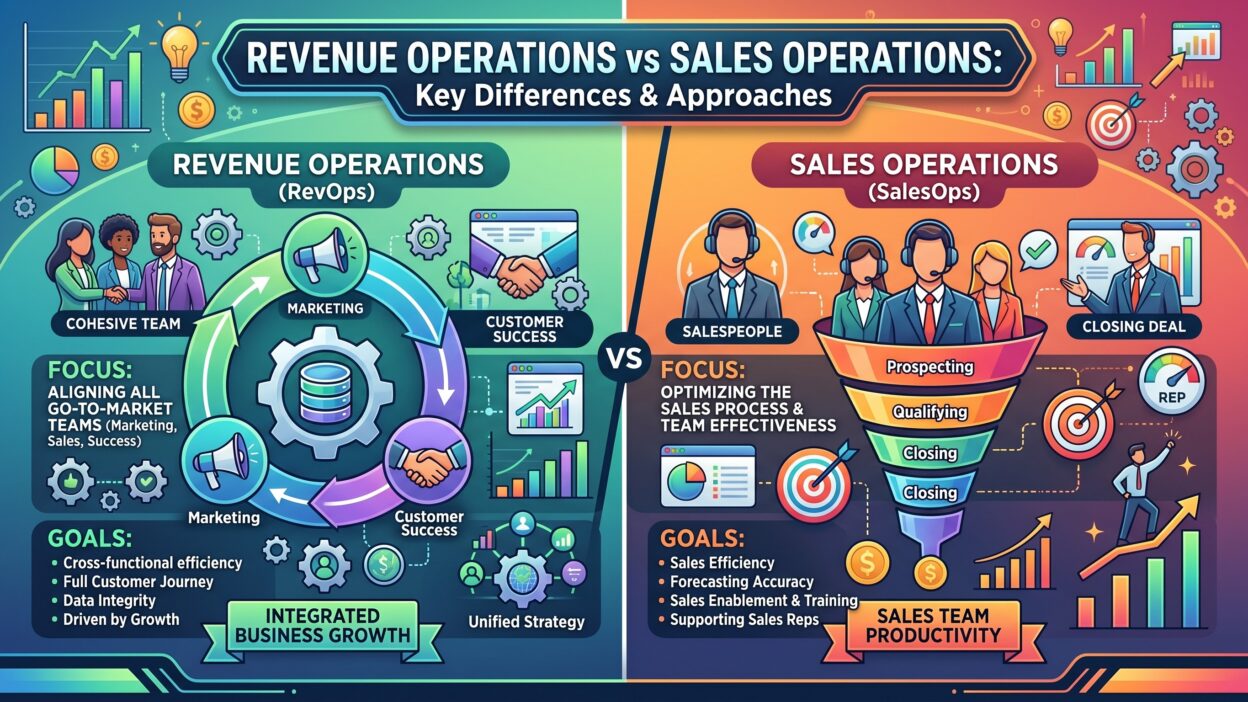
Sales operations is the function that supports the sales team specifically. It handles the tools, processes, data, and administrative work that allow sales reps to focus on selling.
Sales operations emerged decades ago when sales leaders realized reps were spending more time on paperwork and CRM entry than on prospects. The function took those tasks off the rep’s plate. It built the systems and processes that kept the sales engine running efficiently.
A sales operations team typically owns CRM administration, territory planning, quota setting, sales forecasting, sales technology, compensation design, and sales performance reporting. Every responsibility centers on the sales department. The team serves one master — the sales organization.
Sales operations answers one core question: how do we help sales reps sell more, faster, and more consistently? That question drives every decision the team makes, every tool it buys, and every process it designs.
The best sales operations teams are invisible to the reps they support. Reps have clean data. Their tools work. Their territories make sense. Their quotas are achievable and fair. Compensation calculates correctly and on time. When sales operations does its job well, reps notice the absence of friction more than the presence of support.
What Is Revenue Operations?
Revenue operations is a broader function. It aligns sales, marketing, and customer success under one operational umbrella. Its goal is to create a seamless, data-driven revenue engine across the entire customer journey — from the first marketing touchpoint to the final customer renewal.
Revenue operations emerged as a response to a real organizational problem. Marketing, sales, and customer success all had their own data, their own tools, and their own processes. They rarely communicated well. Leads fell between the cracks. Attribution was a mess. Forecasting was unreliable.
Revenue operations solves those problems by breaking down the silos. One team owns the data, the tech stack, and the process design for all three revenue-generating functions. Alignment replaces friction. The whole customer journey becomes a single, managed system.
Revenue operations answers a different question: how do we build a revenue system that converts efficiently from first touch to long-term customer value? That question demands a broader perspective, deeper cross-functional authority, and a more complex data architecture than sales operations alone can provide.
The rise of the Chief Revenue Officer role mirrors the rise of revenue operations. Both reflect the same organizational insight — revenue does not belong to sales alone. Every function that touches the customer owns a piece of the revenue outcome.
Revenue Operations vs Sales Operations: The Core Differences
Understanding revenue operations vs sales operations clearly requires looking at specific dimensions where the two functions diverge most. These are not minor differences in scope. They are fundamental differences in purpose, authority, and organizational impact.
Scope of Responsibility
Sales operations focuses exclusively on the sales team. It owns sales-specific tools, sales data, sales processes, and sales performance. Everything it builds serves the quota-carrying team.
Revenue operations takes ownership across marketing, sales, and customer success. It builds shared systems. It ensures data flows cleanly from marketing attribution through pipeline management into customer retention metrics. The scope is three times wider. The organizational influence is significantly greater.
This difference in scope is the defining characteristic of revenue operations vs sales operations. Everything else flows from this fundamental distinction.
Data Ownership and Reporting
A sales operations team reports on sales-specific metrics. Pipeline coverage, quota attainment, win rates, average deal size, and sales cycle length — these are the numbers a sales operations team tracks and optimizes relentlessly.
A revenue operations team reports on metrics that cross functional lines. It tracks lead-to-revenue conversion rates, customer acquisition cost, lifetime value, net revenue retention, and full-funnel attribution. The data picture is complete, not siloed.
This is one of the most important distinctions in the revenue operations vs sales operations debate. Sales operations sees one piece of the revenue puzzle. Revenue operations sees the whole board. Leadership makes better decisions when they can see the full picture.
Clean, connected data is the most powerful asset a revenue operations team creates. Every decision about hiring, territory, pricing, or market investment improves when it draws from a complete, trustworthy data system.
Technology Management
Sales operations manages the sales tech stack. This includes the CRM, sales engagement tools, dialing software, forecasting platforms, and sales enablement tools. The team evaluates, implements, and administers tools that sales reps use every day.
Revenue operations manages the entire go-to-market technology ecosystem. It owns the marketing automation platform, the customer success software, the revenue intelligence tools, and the data infrastructure that connects all of them. Integration architecture becomes a core competency.
The average go-to-market technology stack contains between 10 and 30 tools. Without centralized ownership, those tools create data silos, duplicate records, and conflicting reports. Revenue operations brings coherence to that complexity.
Team Alignment and Cross-Functional Work
Sales operations works closely with sales leadership and individual contributors. Its stakeholders live within the sales department. It rarely needs to coordinate deeply with marketing or customer success. Its influence is real but narrow.
Revenue operations sits between all three functions. It builds bridges. It designs shared processes. It creates handoff protocols between marketing and sales, and between sales and customer success. The stakeholder map is much broader and requires stronger organizational influence.
Getting buy-in from three functions instead of one is harder. Revenue operations leaders need political skills alongside analytical skills. They manage competing priorities and sometimes competing cultures within the same organization.
Strategic vs Tactical Orientation
Sales operations leans more tactical. It builds processes, manages tools, and runs the daily operations of the sales team. Its value is felt daily by reps who have cleaner data, better tools, and less administrative work.
Revenue operations leans more strategic. It informs executive decisions about go-to-market investment, channel mix, customer segments, and growth forecasting. It produces the insights that shape company-level strategy, not just sales team efficiency.
This does not mean sales operations lacks strategic value. It means the two functions operate at different altitudes when it comes to revenue operations vs sales operations in practice. Both altitudes matter. Both deserve investment and attention.
Where Revenue Operations and Sales Operations Overlap
The revenue operations vs sales operations comparison is not a story of two completely separate worlds. The two functions share significant common ground. Understanding the overlaps helps organizations avoid duplication and design clear accountability.
CRM Ownership
Both functions care deeply about CRM health. Sales operations typically manages CRM configuration, user training, and data hygiene for the sales team. Revenue operations takes that a step further by ensuring the CRM connects cleanly with marketing and customer success data.
In some organizations, one team handles CRM end-to-end. In others, responsibilities split by function. Either way, clean CRM data sits at the center of both worlds. Bad CRM data is the single most common root cause of broken reporting, poor forecasting, and misaligned teams. Both functions have strong incentives to invest in CRM quality.
Forecasting and Pipeline Management
Both functions use pipeline data to generate forecasts. Sales operations produces sales-specific forecasts for quota planning and headcount decisions. Revenue operations incorporates marketing pipeline contribution and customer success expansion revenue to build a complete revenue forecast.
The forecasting methods overlap significantly. The inputs and outputs differ based on the broader vs narrower scope of each function. Revenue operations forecasts give leadership a more accurate and complete view of expected revenue across every source.
Process Design and Optimization
Sales operations designs the processes that guide reps through a deal cycle. Revenue operations designs the processes that guide a buyer through the entire customer journey. Both functions use process design as a core tool for improving performance.
When organizations begin their journey into revenue operations vs sales operations decisions, they often start by auditing their existing processes. This audit reveals where sales operations is doing good work and where gaps exist that only revenue operations can fill.
Technology Evaluation
Both teams evaluate and recommend technology investments. Sales operations focuses on tools that help reps sell. Revenue operations evaluates the entire go-to-market stack and ensures tools integrate and share data correctly.
Good technology decisions require both perspectives. Revenue operations ensures the tools chosen by sales fit into a broader architecture that marketing and customer success can also leverage effectively.
How the Two Functions Fit Into Different Organizational Stages
One of the most practical frameworks for thinking about revenue operations vs sales operations is organizational maturity. Most companies need different functions at different stages of growth.
Early Stage: Sales Operations First
Early-stage companies with a founding sales team do not need revenue operations yet. They need sales operations fundamentals. They need a working CRM, a basic sales process, and clean reporting on pipeline and revenue.
Building full revenue operations infrastructure before the business has predictable revenue is premature. It creates complexity the organization cannot yet benefit from. Start with sales operations. Build the core sales system first. Get the foundation right before expanding the architecture.
Growth Stage: Revenue Operations Becomes Critical
As a company scales past 50 to 100 employees, marketing and customer success functions grow alongside sales. The gaps between those teams become costly. Lead handoffs break down. Attribution becomes disputed. Retention data sits disconnected from sales data.
This is the inflection point where revenue operations vs sales operations becomes a genuine strategic question. The answer for most growing companies is to evolve sales operations into a broader revenue operations function or build revenue operations as a parallel team with a clear mandate and executive sponsorship.
The companies that make this transition successfully see measurable improvements in pipeline efficiency, forecast accuracy, and cross-functional collaboration. The companies that wait too long pay the price in lost deals, poor retention, and unreliable forecasts that mislead the board.
Enterprise Stage: Hybrid Structures
Large enterprise organizations often run both functions simultaneously. Revenue operations sets the strategy, manages the shared data infrastructure, and drives cross-functional alignment. Sales operations handles the day-to-day execution within the sales team.
This hybrid model works when the two functions have clearly defined responsibilities and strong communication. Without clear lines, the revenue operations vs sales operations debate becomes an internal turf war that nobody wins. Clear charters and executive alignment prevent that outcome.
Building a Revenue Operations Function From Scratch
Many organizations decide to build revenue operations after running sales operations for years. The transition requires deliberate planning, executive support, and a clear timeline. Rushing the build creates confusion and resistance.
Start With a Data Audit
Before restructuring any team or hiring any leader, audit the current state of data across marketing, sales, and customer success. Identify where data lives, how clean it is, and where the biggest gaps exist.
Most organizations find that each function has its own spreadsheets, its own CRM fields, and its own definitions for common terms like “qualified lead” or “active customer.” Revenue operations cannot succeed without a unified data layer. The audit reveals exactly what needs to be built.
Define Shared Metrics
Revenue operations needs shared metrics that all three functions contribute to and care about. These are not marketing metrics or sales metrics. They are revenue metrics that cross all three functions together.
Metrics like customer acquisition cost, pipeline velocity, net revenue retention, and customer lifetime value force marketing, sales, and customer success to work toward a common outcome. Defining these metrics is one of the first and most important moves in building revenue operations.
Getting agreement on shared definitions is harder than it sounds. Marketing and sales often disagree on what counts as a qualified lead. Sales and customer success often disagree on when a deal is truly closed and implemented. Revenue operations facilitates those conversations and drives consensus where none existed before.
Consolidate the Tech Stack
Most organizations that run separate marketing ops, sales ops, and customer success ops end up with redundant tools that do not talk to each other. Revenue operations consolidates that stack. It eliminates redundancy, ensures integration, and creates a single source of truth for revenue data.
This consolidation takes time and requires executive sponsorship. It also saves money. Many companies discover they are paying for four or five tools that do the same thing in different departments. The consolidation exercise often funds the revenue operations function itself through cost savings.
Hire the Right Revenue Operations Leader
The first revenue operations hire is critical. This person needs to understand sales, marketing, and customer success. They need strong data skills, technical aptitude for CRM and marketing automation, and the ability to lead cross-functional change.
This profile is different from a classic sales operations leader who lives and breathes the sales funnel. Revenue operations leadership requires a broader perspective and stronger organizational influence. The wrong hire creates a sales operations function with a bigger title, not a genuine revenue operations capability.
Career Paths in Revenue Operations vs Sales Operations
The revenue operations vs sales operations distinction matters to professionals building their careers, not just to executives making structural decisions. Each path offers different rewards and requires different skills.
Sales Operations Career Path
Sales operations professionals typically start as analysts or coordinators supporting the sales team. They manage CRM data, build sales reports, and assist with territory planning. Strong performers move into manager and director roles where they own larger pieces of the sales ops function.
Senior sales operations leaders often become Vice Presidents of Sales Operations or Chief of Staff to the CRO. Their expertise runs deep in the sales domain. Their value to the organization is specific and well-understood by every sales leader they work with.
Revenue Operations Career Path
Revenue operations professionals build broader skills across marketing, sales, and customer success systems. Early-career roles often involve data analysis, CRM administration, or marketing automation management. The career path moves toward revenue operations manager, director, and eventually VP of Revenue Operations or Chief Revenue Officer.
The revenue operations career path rewards generalists with depth. Professionals who understand data architecture, cross-functional process design, and organizational dynamics build the most valuable profiles in this space. Demand for this profile far exceeds supply in 2026.
Which Path Is Right for You?
The choice between revenue operations vs sales operations as a career depends on temperament and ambition. Sales operations professionals who love going deep in one domain thrive in focused sales ops roles. Professionals who want broader organizational influence and strategic impact tend to gravitate toward revenue operations.
Both paths are rewarding. Both are in high demand. The market for strong revenue operations talent is growing faster than supply. Professionals who build skills in data, CRM systems, and cross-functional collaboration position themselves well in either direction.
Metrics Each Function Owns
Understanding which metrics belong to each function clarifies the revenue operations vs sales operations divide better than any organizational chart.
Sales Operations Metrics
Sales operations owns the metrics that measure sales team performance. Quota attainment shows what percentage of reps hit their number. Pipeline coverage shows how much pipeline exists relative to quota. Win rate shows how often deals close. Average deal size shows the typical contract value. Sales cycle length shows how long deals take from first contact to close.
These metrics live inside the sales function. They inform sales hiring, coaching, territory design, and quota planning. They do not tell the full story of revenue generation.
Revenue Operations Metrics
Revenue operations owns the metrics that cross all three revenue functions. Customer acquisition cost combines marketing spend and sales cost per new customer. Pipeline velocity measures how fast deals move from lead to close. Net revenue retention shows how much existing customers grow or shrink over time. Full-funnel conversion rate measures the percentage of leads that become customers. Customer lifetime value shows the total revenue a customer generates over their relationship with the company.
These metrics inform executive decisions about resource allocation, market prioritization, and growth investment. They demand data from marketing, sales, and customer success combined.
Common Misconceptions About Revenue Operations vs Sales Operations
Several persistent misconceptions cloud the revenue operations vs sales operations conversation. Addressing them directly helps leaders make better decisions and avoid expensive mistakes.
Misconception One: Revenue Operations Replaces Sales Operations
Revenue operations does not eliminate the need for sales operations work. It expands the scope. In many organizations, sales operations becomes a specialty within revenue operations, focused on execution while revenue operations handles strategy and cross-functional alignment.
Misconception Two: Only Large Companies Need Revenue Operations
The revenue operations model benefits companies of all sizes. A 20-person company with a marketing team and a customer success function can create misaligned systems that hurt growth. Revenue operations thinking helps small teams avoid the silos that slow large organizations down.
Misconception Three: Revenue Operations Is Just Renaming Sales Operations
This is the most common misconception in the revenue operations vs sales operations debate. Adding “revenue” to the title without changing scope, responsibilities, or team structure accomplishes nothing meaningful. Real revenue operations requires structural change, not a title change.
Misconception Four: Revenue Operations Is Purely a Technology Function
Revenue operations involves technology, but it is primarily a strategic and organizational function. The best revenue operations leaders use technology as a tool to execute strategy. They do not build technology for its own sake.
Topics That Matter in Revenue Operations vs Sales Operations
The revenue operations vs sales operations conversation connects to several related topics worth understanding in depth before making structural decisions.
Go-to-Market Strategy
Revenue operations is deeply tied to go-to-market strategy. It provides the data infrastructure that enables leadership to make smart decisions about which markets to enter, which customer segments to prioritize, and which channels to invest in. Without revenue operations, go-to-market strategy often rests on assumptions rather than evidence.
Revenue Intelligence
Revenue intelligence platforms like Gong, Clari, and Chorus sit at the intersection of both functions. They capture conversation data, predict deal outcomes, and surface coaching opportunities. Revenue operations teams use these tools to build a complete picture of pipeline health across every stage of the customer journey.
Sales Enablement
Sales enablement is closely related to sales operations. It covers the content, training, and tools that help reps have better conversations. In organizations with revenue operations, enablement often moves under the revenue operations umbrella to ensure alignment with marketing content and customer success messaging.
Customer Success Operations
Customer success operations manages the systems and processes that support retention and expansion. In a revenue operations model, customer success operations reports to or coordinates closely with the central revenue operations team. This ensures retention metrics feed into the same system as acquisition metrics.
Data and Analytics Strategy
Revenue operations requires a data strategy. This includes decisions about data governance, tool integration, reporting infrastructure, and data quality standards. Strong revenue operations teams invest in data as a foundational asset, not an afterthought. The data strategy determines whether insights are trustworthy or misleading.
FAQs About Revenue Operations vs Sales Operations
What is the main difference between revenue operations and sales operations?
Sales operations supports the sales team specifically. Revenue operations aligns sales, marketing, and customer success under one operational function. The scope, data ownership, and strategic orientation are broader in revenue operations. The core difference is one of scope and organizational reach.
Should I hire a revenue operations leader or a sales operations leader?
The answer depends on your organization’s stage and structure. Early-stage companies with only a sales function need sales operations first. Companies with active marketing and customer success teams that are not well aligned should hire for revenue operations.
Can revenue operations and sales operations coexist in the same organization?
Yes. Many enterprise organizations run both functions. Revenue operations handles cross-functional strategy and data infrastructure. Sales operations handles day-to-day execution within the sales team. Clear role definitions prevent overlap and internal conflict.
What does a revenue operations team typically own?
A revenue operations team typically owns go-to-market data strategy, CRM and tech stack management across all revenue functions, cross-functional process design, revenue forecasting, and shared metrics and reporting. In many organizations it also owns revenue intelligence and sales enablement.
How does revenue operations improve company performance?
Revenue operations improves performance by removing the friction between marketing, sales, and customer success. Clean data flows mean better forecasting. Aligned processes mean fewer leads fall through the cracks. Shared metrics mean all three teams work toward the same outcomes.
Is revenue operations just a trend or a lasting function?
Revenue operations reflects a genuine shift in how high-performing companies structure their go-to-market teams. The function addresses real problems created by siloed organizational structures. Companies that adopt it see measurable improvements in pipeline efficiency, forecast accuracy, and revenue growth.
What skills does a revenue operations professional need?
Strong revenue operations professionals combine analytical skills, CRM and marketing automation expertise, process design ability, and cross-functional communication skills. They understand data, technology, and people equally well. The best ones influence effectively across multiple teams without direct authority.
How do I transition from sales operations to revenue operations?
Start by expanding your data scope beyond sales. Audit marketing and customer success systems. Define cross-functional metrics. Build relationships with marketing and customer success leadership. Propose a unified data structure. Get executive sponsorship before restructuring the team or the title.
Read More:-Top 10 LLM Research Papers of 2026
Conclusion

The revenue operations vs sales operations question does not have a single right answer for every company. Both functions deliver real value. The right choice depends on your stage, your team structure, and your biggest growth constraints right now.
Sales operations builds the foundation. It gives the sales team the tools, processes, and data it needs to perform. Every serious sales organization needs sales operations work done well before anything else can succeed.
Revenue operations builds the system. It connects marketing, sales, and customer success into a coherent revenue engine. It turns disconnected data into shared intelligence. It replaces silos with alignment and friction with flow.
As companies grow and go-to-market complexity increases, the revenue operations vs sales operations decision becomes more urgent. Organizations that wait too long to align their revenue functions pay the price in misattribution, poor handoffs, inaccurate forecasts, and lost deals.
The best move is to build with the future in mind. Start with strong sales operations fundamentals. Expand intentionally into revenue operations as the organization grows. Build shared data, shared metrics, and shared processes one step at a time. Get executive buy-in at each stage of that evolution.
Revenue operations vs sales operations is not a competition. It is an evolution. The companies that understand this distinction and act on it early gain a structural advantage that compounds with every quarter of growth. That advantage shows up in cleaner pipelines, more accurate forecasts, stronger retention, and faster revenue growth overall.
Make the right choice for where your company is today. Build toward what it needs to become tomorrow.