Introduction
TL;DR Retail technology is changing fast. Stores now rely on real-time AI for demand forecasting, inventory tracking, and customer behavior analysis. These tasks need accurate predictions at the shelf, the checkout, and the warehouse floor.
Most AI teams train large LSTM models in the cloud. Those models perform well on benchmarks. But they fail on the shop floor because edge hardware is resource-limited. Memory is tight. Compute is slow. Power consumption matters.
Compressing LSTM Models for Retail Edge Deployment solves this problem directly. Compression makes large models small enough to run on embedded devices, retail kiosks, and low-power servers at the store level. This blog covers the most important compression methods, compares their performance tradeoffs, and gives you a clear decision framework.
Table of Contents
Why LSTM Models Matter in Retail
Retail operations generate sequential data constantly. Sales figures change by the hour. Customer foot traffic follows daily and weekly patterns. Inventory levels fluctuate across thousands of SKUs simultaneously.
LSTM (Long Short-Term Memory) networks handle sequential data exceptionally well. They learn long-range dependencies in time series data. This makes them the go-to architecture for demand forecasting, stockout prediction, and replenishment scheduling.
Retailers who run LSTM inference at the edge gain significant advantages. Decisions happen locally without round-trip latency to cloud servers. Store operations stay functional even during network outages. Data privacy improves because raw transaction data never leaves the store.
The Gap Between Cloud Performance and Edge Reality
A well-trained LSTM model in the cloud can be massive. Models with hundreds of LSTM units and multiple stacked layers are common. These models achieve excellent forecast accuracy. They also consume gigabytes of memory and require powerful GPUs.
Edge hardware at the store level tells a different story. Raspberry Pi devices, NVIDIA Jetson Nano modules, and embedded retail terminals have strict limits. RAM is measured in hundreds of megabytes. Storage is limited. Power draw must stay low to avoid heating and electrical issues.
The challenge for ML engineers is clear. You need the predictive power of a large LSTM but the resource footprint of a tiny model. Compressing LSTM Models for Retail Edge Deployment bridges that gap effectively.
What Edge Deployment Actually Looks Like in Retail
Edge deployment in retail covers several physical locations. Point-of-sale terminals run checkout optimization models. Smart shelf sensors run inventory tracking models. Back-room systems run replenishment scheduling models. Digital signage servers run customer engagement models.
Each location has different hardware constraints. Each use case has different latency and accuracy requirements. A practical compression strategy accounts for all of these variables before choosing a method.
Overview of LSTM Compression Methods
Several well-established techniques reduce LSTM model size and inference cost. Each method attacks the problem from a different angle. Understanding the mechanics of each helps you choose the right tool for your retail use case.
Quantization
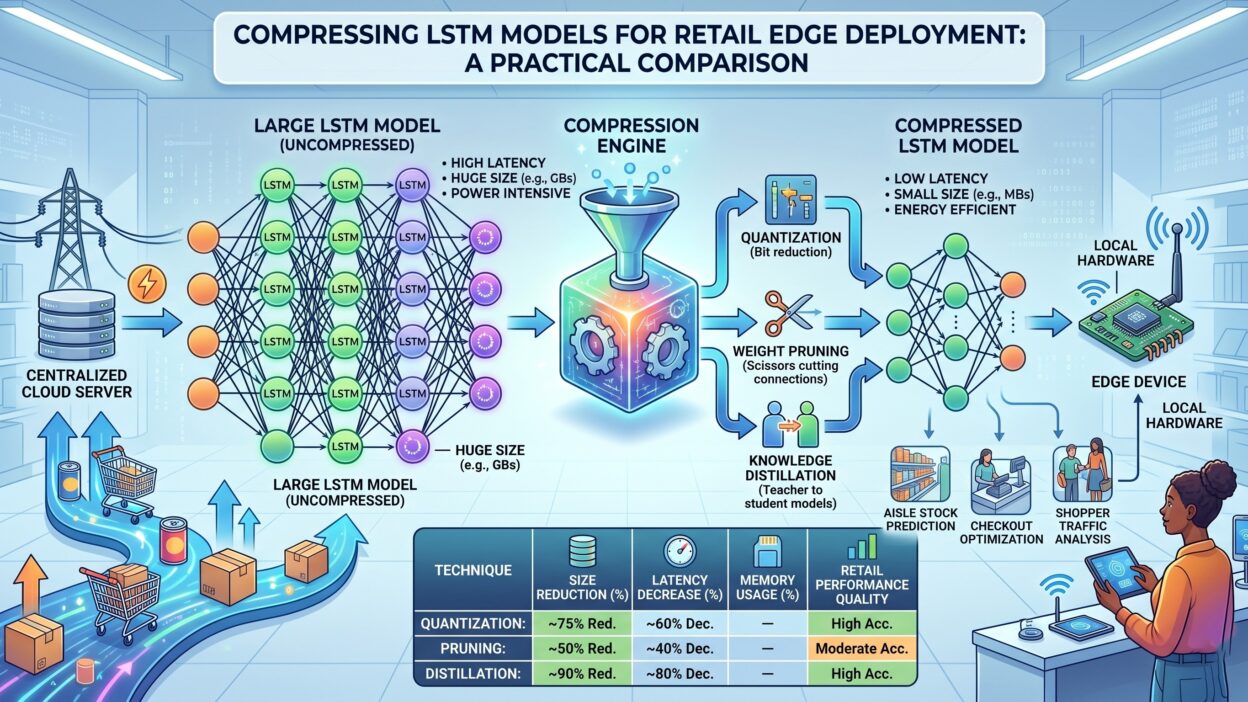
Quantization reduces the numerical precision of model weights. A standard LSTM model stores weights as 32-bit floating point numbers. Quantization converts them to 16-bit or 8-bit integers.
Fewer bits per weight means smaller model files. Smaller files need less memory during inference. Integer arithmetic also runs faster than floating point on many edge processors. This directly benefits Compressing LSTM Models for Retail Edge Deployment workflows.
Post-training quantization (PTQ) applies quantization after training completes. It is fast to implement and requires no retraining. Quantization-aware training (QAT) simulates quantization during the training process. QAT preserves more accuracy but requires additional training compute.
For retail forecasting models, 8-bit quantization typically causes less than one percent accuracy loss. That tradeoff is acceptable in most inventory and demand prediction scenarios. The memory reduction can reach 75 percent compared to full 32-bit precision models.
Pruning
Pruning removes parameters that contribute little to model output. LSTM models contain millions of weights. Research consistently shows that a large fraction of those weights are redundant. Removing them shrinks the model without meaningful accuracy loss.
Unstructured pruning removes individual weight values. It creates sparse weight matrices. These sparse models are smaller on disk but require specialized sparse inference libraries to realize speed gains on hardware.
Structured pruning removes entire neurons, gates, or LSTM units. This creates smaller dense models. Dense models run efficiently on standard edge hardware without special libraries. For retail edge scenarios, structured pruning is often the more practical choice.
Iterative pruning produces the best results. The model prunes gradually. After each pruning step, a fine-tuning phase recovers lost accuracy. This cycle repeats until the target sparsity level is reached.
Knowledge Distillation
Knowledge distillation trains a small student model to mimic a large teacher model. The teacher LSTM retains its full size and accuracy. The student LSTM is purpose-built to be compact.
During distillation training, the student learns from both the ground truth labels and the teacher’s soft probability outputs. Soft outputs carry more information than hard labels alone. The student learns more nuanced patterns from this richer training signal.
Distillation is highly effective for Compressing LSTM Models for Retail Edge Deployment because you control the student architecture precisely. You design it to fit your target hardware before training begins. The result is a model built for edge deployment from the start.
The main cost is additional training time. You need both a trained teacher model and a distillation training run. For large retail deployments where the edge model runs across hundreds of stores, this upfront investment pays off quickly.
Weight Sharing and Low-Rank Factorization
Weight sharing groups multiple weights and forces them to share a single value. This reduces the number of unique values stored in the model. HashNets and product quantization apply this principle to neural networks effectively.
Low-rank factorization decomposes large weight matrices into smaller factor matrices. An LSTM weight matrix of size N by M gets replaced by two matrices of size N by K and K by M, where K is much smaller than both N and M. This reduces total parameters significantly.
Both techniques integrate well with quantization. Applying factorization first reduces the number of weights. Quantization then reduces the bit width of those remaining weights. Combining methods often achieves better compression than either approach alone.
Neural Architecture Search for Compact LSTMs
Neural Architecture Search (NAS) automates the design of efficient model architectures. Instead of compressing an existing large model, NAS finds a small architecture that achieves target accuracy directly.
Hardware-aware NAS optimizes specifically for target edge devices. The search process measures actual latency on the target hardware and incorporates that into the architecture score. This produces models that are genuinely fast on your specific retail hardware.
NAS has a high compute cost for the search phase. But the resulting architectures are highly optimized. For Compressing LSTM Models for Retail Edge Deployment at enterprise scale, NAS can deliver architectures that manual compression cannot match.
Practical Comparison: Compression Method Performance in Retail Scenarios
Theory matters. Real numbers matter more. This section compares compression methods across the metrics that retail edge deployments actually care about.
Model Size Reduction
Quantization achieves the most consistent size reduction with the least effort. Moving from FP32 to INT8 reduces model size by approximately 75 percent. A 40MB LSTM model becomes roughly 10MB. That fits comfortably on low-memory edge devices.
Pruning at 90 percent sparsity can achieve similar size reduction. But unstructured pruning requires sparse storage formats that add implementation complexity. Structured pruning at 50 to 60 percent typically achieves 40 to 50 percent size reduction while maintaining dense matrix operations.
Distillation produces the smallest models because you design the student architecture from scratch. A well-distilled student can be 5 to 10 times smaller than the teacher while retaining 95 percent of forecast accuracy. This is the best outcome for aggressive size constraints.
Inference Latency on Edge Hardware
Quantized models run faster on processors with native integer arithmetic support. ARM Cortex processors common in retail embedded systems execute INT8 operations faster than FP32. Latency improvements of 2x to 4x are typical with quantization alone.
Structured pruning reduces computation by removing entire neurons. Fewer neurons mean fewer multiply-accumulate operations per inference step. Latency gains depend directly on how aggressively the model was pruned.
Distilled student models offer predictable latency because their architecture is fixed. You know exactly how many operations each inference requires before deployment. This predictability is valuable for real-time retail applications with strict response time requirements.
Forecast Accuracy Retention
Accuracy retention varies by compression method and compression aggressiveness. Quantization with INT8 precision loses under one percent accuracy on typical retail forecasting benchmarks. This is the safest method for accuracy-sensitive use cases.
Pruning up to 50 percent sparsity causes minimal accuracy loss on well-trained LSTM models. Pushing beyond 70 percent sparsity starts to degrade accuracy measurably. Iterative fine-tuning after each pruning step helps recover accuracy at higher sparsity levels.
Distillation accuracy depends heavily on student architecture quality and distillation training data. A well-designed student with sufficient training data retains 94 to 97 percent of teacher accuracy. Poor student architecture design causes larger accuracy drops regardless of training duration.
Implementation Complexity and Team Effort
Quantization is the fastest compression method to implement. Most major ML frameworks support post-training quantization natively. TensorFlow Lite, PyTorch Mobile, and ONNX Runtime all provide quantization tools. A small team can compress and deploy a quantized model in days.
Pruning requires more careful implementation. The pruning schedule, target sparsity, and fine-tuning protocol all affect outcomes. Teams unfamiliar with pruning often achieve suboptimal results on the first attempt. Budget time for experimentation.
Distillation demands the most upfront effort. Designing the student architecture requires understanding both the teacher model and the target hardware. The distillation training process needs careful hyperparameter tuning. But the payoff in deployment performance justifies the effort for large-scale retail rollouts.
Choosing the Right Compression Method for Your Retail Use Case
The best compression method depends on your specific retail context. There is no universal answer. Several factors guide the decision.
Hardware Constraints
Start with a clear inventory of your target edge hardware. Know the available RAM, storage, processor type, and power budget. This information immediately eliminates some methods and highlights others.
ARM-based embedded processors benefit most from quantization. They execute integer operations natively and efficiently. NVIDIA Jetson devices support more varied compression approaches because they have GPU cores.
Very constrained devices like Raspberry Pi Zero benefit most from aggressive distillation combined with quantization. These combinations achieve the smallest possible footprint.
Accuracy Requirements
Demand forecasting at the SKU level is accuracy-sensitive. Forecast errors directly cause overstock or stockout situations. These situations have real financial costs. Choose conservative compression methods for this use case.
Customer engagement models at kiosks can tolerate more accuracy variance. A slightly less precise recommendation model still provides useful suggestions. More aggressive compression is acceptable here.
Always benchmark compressed models on representative retail data before deployment. Benchmark accuracy on your data matters more than published results on standard datasets.
Development Timeline
Tight deployment timelines favor quantization. It requires minimal development effort and delivers meaningful compression gains quickly. Teams with weeks rather than months should start with post-training quantization.
Longer timelines open the door to distillation and NAS approaches. These methods require more development cycles but produce superior edge-optimized models. Invest the extra time when the deployment scale justifies it.
Maintenance and Update Frequency
Retail demand patterns shift seasonally. LSTM models need retraining to stay accurate. Consider how easily each compression method integrates into your model update pipeline.
Quantization pipelines are easy to automate. Retrain the base model, apply quantization, validate accuracy, and push to edge devices. This cycle integrates cleanly into MLOps workflows.
Distilled models require retraining the student when the teacher updates significantly. This adds steps to the update pipeline. Plan for this overhead when choosing distillation at scale.
Deployment Tools and Frameworks for Retail Edge LSTM Inference
Choosing the right inference framework matters as much as choosing the right compression method. The framework determines how well the compressed model performs on actual retail hardware.
TensorFlow Lite
TensorFlow Lite is the leading framework for mobile and embedded edge deployment. It supports INT8 quantization natively. The TFLite LSTM delegate accelerates LSTM inference on supported ARM processors.
Conversion from a full TensorFlow LSTM model to TFLite format is straightforward. The TFLite converter handles most standard LSTM architectures automatically. Quantization parameters integrate into the conversion step.
TFLite runs on Android devices, Raspberry Pi, and many commercial retail terminals. The ecosystem is mature and well-documented. For teams already using TensorFlow, TFLite is the natural deployment path.
ONNX Runtime
ONNX Runtime supports multiple hardware backends through its execution provider system. It runs on CPUs, NVIDIA GPUs, ARM processors, and specialized accelerators. This flexibility suits retailers with diverse hardware across store locations.
ONNX models export from PyTorch, TensorFlow, and Keras. The ONNX quantization toolkit handles INT8 conversion. ONNX Runtime’s graph optimizations often improve inference speed beyond quantization gains alone.
PyTorch Mobile
PyTorch Mobile is the natural choice for teams developing in PyTorch. It supports dynamic quantization for LSTM models natively. The TorchScript format prepares models for mobile and edge inference.
PyTorch Mobile’s LSTM support is strong because PyTorch is the dominant research framework. Most cutting-edge LSTM architectures get implemented in PyTorch first. Teams working with novel architectures benefit from PyTorch Mobile’s broad model support.
TensorRT for NVIDIA Jetson
NVIDIA Jetson devices are popular in premium retail edge deployments. TensorRT is the optimization framework for these devices. It applies layer fusion, precision calibration, and kernel auto-tuning to maximize inference throughput.
TensorRT combined with INT8 quantization on Jetson hardware produces exceptional inference performance. Compressing LSTM Models for Retail Edge Deployment on Jetson with TensorRT often achieves real-time inference at minimal power draw.
Common Pitfalls When Compressing LSTM Models for Retail Edge Deployment
Teams new to model compression make predictable mistakes. Knowing these pitfalls in advance saves weeks of troubleshooting.
Skipping Hardware Profiling
Many engineers compress a model without measuring actual performance on target hardware first. They optimize for theoretical metrics like parameter count and FLOP reduction. Real hardware performance often differs from these theoretical estimates.
Always profile inference time, memory usage, and power consumption on the actual target device before and after compression. Use the profiling data to guide compression decisions.
Over-Compressing Without Fine-Tuning
Aggressive compression without proper fine-tuning destroys model accuracy. Some engineers apply maximum quantization and maximum pruning simultaneously hoping for additive gains. The result is typically a model that fails to generalize.
Apply compression incrementally. Validate accuracy at each compression step. Fine-tune when accuracy drops beyond acceptable thresholds. This disciplined approach produces deployable models consistently.
Ignoring Distribution Shift in Retail Data
Retail data has strong seasonal and promotional patterns. A model calibrated for quantization on one season’s data may degrade during peak shopping periods if the data distribution shifts significantly.
Calibrate quantization parameters on a representative sample that includes seasonal variation. For pruning and distillation, train on data spanning multiple retail seasons when possible.
Forgetting the Inference Pipeline
Compression optimizes the model itself. But the full inference pipeline includes data preprocessing, feature engineering, and post-processing steps. These steps also consume time and memory on edge hardware.
Profile and optimize the full pipeline, not just the model. Sometimes preprocessing is the actual bottleneck on edge devices. Compressing LSTM Models for Retail Edge Deployment requires optimizing every stage of the pipeline.
Frequently Asked Questions About Compressing LSTM Models for Retail Edge Deployment
What compression ratio is achievable without losing retail forecast accuracy?
Most retail LSTM models tolerate 4x to 8x compression with under two percent accuracy loss. Quantization alone achieves 4x. Combining quantization with structured pruning reaches 8x in many cases. Distillation can push compression ratios to 10x or higher for accuracy-tolerant use cases.
Which hardware platforms are most commonly used for retail edge LSTM inference?
The most common platforms are Raspberry Pi 4, NVIDIA Jetson Nano, Intel Neural Compute Stick, and commercial retail terminals running embedded Linux. ARM Cortex-A class processors dominate the low-cost tier. NVIDIA Jetson covers the premium performance tier.
How long does it take to implement quantization for an LSTM retail model?
Post-training quantization takes one to three days for an experienced ML engineer familiar with TFLite or ONNX Runtime. Quantization-aware training takes one to two weeks including retraining time. The initial setup is the main time cost. Subsequent model updates run much faster once the pipeline is established.
Can distilled LSTM models match cloud model accuracy for demand forecasting?
Well-designed distilled models typically achieve 94 to 97 percent of teacher model accuracy on retail forecasting benchmarks. Whether that accuracy level meets your business requirements depends on the specific forecasting use case and the financial impact of forecast errors.
Is knowledge distillation suitable for small retail teams?
Distillation requires ML engineering expertise to implement well. Small teams without dedicated ML engineers may find it challenging. Starting with quantization is more realistic for resource-constrained teams. Distillation becomes more accessible when using frameworks like Hugging Face’s neural network compression toolkit or Intel’s Neural Network Compression Framework.
What accuracy metrics matter most when evaluating compressed LSTM retail models?
Mean Absolute Error (MAE) and Root Mean Squared Error (RMSE) on held-out retail test data are the primary metrics. Track these on multiple product categories and seasonal periods. A model that maintains accuracy across seasonal shifts is more valuable than one that only performs well on flat demand periods.
How do compressed LSTM models handle sudden demand shocks like promotions?
Compressed models react to demand shocks the same way their full-size counterparts do, assuming the compression preserved the model’s temporal pattern recognition. Severe compression that removes too many LSTM units can impair the model’s ability to respond to sudden pattern changes. Test compressed models specifically on promotional event data before deployment.
What is the best starting point for a team new to Compressing LSTM Models for Retail Edge Deployment?
Start with post-training INT8 quantization using TensorFlow Lite or ONNX Runtime. Apply it to your existing trained model. Measure accuracy on your retail test set and inference latency on target hardware. This baseline gives you concrete numbers to compare against more complex compression methods. Most retail teams find quantization alone sufficient for initial edge deployments.
Future Directions in Retail Edge LSTM Compression
Compression research moves quickly. Several developments will shape Compressing LSTM Models for Retail Edge Deployment in the coming years.
Hardware-Native Compression Support
Chip manufacturers are embedding compression-aware inference engines directly into edge processors. ARM Cortex-M55 and NVIDIA Orin already include hardware acceleration for quantized neural network inference. This trend will make edge deployment faster and simpler across the retail hardware ecosystem.
Automated Compression Pipelines
MLOps platforms are adding automated compression features. Engineers specify target hardware constraints and accuracy requirements. The platform automatically selects and applies the best compression strategy. This removes manual decision-making from the compression workflow.
Transformer Alternatives and Hybrid Architectures
Transformer-based time series models are gaining ground on traditional LSTM architectures. These models offer different compression trade-offs. Retail ML teams should monitor whether transformer-based forecasting models offer better compressibility for their specific use cases. Hybrid LSTM-Transformer architectures may combine the temporal modeling strengths of both approaches.
Read More:-What is Prompt Chaining? A Complete Guide for 2025
Conclusion

Compressing LSTM Models for Retail Edge Deployment is no longer optional for retailers serious about on-premise AI. Cloud-only inference creates latency, cost, and reliability problems at scale. Edge inference solves all three problems simultaneously.
The four core compression methods each serve different needs. Quantization delivers fast, easy compression with minimal accuracy loss. Pruning removes redundant capacity from over-parameterized models. Distillation builds purpose-designed compact models from scratch. Low-rank factorization and NAS offer specialized solutions for specific hardware and accuracy targets.
The practical comparison makes the decision clearer. For most retail teams, quantization is the right starting point. It delivers meaningful compression with minimal implementation risk. Teams with more resources and scale should invest in distillation for maximum edge efficiency.
Compressing LSTM Models for Retail Edge Deployment done well produces real operational benefits. Faster inference at the shelf. Reliable AI during network outages. Lower infrastructure costs across the store network. These gains compound across hundreds or thousands of store locations.
Start with hardware profiling. Choose the compression method that fits your constraints. Validate on representative retail data. Deploy iteratively. The tools and frameworks are mature enough today to make this work accessible to any serious retail ML team.
The retailers who master Compressing LSTM Models for Retail Edge Deployment now will build meaningful competitive advantages in store-level intelligence. The technical barriers are lower than ever. The business case is stronger than ever. The time to act is now.