Introduction
TL;DR Your CRM lied to you this morning. Not on purpose. The contact you pulled up still shows a title that person left months ago. This happens because static data sits still while the real world keeps moving. Dynamic data solves this problem by updating itself as facts change. This blog explains why B2B teams need dynamic data now, not later. You get real numbers, practical steps, and a clear picture of what changes once your data starts moving with the market instead of sitting frozen in a spreadsheet.
Table of Contents
What Is Dynamic Data
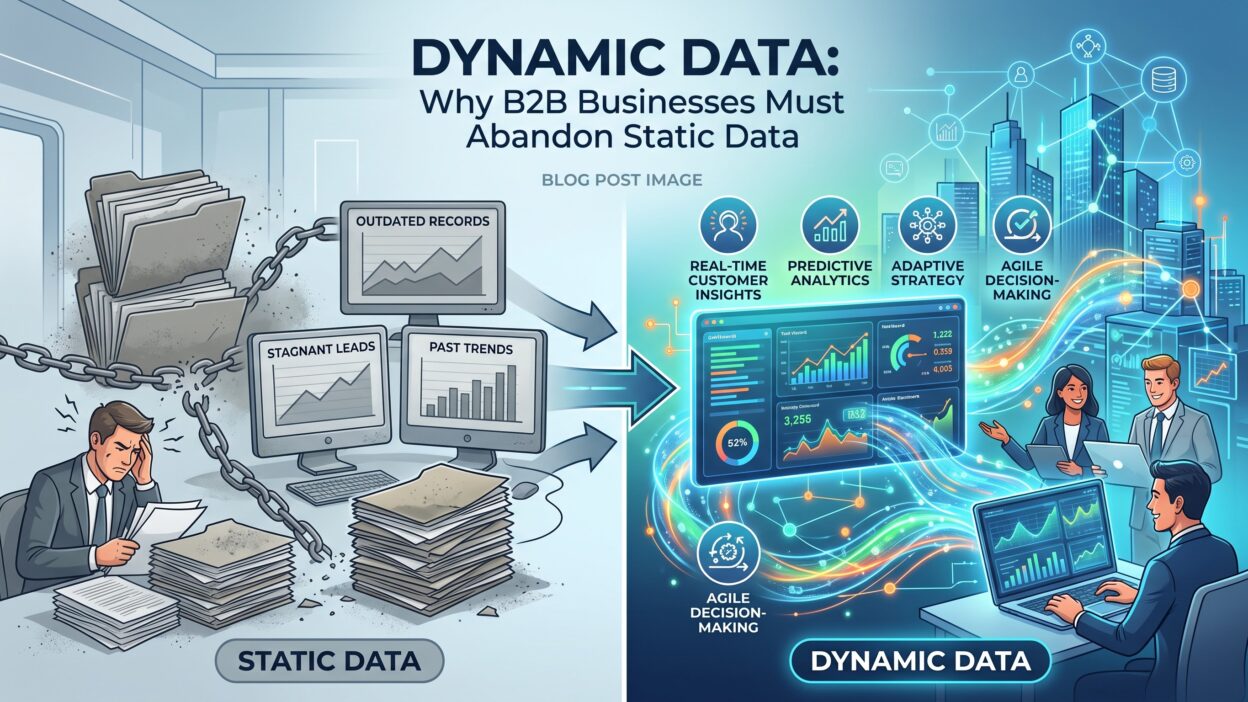
Dynamic data refers to information that updates continuously as real-world conditions change. A dynamic data record reflects a person’s current job, a company’s current size, and a deal’s current stage. Static data does the opposite. It freezes a fact at the moment someone typed it in, then leaves that fact untouched for months or years.
B2B teams collect huge volumes of contact and account records. Static data ages fast inside that environment. A title changes. A company gets acquired. A phone number gets reassigned. Dynamic data tracks these shifts as they happen instead of waiting for someone to notice the record is wrong.
Dynamic Data vs Static Data
Static data enters your system once and stays put. A sales rep exports a list, uploads it, and moves on. Dynamic data behaves like a living feed. New signals flow in constantly through enrichment tools, verification services, and connected data sources. The record in your CRM changes shape as the person or company behind it changes in real life.
Why This Distinction Matters for B2B Teams
A B2B sales cycle often stretches across months. A prospect can switch jobs twice during that window. Static data locks your team into targeting a person who no longer holds decision-making power at that company. Dynamic data catches that shift and routes your outreach toward the person who actually holds the role today.
The Real Cost of Static Data in B2B
Static data does not sit harmlessly in the background. It actively costs revenue every single day it goes unrefreshed.
Data Decay Numbers Every GTM Leader Should Know
Research from multiple industry sources puts annual B2B contact decay somewhere between 22.5% and 70.3%, depending on the field and the industry tracked. Email addresses decay even faster, with monthly decay rates climbing past 3.6% in recent benchmarks. A list of ten thousand contacts built today loses over two thousand accurate records within twelve months if nobody touches it. Dynamic data exists specifically to fight this decay curve instead of accepting it as a cost of doing business.
Revenue Lost to Outdated Records
Poor data quality costs American businesses an estimated $3.1 trillion every year. Individual organizations report losses between $12.9 million and $15 million annually tied directly to bad contact and account data. Dynamic data attacks this loss at the source. It replaces stale records before they cost a closed deal or a missed renewal.
Wasted Sales and Marketing Hours
Sales reps report spending a large share of their week chasing leads built on outdated information. Some studies place this waste above 27% of total selling time. Marketing teams face a similar drain when they run campaigns against contact lists full of dead emails and outdated titles. Dynamic data removes this waste by keeping the underlying records accurate before a rep or a campaign manager ever touches them.
How Dynamic Data Changes B2B Operations
A shift toward dynamic data changes daily workflows across an entire revenue organization, not just one department.
Real-Time Enrichment vs Periodic Cleanup
Most teams still rely on periodic data cleanup. Someone runs a quarterly scrub, removes bounced emails, and calls it done. Dynamic data replaces this cycle with continuous enrichment. New information flows into a record the moment a trigger fires, whether that trigger is a job change, a funding announcement, or a new hire at the target account. Periodic cleanup treats decay as a problem you fix later. Dynamic data treats decay as a problem you prevent constantly.
Continuous Verification Cycles
A strong dynamic data setup verifies contact and account fields on a rolling schedule rather than a fixed calendar date. Some fields need daily verification, like email deliverability. Other fields need lighter checks, like company headcount. Dynamic data platforms assign different refresh rates to different field types based on how fast each one tends to decay.
Dynamic Data in Sales
Sales teams feel the impact of dynamic data faster than any other department, since outreach depends entirely on accurate targeting.
Prospecting With Live Signals
A rep working from dynamic data sees a prospect’s current company, current title, and current buying signals in one view. This replaces the old habit of manually checking LinkedIn before every call. Dynamic data pulls that context automatically and keeps it current without extra manual work from the rep.
Lead Scoring That Updates Itself
Static lead scores go stale the moment a prospect’s situation changes. A lead scored high six months ago might now work at a company with no budget for your product. Dynamic data feeds a scoring model with live signals, so the score shifts automatically as new facts arrive. This keeps a sales team focused on leads that actually deserve attention right now.
Dynamic Data in Marketing
Marketing teams depend on accurate segmentation and personalization, and both break down fast once static data takes over a database.
Personalization That Stays Accurate
A personalized email referencing an outdated job title damages trust instantly. Dynamic data prevents this by keeping personalization fields current at send time. The message a prospect receives matches their actual role, not a role they left months earlier.
Campaign Targeting and List Hygiene
Campaign performance drops fast when a list carries a high share of dead emails. Dynamic data keeps deliverability high by removing invalid addresses before a campaign launches. Marketing teams running on dynamic data see fewer bounces, better sender reputation, and stronger response rates across every channel they run.
Dynamic Data in Customer Success and Account Management
Customer-facing teams need accurate account context just as much as sales and marketing do, though this need often gets overlooked.
Tracking Account Changes in Real Time
An account manager working from static data might miss a customer’s leadership change entirely. Dynamic data surfaces that change the moment it happens, giving the account team a chance to build a relationship with the new decision maker before a competitor gets there first.
Reducing Churn Through Fresh Context
Churn often follows a pattern where the internal champion leaves the company and nobody at the vendor notices for weeks. Dynamic data flags this kind of change immediately. A customer success team acting on fresh information can intervene early instead of discovering the loss at renewal time.
Building a Dynamic Data Infrastructure
A move toward dynamic data requires more than a single tool. It requires a full infrastructure built around continuous data flow.
Data Sources That Feed a Dynamic System
A dynamic data system pulls from several sources at once. Firmographic providers supply company-level signals like funding and headcount. Intent data providers supply behavioral signals like content downloads and website visits. Verification services confirm that email addresses and phone numbers still work. Combined, these sources give a dynamic data platform enough signal to keep records fresh without constant manual input.
Governance and Ownership
Dynamic data needs an owner. Without clear ownership, teams drift back into static habits within a few months. A dedicated data operations function should define refresh cadences, monitor accuracy, and resolve conflicts when two sources disagree about the same fact. This governance layer keeps a dynamic data system trustworthy over the long run.
Tools and Platforms That Support Dynamic Data
Modern revenue platforms increasingly build dynamic data support directly into their core product rather than treating it as an add-on. Enrichment tools, verification APIs, and intent data feeds all plug into a CRM to keep records current automatically. A B2B team evaluating new tools should ask directly how each platform handles dynamic data refresh, since this single question separates a modern stack from a static one.
Dynamic Data and AI in B2B
AI adoption inside B2B revenue teams raises the stakes around data freshness even further.
Why AI Models Need Dynamic Data, Not Static Snapshots
An AI model trained on stale records makes stale recommendations. A scoring model built on six-month-old job titles routes leads to the wrong buyer. A forecasting model built on outdated deal stages produces a forecast nobody can trust. Dynamic data gives an AI system the fresh input it needs to produce output a revenue team can actually act on.
Automation Risks Without Fresh Data
Automated outreach sequences amplify the damage a static database causes. A sequence built on outdated titles sends dozens of messages to the wrong person before a human ever catches the mistake. Dynamic data prevents this by keeping the underlying trigger conditions accurate, so automation acts on current facts instead of outdated ones.
Static Data vs Dynamic Data: The Side-by-Side Reality
Static data answers a question about the past. It tells you who held a role on the day someone entered the record. Dynamic data answers a question about the present. It tells you who holds that role right now. Static data requires manual intervention to stay useful, usually through a scheduled cleanup project that pulls resources away from other work. Dynamic data requires infrastructure investment up front, then runs with far less manual intervention over time. Static data degrades in value every single day after entry. Dynamic data holds its value because it keeps refreshing itself against the real world.
How to Move From Static Data to Dynamic Data
A shift from static data to dynamic data does not happen overnight, but the path stays fairly consistent across most B2B organizations.
Audit Your Current Data
Start by measuring how stale your current database actually is. Pull a sample of records and verify them manually against current sources. This audit gives you a real decay rate instead of a guess, and it gives leadership a concrete number to justify the investment dynamic data requires.
Set a Refresh Cadence
Different fields decay at different speeds, so a single refresh schedule rarely fits every field type. Email addresses need frequent checks. Company-level data can run on a slower cycle. Dynamic data platforms typically let you configure these cadences separately, so build that structure early rather than treating every field the same way.
Assign Ownership
Pick a single owner for data quality before you roll out any new tooling. This person tracks accuracy metrics, manages vendor relationships, and keeps the dynamic data initiative from losing momentum once the initial excitement fades. Without this role, most dynamic data projects quietly slide back into static habits within a year.
Dynamic Data in Account-Based Marketing
Account-based marketing depends on precise targeting at the account level, which makes stale records especially damaging inside this motion.
Building Target Account Lists That Stay Current
An ABM program builds a target list around firmographic fit, then tracks buying signals across every contact inside those accounts. Static data leaves that list frozen the day someone built it. Dynamic data keeps the list breathing, adding new accounts that now fit the criteria and flagging accounts that drifted out of scope, such as one that got acquired or shrank below a headcount threshold.
Coordinating Sales and Marketing Around Shared Signals
ABM only works when sales and marketing act on the same account context at the same time. Dynamic data gives both teams a shared, current view instead of two separate exports pulled on different days. A marketing team launching an account-specific campaign and a sales rep calling that same account both work from identical, current information when dynamic data sits underneath the stack.
Dynamic Data and Privacy Compliance
Continuous data refresh raises real questions about consent and regulation, and a serious dynamic data program addresses these directly rather than treating them as an afterthought.
Consent Tracking Inside a Dynamic System
Regulations like GDPR and CCPA require organizations to track how and why they hold a piece of personal data. A dynamic data platform needs to track consent status alongside every other field, updating that status the same way it updates a job title or phone number. A record that loses valid consent should stop receiving outreach immediately, not weeks later during a manual review.
Balancing Freshness With Data Minimization
Privacy regulation often pushes toward collecting less data, while a dynamic data strategy pushes toward keeping more fields current. These goals do not actually conflict. A well-built dynamic data program only refreshes fields the business genuinely needs, then drops fields that no longer serve a clear purpose. This keeps the system lean and compliant while still staying current on the fields that matter.
Dynamic Data Metrics Worth Tracking
A dynamic data program needs clear metrics, or leadership loses sight of whether the investment actually works.
Accuracy Rate by Field
Track accuracy separately for email, phone, title, and company size, since each field decays at its own pace. A single blended accuracy score hides which fields need more attention. Dynamic data programs that track field-level accuracy catch problems faster than programs relying on one overall number.
Time to Detect a Change
Measure how long it takes your system to catch a job change or account shift after it happens. A dynamic data setup with a short detection window gives sales and marketing a real edge over competitors still working from static exports. A long detection window signals that your refresh cadence needs tightening.
Downstream Impact on Pipeline
Connect data quality metrics directly to pipeline outcomes. Track response rates, meeting-booked rates, and close rates against records that recently refreshed versus records that sat untouched for months. This comparison gives leadership concrete proof that dynamic data drives revenue, not just cleaner spreadsheets.
Common Mistakes B2B Teams Make With Dynamic Data
Teams often buy a dynamic data tool and expect the problem to solve itself. This rarely works, since a tool only helps when someone configures it correctly and monitors its output. Another common mistake involves treating every field as equally urgent, which wastes verification budget on low-priority data while high-priority fields still decay unnoticed. A third mistake skips governance entirely, letting multiple tools feed conflicting updates into the same record without a clear resolution process. Dynamic data delivers value only when a team pairs the technology with real process discipline behind it.
Frequently Asked Questions
What is dynamic data in simple terms? Dynamic data means information that updates itself as real-world facts change, instead of staying frozen at the moment someone first entered it into a system.
How is dynamic data different from real-time data? Real-time data updates instantly as an event happens. Dynamic data covers a broader idea, including data that refreshes on a scheduled cycle rather than the exact instant a change occurs. Most B2B dynamic data systems blend both approaches depending on the field.
Why does static data hurt B2B sales teams specifically? B2B sales cycles run long, often across several months. A prospect’s job, company, or budget authority can shift multiple times during that window. Static data locks a sales team into targeting information that no longer reflects reality, while dynamic data keeps that targeting accurate throughout the entire cycle.
How often should B2B teams refresh their data? Refresh frequency depends on the field. Email addresses benefit from frequent checks, sometimes weekly. Company-level facts like headcount can run on a monthly or quarterly cycle. Dynamic data platforms let a team set these cadences separately instead of forcing one schedule across every field.
Does dynamic data replace the need for a CRM? No. Dynamic data feeds a CRM rather than replacing it. The CRM still stores and organizes records. Dynamic data keeps those records accurate through continuous enrichment and verification running in the background.
What tools support dynamic data for B2B teams? Enrichment platforms, verification services, and intent data providers all support a dynamic data strategy. Many CRMs now build native connections to these sources, so records update automatically without manual exports and imports.
Is dynamic data worth the cost for a small B2B team? Even a small team loses revenue to stale contact data. A smaller database actually makes dynamic data cheaper to implement, since verification and enrichment costs scale with record count. Small teams often see a faster return simply because bad data among fewer prospects does proportionally more damage.
How do you measure the ROI of a dynamic data investment? Track campaign response rates, close rates, and time reps spend on manual research before and after implementation. Teams that shift to dynamic data commonly report double-digit gains in response rates and close rates within the first six months.
Does dynamic data create extra privacy risk? Not when a team builds consent tracking directly into the refresh process. Dynamic data should update consent status the same way it updates any other field, so outreach stops immediately once a contact withdraws permission.
Can dynamic data work alongside a legacy CRM that was not built for it? Yes, through connected enrichment and verification tools that sync into the existing CRM rather than replacing it. Most legacy systems support this through APIs or native integrations, so a full platform migration is rarely the only path to dynamic data.
Read More:-7 Best Salesforce Integrations to Extend Your CRM in 2026
Conclusion

Static data quietly drains revenue out of every B2B team that tolerates it. The fix is not a one-time cleanup project. The fix is a permanent shift toward dynamic data that keeps every record accurate as the real world changes around it. Sales teams reach the right buyer instead of a ghost record. Marketing teams send messages that match reality instead of an outdated title. Customer success teams catch account risk before it turns into churn. Dynamic data asks for real investment in infrastructure, governance, and ownership, but the return shows up fast in cleaner pipelines and stronger close rates. Static data made sense when B2B teams updated records by hand once a quarter. That approach cannot keep up with how fast people change jobs and companies change shape today. Dynamic data meets that pace directly. Any B2B team still running on static data is working with a map of a city that moved months ago.