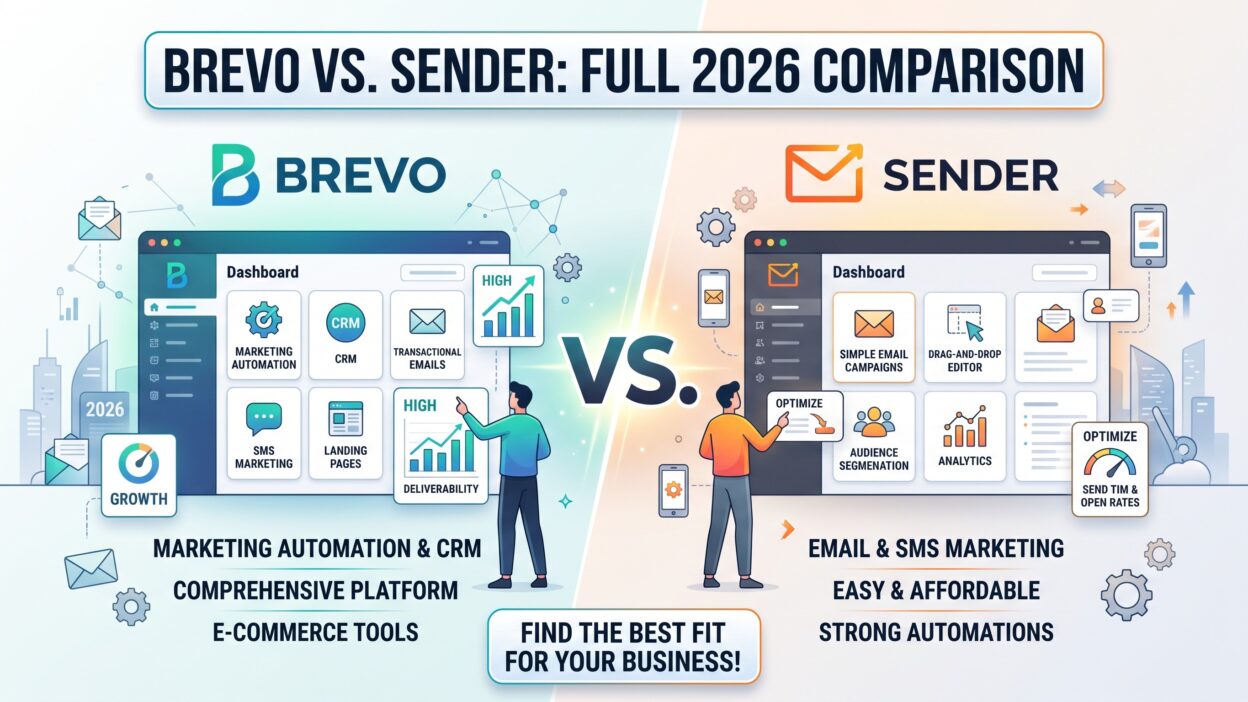
Choosing between two email marketing tools wastes hours when the marketing pages all sound the same. This Brevo vs. Sender comparison cuts through that noise. You get real pricing numbers, real feature differences, and a clear answer on which platform fits your list size and budget. Both tools serve small businesses well, but they take different approaches to pricing and feature depth. This guide breaks down every part of that difference, section by section, so you finish this Brevo vs. Sender review ready to sign up for the right platform instead of guessing. Bookmark this page if you need a reference point later, since pricing on both platforms tends to shift a few times a year.
Table of Contents
Brevo vs. Sender at a Glance
Brevo started life as Sendinblue before its 2023 rebrand, and it now serves over 600,000 customers worldwide, including brands like eBay and IKEA. Sender built its reputation on one thing: the most generous free plan in the email marketing space. Both platforms handle email campaigns, automation, and basic segmentation well. Where they split apart is pricing structure, channel breadth, and who each tool actually targets. Keep both of those variables in mind as you read through the rest of this Brevo vs. Sender breakdown, since almost every section below ties back to one or the other.
Quick Verdict
Pick Sender if your list sits under 5,000 contacts and you want the strongest free tier available today. Pick Brevo if your list runs larger, your send frequency stays low, or you need channels beyond email and SMS. This Brevo vs. Sender decision usually comes down to those two variables more than anything else in the feature list.
Brevo vs. Sender Pricing Compared
Pricing structure sits at the center of almost every Brevo vs. Sender debate, since the two platforms bill customers in completely different ways.
Brevo’s Pricing Model
Brevo charges based on email volume, not contact count. A business with fifty thousand contacts that only sends one campaign a month pays far less than a platform charging by list size would suggest. Brevo restructured its paid plans in October 2025, introducing contact caps on lower tiers. The Starter plan now starts around seven euros a month with a five hundred contact cap, while the Standard plan starts near fifteen euros a month with a fifteen hundred contact cap. A business with a larger list needs to step up to a higher Standard tier to stay under the new caps.
Sender’s Pricing Model
Sender charges based on subscriber count instead of email volume. This favors a business that emails frequently but keeps a smaller list. Sender also applies a multiplier to certain plans based on how many times a month you plan to email each subscriber, and this multiplier confuses plenty of buyers who skip the pricing calculator during signup. At ten thousand subscribers, Sender’s Standard plan runs close to fifty dollars a month for email and SMS combined.
Real Cost Examples at Different List Sizes
A business with twenty five thousand contacts sending twenty thousand emails a month pays roughly twenty five dollars on Brevo. The same list size and volume on a subscriber-based competitor often costs several times more. Flip the scenario for a business with five thousand contacts sending daily campaigns, and Sender’s subscriber-based model starts looking more competitive against Brevo’s email-volume caps. This Brevo vs. Sender pricing gap widens or narrows entirely based on your actual sending habits.
Free Plan Comparison
Both platforms lead with a free plan, and both plans genuinely work for a small list rather than acting as a crippled trial.
What Brevo’s Free Plan Includes
Brevo’s free plan allows unlimited contacts but caps daily sending at three hundred emails. No credit card is required to start. This structure favors a business building a large list slowly, since the contact count never triggers a forced upgrade on its own.
What Sender’s Free Plan Includes
Sender’s free plan allows up to twenty five hundred subscribers and fifteen thousand emails a month. This plan includes marketing automation, audience segmentation, pop-up forms, and campaign analytics at no cost. Twenty four hour live chat support comes included even on the free tier, which few competitors match at this price point. The main tradeoff sits in required Sender branding inside every email sent from the free plan.
Email Campaign and Design Tools
Campaign creation needs to stay accessible to a non-designer, and both platforms build their editors around that requirement.
Brevo’s Email Builder and Templates
Brevo ships a drag-and-drop email builder paired with more than fifty responsive templates. Its Aura AI agent generates subject lines, writes body copy drafts, and optimizes send times per individual recipient based on past open behavior. This AI layer extends the builder past simple drag-and-drop editing into genuine campaign assistance.
Sender’s Email Builder and Templates
Sender offers three separate editor modes: drag-and-drop, raw HTML, and plain text. Its template library runs past eleven hundred designs, giving a marketer far more starting points than Brevo’s smaller collection. A business that changes campaign themes often benefits from this larger template variety.
AI Features in Both Platforms
Brevo currently pushes further into AI-assisted campaign creation through its Aura agent. Sender’s AI tooling stays more limited today, focusing mainly on subject line suggestions rather than full campaign generation. Anyone weighing this Brevo vs. Sender decision around AI capability should lean toward Brevo for now.
Marketing Automation Compared
Automation quality often decides whether a small marketing team can actually run a real lifecycle program without hiring extra staff.
Brevo Automation Workflows
Brevo’s automation builder supports welcome sequences, abandoned cart flows, and behavior-triggered campaigns across multiple channels at once. A single workflow can combine email, SMS, and web push depending on how the recipient responds at each step. This cross-channel flexibility gives Brevo an edge for a business running a more complex customer journey.
Sender Automation Workflows
Sender’s visual workflow builder supports eleven separate starting triggers, covering behavioral events like link clicks and cart abandonment alongside date-based triggers like birthdays. This trigger library covers most standard ecommerce and newsletter use cases well, even without Brevo’s cross-channel workflow options.
Multichannel Marketing: SMS, WhatsApp, and Push
Channel breadth separates these two platforms more than almost any other category. Brevo covers email, SMS, WhatsApp on its Professional tier, web push notifications, and a live website chat widget from one connected dashboard. Sender covers email and SMS only, with no WhatsApp support and no live chat widget for a website. A business planning to run WhatsApp campaigns or embed live chat on its site needs to lean toward Brevo, since Sender simply does not offer either feature today.
CRM and Sales Features
Brevo bundles a built-in Sales CRM with deal pipeline tracking directly into its platform, giving a small sales team basic pipeline visibility without a separate tool. Sender offers far more limited CRM capability, staying focused on email and SMS marketing rather than sales pipeline management. A solo marketer running campaigns only will not miss this gap. A small business trying to track deals alongside campaigns should weight this part of the Brevo vs. Sender comparison heavily.
Deliverability and Sending Reputation
Both platforms send marketing email reliably for the average small business use case. Neither platform publishes detailed public deliverability benchmarks, so real-world results vary by list quality and sending practices more than by platform choice alone. A business with a clean, permission-based list should see strong inbox placement on either tool, provided sender authentication gets configured correctly during setup.
E-commerce Integrations
Ecommerce sellers care about how tightly a platform connects to their storefront. Brevo offers a native Shopify integration built through Shopify’s own OAuth connection, avoiding third-party middleware. Sender also connects well with Shopify and WooCommerce, supporting abandoned cart recovery and transactional emails tied directly to storefront events. Both platforms handle the core ecommerce use case competently, though Brevo’s broader feature set gives an ecommerce store more room to grow into SMS and WhatsApp campaigns later.
Data Residency and Compliance
Brevo operates as a French company with servers located in France, Belgium, and Germany, holding ISO 27001:2022 certification. This makes Brevo a stronger fit for a European business with a strict GDPR data residency requirement written into its compliance policy. Sender does not market the same explicit EU data residency guarantee, which matters most to regulated industries or public sector organizations operating inside Europe.
Customer Support Compared
Sender includes twenty four hour live chat support even on its free plan, which stands out compared to most competitors gating support behind a paid tier. Brevo offers support tied to plan level, with faster response times generally reserved for higher-tier subscribers. A business just starting out and leaning on the free plan may find Sender’s support access more useful during those early months.
User Reviews and Ratings
Both platforms score well on major review sites. Brevo holds a rating near 4.5 stars on G2 across more than twenty five hundred reviews, alongside a Capterra Ease of Use award for 2026. Sender holds a similarly strong rating on Capterra, closer to 4.7 stars, though built on a smaller total review count than Brevo. Review volume itself tells a story here. Brevo’s larger customer base generates more feedback, while Sender’s smaller but highly rated base suggests strong satisfaction among the customers who do use it.
Landing Pages and Web Tracking
A marketing platform that stops at email leaves a gap for a business running lead generation campaigns. Brevo includes landing page building on its Standard tier and above, letting a marketer capture leads without a separate landing page tool. Web tracking also comes bundled, so a campaign manager sees which website pages a contact visited before converting. Sender does not offer a comparable landing page builder, keeping its focus narrower on email, SMS, and pop-up forms. This gap matters most for a business running paid traffic campaigns that need a dedicated capture page, and it tips this part of the Brevo vs. Sender comparison clearly toward Brevo.
Segmentation and List Management
Both platforms let a marketer split a list by behavior, purchase history, and custom fields. Brevo’s segmentation ties directly into its broader contact and CRM data, so a segment can factor in deal stage alongside email engagement. Sender’s segmentation stays focused on email and SMS behavior, covering opens, clicks, and purchase triggers pulled from connected ecommerce platforms. A marketer running simple newsletter segments will find either tool sufficient. A marketer building segments around sales pipeline stage benefits more from Brevo’s deeper data connections.
A/B Testing Capabilities
Testing subject lines and content variations helps a marketing team improve open rates over time. Brevo supports A/B testing across subject lines, send times, and content blocks, with results reported directly inside the campaign dashboard. Sender’s testing tools stay more basic today, generally limited to subject line variations rather than full content testing. A team running a disciplined testing program month over month will likely outgrow Sender’s testing depth faster than Brevo’s.
Onboarding and Ease of Use
First impressions matter when a new user opens either platform for the first time. Sender’s simpler feature set means a new user builds and sends a first campaign faster, often within thirty minutes of signing up. Brevo’s broader feature set adds a small learning curve, though its interface still stays approachable compared to larger enterprise marketing platforms. A solo founder wanting the fastest path to a first campaign may prefer Sender’s simplicity, while a team planning to grow into multichannel marketing benefits from learning Brevo’s fuller interface from the start.
Transactional Email Capabilities
Order confirmations, password resets, and shipping notifications need reliable delivery separate from marketing campaigns. Brevo includes native transactional email support, letting a developer send these automated messages through the same account as marketing campaigns and track them inside one unified dashboard. Sender’s transactional email capability stays more limited, often requiring a workaround or a separate tool for a business with heavy transactional volume. A SaaS company or an ecommerce store sending high transactional volume alongside marketing campaigns should factor this gap into any Brevo vs. Sender decision.
Mobile Apps and On-the-Go Management
A marketer checking campaign performance from a phone needs a functional mobile experience. Brevo offers a mobile app covering campaign monitoring, contact management, and basic reporting on the go. Sender’s mobile experience leans more heavily on a responsive web dashboard rather than a dedicated native app. Neither gap proves disqualifying for most small teams, though a marketer who checks metrics constantly between meetings may notice the difference in daily use.
Pros and Cons Summary
Brevo’s strengths stack up around breadth. It covers more channels, bundles a CRM, includes landing pages, and offers stronger EU data residency guarantees. Its weakness shows up in the October 2025 pricing restructure, which introduced contact caps that catch some buyers off guard if they only remember the old headline pricing. Sender’s strengths stack up around simplicity and value at a small scale. Its free plan remains one of the most generous available, and its template library outpaces Brevo’s by a wide margin. Its weakness shows up in channel limitations, with no WhatsApp support and a thinner CRM offering compared to Brevo. Every Brevo vs. Sender decision ultimately weighs these tradeoffs against your specific list size and growth plans.
Brevo vs. Sender: Who Should Choose Which
The right answer in this Brevo vs. Sender debate depends entirely on list size, channel needs, and budget priorities.
Choose Brevo If
Choose Brevo if your contact list runs into the tens of thousands, your campaign frequency stays moderate, or you need WhatsApp, live chat, or CRM features bundled into one platform. European businesses with strict data residency requirements should also lean toward Brevo given its EU-based infrastructure.
Choose Sender If
Choose Sender if your list stays under five thousand contacts, you send frequently, and you want the strongest possible free plan on the market today. A small ecommerce store just getting started often finds Sender’s pricing and template variety a better starting point before it outgrows the platform’s channel limitations.
Frequently Asked Questions
Which is cheaper, Brevo or Sender? It depends on your sending habits. Brevo often costs less for a large list with infrequent sends, since it bills by email volume. Sender often costs less for a smaller list with frequent sends, since it bills by subscriber count.
Does Sender support WhatsApp marketing? No. Sender covers email and SMS only. Brevo supports WhatsApp campaigns on its Professional tier, making it the better choice for a business planning WhatsApp outreach.
Which platform has a better free plan? Sender’s free plan allows twenty five hundred subscribers and fifteen thousand emails a month with full automation included. Brevo’s free plan allows unlimited contacts but caps daily sending at three hundred emails. The better fit depends on whether your priority is list size or daily send volume.
Is Brevo good for European businesses? Yes. Brevo operates as a French company with servers in France, Belgium, and Germany, holding ISO 27001:2022 certification. This makes it a strong fit for any business with a strict EU data residency requirement.
Does Brevo include a CRM? Yes. Brevo bundles a built-in Sales CRM with deal pipeline tracking. Sender offers much more limited CRM functionality, staying focused primarily on email and SMS marketing.
Which platform has more email templates? Sender offers a larger template library, running past eleven hundred designs. Brevo ships with more than fifty responsive templates, a smaller but still solid starting selection.
Can I switch from Sender to Brevo later without losing data? Most contact lists and campaign history export as a CSV file from either platform, which you can then import into the other. Automation workflows and templates typically need to be rebuilt manually, since these do not transfer directly between platforms.
Which platform works better for ecommerce stores? Both integrate well with Shopify and WooCommerce. Sender fits a smaller store just starting out, while Brevo fits a growing store that wants room to add SMS, WhatsApp, and CRM features as it scales.
Does either platform offer landing pages? Brevo includes a landing page builder on its Standard tier and above. Sender does not offer a comparable landing page tool, focusing instead on email, SMS, and pop-up forms.
Is Brevo or Sender better for a beginner? Sender’s simpler interface and narrower feature set make it faster to learn for a first-time user. Brevo takes slightly longer to master but rewards that extra effort once a business grows into multichannel campaigns and CRM needs.
How does the pricing gotcha in Sender’s plans work? Sender applies a multiplier to certain paid plans based on how many times a month you plan to email each subscriber. Buyers who skip the pricing calculator during signup often underestimate their actual monthly bill, so run your numbers through Sender’s calculator before committing to a plan.
Does Brevo’s October 2025 pricing change affect existing customers? Customers who signed up before the October 2025 restructure generally kept their legacy plan terms. New signups since that date fall under the current contact-capped Starter and Standard tiers described earlier in this Brevo vs. Sender comparison.
Read More:-7 Best CLI Tools for Sales in 2026
Conclusion

This Brevo vs. Sender comparison comes down to a simple tradeoff. Brevo wins on channel breadth, CRM features, and EU data residency, making it the stronger pick for a growing business with a larger list. Sender wins on its free plan generosity and template variety, making it the stronger pick for a small business just getting started with a list under five thousand contacts. Neither platform is objectively better across every use case. Match the platform to your actual list size and sending frequency, and this Brevo vs. Sender decision becomes far easier than the marketing pages make it look.