Introduction
TL;DR Every data scientist faces a technical interview at some point. Interviewers love to probe foundational knowledge before moving to advanced topics. Deep learning questions appear in nearly every data science interview today. Knowing the right answers separates strong candidates from average ones.
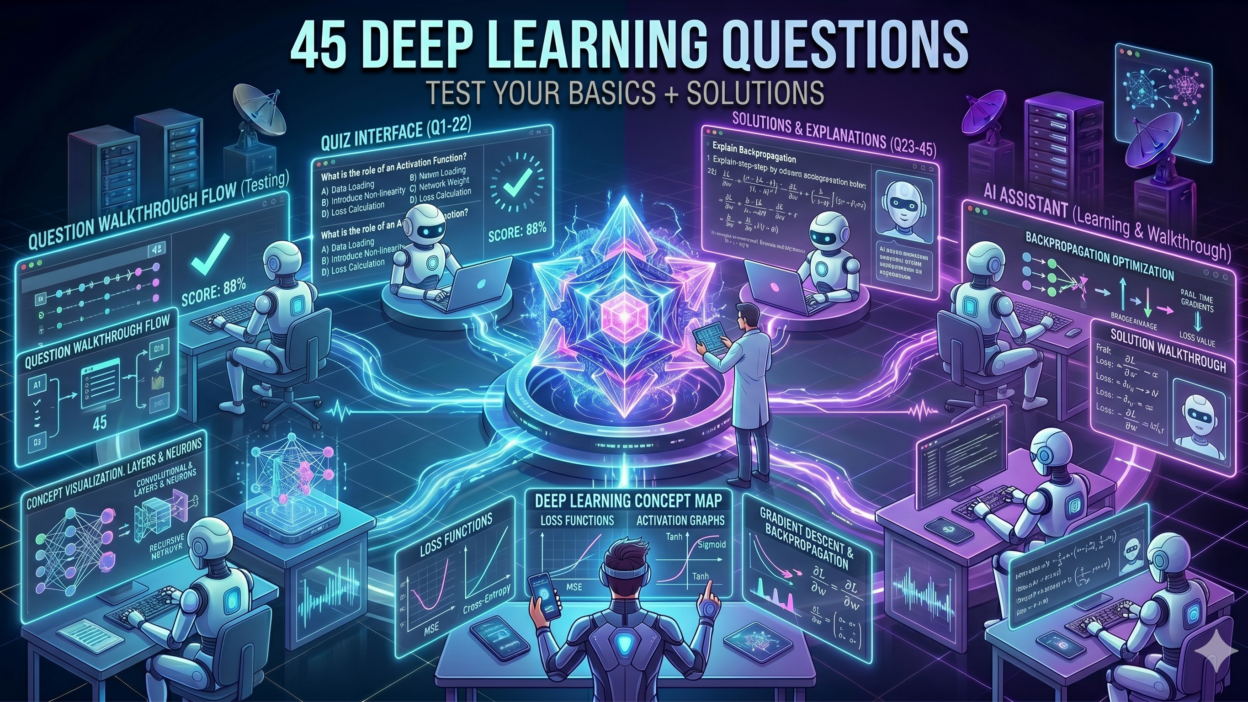
This blog compiles 45 deep learning questions that cover the core building blocks of the field. Each question comes with a clear, accurate solution. The goal is simple. You should walk into any interview feeling confident and prepared.
Deep learning questions test your understanding of neural networks, training dynamics, activation functions, optimization, and model evaluation. Companies expect data scientists to understand both theory and practical application. Reviewing these questions sharpens both skills.
Whether you are preparing for your first job or aiming for a senior role, these deep learning questions build real competence. Work through them honestly. Identify your weak spots. Revisit concepts that feel unclear. That approach produces lasting knowledge.
Fundamentals of Neural Networks
Core Deep Learning Questions Every Data Scientist Must Nail
The first ten deep learning questions focus on neural network fundamentals. These form the bedrock of every advanced concept. Get these right and you demonstrate genuine understanding of the field.
Q1. What is a neural network?
A neural network is a computational model inspired by the human brain. It consists of layers of interconnected nodes called neurons. Each neuron receives inputs, applies a weight, adds a bias, and passes the result through an activation function. The output layer produces the final prediction.
Q2. What is the difference between a shallow and a deep neural network?
A shallow neural network has one hidden layer. A deep neural network has two or more hidden layers. Depth allows the model to learn hierarchical feature representations. Simple patterns combine into complex abstractions across layers.
Q3. What is a perceptron?
A perceptron is the simplest neural unit. It takes multiple inputs, multiplies each by a weight, sums the results, and applies a step activation function. It produces a binary output. The perceptron is the ancestor of all modern neural network architectures.
Q4. What does forward propagation mean?
Forward propagation is the process of passing input data through a network layer by layer. Each layer transforms the input using weights, biases, and activation functions. The final layer produces the model’s prediction. This step runs during both training and inference.
Q5. What is backpropagation?
Backpropagation computes gradients of the loss function with respect to each weight in the network. It applies the chain rule of calculus layer by layer in reverse order. The gradients tell the optimizer how to adjust each weight to reduce loss. It is the core training mechanism of neural networks.
Q6. What is a loss function?
A loss function measures how far the model’s predictions are from the true labels. Mean squared error suits regression tasks. Cross-entropy loss suits classification tasks. The optimizer works to minimize the loss function during training.
Q7. What is gradient descent?
Gradient descent is an optimization algorithm. It updates model weights by moving in the direction opposite to the gradient of the loss function. The step size is controlled by the learning rate. Smaller steps lead to stable but slow convergence. Larger steps risk overshooting the minimum.
Q8. What is the learning rate?
The learning rate controls how much the model weights change after each gradient update. A high learning rate speeds up training but risks instability. A low learning rate trains stably but slowly. Learning rate scheduling adjusts the value during training to get the best of both behaviors.
Q9. What is an epoch?
An epoch is one complete pass through the entire training dataset. After each epoch, the model updates its weights based on the accumulated gradients. Multiple epochs allow the model to refine its weights gradually. The number of epochs is a key hyperparameter in deep learning.
Q10. What is a batch size?
Batch size is the number of training samples the model processes before updating its weights. A batch size of 1 is called stochastic gradient descent. Large batches use more memory but provide stable gradient estimates. Small batches introduce noise but often improve generalization.
Activation Functions
Deep Learning Questions on Non-Linearity and Network Behavior
Activation functions introduce non-linearity into neural networks. Without them, stacking layers would produce only linear transformations. These deep learning questions reveal how well you understand network behavior.
Q11. Why do neural networks need activation functions?
Without activation functions, every layer performs a linear transformation. Stacking linear transformations produces another linear transformation. The network cannot learn complex patterns. Activation functions introduce non-linearity and allow networks to approximate any function.
Q12. What is the sigmoid activation function?
Sigmoid maps any input to a value between 0 and 1. It was the default activation function in early networks. It suffers from the vanishing gradient problem for inputs far from zero. It remains useful in the output layer for binary classification tasks.
Q13. What is the tanh activation function?
Tanh maps inputs to values between -1 and 1. It is zero-centered, which makes optimization easier than sigmoid. It still suffers from vanishing gradients at extreme input values. Networks using tanh often converge faster than those using sigmoid.
Q14. What is the ReLU activation function?
ReLU stands for Rectified Linear Unit. It outputs the input directly if it is positive and zero otherwise. ReLU does not saturate for positive values, so gradients flow well. It is the most widely used activation function in hidden layers of deep networks.
Q15. What is the dying ReLU problem?
Neurons with ReLU can output zero for all inputs if they receive consistently negative pre-activation values. Once a neuron outputs zero, its gradient becomes zero. Weight updates stop flowing through that neuron. It effectively dies and contributes nothing to the network.
Q16. How does Leaky ReLU fix the dying neuron problem?
Leaky ReLU allows a small negative slope for inputs below zero instead of outputting exactly zero. This keeps a nonzero gradient flowing even for negative inputs. Dead neurons become rare. The small slope value is typically set to 0.01.
Q17. What is the softmax function?
Softmax converts a vector of raw scores into a probability distribution. Each output value falls between 0 and 1. All output values sum to 1. Networks use softmax in the output layer for multi-class classification tasks.
Q18. What is the ELU activation function?
ELU stands for Exponential Linear Unit. It outputs the input for positive values and an exponential curve for negative values. It reduces the mean activation closer to zero, which speeds up learning. It handles negative inputs more smoothly than ReLU or Leaky ReLU.
Regularization and Optimization
Deep Learning Questions on Preventing Overfitting and Tuning Models
Regularization and optimization are two of the most practical deep learning questions topics. Knowing these concepts well signals that you can build models that work in production, not just on training data.
Q19. What is overfitting in deep learning?
Overfitting occurs when a model performs well on training data but poorly on new data. The model memorizes noise and specific patterns from training samples. It fails to generalize to unseen inputs. Overfitting becomes more likely as model complexity grows relative to dataset size.
Q20. What is dropout and how does it work?
Dropout randomly deactivates a fraction of neurons during each training step. This prevents neurons from co-adapting too strongly. The network learns multiple redundant representations. At inference time, all neurons are active and their outputs are scaled appropriately.
Q21. What is L1 regularization?
L1 regularization adds the sum of absolute weight values to the loss function. This encourages the model to push small weights toward zero. The result is a sparse model where many weights become exactly zero. L1 regularization effectively performs feature selection during training.
Q22. What is L2 regularization?
L2 regularization adds the sum of squared weight values to the loss function. It penalizes large weights without making them exactly zero. The result is a model with smaller, more evenly distributed weights. L2 regularization is also called weight decay.
Q23. What is batch normalization?
Batch normalization normalizes the outputs of a layer across the current mini-batch. It scales and shifts the normalized values using learned parameters. This stabilizes training, allows higher learning rates, and reduces sensitivity to weight initialization. It also acts as a mild regularizer.
Q24. What is the vanishing gradient problem?
The vanishing gradient problem occurs when gradients shrink to near-zero values during backpropagation. Earlier layers receive very small gradient signals. Their weights update extremely slowly. Deep networks with sigmoid or tanh activations are especially vulnerable. ReLU and batch normalization help mitigate this.
Q25. What is the exploding gradient problem?
Exploding gradients occur when gradients grow exponentially during backpropagation. Large gradients cause unstable weight updates. Training can diverge completely. Gradient clipping limits the maximum gradient norm and prevents this instability.
Q26. What is the Adam optimizer?
Adam combines momentum and adaptive learning rates. It maintains running estimates of both the first and second moments of the gradients. It adjusts each weight’s learning rate individually. Adam converges fast and works well across a wide range of deep learning problems.
Q27. What is momentum in gradient descent?
Momentum adds a fraction of the previous weight update to the current update. This accelerates convergence in consistent gradient directions. It dampens oscillations in directions with noisy or conflicting gradients. Momentum helps the optimizer escape shallow local minima.
Q28. What is early stopping?
Early stopping monitors model performance on a validation set during training. Training halts when validation performance stops improving. This prevents the model from overfitting the training data. It is one of the simplest and most effective regularization techniques in deep learning.
CNN and RNN Architectures
Deep Learning Questions on Specialized Network Types
Architecture knowledge is central to advanced deep learning questions. Interviewers expect you to explain CNNs and RNNs clearly. They also want to know when you would choose one over the other.
Q29. What is a convolutional neural network (CNN)?
A CNN is a neural network designed primarily for grid-structured data like images. It uses convolutional layers to detect local patterns such as edges and textures. Pooling layers reduce spatial dimensions. Fully connected layers at the end produce the final output.
Q30. What does a convolutional layer do?
A convolutional layer applies learnable filters across the input. Each filter slides over the input and computes dot products at each position. This produces a feature map that highlights where the pattern exists in the input. Multiple filters detect multiple patterns simultaneously.
Q31. What is max pooling?
Max pooling selects the maximum value within each pooling window. It reduces the spatial size of feature maps. This cuts computational cost and introduces spatial invariance. Small shifts in the input produce the same pooled output.
Q32. What is a recurrent neural network (RNN)?
An RNN processes sequential data by maintaining a hidden state across time steps. The hidden state carries information from previous inputs. It updates at each time step based on the current input and the previous hidden state. RNNs model dependencies in sequences like text, speech, and time series.
Q33. What is the vanishing gradient problem in RNNs?
Standard RNNs struggle to learn long-range dependencies. Gradients shrink as they travel back through many time steps. Earlier time steps receive negligible gradient signals. The model forgets information from distant past inputs. LSTM and GRU architectures solve this.
Q34. What is an LSTM network?
LSTM stands for Long Short-Term Memory. It uses a gating mechanism with input, forget, and output gates. These gates control what information the network stores, discards, or passes forward. LSTMs capture long-range dependencies that standard RNNs cannot learn reliably.
Q35. What is a GRU?
GRU stands for Gated Recurrent Unit. It simplifies the LSTM architecture using only two gates: the reset gate and the update gate. GRUs train faster than LSTMs because they have fewer parameters. They perform comparably to LSTMs on many sequence tasks.
Q36. What is the attention mechanism?
Attention allows a model to focus on the most relevant parts of the input when generating each output. It computes alignment scores between the query and all input positions. High-scoring positions receive more weight. Attention broke the bottleneck of encoding entire sequences into a fixed-length vector.
Q37. What is a Transformer model?
A Transformer is an architecture built entirely on attention mechanisms without recurrence. It processes all input positions simultaneously using self-attention. This enables massive parallelism during training. Transformers power GPT, BERT, and nearly all state-of-the-art language models in 2026.
Training Dynamics and Evaluation
Deep Learning Questions on Building Reliable Models
The final group of deep learning questions covers training choices and model evaluation. These questions reveal whether you can build a model that actually works. Theoretical knowledge must connect to practical decisions here.
Q38. What is transfer learning?
Transfer learning reuses a model trained on one task as a starting point for a different task. The pretrained model has already learned useful low-level features. Fine-tuning on the new task updates higher-level features. Transfer learning reduces training time and data requirements significantly.
Q39. What is fine-tuning?
Fine-tuning continues training a pretrained model on a new dataset. You typically freeze early layers and train only the later layers at first. Gradual unfreezing can then improve performance further. Fine-tuning adapts general knowledge to a specific domain.
Q40. What is weight initialization and why does it matter?
Weight initialization sets the starting values of model weights before training begins. Poor initialization causes vanishing or exploding gradients immediately. Xavier initialization suits sigmoid and tanh activations. He initialization suits ReLU-based networks. Good initialization leads to faster, more stable training.
Q41. What is data augmentation?
Data augmentation generates additional training samples by applying transformations to existing data. Flipping, rotating, cropping, and adjusting brightness are common image augmentation techniques. Augmentation artificially increases dataset diversity. It reduces overfitting without collecting more data.
Q42. What is the difference between validation loss and training loss?
Training loss measures model error on data used for weight updates. Validation loss measures model error on held-out data not used for training. A growing gap between the two indicates overfitting. Monitoring both losses together guides decisions about model capacity and regularization.
Q43. What is a confusion matrix?
A confusion matrix summarizes classification model performance across all class combinations. Rows represent actual classes. Columns represent predicted classes. True positives, false positives, true negatives, and false negatives are all visible at once. It enables calculation of precision, recall, and F1-score.
Q44. What is the ROC-AUC score?
ROC-AUC measures a classifier’s ability to separate classes across all decision thresholds. An AUC of 1.0 indicates perfect separation. An AUC of 0.5 indicates no better than random guessing. It is especially useful for imbalanced datasets where accuracy alone misleads.
Q45. What is hyperparameter tuning?
Hyperparameter tuning searches for the combination of settings that produces the best model performance. Learning rate, batch size, number of layers, and dropout rate are typical hyperparameters. Grid search, random search, and Bayesian optimization are common tuning strategies. Automated tools like Optuna handle this efficiently in 2026.
Neural Network Interview Questions
Neural network interview questions overlap heavily with deep learning questions. Interviewers test both together. Topics like forward propagation, backpropagation, activation functions, and weight initialization appear in nearly every technical screen. Strong answers show both conceptual clarity and practical awareness.
Deep Learning Interview Preparation Tips
Prepare for deep learning questions by working through code, not just reading theory. Build a small neural network from scratch. Train it on a public dataset. Debug common issues like vanishing gradients or training instability. Hands-on experience makes your answers more concrete and credible.
Machine Learning vs. Deep Learning
Machine learning uses algorithms that rely on manual feature engineering. Deep learning learns features automatically from raw data through multiple layers. Deep learning questions often probe this distinction. You should explain when deep learning outperforms traditional machine learning and when it does not.
Common Mistakes in Deep Learning Interviews
Many candidates memorize definitions without understanding the underlying logic. Interviewers notice this quickly. They ask follow-up questions that require genuine comprehension. Practice explaining deep learning questions to someone with no technical background. Clear explanations reveal deep understanding.
Frequently Asked Questions
How many deep learning questions appear in a data science interview?
The number varies by company and role. Entry-level roles typically include five to ten deep learning questions. Senior roles go deeper, covering architecture choices, training strategies, and debugging methods. Research-focused roles explore theoretical foundations extensively.
What topics do deep learning questions usually cover?
Deep learning questions span neural network basics, activation functions, regularization, optimization, CNN and RNN architectures, training dynamics, and model evaluation. Advanced interviews add topics like attention mechanisms, transformers, and generative models. This blog covers all core topics across its 45 questions.
Do I need to memorize formulas for deep learning interviews?
You should understand key formulas rather than memorize them blindly. Know how backpropagation applies the chain rule. Understand the math behind cross-entropy loss. Recognize why certain activation functions saturate. Conceptual understanding with working knowledge of the math earns more respect than rote memorization.
How should I structure my answers to deep learning questions?
Start with a clear definition. Follow with the core mechanism or intuition. Give a real-world use case or example. Mention limitations if relevant. Keep each answer focused and direct. Interviewers appreciate brevity paired with accuracy. Avoid padding your answer with unnecessary details.
Which deep learning frameworks should I know?
PyTorch dominates research environments in 2026. TensorFlow remains strong in enterprise and production pipelines. Keras provides a high-level interface on top of TensorFlow. JAX is growing in research settings for its functional programming model. Familiarity with at least one framework is essential.
Read More:-Meta Muse Spark Review: Is It Worth the Hype?
Conclusion

These 45 deep learning questions cover every foundational topic a data scientist needs to master. Neural networks, activation functions, regularization, optimization, CNN, RNN, and model evaluation all appear here with clear, accurate solutions.
Deep learning questions test more than memory. They reveal how you think about problems. They show whether you understand the trade-offs in design choices. They expose whether your knowledge connects theory to practice.
Use this blog as a study guide. Work through every question before reading the answer. Write down your own response first. Compare it to the solution provided. Identify gaps in your understanding and fill them with hands-on experimentation.
The field of deep learning moves fast. New architectures, training techniques, and tools emerge every year. But the fundamentals stay constant. Backpropagation, gradient descent, activation functions, and regularization remain essential regardless of what tools dominate in any given year.
Mastering these deep learning questions gives you a durable advantage. It makes you a stronger candidate, a better practitioner, and a more confident collaborator on AI projects. Study consistently. Build projects. Revisit these questions regularly. That process builds the kind of expertise that lasts.