Introduction
TL;DR Creatio built a strong name as a low-code CRM and BPM suite. It bundles sales, marketing, and service tools with a workflow engine that lets a team build custom apps without heavy coding. That flexibility comes at a cost though. Some teams find the platform overkill for a simple sales pipeline. Others want a faster setup or a lighter price tag. This guide walks through the best Creatio alternatives available right now. It covers what each tool does well. It covers who each tool actually fits. By the end, you will have a clear shortlist of Creatio alternatives worth a real trial run.
Table of Contents
Why Teams Look for Creatio Alternatives
Creatio serves mid market and enterprise teams that want deep process automation baked into a CRM. That strength turns into a weakness for a small sales team that just wants contact management and a clean pipeline view. A workflow engine built for complex approval chains feels heavy when your actual use case stays simple.
Pricing structure raises questions too. Creatio splits its offering into separate products for sales, marketing, and service, and costs stack up fast once a team adds more than one module. Implementation time adds to the concern, since a platform built around custom workflows usually needs a longer setup phase than a plug and play CRM.
Some teams also want a sharper focus instead of a broad platform. A team obsessed with email marketing wants deep campaign tools first. A team living inside customer support wants ticketing and SLAs above anything else. These gaps push buyers to start comparing Creatio alternatives early in a renewal cycle or a fresh CRM search.
What to Check Before You Pick From the Creatio Alternatives List
A feature checklist rarely tells the full story on its own. A few practical checks matter more once you start narrowing down Creatio alternatives for your own team.
Core CRM Depth
Confirm the tool covers contact management, pipeline tracking, and reporting well before anything else. A flashy AI feature means little if the basic pipeline view feels clunky day to day.
Low-Code and Automation Needs
Some teams need Creatio’s level of custom workflow building. Others just want simple automation like a follow up reminder or a lead assignment rule. Match this need against your actual process complexity before you commit to any option on this Creatio alternatives shortlist.
Pricing Transparency
Some platforms publish clear per user pricing. Others push every buyer toward a custom quote. Ask for full pricing details early, since a demo call rarely reveals hidden costs for add on modules or extra contacts.
Support and Onboarding
A larger platform often ships with a dedicated implementation team. A smaller platform may lean on self serve guides and community forums instead. Decide how much hands on help your team actually needs before signing anything.
The 7 Best Creatio Alternatives
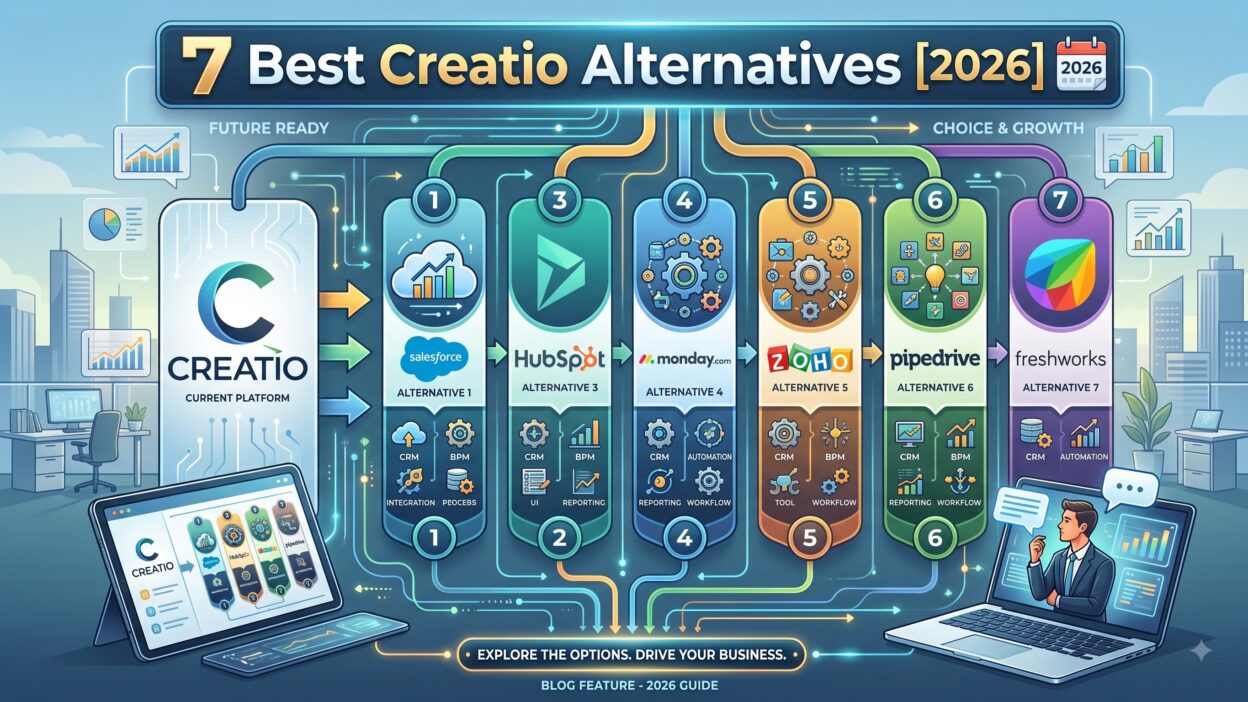
Here is the full list of Creatio alternatives worth a serious look this year.
1. Salesforce
Salesforce remains the largest name in CRM, and it competes with Creatio directly at the enterprise level. The platform covers sales, service, marketing, and analytics inside one connected ecosystem, backed by a massive app marketplace called AppExchange.
Customization runs deep here too, much like Creatio’s own low-code approach, though Salesforce leans more on its own proprietary language for advanced builds. Teams switching from Creatio often pick Salesforce when they need the widest possible integration options and the largest talent pool of certified admins and developers.
Cost sits on the higher end once a team adds premium modules like Marketing Cloud or Service Cloud. Implementation usually needs a certified partner for anything beyond a basic setup, and that adds real time and budget on top of the license fee.
2. HubSpot CRM
HubSpot CRM built its reputation on ease of use, and it draws a lot of interest from teams that find Creatio’s workflow engine more complex than they need. The free tier alone gives a small team real CRM functionality, and paid tiers add marketing automation, service tools, and reporting as a business grows.
Onboarding stays fast compared to most enterprise platforms. A new user can usually build a pipeline and send a tracked email within the first day. Teams that want strong inbound marketing tools paired with a clean, intuitive interface tend to prefer HubSpot CRM among current Creatio alternatives.
The tradeoff shows up once a business needs deep custom process automation. HubSpot’s workflow tools stay solid for standard marketing and sales sequences, but they rarely match the depth Creatio built specifically around BPM.
3. Zoho CRM
Zoho CRM earns steady praise for value, packing a wide feature set into a price point well below most enterprise competitors. The platform covers sales automation, basic marketing tools, and an AI assistant called Zia, all inside the broader Zoho software suite.
Small and mid size businesses find Zoho CRM one of the more budget friendly Creatio alternatives during a renewal cycle. The interface takes a short learning curve, and most teams get comfortable within the first couple of weeks.
Zoho’s low-code tools have grown over recent years, though they still trail Creatio’s dedicated BPM engine for truly complex approval chains and multi department workflows. A team with straightforward automation needs rarely notices the gap in daily use.
4. Microsoft Dynamics 365
Microsoft Dynamics 365 fits organizations already running deep inside the Microsoft ecosystem. A company using Office 365, Teams, and Azure gains a natural data connection once Dynamics 365 joins the stack, cutting down on integration work other tools still need.
The platform covers sales, customer service, field service, and finance modules, giving it a scope similar to Creatio’s own broad suite. Reporting through Power BI stands out as a real strength, letting teams build detailed dashboards without a separate analytics tool.
Setup complexity runs high though, and most enterprise deployments need a certified implementation partner. Among current Creatio alternatives, this one suits a company that already lives inside Microsoft’s broader software world.
5. Pipedrive
Pipedrive keeps its focus narrow and clear: a visual sales pipeline built for a sales team that wants speed over sprawling features. The kanban style deal view stays intuitive, and most reps pick up the tool within a single onboarding session.
Automation exists here too, though it stays lighter than Creatio’s BPM engine by design. A sales manager can set simple triggers like task reminders or stage based email sends without touching a single line of code.
Teams that find Creatio’s full suite too heavy for a pure sales use case often land on Pipedrive among these Creatio alternatives. Pricing stays transparent and predictable, which helps smaller teams budget with confidence before ever booking a sales call.
6. Freshworks CRM
Freshworks CRM, known also as Freshsales, blends sales and marketing tools inside one approachable platform. AI powered lead scoring helps a sales team prioritize the right contacts first, while built-in phone and email tools keep outreach inside a single dashboard.
Support quality earns consistent praise across reviews, with responsive live chat and a solid help center backing every plan tier. Teams already using other Freshworks products like Freshdesk find a natural fit here too, since data flows cleanly across the wider suite.
Deep custom workflow building still trails Creatio’s dedicated BPM tools, though most small and mid size teams rarely push past what Freshworks already offers out of the box.
7. Monday.com CRM
Monday.com CRM grew out of a broader work management platform, and that heritage shows in its highly visual, flexible interface. Teams that already run projects on Monday.com find the CRM module a natural extension, since data and workflows connect across both tools without extra setup.
Customization stays approachable even for a non technical user, with drag and drop boards replacing the need for deep coding knowledge. Teams that want lightweight automation paired with strong visual project tracking often choose Monday.com CRM among current Creatio alternatives.
The platform still trails Creatio in dedicated CRM depth, particularly around advanced sales forecasting and complex service management. A team that values flexibility and visual clarity over deep vertical CRM features tends to find the tradeoff worthwhile.
Integrations and Ecosystem Fit
A CRM rarely works alone inside a modern tech stack. Most teams already run an email tool, a support desk, and an accounting system before they even start evaluating Creatio alternatives. Salesforce wins here through sheer scale, since its AppExchange marketplace covers thousands of prebuilt connectors for nearly any tool a business already runs.
Microsoft Dynamics 365 naturally connects best for any team already inside the Microsoft ecosystem, syncing cleanly with Outlook, Teams, and Power BI without a third party bridge. HubSpot CRM and Zoho CRM both maintain wide integration marketplaces of their own, covering common tools like Slack, Mailchimp, and QuickBooks. Freshworks CRM connects tightly across its own product family, which matters most for a team already running Freshdesk or Freshchat. Check your current stack against each vendor’s integration list before signing, since a missing connector can turn into months of custom engineering work later.
Industry Fit Across These Tools
Not every CRM suits every industry equally well. Salesforce and Microsoft Dynamics 365 both offer dedicated industry clouds for sectors like financial services, healthcare, and manufacturing, giving large enterprises prebuilt compliance and workflow templates out of the box. This depth mirrors Creatio’s own strong presence in regulated, process heavy industries like banking and insurance.
HubSpot CRM and Pipedrive both lean toward general business use, fitting a wide range of industries without heavy vertical specialization. Zoho CRM covers a similarly broad range, though its lower cost makes it a common pick for retail, education, and professional services firms watching budget closely. Monday.com CRM tends to shine in agencies and project driven businesses, where visual boards map naturally onto client work and deliverables.
Onboarding and Support Experience Across These Tools
Time to first working pipeline varies more than most buyers expect. HubSpot CRM and Pipedrive both tend to get a new team live within a single day, since both platforms lean on clean interfaces and guided setup wizards. Zoho CRM and Freshworks CRM usually take a few days longer, mostly due to the extra configuration behind their broader feature sets.
Salesforce and Microsoft Dynamics 365 both ask for a longer runway, often several weeks or more, especially once a team wants full use of custom objects and advanced automation. A certified implementation partner sometimes speeds this up, though that also adds cost on top of the license fee. Ongoing support quality stays strong across most of these vendors, though smaller teams should confirm whether a dedicated account manager comes with the plan or whether support runs through a shared ticket queue instead.
Security and Compliance Considerations
Enterprise buyers usually raise data residency and compliance questions early in a vendor conversation. Most platforms on this list, including Salesforce, Microsoft Dynamics 365, and Zoho CRM, hold standard certifications like SOC 2 and GDPR compliance documentation ready for review. A smaller vendor may still meet these same standards, though the paperwork sometimes takes longer to produce during due diligence.
A regulated industry like banking or healthcare should request a full compliance packet before any contract discussion goes further. This step matters just as much as feature comparison during a vendor search, since a compliance gap can block a deployment entirely regardless of how strong the product looks in a demo.
How These Creatio Alternatives Compare on Price
Pricing transparency varies widely across this list. HubSpot CRM, Zoho CRM, Pipedrive, and Monday.com CRM all publish clear per user pricing, which helps a smaller team budget before booking a single sales call. Salesforce and Microsoft Dynamics 365 both lean toward custom enterprise quotes once add on modules enter the picture, much like Creatio’s own composable pricing model.
Freshworks CRM sits in the middle, with published starting prices that still scale up once a team adds premium AI or automation features. A buyer comparing Creatio alternatives on cost alone should still request a real quote from each shortlisted vendor, since published numbers rarely capture the full contract value at scale.
Which Creatio Alternative Fits Which Team
A large enterprise needing deep customization and a huge app ecosystem fits well with Salesforce. A small team that wants fast setup and strong inbound marketing fits HubSpot CRM best. A budget conscious business chasing solid core features fits Zoho CRM well.
A company already anchored inside Microsoft’s software world fits Dynamics 365 naturally, despite the setup complexity. A pure sales team that wants visual simplicity fits Pipedrive nicely. A team craving AI lead scoring alongside marketing tools fits Freshworks CRM well, while a team that lives inside project boards fits Monday.com CRM among these options.
Common Mistakes When Switching Away From Creatio
Teams often choose a new platform based on a polished demo instead of daily fit. A workflow feature that looks impressive during a sales pitch can sit unused months later if it does not match how your team actually operates.
Skipping a data migration plan causes real trouble too. Contact records, deal history, and custom workflow logic all need a clear path into the new platform. A rushed migration often loses process detail that took years to refine inside Creatio.
Ignoring team training ranks as another common misstep. Even the simplest tools on this list still need a short onboarding period. A team that skips training tends to underuse the new platform for months after the switch.
A Practical Migration Checklist
Switching CRMs works better with a plan written down before the first login. Start by exporting every contact record, deal stage, and custom field definition from Creatio. Most vendors on this list accept a CSV import for standard fields, though custom workflow logic often needs manual rebuilding.
Pause low priority automations for the first two weeks after migration instead of moving everything at once. Move your highest value sales pipeline first, watch it closely, then bring over marketing and service workflows once the new setup proves stable. This staged approach catches a broken field mapping or a missing automation trigger before it disrupts a live deal cycle.
Keep both platforms running in parallel for at least one full billing cycle if your contract allows it. This overlap period gives your team a safety net and gives you real comparison data on adoption and deal velocity between the old and new system.
Train your team on the new interface before the old one goes dark. A short internal walkthrough, even thirty minutes, saves hours of confused questions during the first live sales cycle on new software.
Real World Signals Worth Watching
Reviews on sites like G2 and Gartner Peer Insights offer a useful gut check beyond a vendor’s own marketing page. Look specifically for comments about implementation time, since a long, costly rollout can eat into the savings a cheaper license promised upfront. Look for comments about hidden fees too, since extra costs for storage, contacts, or premium support show up often in verified reviews even when a sales call never mentioned them.
Case studies published by each vendor carry useful detail, though they naturally lean toward best case outcomes. Weigh a glowing case study against a handful of neutral or critical reviews from a similar company size and industry before trusting the numbers fully. A brand your size, running a similar sales process, tells you far more than a headline metric from a much larger enterprise customer.
FAQs About Creatio Alternatives
What is the closest alternative to Creatio?
Salesforce and Microsoft Dynamics 365 come up most often as the closest match in scope and customization depth. Both cover broad CRM functionality alongside deep workflow automation, much like Creatio itself.
Are any Creatio alternatives cheaper?
Zoho CRM and Pipedrive generally land on the lower end of the pricing spectrum compared to Creatio’s composable module pricing. Exact cost still depends on user count and feature tier, so a direct quote remains the safest way to compare.
Which alternative works best for a small team?
HubSpot CRM and Pipedrive both suit a small or growth stage team well, since setup stays fast and neither platform demands a heavy enterprise learning curve. A small sales team can usually launch a working pipeline within the first day.
Does any alternative match Creatio’s low-code workflow engine?
Salesforce and Microsoft Dynamics 365 both offer serious low-code and custom development tools, though each leans on its own proprietary approach rather than Creatio’s specific BPM framework. Zoho CRM has expanded its automation tools too, though it still trails these two for the most complex approval chains.
Is Salesforce harder to set up than Creatio?
Salesforce often needs a certified implementation partner for anything beyond a basic configuration, and that process tends to run longer than a typical Creatio rollout. Teams with in house Salesforce admins or a strong partner relationship get the most value from that flexibility.
Should I replace Creatio entirely or add a point solution?
Some teams replace the whole platform when it overshoots daily needs. Others keep Creatio for core process automation and add a smaller tool for one specific function like marketing or support. Answering this question first narrows the right choice among Creatio alternatives fast.
How long does a typical migration away from Creatio take?
A simple sales-only migration to a tool like Pipedrive or HubSpot CRM often finishes within a few weeks. A full enterprise rollout to Salesforce or Microsoft Dynamics 365, especially one involving custom workflow logic, can take a few months once data migration and staff training both factor in.
Read More:-Relationship Intelligence Data: The Complete Guide for Revenue Teams
Conclusion

The right pick among these Creatio alternatives depends on your process complexity, your budget, and how much customization your team truly needs day to day. Salesforce and Microsoft Dynamics 365 suit large enterprises chasing deep customization and broad ecosystems. HubSpot CRM and Pipedrive suit smaller teams wanting fast setup and clean simplicity. Zoho CRM suits budget conscious buyers, while Freshworks CRM and Monday.com CRM suit teams craving AI powered outreach or visual project style CRM work. Book a real trial with two or three names from this list before you commit, and let your actual daily workflow decide the winner.