Introduction
TL;DR Generic marketing does not work anymore. Buyers ignore messages that do not speak to their specific situation. They delete cold emails that could have been sent to anyone. They skip ads that feel irrelevant to their world.
Audience segmentation solves this problem at the root. It breaks your market into distinct groups with shared characteristics. It lets you craft messages that feel personal, relevant, and timely to each group.
B2B marketers who segment well consistently outperform those who do not. They generate higher quality leads. They close deals faster. They spend less on campaigns that miss the mark. Their messaging lands because it matches the exact reality of the buyer reading it.
This guide walks you through every dimension of audience segmentation for B2B marketing. It covers firmographic, behavioral, psychographic, and technographic segmentation. It shows you how to build segments, activate them across channels, and measure their impact on pipeline and revenue.
Whether you run a small marketing team or manage a full enterprise operation, this guide gives you a practical framework to segment smarter and market more effectively. Every section gives you something you can act on right away.
Table of Contents
What Is Audience Segmentation and Why Does It Matter in B2B
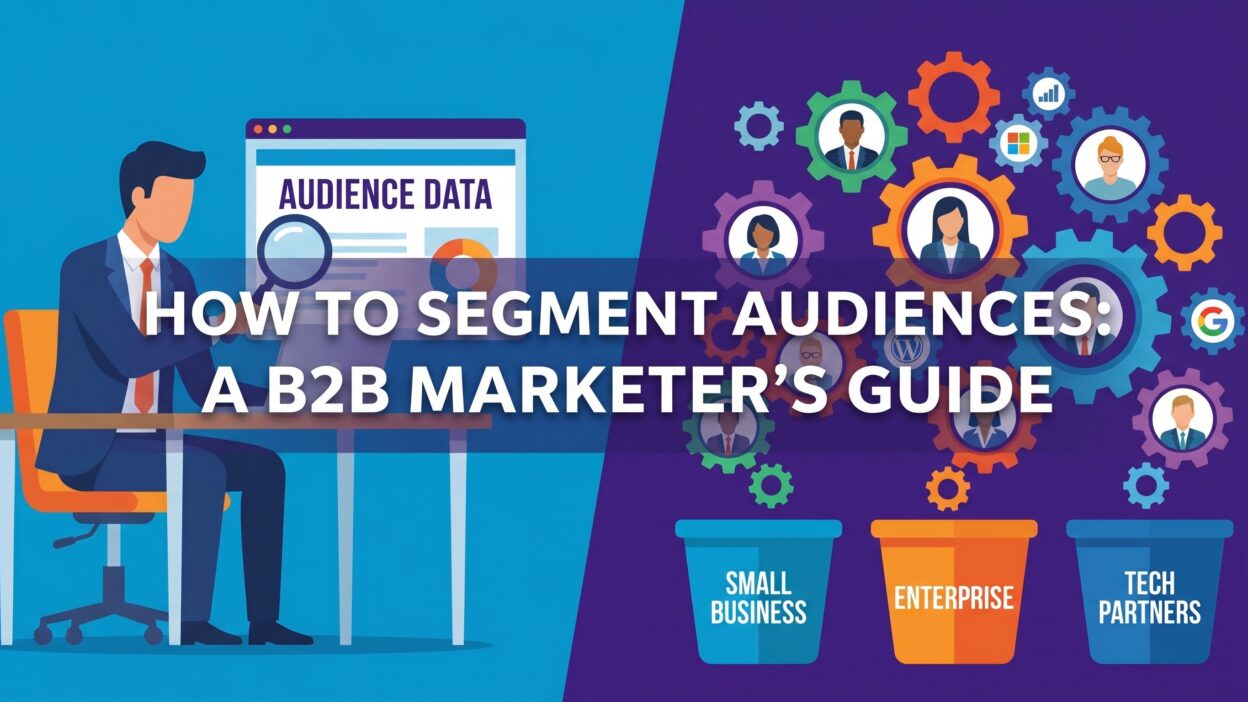
Audience segmentation is the process of dividing your total addressable market into groups of companies or contacts that share meaningful characteristics. Each group gets messaging, content, and campaigns tailored to its specific context.
In B2B marketing, this matters enormously. Enterprise companies buy differently from SMBs. Finance teams have different concerns than engineering teams. A company in a regulated industry faces different pressures than one in an unregulated market. Audience segmentation lets you speak to each of these realities with precision.
Without segmentation, your marketing is a generalization. It might be accurate for some buyers and completely wrong for others. The result is a muddled message that resonates with nobody strongly enough to take action.
With strong audience segmentation, every campaign speaks directly to a defined group. The copy addresses their specific pain points. The offer matches their buying stage. The channel reaches them where they actually spend their attention. Relevance at this level produces dramatically better results.
The Business Case for Audience Segmentation
Research from McKinsey shows that companies with strong personalization capabilities generate 40 percent more revenue from their marketing than companies without them. Segmentation is the foundation of personalization. You cannot personalize without first knowing who you are personalizing for.
Segmentation also reduces wasted spend. Campaigns targeted at precisely defined segments convert at higher rates. Cost per acquisition drops. Budget stretches further. Every dollar of marketing spend produces more measurable output.
The companies that invest in rigorous audience segmentation consistently build stronger pipelines, shorter sales cycles, and higher customer lifetime value. The returns compound over time as segment data improves and campaign execution gets sharper.
The Four Core Types of B2B Audience Segmentation
B2B audience segmentation draws from four primary data dimensions. Each dimension tells you something different about your buyer. The strongest segmentation strategies combine multiple dimensions to create rich, actionable segments.
Firmographic Segmentation
Firmographic segmentation divides your market by company-level attributes. Industry vertical, company size, annual revenue, geographic location, ownership structure, and growth stage are the most common firmographic variables.
This is the starting point for most B2B audience segmentation programs. A company selling compliance software targets regulated industries differently from unregulated ones. A company selling enterprise infrastructure speaks differently to a 5,000-person company than to a 50-person startup.
Firmographic data is widely available through tools like ZoomInfo, Clearbit, and LinkedIn. It is relatively stable over time and easy to append to existing CRM records. Build your foundational segments on firmographic criteria first, then layer in additional dimensions.
Behavioral Segmentation
Behavioral segmentation groups contacts based on their actions. Website visits, content downloads, email clicks, webinar attendance, product usage patterns, and purchase history all qualify as behavioral signals.
Behavioral audience segmentation reveals intent. A contact who visits your pricing page three times in a week is behaving very differently from one who downloaded a top-of-funnel ebook six months ago. These two contacts need completely different messages.
Behavioral data lives in your marketing automation platform, CRM, and website analytics. Map behaviors to buying stages. Use behavior-based segments to trigger timely outreach and relevant content recommendations.
Psychographic Segmentation
Psychographic segmentation groups buyers by attitudes, values, priorities, and decision-making styles. Risk tolerance, innovation appetite, vendor selection criteria, and organizational culture all fall into this category.
This dimension of audience segmentation requires qualitative research. Customer interviews, win-loss analysis, and survey data surface psychographic patterns that quantitative data misses. A buyer who prioritizes vendor stability needs different messaging than one who prioritizes cutting-edge features.
Psychographic segments inform tone, proof points, and objection handling. Conservative buyers want case studies from established companies. Bold buyers want innovation narratives. Matching your tone to your audience’s psychology lifts conversion rates significantly.
Technographic Segmentation
Technographic segmentation divides your market by the technology tools and platforms each company uses. A company running Salesforce as its CRM has different integration needs than one running Microsoft Dynamics. A company on AWS has different infrastructure preferences than one on Azure.
Technographic data is available through providers like BuiltWith, HG Insights, and Bombora. It is especially valuable for technology companies whose solutions integrate with or compete against specific platforms.
Technographic audience segmentation enables highly specific messaging. Instead of a generic product pitch, you can say exactly how your solution works with the stack your prospect already uses. That specificity shortens sales cycles and increases conversion rates.
How to Build Your First B2B Audience Segmentation Model
Building a segmentation model from scratch can feel overwhelming. Break it into clear phases. Each phase builds on the one before it. The result is a structured, actionable framework your entire marketing team can use.
Start With Your Best Customers
Pull a list of your top 20 customers by revenue, retention, and lifetime value. Study what they have in common. Look at their industry, company size, tech stack, buying timeline, key stakeholders, and the pain point that drove the original purchase.
This analysis reveals your natural segment clusters. You will likely find two or three distinct profiles among your best customers. These profiles become the foundation of your audience segmentation model.
Do not rely on internal assumptions alone. Talk to customers directly. Ask them how they describe their problem before they found you. Ask why they chose you over competitors. Their language and priorities reveal psychographic patterns your data cannot.
Define Segment Criteria
For each segment, document the specific criteria that define membership. Include both firmographic thresholds and behavioral or psychographic characteristics. A segment definition should be specific enough that any team member can classify a new account correctly.
Give each segment a name that reflects its identity, not just its attributes. A name like Enterprise CFO-Led Buyers is more actionable than Segment B. Names help marketing and sales teams internalize the segments and apply them consistently in their work.
Map Content and Messaging to Each Segment
Each segment needs its own messaging framework. Define the core pain point, the primary value proposition, the key proof points, and the main objections for each one. This mapping drives every piece of content, every campaign brief, and every sales conversation guide your team creates.
A segment without a distinct messaging framework collapses into generic marketing. The work of audience segmentation only delivers value when it produces genuinely differentiated communication for each group.
Validate and Refine
Run campaigns against your initial segments. Measure engagement, conversion, and pipeline by segment. Refine your criteria based on what you learn. Segments that perform well deserve more investment. Segments that underperform need diagnostic attention — either the segment definition is wrong or the messaging needs work.
Audience segmentation is not a one-time project. Revisit and refine your segments quarterly. Markets shift. Buyer priorities change. Your product evolves. Your segments must evolve with them.
Audience Segmentation for Email Marketing in B2B
Email remains one of the highest-ROI channels in B2B marketing. Audience segmentation makes it dramatically more effective. Segmented email campaigns generate 760 percent more revenue than non-segmented ones, according to Campaign Monitor research.
The key is matching email content to segment-specific interests and buying stages. A first-touch nurture email for a mid-market IT buyer reads nothing like a renewal email for an enterprise CFO. Audience segmentation makes that distinction automatic and scalable.
Segmenting by Buying Stage
Map your email content to the buying journey for each segment. Awareness-stage contacts need educational content that frames the problem your solution solves. Consideration-stage contacts need comparison content, case studies, and proof of ROI. Decision-stage contacts need risk reduction content, implementation detail, and social proof from similar companies.
Behavioral triggers should move contacts between stages automatically. A contact who downloads a pricing guide moves from awareness to consideration. A contact who requests a demo moves from consideration to decision. Your email sequences adjust accordingly.
Segmenting by Role and Function
A CFO and a CTO at the same company read the same email very differently. CFOs care about cost, risk, and financial return. CTOs care about technical quality, security, and integration complexity. Marketing leaders care about pipeline impact and brand outcomes.
Build role-specific email tracks for each of your primary buyer personas within each segment. This level of audience segmentation requires more content, but the conversion lift justifies the investment decisively.
Suppression Segments
Segmentation is not only about who to include. It is also about who to exclude. Suppression segments prevent emails from reaching current customers, recent churned accounts, active deal prospects already in sales conversations, and contacts who unsubscribed from specific content types. Clean suppression logic keeps your sender reputation strong and your list healthy.
Audience Segmentation for Paid Media and ABM Campaigns
Paid media without audience segmentation burns budget. LinkedIn, Google, and programmatic display platforms all support sophisticated segmentation. The marketers who use these capabilities outperform those who run broad campaigns by a wide margin.
LinkedIn Audience Segmentation
LinkedIn offers the most powerful B2B audience segmentation in paid media. You can target by company size, industry, job function, seniority, skills, and company name. You can upload a matched audience list from your CRM. You can retarget website visitors from specific companies.
Layer your segmentation criteria to build tight audiences. A campaign targeting VP-level Finance leaders at manufacturing companies with 500 to 5,000 employees reaches a very specific slice of your market. That specificity produces higher relevance scores and better cost-per-lead outcomes.
Programmatic and Intent-Based Segmentation
Programmatic ad platforms let you target accounts showing intent signals around specific topics. Pair intent data from Bombora with your firmographic segment criteria to build audiences of companies that match your ICP and are actively researching relevant solutions.
This combination of audience segmentation variables means your ads reach the right companies at the right moment in their buying journey. The timing advantage alone significantly improves click-through and conversion rates.
Website Personalization by Segment
Tools like Mutiny and Clearbit Reveal identify which company a website visitor belongs to. You can then serve segment-specific content — industry-specific headlines, relevant case studies, tailored CTAs — to each visitor based on their segment.
Website personalization driven by audience segmentation data lifts conversion rates on your highest-traffic pages. It makes your website feel like a custom experience rather than a generic product brochure, which increases engagement and demo requests from target accounts.
How Sales Teams Use Audience Segmentation Data
Audience segmentation is not only a marketing tool. Sales teams that understand and act on segmentation data have sharper conversations and close deals faster.
When a rep knows a prospect belongs to a specific segment, they understand the prospect’s likely pain points, buying priorities, and decision-making process before the first call. They can open with relevant questions rather than generic discovery. They can lead with proof points from similar companies rather than hoping the prospect connects the dots.
Share your segment definitions, messaging frameworks, and content maps with your sales team. Build segment-specific call scripts and objection handling guides. Give reps a reference card for each major segment that covers the top pain points, key value propositions, common objections, and recommended proof points.
The best B2B marketing teams run regular sessions with sales to review segment performance. They share which segments are converting fastest, which content pieces are driving the most engagement, and which objections are appearing most often. This feedback loop keeps both teams aligned and continuously improving their approach to audience segmentation.
Tools That Power B2B Audience Segmentation
The right tools make audience segmentation scalable and accurate. The wrong tools create complexity without clarity. Build your segmentation tech stack in layers — start with what you have, add where you have clear gaps.
CRM as the Segmentation Foundation
Your CRM is the master record for every contact and account. Salesforce, HubSpot, and Microsoft Dynamics all support custom properties, segment tags, and list-based segmentation. Build your segment definitions directly into the CRM so every team member works from the same classification system.
Keep your CRM data clean. Audience segmentation is only as good as the data underlying it. Invest in data hygiene, enrichment, and deduplication before building complex segments on top of a dirty database.
Marketing Automation for Behavioral Segmentation
Marketo, HubSpot Marketing Hub, and Pardot track behavioral signals and trigger segment assignments automatically. A contact who downloads a specific piece of content gets tagged with the relevant segment. A contact who reaches a certain engagement score moves to a different nurture track.
Automation removes the manual effort from behavioral audience segmentation. Segments update in real time as contacts take action. Your campaigns respond automatically without requiring a human to reclassify every record.
Data Enrichment for Firmographic and Technographic Segmentation
ZoomInfo, Clearbit, and Apollo.io append firmographic and technographic data to your CRM records automatically. BuiltWith and HG Insights provide deep technographic intelligence. Bombora surfaces intent signals by company and topic.
Enrichment tools keep your segmentation data current without manual effort. They catch job changes, company rebrands, tech stack shifts, and growth signals that affect segment classification. Schedule enrichment runs quarterly at minimum.
Analytics for Segment Performance
Google Analytics 4, Tableau, and Looker let you measure campaign performance by segment. Build dashboards that show engagement, pipeline contribution, win rate, and deal size broken down by segment. These views reveal which audience segmentation strategies are producing revenue and which need refinement.
Common Audience Segmentation Mistakes B2B Marketers Make
Most B2B marketers know segmentation matters. Far fewer execute it consistently well. The same mistakes appear repeatedly across companies of every size and industry.
The most common mistake is creating too many segments. When every segment is unique, none of them gets sufficient attention. Content production falls behind. Campaigns get shallow. The segmentation collapses into a list of labels nobody uses in practice. Start with three to five segments. Add more only when you have the resources to support them fully.
The second mistake is building segments on assumptions rather than data. Internal opinions about what customers care about are often wrong. Customer interviews, CRM data, and behavioral analytics surface the real patterns. Build your audience segmentation on evidence.
The third mistake is failing to activate segments across every channel. Segmentation data sitting in your CRM does nothing if your paid media team runs broad campaigns and your sales reps ignore the segment tags. Segmentation produces value only when every channel and every team member uses it consistently.
The fourth mistake is treating audience segmentation as a static exercise. A segment built in January may not reflect market reality by July. Review your segments quarterly. Kill segments that no longer perform. Create new ones as your market evolves and your data improves.
Measuring the Impact of Audience Segmentation on B2B Revenue
Every audience segmentation investment needs a measurable return. Build a clear measurement framework before launching your first segmented campaign so you can track impact from day one.
Measure engagement rate by segment. Email open rates, click-through rates, content download rates, and website session depth all tell you how well your messaging resonates with each segment. A segment with consistently low engagement signals a mismatch between your message and the audience’s actual priorities.
Track pipeline contribution by segment. Which segments generate the most qualified opportunities? Which convert from MQL to SQL at the highest rate? Which produce the largest average deal size? These metrics reveal where your audience segmentation model creates real revenue impact.
Measure win rate by segment. A high win rate in one segment and a low win rate in another tells you something important. Either you serve one segment better than the other, or your segmentation criteria for the underperforming group need refinement.
Calculate customer lifetime value by segment. The segments that produce the largest, most loyal customers deserve the most marketing investment. LTV by segment is the most important metric for long-term audience segmentation strategy decisions. Report it to leadership quarterly alongside pipeline and win rate data.
Frequently Asked Questions About Audience Segmentation
What is audience segmentation in B2B marketing?
Audience segmentation in B2B marketing is the process of dividing your total market into distinct groups based on shared characteristics. These characteristics include company size, industry, behavior, technology usage, and buying priorities. Each segment receives tailored messaging and campaigns designed to match its specific context and needs. Segmentation improves relevance, lifts conversion rates, and reduces wasted marketing spend.
What are the main types of audience segmentation?
The four core types of audience segmentation in B2B are firmographic, behavioral, psychographic, and technographic. Firmographic segmentation uses company attributes like size and industry. Behavioral segmentation uses actions like website visits and content downloads. Psychographic segmentation uses attitudes and decision-making styles. Technographic segmentation uses the tools and platforms a company runs. The strongest B2B segments combine multiple dimensions.
How many segments should a B2B marketing team manage?
Start with three to five well-defined segments. This number allows meaningful personalization without overwhelming your content and campaign production capacity. Add new segments only when you have the data to justify them and the resources to support them fully. Depth of execution within each segment matters far more than the total number of segments you define.
How does audience segmentation improve email marketing performance?
Audience segmentation improves email performance by matching content to the specific interests, buying stage, and role of each recipient. Segmented campaigns deliver higher open rates, click-through rates, and conversion rates than non-segmented sends. Behavioral triggers automatically move contacts into the right segment track based on their actions, keeping your nurture sequences relevant without manual intervention.
What tools are best for B2B audience segmentation?
The best tools for B2B audience segmentation include Salesforce or HubSpot for CRM-based segmentation, Marketo or HubSpot Marketing Hub for behavioral segmentation, ZoomInfo or Clearbit for firmographic and technographic enrichment, Bombora for intent-based segmentation, and LinkedIn Campaign Manager for paid media segmentation. Build your stack progressively based on where you have the biggest data gaps.
How often should I update my audience segments?
Review your audience segments quarterly. Check that segment criteria still reflect current market reality. Update firmographic thresholds as your ICP evolves. Revise behavioral triggers as your product and buyer journey change. Kill segments that no longer perform. Add segments when new customer clusters emerge in your data. Audience segmentation is a living system that improves with continuous attention and refinement.
Read More:-Crucial Marketing KPIs Your Team Needs To Track in 2026
Conclusion

Generic marketing is invisible. Relevant marketing drives revenue. The difference between the two is audience segmentation.
B2B buyers have high expectations. They want content that speaks their language. They want offers that match their buying stage. They want proof from companies that look like theirs. Audience segmentation gives you the structure to deliver all of this at scale — across email, paid media, your website, and every sales conversation.
Start with what you know. Pull your best customers. Find the patterns. Define three to five clear segments with specific criteria and distinct messaging. Map content to each segment. Activate across every channel. Measure the impact on engagement, pipeline, and revenue.
Keep refining. Markets change. Buyers evolve. Your data improves over time. Your audience segmentation model should get sharper every quarter as you learn what resonates and what falls flat.
The B2B marketers who build strong audience segmentation capabilities consistently outperform those who rely on broad messaging. They spend less to generate more. They win more deals. They retain customers longer. They have sharper conversations at every stage of the funnel.
Commit to rigorous audience segmentation. The market rewards relevance. Make every message count.