Introduction
TL;DR Customer loyalty used to be simple. A good product at a fair price kept people coming back. A friendly face at the counter made them feel valued. Word spread through neighborhoods. Repeat business followed naturally.
That world no longer exists. Customers today have unlimited choices. Every competitor is one click away. Switching costs are nearly zero. Brand loyalty erodes faster than most companies realize. Keeping a customer requires something far more sophisticated than a discount card or a birthday email AI hyper-personalization for customer loyalty has emerged as the defining capability separating growing brands from stagnating ones. Companies that know their customers deeply — their preferences, behaviors, timing, and emotional triggers — retain them at dramatically higher rates. AI makes that depth of knowledge achievable at scale.
This blog explains how AI hyper-personalization works, why it drives loyalty so powerfully, and how brands can implement it effectively across every customer touchpoint.
What Is AI Hyper-Personalization and Why Does It Matter?
Moving Beyond Basic Personalization
Basic personalization uses a customer’s name in an email. It recommends products from a category the customer has browsed before. It sends birthday discounts automatically. These tactics were impressive a decade ago. Customers expect them now. They no longer differentiate any brand.
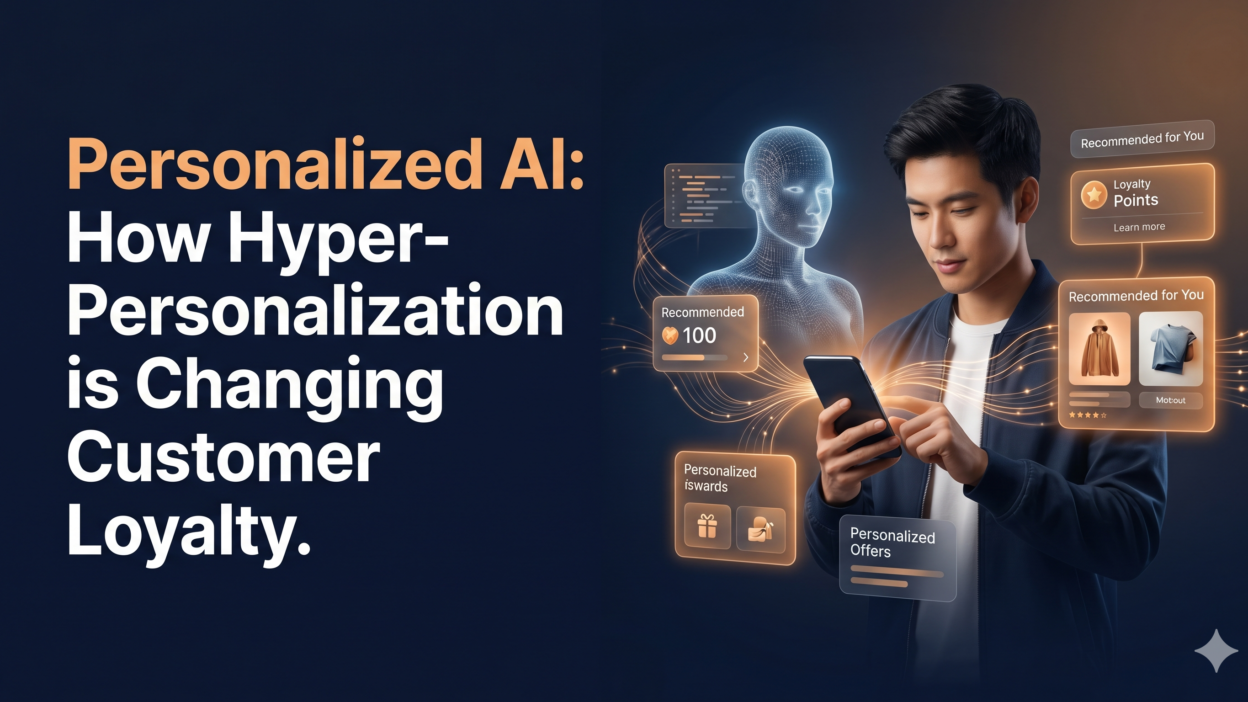
AI hyper-personalization for customer loyalty operates at a completely different level. It combines real-time behavioral data, purchase history, browsing patterns, location signals, device preferences, and even sentiment indicators to build a living, dynamic model of each individual customer. The AI does not just know what the customer bought last month. It understands what the customer wants right now, in this moment, through this channel.
That level of precision changes the entire customer relationship. The brand stops feeling like a vendor. It starts feeling like a trusted advisor who understands the customer genuinely.
The Data Foundation That Powers Hyper-Personalization
AI hyper-personalization for customer loyalty depends on rich, unified customer data. First-party data from transactions, website interactions, app sessions, and customer service contacts feeds the AI continuously. Second-party data from partnerships adds context the brand cannot collect alone. Third-party data enriches profiles with demographic and psychographic signals.
The AI synthesizes all these data streams into a coherent customer profile that updates in real time. Static customer segments become obsolete. Dynamic individual profiles replace them. Every customer interaction teaches the AI something new. Every new data point sharpens the personalization precision.
Why Personalization Drives Loyalty Specifically
Customers feel loyalty when they feel understood. Understanding creates emotional connection. Emotional connection creates preference. Preference drives repeat purchase. Repeat purchase becomes habit. Habit becomes identity. Identity becomes advocacy.
AI hyper-personalization for customer loyalty accelerates every step in this chain. The AI delivers experiences that make customers feel seen, valued, and prioritized. That feeling is not manufactured. It results from genuinely relevant interactions that respect the customer’s time and reflect their actual preferences accurately.
How AI Hyper-Personalization Works in Practice
Real-Time Behavioral Analysis
The AI monitors customer behavior as it happens. A customer browses running shoes on a mobile app. They view three specific models. They spend forty seconds on one product page. They abandon without purchasing. Within seconds, the AI processes these signals. It updates the customer’s interest profile. It adjusts product recommendations across every channel. It prepares a targeted follow-up message calibrated to arrive when the customer is most likely to engage.
This real-time responsiveness is the core power of AI hyper-personalization for customer loyalty. The AI does not wait for weekly batch processing. It acts immediately on fresh signals while they still reflect current customer intent.
Predictive Intent Modeling
Beyond current behavior, AI models predict future behavior. What does this customer need next? When will they need it? What message will motivate them to act? Predictive models trained on millions of customer journeys identify patterns that humans cannot detect.
A grocery retailer’s AI notices that a customer buys protein powder every six weeks. Week five arrives. The AI surfaces a reorder reminder at exactly the right moment. The customer feels the brand is paying attention. A churn prediction model flags a loyal customer whose engagement has dropped 40% over three weeks. The brand proactively reaches out with a personalized offer. The customer feels valued rather than forgotten. AI hyper-personalization for customer loyalty turns predictive accuracy into emotional impact.
Dynamic Content Personalization
AI personalizes not just what customers see but how they see it. A fashion brand’s website serves a different homepage to each visitor. A customer who consistently buys minimalist styles sees clean editorial imagery. A customer who buys bold, colorful pieces sees vibrant campaign photography. Same website. Completely different experience.
Email campaigns personalize beyond subject lines. The AI selects the product images, the promotional offers, the testimonials, the call-to-action language, and even the email send time based on each recipient’s individual profile. Every element serves that specific person’s preferences. Response rates climb significantly when content feels genuinely relevant rather than generically broadcast.
Conversational AI and Personalized Support
AI-powered chat interfaces deliver personalized customer service at scale. The AI greets returning customers by name. It references their purchase history when they raise an issue. It anticipates their question based on their recent activity. It resolves problems faster because it knows the context immediately.
AI hyper-personalization for customer loyalty extends naturally into service interactions. Customers who receive fast, knowledgeable, contextually aware service feel far more loyal than those who repeat their account information three times to different agents. The AI remembers everything so the customer never has to repeat themselves.
Industries Leading in AI Hyper-Personalization for Customer Loyalty
Retail and E-Commerce
Retail brands have led adoption of AI hyper-personalization for customer loyalty because the impact on revenue is immediate and measurable. Amazon’s recommendation engine drives a substantial portion of its total revenue. Netflix retains subscribers through AI-curated content that feels specifically chosen for each viewer. Spotify’s Discover Weekly creates emotional attachment to a platform through music recommendations that feel uncannily accurate.
Smaller retailers deploy the same capabilities through accessible AI platforms. A mid-market apparel brand can now serve individualized shopping experiences that rival what only the largest retailers could achieve five years ago. The technology has democratized significantly.
Financial Services and Banking
Banks and financial institutions use AI hyper-personalization for customer loyalty to deepen relationships beyond transactional interactions. The AI identifies when a customer’s financial behavior signals readiness for a new product. A customer who starts depositing larger amounts regularly receives a timely conversation about high-yield savings. A customer approaching a home purchase receives personalized mortgage pre-qualification outreach before they begin shopping.
Financial personalization builds trust, which is the ultimate driver of loyalty in a category where customers are particularly sensitive to how companies handle their data and their money. AI hyper-personalization for customer loyalty in financial services must balance commercial opportunity with genuine customer benefit carefully.
Travel and Hospitality
Loyalty in travel depends on recognition. Frequent travelers want hotels and airlines to remember their preferences without being asked each time. AI enables total preference memory at scale. A hotel AI recalls that a guest prefers high floors, hypoallergenic pillows, and late check-out. Those preferences appear automatically at booking across every property in the chain.
Airlines use AI hyper-personalization for customer loyalty through dynamic seat upgrades, proactive disruption communication, and personalized loyalty point redemption suggestions that match each traveler’s actual travel patterns. Customers who feel genuinely recognized choose the same brand repeatedly even when alternatives exist.
Streaming and Digital Entertainment
Streaming platforms live or die by churn prevention. AI hyper-personalization for customer loyalty drives retention by keeping subscribers engaged through continuously relevant content discovery. The AI analyzes viewing completion rates, genre preferences, day-of-week patterns, and device choices to surface content at precisely the right moment.
Personalized content notifications pull disengaging subscribers back before they cancel. The AI notices reduced login frequency and triggers a personalized recommendation of a new release that matches the subscriber’s strongest content preferences. Retention improves because the intervention feels relevant rather than desperate.
Building an AI Hyper-Personalization Strategy That Drives Real Loyalty
Unify Customer Data Across Every Touchpoint
Personalization fails when customer data lives in silos. An online purchase history that never connects to in-store behavior produces an incomplete picture. A customer service record that does not inform email marketing creates contradictory experiences. Data unification is the prerequisite for any meaningful AI hyper-personalization for customer loyalty initiative.
Customer data platforms (CDPs) consolidate data from every source into a single, accessible customer profile. The AI draws on this unified profile to deliver consistent personalization across every channel simultaneously. Online, in-store, mobile, email, and customer service all reflect the same understanding of each customer. Consistency builds trust. Trust builds loyalty.
Define Loyalty Outcomes Before Building Models
AI systems optimize for whatever metrics they receive. Define loyalty outcomes precisely before building personalization models. Repeat purchase rate, net promoter score, customer lifetime value, and churn rate are all legitimate loyalty metrics. Each one produces a different optimization target for the AI.
A model optimizing for short-term repeat purchase may recommend frequent promotional discounts. A model optimizing for customer lifetime value may instead prioritize introducing customers to higher-margin product categories that create longer-term attachment. Choose loyalty metrics that reflect the business relationship you genuinely want to build. The AI will pursue them relentlessly.
Balance Personalization with Privacy Respect
AI hyper-personalization for customer loyalty requires customer data. Customers increasingly understand this. Their willingness to share data depends entirely on whether they trust the brand to use it responsibly and deliver genuine value in return.
Be transparent about data collection. Offer clear opt-in choices. Demonstrate the value exchange explicitly. A loyalty program that says “share your preferences and we will serve you better” earns far more data permission than one that silently collects and uses data without acknowledgment. Privacy respect is not just an ethical obligation. It is a practical requirement for building the data foundation personalization depends on.
Invest in Real-Time Infrastructure
AI hyper-personalization for customer loyalty requires real-time data processing. Batch-processed personalization that updates customer profiles nightly cannot respond to live behavioral signals. A customer who browses a product on Monday should not receive a recommendation for it on Wednesday after they have already purchased it elsewhere.
Real-time event streaming infrastructure — tools like Apache Kafka, AWS Kinesis, or Google Pub/Sub — processes behavioral signals as they arrive. The AI receives fresh signals instantly and updates recommendations, messages, and experiences accordingly. Real-time capability is the infrastructure prerequisite that separates genuine hyper-personalization from its slower, less effective predecessors.
Test, Learn, and Refine Continuously
No AI personalization model is perfect at launch. Customer preferences evolve. Market conditions shift. Seasonal patterns disrupt established behaviors. Continuous A/B testing reveals which personalization approaches drive the strongest loyalty outcomes. Models improve as they process more customer interactions.
Build a culture of experimentation around AI hyper-personalization for customer loyalty. Test different recommendation algorithms. Test message timing variations. Test content format differences. Each test produces insights that sharpen the AI’s effectiveness. Brands that treat personalization as a continuous improvement program outperform those that deploy and forget.
Measuring the Impact of AI Hyper-Personalization on Customer Loyalty
Customer Lifetime Value as the North Star Metric
Customer lifetime value (CLV) is the most comprehensive measure of loyalty impact. It captures repeat purchase frequency, average order value, and customer tenure in a single number. AI hyper-personalization for customer loyalty should demonstrably increase CLV over time in any successful implementation.
Track CLV for customers who receive personalized experiences versus those who do not. The gap between these cohorts reveals the commercial impact of personalization investment. Most brands that measure carefully find CLV improvements of 20–40% in highly personalized customer segments compared to control groups.
Net Promoter Score and Emotional Loyalty
Behavioral loyalty measures what customers do. Emotional loyalty measures how customers feel. Net Promoter Score captures emotional loyalty directly by asking customers how likely they are to recommend the brand. High NPS correlates with reduced churn, higher spending, and more referrals simultaneously.
AI hyper-personalization for customer loyalty drives NPS improvement by creating experiences that customers genuinely want to tell others about. A recommendation that arrives at the perfect moment, a service interaction that resolves a problem instantly, a loyalty reward that reflects exactly what the customer values — these experiences generate genuine enthusiasm. That enthusiasm becomes word of mouth that no advertising budget can replicate.
Engagement Rate Across Personalized Channels
Email open rates, click-through rates, app session frequency, push notification response rates, and website revisit frequency all measure engagement. Engagement is the behavioral precursor to loyalty. Customers who engage frequently with a brand’s content and communications are significantly more likely to purchase repeatedly.
Track engagement rates separately for personalized versus non-personalized communications. The personalized cohort should show meaningfully higher engagement across every channel metric. When engagement gaps are small, the personalization model needs refinement. When gaps are large, the model is working effectively and deserves further investment.
Churn Rate Reduction
Churn rate reduction is the most direct measure of loyalty impact. Every customer the AI prevents from leaving represents retained revenue that would otherwise disappear. Calculate churn rates for customers actively receiving personalized experiences and compare to baseline churn rates from periods before personalization investment.
AI hyper-personalization for customer loyalty typically shows the strongest churn reduction impact in the customers identified as at-risk through predictive modeling. Proactive personalized outreach to at-risk customers can reduce churn in that segment by 25–35% in well-implemented programs. That retention impact translates directly to measurable revenue protection.
Common Mistakes That Undermine AI Hyper-Personalization for Customer Loyalty
Personalization Without Purpose
Not every customer interaction needs to feel personalized. Aggressive personalization of every touchpoint can feel intrusive rather than helpful. A customer who receives a hyper-personalized message every hour feels surveilled, not served. Personalization works best when it arrives at genuinely useful moments rather than at maximum possible frequency.
Design personalization to serve the customer’s needs rather than to maximize the brand’s touchpoint frequency. Ask whether each personalized interaction genuinely helps the customer accomplish something. If the answer is no, the interaction should not happen regardless of whether the AI can execute it.
Over-Reliance on Historical Data
AI models trained exclusively on historical behavior predict what customers have done. They are less reliable at predicting what customers want to do next. Customer preferences evolve. Life events change purchase patterns dramatically. A customer who moved from an apartment to a house has completely different home goods needs. A customer who had a child has entirely new priorities.
AI hyper-personalization for customer loyalty must incorporate real-time signals alongside historical patterns. Balance what the data says customers have done with what current signals suggest they need now. Models that weight recency appropriately serve customers better than models that project historical patterns indefinitely forward.
Ignoring the Emotional Dimension
Loyalty is fundamentally emotional. Customers feel loyal. Data alone cannot explain or create that feeling. AI systems that optimize purely for behavioral metrics — clicks, purchases, open rates — miss the emotional dimension that genuine loyalty requires.
Build AI hyper-personalization for customer loyalty with emotional outcomes in mind. Design interactions that make customers feel appreciated, understood, and valued. Measure emotional indicators alongside behavioral metrics. Combine quantitative AI optimization with qualitative understanding of what makes your customers genuinely happy with their relationship with your brand.
The Future of AI Hyper-Personalization for Customer Loyalty
Multimodal Personalization Across Every Sense
Personalization is expanding beyond screens into physical retail, voice interfaces, and even sensory experiences. A physical store that uses AI to recognize a loyal customer, display their name on a digital display, and alert a staff member to their favorite products delivers a personalization experience that digital channels cannot replicate.
Voice AI personalizes through audio. A smart speaker that knows a customer’s music preferences, news interests, and shopping habits creates a daily routine around the brand experience. AI hyper-personalization for customer loyalty will extend progressively into every channel and interface through which customers interact with brands.
Generative AI for Individualized Content Creation
Generative AI creates personalized content at a scale previously impossible. Every customer receives a product description written specifically for their interest profile. Every loyalty program communication uses language calibrated to their communication style preference. Every recommendation arrives with reasoning that matches their specific decision-making criteria.
This generation of content personalization goes far beyond template substitution. The AI creates genuinely unique content for each person rather than filling slots in a pre-written template. AI hyper-personalization for customer loyalty reaches an entirely new level of intimacy when every word serves a specific individual rather than a broad segment.
Emotion AI and Sentiment-Driven Personalization
Emotion AI analyzes tone, word choice, and interaction patterns to infer customer emotional state. A customer who contacts support with frustration receives a different type of response than a customer who contacts with curiosity. The AI calibrates empathy, urgency, and resolution approach based on emotional context.
Sentiment-driven personalization makes every interaction feel emotionally intelligent rather than mechanically optimized. Customers who feel that a brand understands not just their preferences but their current emotional state develop exceptionally strong loyalty. AI hyper-personalization for customer loyalty is moving steadily toward this emotional intelligence frontier.
FAQs About AI Hyper-Personalization for Customer Loyalty
What is the difference between personalization and hyper-personalization?
Standard personalization uses basic demographic or segment data to tailor broad experiences. Hyper-personalization uses real-time behavioral data, predictive modeling, and AI to create individualized experiences that reflect each person’s unique preferences in the current moment. AI hyper-personalization for customer loyalty operates at the individual level, not the segment level.
How much data does hyper-personalization require?
Effective hyper-personalization requires unified first-party data including purchase history, browsing behavior, service interactions, and channel preferences at minimum. The more data sources the AI can access, the more precise the personalization becomes. Starting with first-party data is sufficient for meaningful initial results. Data richness improves over time as the AI learns from more interactions.
Is AI hyper-personalization only for large enterprises?
No. Cloud-based AI personalization platforms make these capabilities accessible to mid-market companies and growing brands at reasonable costs. The entry point for meaningful AI hyper-personalization for customer loyalty has dropped dramatically over the past three years. Companies with as few as 10,000 customers can build effective hyper-personalization programs with modern tooling.
How do customers feel about AI-driven personalization?
Research consistently shows customers respond positively to personalization when it delivers genuine value. They appreciate relevant recommendations, timely reminders, and contextualized service. They react negatively to personalization that feels intrusive, overly frequent, or based on data they did not knowingly share. Transparent, value-driven AI hyper-personalization for customer loyalty earns trust rather than eroding it.
What technology infrastructure does hyper-personalization require?
The core infrastructure includes a customer data platform for data unification, a real-time event streaming layer for behavioral signal processing, an AI engine for model training and inference, and a delivery layer for executing personalized experiences across channels. Modern cloud platforms bundle many of these components. Full implementation complexity varies significantly by existing technology stack maturity.
How long does it take to see loyalty improvements from AI personalization?
Early engagement improvements — higher open rates, click-through rates, and session frequency — appear within weeks of launching personalized experiences. Meaningful loyalty metric improvements in repeat purchase rate and churn reduction typically emerge within three to six months. Customer lifetime value improvements reflect over longer measurement periods of twelve to twenty-four months.
How does AI personalization affect data privacy compliance?
AI hyper-personalization for customer loyalty must comply with GDPR, CCPA, and applicable local data regulations. This requires explicit consent for data collection, clear privacy disclosures, data minimization practices, and robust customer data rights management. Privacy-compliant personalization is achievable and practically necessary. Brands that build personalization on a foundation of genuine customer consent build more durable loyalty.
Read More:-Logistics Automation: Using AI to Optimize Route Planning and Fleet Management
Conclusion

Customer loyalty belongs to brands that understand their customers better than competitors do. Understanding at scale requires AI. AI hyper-personalization for customer loyalty delivers that understanding through real-time data synthesis, predictive intent modeling, and dynamic experience delivery that no human team can replicate manually.
The brands winning loyalty today are not just offering better products or lower prices. They are delivering experiences that feel specifically crafted for each individual. Every recommendation lands at the right moment. Every message speaks to a genuine interest. Every service interaction reflects complete context. Customers notice. Customers remember. Customers return.
Building this capability requires investment in data infrastructure, AI tooling, and organizational commitment to continuous improvement. It requires balancing technological sophistication with genuine respect for customer privacy and emotional intelligence. It requires defining loyalty outcomes clearly before optimizing for them relentlessly.
AI hyper-personalization for customer loyalty is not a future capability that companies should plan for eventually. It is a present competitive advantage that leading brands already deploy. Every month without a personalization strategy is a month during which competitors deepen their customer relationships while yours remain surface-level.
Start with unified customer data. Choose the right AI platform. Define your loyalty metrics precisely. Test continuously. The customers you retain through genuinely personalized experiences will not just stay with your brand. They will become the advocates who bring others.
Loyalty earned through genuine understanding lasts. AI makes genuine understanding achievable for every brand willing to build it.