Introduction
TL;DR Every business leader faces this question today. Should you deploy an AI agent or hire a person? The answer is not always obvious. AI Agents vs Hiring is one of the most debated topics in modern business strategy. Get it right, and your company moves faster with lower costs. Get it wrong, and you waste money — either on tools that don’t fit or people doing work machines should handle.
This guide breaks it all down. You will learn what AI agents actually do, where human employees still win, and how to make smart decisions for your specific situation.
Table of Contents
What Are AI Agents and Why Is Everyone Talking About Them?
An AI agent is software that perceives its environment, makes decisions, and takes actions to reach a goal. It does not just answer questions. It completes tasks. A modern AI agent can browse the web, write and execute code, send emails, analyze data, manage files, and interact with external software tools.
AI agents differ from simple automation. Traditional automation follows fixed rules. AI agents adapt. They handle variation and ambiguity. A customer support AI agent does not need a script for every possible question. It reasons through novel situations and generates appropriate responses.
The conversation around AI Agents vs Hiring grew louder because AI agent capability jumped dramatically in 2023 and 2024. Models like GPT-4, Claude, and Gemini gave agents the reasoning ability needed to handle real business workflows. What once required a skilled professional can now run autonomously at scale.
Yet capability alone does not determine what you should do. Business context matters. Workflow complexity matters. Stakes matter. Understanding both sides of AI Agents vs Hiring gives you the clarity to decide wisely.
How AI Agents Actually Work Inside a Business
AI agents run inside orchestration frameworks. Tools like LangChain, CrewAI, and AutoGen let developers connect agents to data sources, APIs, and business software. An agent receives a goal. It breaks that goal into steps. It executes each step using available tools. It checks results and adjusts.
Multi-agent systems take this further. One agent handles research. Another drafts content. A third reviews it. A fourth publishes it. All four work together without human involvement. This mirrors how a human team operates, but at machine speed and scale.
Agents connect to your CRM, your calendar, your inbox, your project management tools, and your databases. They do not just read information. They act on it. This operational capability is what makes AI Agents vs Hiring a genuine strategic conversation rather than a theoretical one.
The Real Cost Comparison: AI Agents vs Hiring
Cost is usually the first thing business owners examine in the AI Agents vs Hiring debate. The math looks simple on the surface. It is more nuanced in practice.
Hiring a full-time employee in the United States costs far more than a base salary. Factor in payroll taxes, health benefits, paid time off, equipment, office space, training, and management overhead. A $60,000 salary employee often costs the company $85,000 to $95,000 per year in total. Senior roles push that figure well above $150,000.
AI agents carry different costs. You pay for compute, API calls, and platform subscriptions. A capable AI agent handling customer support or data analysis might cost $500 to $5,000 per month depending on volume and complexity. At high usage, costs scale, but rarely to the same level as human equivalents.
Speed is another cost dimension. Hiring takes weeks or months. Posting a role, screening candidates, interviewing, negotiating, and onboarding typically takes 30 to 90 days. Deploying an AI agent takes days or weeks. For fast-moving companies, that time difference has real business value.
Availability changes the equation too. An AI agent works 24 hours a day, 7 days a week, without overtime, sick leave, or vacation. A human employee works roughly 40 hours per week. For tasks requiring constant availability, AI Agents vs Hiring becomes a very clear calculation.
Hidden Costs Teams Forget to Include
AI agents carry hidden costs too. You need engineers to build and maintain them. Prompt engineering requires skill. Integrations break and need updates. Model providers change pricing. Data quality problems surface over time. A team relying heavily on AI agents still needs technical staff to keep those agents working.
Human employees bring hidden value too. They build relationships with clients. They mentor junior team members. They catch problems that fall outside any defined workflow. They contribute to company culture. These contributions rarely appear in cost spreadsheets but they matter enormously.
Where AI Agents Win Decisively
Certain categories of work clearly favor AI agents over human hires. Understanding these categories sharpens your AI Agents vs Hiring decision-making process.
Repetitive, high-volume tasks are the clearest win for AI agents. Data entry, report generation, invoice processing, ticket tagging, and email categorization follow predictable patterns. AI agents handle these tasks faster, cheaper, and with fewer errors than human workers doing repetitive work hour after hour.
Research and synthesis work well for AI agents. Summarizing market research reports, extracting insights from customer feedback, monitoring competitor websites, and compiling industry news all fit the AI agent profile. A research agent completes in minutes what takes a human analyst several hours.
Content at scale suits AI agents. Writing product descriptions, generating SEO meta tags, drafting social media posts, and creating email templates are tasks where AI agents produce high output at low cost. Human editors still improve quality, but AI agents reduce the raw production burden dramatically.
Customer support tier-one resolution belongs in the AI agent column. Simple questions about order status, return policies, account information, and product specs repeat thousands of times a day. An AI agent answers them instantly at any hour. This frees human support agents to focus on complex, emotionally sensitive cases.
Code generation and testing represent a growing AI agent strength. Agents write boilerplate code, generate unit tests, document existing functions, and scan for common security vulnerabilities. Developers using AI coding agents report 20 to 40 percent productivity gains on standard development tasks.
Industries Adopting AI Agents Fastest
Financial services firms deploy AI agents for transaction monitoring, document processing, compliance checks, and client onboarding. E-commerce companies use them for inventory management, product listing optimization, and customer query handling. Healthcare organizations apply them to appointment scheduling, medical record summarization, and insurance pre-authorization workflows. Marketing agencies run AI agents for campaign reporting, audience segmentation, and ad copy generation. The pattern across these industries is consistent. AI agents handle volume and repetition. Humans handle judgment and relationships.
Where Human Employees Win Decisively
The AI Agents vs Hiring debate sometimes creates false impressions. Some people assume AI agents can replace almost any worker soon. This view underestimates what skilled human employees actually bring.
Strategic decision-making requires human judgment. A CEO deciding whether to enter a new market weighs data, intuition, political dynamics, cultural context, and long-term vision. No AI agent today matches the contextual reasoning a seasoned executive applies to complex, high-stakes choices. The information inputs may come from AI. The decision belongs with a human.
Relationship-driven roles resist automation strongly. Sales relationships built over years on trust, shared experiences, and personal chemistry do not transfer to AI agents. Key account managers, enterprise sales representatives, and client success directors create loyalty that sustains contracts. Customers notice when they interact with a machine versus a person who genuinely cares about their success.
Creative leadership needs human originality. An AI agent can generate creative content from existing patterns. A truly original campaign, product concept, or brand direction requires a human creative director who synthesizes cultural trends, personal experience, and genuine creative instinct. AI assists. Humans lead.
Crisis management demands human adaptability. When a data breach hits, a PR crisis erupts, or a supply chain collapses, companies need leaders who read the room, make fast judgment calls, and communicate with empathy under pressure. These situations involve too many variables and too much emotional nuance for current AI agents.
Mentorship and team development stay human. Senior employees shape junior talent. They model professional behavior. They give feedback that balances technical criticism with personal encouragement. They notice when a team member struggles and intervene with the right support at the right time. AI agents do not fill this role.
The Soft Skills Gap That AI Cannot Close
Emotional intelligence separates human employees from AI agents in client-facing and team-leadership roles. Reading body language, adjusting communication style for different personalities, building genuine rapport, and navigating interpersonal conflict require social skills that current AI systems lack. Organizations that underestimate this gap often learn the hard way when AI deployments damage client relationships or lower team morale.
A Practical Framework for the AI Agents vs Hiring Decision
Leaders need a structured way to evaluate AI Agents vs Hiring for each specific role or task. Use this framework to cut through the noise and make a clear choice.
Start by defining the task precisely. What inputs does it require? What outputs does it produce? How often does it repeat? How much variation exists between instances? Tasks with clear inputs, defined outputs, high frequency, and low variation are AI agent territory. Tasks with ambiguous inputs, judgment-dependent outputs, low frequency, and high variation belong with human employees.
Assess the error cost next. What happens when this task produces a wrong output? If a data formatting error delays a report by an hour, the cost is low. If a wrong medical recommendation harms a patient, the cost is catastrophic. Higher error costs push the decision toward human oversight regardless of automation capability.
Evaluate relationship requirements. Does completing this task require trust developed over time? Does it involve reading emotional cues or navigating personal dynamics? If yes, a human employee belongs in this role. AI agents excel at transactional interactions. They struggle with relational ones.
Consider regulatory and compliance context. Some industries require human accountability for certain decisions. A licensed professional must sign off on legal advice, medical diagnoses, or financial plans. No AI agent replaces this legal accountability. Know your industry’s rules before automating anything client-facing.
Finally, look at scalability needs. Do you expect this task volume to grow 5x or 10x in the next two years? If yes, hiring more humans to keep up means linearly growing costs. AI agents scale without proportional cost increases. For high-growth contexts, AI Agents vs Hiring often tilts clearly toward agents for scalable task categories.
The Hybrid Model Most Companies End Up Using
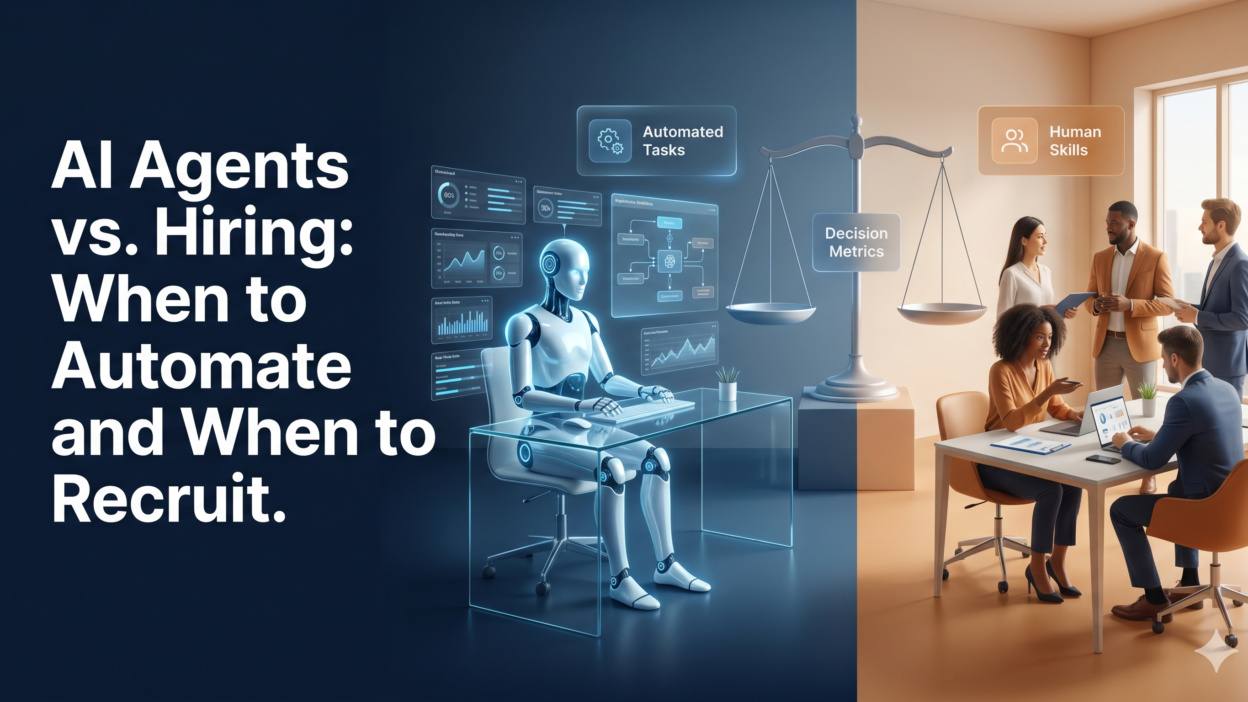
Most companies that think carefully about AI Agents vs Hiring land on a hybrid approach. AI agents handle volume and repetition. Human employees handle judgment, relationships, and strategy. The ratio shifts by role, industry, and company size. A 50-person startup might run lean on headcount and heavy on AI agents for operational tasks. A 500-person professional services firm might use AI agents for research and reporting while keeping client-facing roles fully human. Neither approach is universally right. The goal is matching capability to context.
Role-by-Role Breakdown: AI Agent or Human Hire?
Let’s apply the AI Agents vs Hiring framework to specific roles most companies face.
Customer support tier-one roles go to AI agents. Repetitive, high-volume, round-the-clock availability requirements all point to automation. Human support managers still needed to handle escalations and train agents.
Data analysts present a split decision. Routine report generation, dashboard updates, and data cleaning suit AI agents well. Strategic analysis, stakeholder communication, and business insight generation still need skilled human analysts.
Copywriters face a nuanced picture. AI agents generate high-volume, SEO-driven content efficiently. Brand storytelling, thought leadership, and creative campaign concepts need experienced human writers who bring perspective and original thinking.
Software developers remain strongly human-led. AI coding assistants accelerate development. They do not replace senior engineers who architect systems, make technology choices, review code for security, and lead technical teams.
Sales development representatives (SDRs) see AI agents handling email outreach, lead scoring, and meeting scheduling. The actual sales conversation where a rep builds rapport and handles complex objections stays human.
HR generalists split similarly. Candidate screening, interview scheduling, onboarding document processing, and benefits administration suit AI agents. Employee relations, performance coaching, and conflict resolution need human HR professionals.
Finance and accounting functions automate well at the transactional level. Invoice processing, expense reconciliation, and financial reporting templates run efficiently as AI workflows. CFO-level strategy, audit management, and investor relations require experienced human finance leaders.
Mistakes Companies Make in the AI Agents vs Hiring Decision
Many companies approach AI Agents vs Hiring poorly and pay for it. Knowing the common mistakes helps you avoid them.
The first mistake is automating before understanding the workflow. Companies deploy AI agents on complex, poorly documented processes and then wonder why performance is poor. Map every workflow step before building an AI agent. Understand edge cases. Document exceptions. Automation of a messy process produces messy automation.
The second mistake is choosing automation purely to cut costs without measuring quality impact. A customer support AI agent that resolves 80 percent of tickets but drops satisfaction scores by 20 percent is not a win. Always measure quality outcomes alongside cost savings.
The third mistake is under-investing in human oversight of AI systems. AI agents make errors. They need humans to catch those errors, retrain the systems, and update workflows when business rules change. Companies that eliminate human oversight entirely create brittle systems that fail at the worst moments.
The fourth mistake is hiring when AI agents already do the job better. Some companies hire junior analysts to compile reports that AI agents could produce faster and more accurately. Organizational inertia and discomfort with technology lead to unnecessary headcount. This slows productivity and wastes budget that could fund strategic hires.
The fifth mistake is ignoring the change management dimension. Deploying AI agents inside a team that fears automation creates resistance. Employees disengage, withhold cooperation, and sometimes actively work against new tools. Involve your team early. Be transparent about what will change. Explain what stays human. Companies that manage this well see faster adoption and better outcomes.
Building Internal AI Literacy Before You Deploy
Successful AI agent deployments start with internal education. Teams need to understand what AI agents can and cannot do. They need confidence that AI agents augment their work rather than threaten their jobs. Invest in AI literacy training before rolling out any agent-based automation. Teams that understand the tools use them better. They catch errors faster. They improve prompts and workflows over time. This learning loop improves ROI from every AI investment.
Future Outlook: How the AI Agents vs Hiring Landscape Will Shift
The AI Agents vs Hiring balance will keep shifting as AI capability advances. Tasks that require human judgment today may fall to AI agents in three to five years as models improve reasoning and planning ability.
Agentic AI systems are evolving fast. Multi-agent frameworks where specialized agents collaborate on complex projects are maturing rapidly. The gap between what AI agents can do and what they could do two years ago is enormous. Extrapolating that trajectory, many mid-complexity white-collar tasks become automatable within a decade.
This does not mean mass unemployment. History shows that automation creates new job categories even as it eliminates old ones. The internet eliminated travel agents but created social media managers, SEO specialists, and UX designers. AI agents will eliminate certain roles while creating demand for AI trainers, agent developers, AI ethicists, and human-AI collaboration specialists.
Smart companies plan for this shift now. They audit which roles are automation-vulnerable. They upskill employees for roles that combine human judgment with AI tools. They build internal AI expertise that becomes a competitive advantage as the technology matures. The companies that navigate AI Agents vs Hiring thoughtfully today will lead their industries tomorrow.
FAQs About AI Agents vs Hiring
Can AI agents fully replace human employees in any department?
Not yet. AI agents replace specific tasks and roles within departments, not entire departments. A customer support department might automate 70 percent of ticket volume with AI agents but still needs human managers, quality reviewers, and senior support leads. Full departmental replacement remains rare and is generally not advisable even when technically possible.
How do I calculate ROI when choosing between AI agents and hiring?
Compare total cost of ownership for each option over 12 to 24 months. For hiring, include salary, benefits, recruiting fees, onboarding time, and management overhead. For AI agents, include setup costs, platform fees, compute costs, and engineering maintenance. Then measure output quality, error rates, and speed for both options. ROI favors AI agents when volume is high, variation is low, and quality remains acceptable.
What tasks should I never automate with AI agents?
Never automate tasks where errors cause irreversible harm. Medical diagnoses, legal advice, financial planning, and crisis communications all carry high stakes that require human accountability. Never automate tasks where client relationships are the core value being delivered. Never automate tasks that require understanding unwritten cultural norms or reading emotional subtext in high-tension situations.
How do small businesses approach the AI Agents vs Hiring decision differently?
Small businesses often benefit most from AI agents because they extend capacity without full-time headcount costs. A 10-person company can use AI agents to run marketing, handle customer queries, and manage scheduling — functions that would otherwise require three additional hires. The savings fund growth. The key is choosing off-the-shelf AI tools that require minimal technical setup rather than building custom agent systems.
Will AI agents make hiring obsolete?
No. The AI Agents vs Hiring conversation will evolve, but human employment will not disappear. Roles requiring creativity, strategic judgment, emotional intelligence, and complex interpersonal dynamics will remain human-led for the foreseeable future. The nature of work changes. The need for human contribution does not end.
How do I start testing AI agents without disrupting my team?
Start with a low-risk, high-repetition internal task. Document processing, meeting notes summarization, or internal data reporting work well as pilots. Run the AI agent alongside your current process for 30 days. Compare output quality, speed, and cost. Use real data to make the case internally before expanding automation to customer-facing or mission-critical functions.
Read More:-How to Build a Custom AI Sales Agent Using CrewAI and Python
Conclusion
The AI Agents vs Hiring question does not have one answer. It has a framework for finding the right answer every time you face it. Define the task clearly. Measure the error cost. Evaluate relationship requirements. Check regulatory constraints. Assess scalability needs. Then decide.
AI agents win when work is repetitive, high-volume, rule-based, and available around the clock. Human employees win when work requires judgment, relationship-building, creative leadership, and emotional intelligence. Most organizations need both working in concert.
The AI Agents vs Hiring decision is ultimately a resource allocation decision. Where does each dollar of labor investment produce the most value? Answer that question rigorously for each role and workflow. Build a team that combines human depth with AI speed.
The companies leading their industries in five years will not be the ones who automated the most. They will be the ones who made the smartest choices about what to automate and what to keep human. That wisdom starts with understanding AI Agents vs Hiring at a deeper level than cost alone. Use this guide as your starting point. Revisit it as the technology evolves. The right answer today may shift tomorrow — and great business leaders stay ahead of that curve.