Introduction
TL;DR Speed wins in real estate. A lead that goes cold costs an agency thousands of dollars in potential commission. Most buyers and sellers make contact with five or more agencies before committing. The first agent to respond with something meaningful earns the relationship. AI Real Estate Lead Follow-ups Automation gives agencies that speed advantage every single day.
This blog covers how real estate agencies of all sizes deploy AI to follow up faster, stay consistent, and close more deals. Every section gives you practical insight you can act on immediately.
Table of Contents
Why Lead Follow-up Is the Biggest Problem in Real Estate
Real estate agents are busy. Showings, paperwork, negotiations, and client calls fill every working hour. Following up with every new lead personally and promptly is nearly impossible without a system. Research shows that 78 percent of sales go to the first responder. In real estate, that number feels even higher because buyer attention spans are short.
A lead fills out a contact form at 11 PM on a Saturday. The agent sees it Monday morning. By then, the buyer already toured a property with a competitor. That single delay cost the agency a deal worth $15,000 in commission. Multiply that across a team of ten agents over a full year, and the revenue loss is staggering.
AI Real Estate Lead Follow-ups Automation closes this gap entirely. An AI system responds within seconds of a new lead arriving, regardless of the time or day. It captures attention before the lead moves on. It keeps the conversation alive until a human agent takes over at the right moment.
Agencies that implemented AI follow-up systems report lead-to-appointment conversion rates improving by 30 to 50 percent. The technology does not replace agents. It gives agents a powerful first line of engagement that works while they sleep.
The Lead Response Window Nobody Talks About
MIT research identified a five-minute response window for inbound leads across industries. Respond within five minutes and the chances of qualifying that lead increase by 400 percent compared to a 10-minute response. Respond after an hour and qualification rates drop to nearly the same level as never responding at all. Real estate operates under these same dynamics. Most agencies miss this window consistently because they rely on agents to check inboxes manually. AI Real Estate Lead Follow-ups Automation makes the five-minute window automatic and reliable.
What AI Lead Follow-up Systems Actually Do
Understanding the mechanics of AI Real Estate Lead Follow-ups Automation helps agencies make better deployment decisions. These systems are not simple autoresponders. They operate with contextual awareness and adaptive logic.
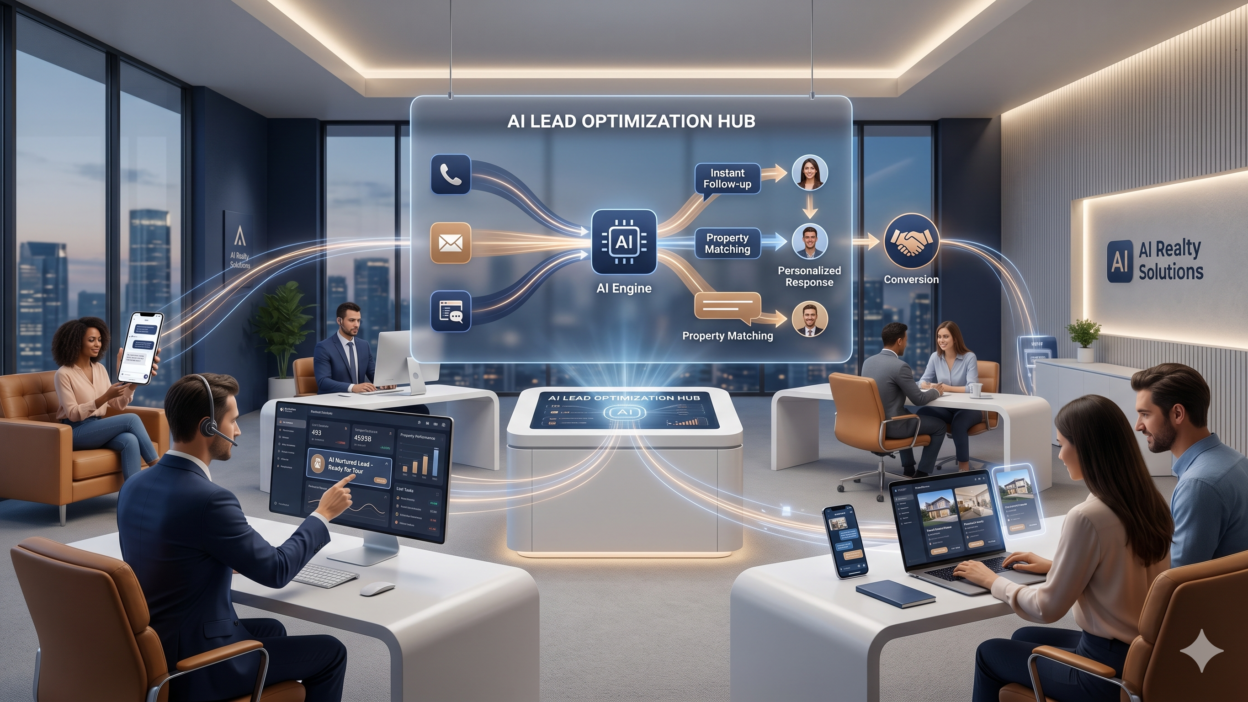
When a new lead comes in from any source — Zillow, Realtor.com, your website, Facebook ads, or Google ads — the AI system captures the lead data immediately. It identifies what property the lead inquired about, what form they filled out, and what time they reached out. This context shapes the first message.
The AI sends a personalized first response within seconds. It references the specific property. It asks a targeted qualifying question. It does not send a generic greeting that feels automated. Modern AI systems generate messages that read like a thoughtful agent took a moment to respond personally.
If the lead does not respond, the AI follows up again. It varies the message tone, timing, and angle. One follow-up might offer a similar property. Another might share a market insight relevant to the neighborhood the lead inquired about. Each touchpoint adds value rather than just pushing for a response.
When the lead does respond, the AI continues the conversation. It qualifies the lead by asking about budget, timeline, preferred neighborhoods, and financing status. It captures all this data and populates the CRM automatically. By the time a human agent picks up the conversation, they have a complete lead profile ready.
Multi-Channel Follow-up That Reaches Every Lead
Effective AI Real Estate Lead Follow-ups Automation does not rely on a single channel. Different leads prefer different communication methods. Some check email constantly. Others respond only to SMS. Some engage through WhatsApp or Facebook Messenger. A strong AI follow-up system reaches leads across all these channels simultaneously. It tracks where each lead responds and prioritizes that channel for future messages. This adaptive approach increases response rates significantly compared to single-channel follow-up strategies.
The Technology Behind Real Estate AI Follow-up Systems
Real estate agencies do not build AI follow-up systems from scratch. They use purpose-built platforms that combine large language models with CRM integrations and workflow automation. Understanding the components helps agencies evaluate and choose the right tools.
Large language models power the message generation layer. Models from OpenAI and Anthropic write contextually relevant, human-sounding messages based on lead data and conversation history. They adapt tone based on lead behavior. A lead who responds warmly gets warmer follow-up. A lead who gives short answers gets more concise, direct messages.
CRM integration is the backbone of any AI Real Estate Lead Follow-ups Automation system. Popular real estate CRMs like Follow Up Boss, LionDesk, Salesforce, and HubSpot connect directly to AI tools. Lead data flows in automatically. Conversation history saves against every lead record. Agents see the full picture without manual data entry.
Workflow automation platforms like Zapier, Make, and n8n connect lead sources to AI engines. When a new lead arrives on Zillow, Zapier triggers the AI system, which fires the first message within seconds. These automations run silently in the background without agent involvement.
Lead scoring adds another layer of intelligence. The AI assigns a score to each lead based on engagement level, responses, and behavioral signals. High-scoring leads get flagged for immediate agent follow-up. Low-scoring leads stay in the AI nurture sequence longer. This prioritization keeps agents focused on the leads most likely to convert.
The Role of Natural Language Processing in Lead Conversations
Natural language processing (NLP) allows AI systems to understand what leads actually mean, not just what they literally say. A lead who says they are just browsing signals low urgency. An NLP-powered system recognizes this and shifts to a low-pressure long-term nurture sequence. A lead who says they need to move by March signals high urgency. The system escalates that lead to an agent immediately. This contextual reading of lead intent separates sophisticated AI Real Estate Lead Follow-ups Automation from basic auto-reply systems.
How Agencies Set Up AI Lead Follow-up Systems
Building an AI Real Estate Lead Follow-ups Automation system follows a clear process. Agencies that structure the setup carefully get better results faster.
The first step is mapping every lead source. List every place leads come from. Include your website contact forms, property listing platforms, social media ad campaigns, open house sign-in sheets, and referral portals. Each source needs a connection to the central system. Missing a lead source means some leads never enter the AI follow-up pipeline.
The second step is choosing a CRM that supports AI integration. Follow Up Boss leads the market for AI-ready real estate CRMs. It connects natively with dozens of AI and automation tools. LionDesk offers strong automation features at a lower price point. Salesforce suits larger agencies that need enterprise-level customization. Pick the CRM before selecting AI tools, because the CRM is the hub everything connects to.
The third step is selecting an AI messaging platform. Structurely, Ylopo, and Roof are popular choices built specifically for real estate. They come with pre-built real estate conversation scripts, qualification frameworks, and CRM integrations out of the box. Agencies with technical resources sometimes build custom solutions using OpenAI’s API or Claude, but off-the-shelf tools work well for most teams.
The fourth step is writing and customizing message sequences. Even AI-powered systems need human-crafted frameworks. Write the first response message carefully. It sets the tone for the entire lead relationship. Write follow-up sequences for different lead scenarios. A buyer who inquired about a single property needs different follow-up than a seller looking for a listing agent.
The fifth step is defining handoff rules. When does the AI hand a lead to a human agent? Common triggers include when a lead agrees to a showing, when a lead asks a complex financing question, or when a lead scores above a certain threshold. Clear handoff rules prevent leads from staying too long in AI sequences when they are ready for a human conversation.
The sixth step is testing before going live. Send 20 test leads through the full system. Verify that messages arrive correctly, CRM data populates accurately, and handoff triggers fire at the right moments. Fix any gaps before the system handles real prospects.
Personalizing AI Messages Without Losing Authenticity
Personalization is the difference between AI follow-up that converts and AI follow-up that annoys. Use the lead’s first name in every message. Reference the specific property they viewed. Mention the neighborhood by name. Include a market stat relevant to their area of interest. These small touches make messages feel personal rather than automated. Agencies that invest time in message customization during setup see significantly higher reply rates. Generic AI messages produce generic results. Personalized AI messages produce relationships.
Real-World Results: What Agencies Report After Deployment
Numbers tell the most honest story about AI Real Estate Lead Follow-ups Automation. Agencies across the country share consistent findings after deploying these systems.
Response time drops from hours to seconds. One mid-size agency in Phoenix reported average first-response time falling from 4.2 hours to under 90 seconds after deploying an AI follow-up system. That single change drove a 41 percent increase in lead-to-appointment conversion within 60 days.
Agent productivity improves significantly. Agents spend less time on cold outreach and more time on warm conversations. When every lead has already been qualified by the AI system, agent calls start from a better place. Agents report spending 60 percent more time on high-value activities like showings and negotiations rather than chasing unresponsive leads.
Lead volume becomes manageable at scale. A brokerage in Austin that runs aggressive social media campaigns generates 400 to 600 new leads per month. Before AI follow-up automation, only 30 percent of those leads received any meaningful follow-up within the first week. After deployment, 100 percent of leads received follow-up within five minutes. The same team handled three times the lead volume without adding staff.
Long-term nurture produces deals months later. Many buyers take six to eighteen months from first inquiry to purchase. AI Real Estate Lead Follow-ups Automation keeps these leads warm throughout that entire journey. One California agency attributed 22 percent of its annual closings to leads that initially went cold but came back through consistent AI nurture sequences.
Measuring the Right Metrics After Launch
Track five core metrics after deploying AI Real Estate Lead Follow-ups Automation. First, average response time — it should drop to under two minutes. Second, lead reply rate — aim for 25 to 40 percent of leads responding to AI messages. Third, qualification rate — measure what percentage of respondents provide budget and timeline information. Fourth, appointment set rate — track how many qualified leads convert to scheduled showings. Fifth, revenue per lead — calculate total closed commission divided by total leads generated. Improvement across all five metrics confirms the system delivers genuine business value.
Common Mistakes Agencies Make With AI Lead Follow-up
Agencies that struggle with AI Real Estate Lead Follow-ups Automation usually make the same set of errors. Avoiding these saves time, money, and frustration.
The first mistake is deploying AI on a weak knowledge base. If your property database, neighborhood guides, and market information are outdated, the AI pulls from bad data and gives leads inaccurate or irrelevant information. Clean your data before automating anything.
The second mistake is making messages too long. AI systems sometimes generate verbose messages that overwhelm leads. Keep every AI message under 100 words. Short messages get read. Long messages get ignored. Edit every message template aggressively before going live.
The third mistake is ignoring negative signals. A lead who opts out must exit the AI sequence immediately. A properly configured system recognizes opt-out language and removes leads from automation. Failing to catch these signals creates legal liability under CAN-SPAM and TCPA regulations.
The fourth mistake is over-automating high-intent leads. When a lead requests an immediate showing, the AI should hand off to a human agent right away, not send another automated message. Automating beyond the right handoff point frustrates warm leads and costs deals.
The fifth mistake is not reviewing AI conversations regularly. Set aside 30 minutes each week to read a sample of AI lead conversations. Look for messages that landed poorly. Look for questions the AI answered incorrectly. Use these insights to improve message sequences and response logic continuously.
Staying Compliant While Using AI for Lead Follow-up
Real estate agencies face specific compliance obligations when running automated communications. The TCPA restricts automated text messaging to leads who have explicitly opted in. CAN-SPAM governs commercial email sequences. Fair housing laws prohibit language that could be interpreted as discriminatory targeting. Every AI message template needs legal review before deployment. Include an easy opt-out mechanism in every message sequence. Work with a real estate attorney to review your automation workflows before going live. Compliance protects your agency from fines and reputational damage.
Choosing the Right AI Lead Follow-up Platform for Your Agency
The market for AI Real Estate Lead Follow-ups Automation tools has grown rapidly. Selecting the wrong platform wastes budget and creates adoption problems. Use a clear evaluation framework.
Start with integration depth. The platform must connect natively with your existing CRM and all your lead sources. Poor integrations create data gaps. Data gaps mean some leads fall through the cracks entirely, defeating the purpose of automation.
Evaluate conversation quality. Request a demo where you interact with the AI as if you were a lead. Does the conversation feel natural? Does the AI handle unexpected responses well? Does it qualify intelligently or just collect names and email addresses? Conversation quality determines whether leads engage or disengage.
Check scalability pricing. Some platforms charge per lead contacted. At high lead volumes, per-lead pricing becomes expensive fast. Other platforms charge flat monthly fees. Calculate your expected monthly lead volume and compare total cost under each pricing model before committing.
Review support quality. AI systems require tuning over time. Your platform provider needs responsive support to help you improve performance. Look for providers that offer onboarding support, regular check-ins, and a knowledge base with real estate-specific guidance.
Ask for case studies from agencies of your size. A platform that works brilliantly for a 200-agent franchise may not suit a 5-agent boutique. Find social proof from agencies that resemble yours in size, market, and lead volume.
Top Platforms for AI Real Estate Lead Follow-ups Automation
Structurely is purpose-built for real estate and handles AI lead conversations across SMS, email, and chat. It integrates with most major real estate CRMs and comes with pre-built qualification scripts. Ylopo combines AI lead follow-up with paid advertising tools, making it popular with agencies running their own digital ad campaigns. Roof AI specializes in website chat and lead qualification for real estate websites. Follow Up Boss, while primarily a CRM, now includes AI-powered smart lists and automated follow-up sequences that work well for smaller agencies that want simplicity. Evaluate each against your specific workflow before deciding.
The Future of AI in Real Estate Lead Management
AI Real Estate Lead Follow-ups Automation is evolving fast. Where it goes next will reshape how agencies operate at every level.
Voice AI is entering the lead follow-up space. AI systems now conduct outbound phone calls that sound remarkably human. A lead misses a showing and the AI calls within minutes to reschedule. This extends automation into the phone channel, which still produces the highest conversion rates in real estate outreach.
Predictive lead scoring is maturing. AI systems analyze behavioral patterns across thousands of leads to predict which new leads are most likely to purchase within 90 days. Agents focus their personal attention on these high-probability leads while AI nurtures the rest. This prioritization will dramatically improve agent efficiency as the models become more accurate.
AI-generated property recommendations are becoming part of follow-up sequences. When a lead does not respond to an initial inquiry, the AI sends alternative property recommendations based on the lead’s stated preferences. This proactive matching keeps leads engaged without requiring them to search again.
Integration with market data will make AI follow-up messages smarter. An AI system that monitors local market conditions can message a lead with genuinely timely information. A new listing hits the market in the lead’s preferred neighborhood and the AI notifies that lead within minutes. This type of real-time relevance turns follow-up sequences into valuable market intelligence services.
Preparing Your Agency for the Next Wave of AI Tools
Agencies that build strong data foundations today will benefit most from tomorrow’s AI tools. Keep your CRM clean and complete. Tag every lead with source, inquiry type, property preference, and communication history. Maintain accurate property data across all platforms. Document your follow-up workflows clearly. These fundamentals determine how well any AI system performs on your data. Agencies that neglect data hygiene now will struggle to leverage advanced AI tools as they mature. The work you do on fundamentals today compounds into a competitive advantage over the next three to five years.
FAQs About AI Real Estate Lead Follow-ups Automation
How quickly can an agency set up an AI lead follow-up system?
A basic system using an off-the-shelf platform like Structurely or Ylopo takes one to two weeks to configure and test. This includes CRM integration, lead source connections, message sequence setup, and staff training. A custom-built system using AI APIs takes four to eight weeks with dedicated technical resources. Most agencies benefit from starting with a proven platform before considering custom builds.
Will leads know they are talking to an AI?
Transparency varies by agency policy and platform. Some agencies disclose AI involvement upfront. Others use AI for initial contact and only identify the system as automated if a lead asks directly. Best practice leans toward transparency. Leads who discover undisclosed AI involvement sometimes feel misled. A clear, brief disclosure in the first message sets expectations without killing engagement.
Does AI lead follow-up work for luxury real estate?
Yes, with adjustments. Luxury buyers expect elevated communication. AI messages for luxury segments need more sophisticated language, stronger personalization, and shorter automation sequences before human agent handoff. A luxury buyer who inquires about a $3 million property should receive an AI acknowledgment but move to a personal agent call within the hour. AI Real Estate Lead Follow-ups Automation handles initial capture and qualification even at the luxury level, but human relationship-building takes over quickly.
What happens when a lead asks a question the AI cannot answer?
Well-configured AI systems recognize questions outside their scope and respond honestly. The system alerts the assigned agent and routes the lead for immediate human follow-up. This graceful handoff protects the lead relationship rather than leaving the person with an unsatisfactory automated response.
How much does AI lead follow-up automation cost for a small agency?
Entry-level platforms start at $300 to $500 per month for small agencies with limited lead volume. Mid-range platforms with fuller features run $500 to $1,500 per month. Enterprise solutions for large brokerages range from $2,000 to $5,000 per month. Most agencies report that a single additional closed deal per month covers the full platform cost, making ROI straightforward to demonstrate internally.
Can AI follow-up systems handle seller leads as well as buyer leads?
Absolutely. Seller lead follow-up requires different message sequences focused on home valuation, listing timelines, and market conditions rather than property search. AI systems handle seller qualification equally well when configured with seller-specific scripts. Agencies that run both buyer and seller lead campaigns use separate AI sequences for each segment to keep messaging relevant and conversion-focused.
Read More:-Cursor vs. Windsurf: Which AI IDE Wins for Enterprise Development?
Conclusion

Real estate is a relationship business, but relationships cannot form if the first contact never happens. AI Real Estate Lead Follow-ups Automation makes sure every lead gets a fast, personal, relevant first response — every single time. No lead waits until Monday morning. No opportunity slips through because an agent was showing property across town.
The agencies winning market share right now combine the speed and consistency of AI with the expertise and empathy of skilled human agents. AI handles the volume. Humans handle the depth. Together, they serve clients better than either could alone.
AI Real Estate Lead Follow-ups Automation is not a future investment. It is a present necessity for any agency serious about growth. The cost is low relative to a single commission. The implementation timeline is weeks, not months. The results show up in your conversion metrics within the first 60 days.
Start by auditing your current follow-up process. Identify every point where leads fall through. Map those gaps to what an AI system covers. Choose a platform that fits your CRM and lead volume. Build your message sequences with care. Test before going live. Monitor results weekly and improve continuously. That process builds an agency that captures more opportunities, serves more clients, and grows with a sustainable competitive edge in any market.