Introduction
TL;DR Marketing teams throw around new acronyms every year. ABX vs ABM confuses many marketers trying to plan their next strategy. Both approaches target specific accounts instead of broad audiences. Both aim to drive revenue from high-value customers. But they work differently under the surface. This guide breaks down the ABX vs ABM debate clearly. You will learn what each term means. You will learn how each strategy operates. You will learn which approach fits your business best.
Table of Contents
What Is ABM?
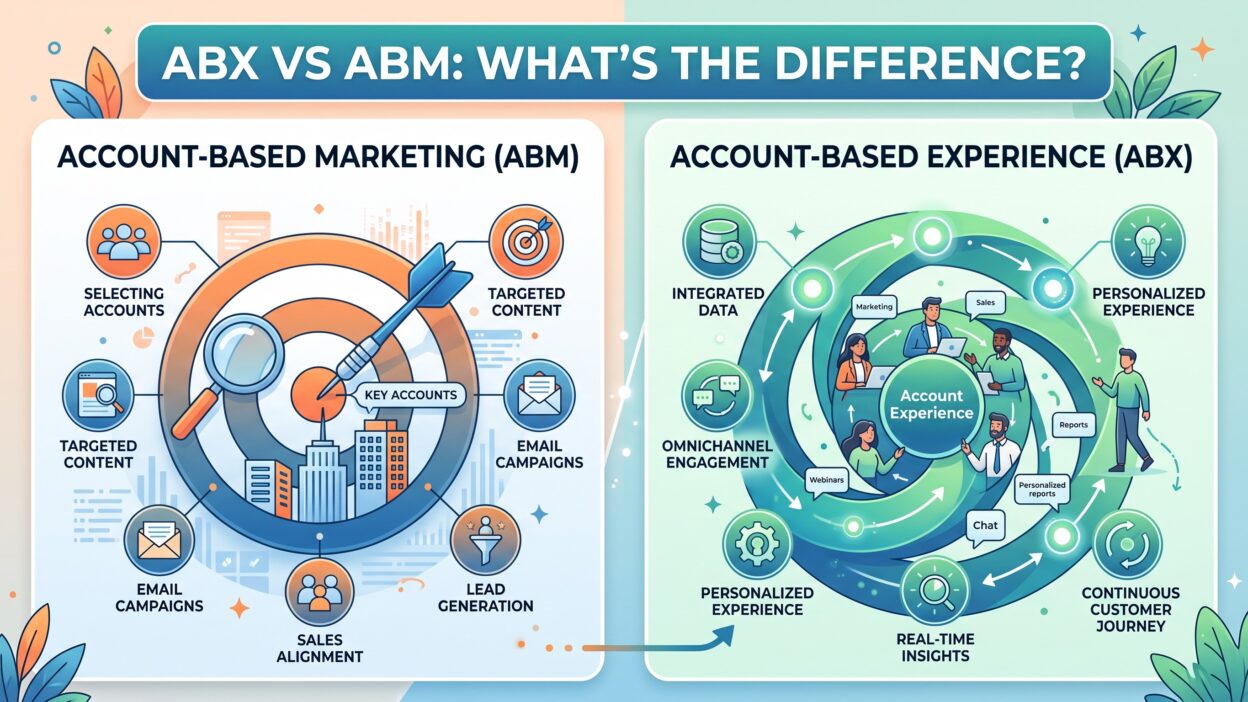
ABM stands for account-based marketing. This strategy targets a defined list of high-value accounts instead of casting a wide net. Marketing and sales teams build campaigns around specific companies. They personalize messaging for each account based on industry, size, and buying stage.
ABM started as a sales-driven strategy. Sales teams identified target accounts first. Marketing then built supporting campaigns around those accounts. This approach works well for companies with a small number of high-value prospects worth deep personalization.
What Is ABX?
ABX stands for account-based experience. This strategy expands on ABM by focusing on the full buyer journey. ABX creates a connected experience across every touchpoint a prospect encounters. It blends marketing, sales, and customer success into one unified motion.
ABX treats the account relationship as ongoing rather than campaign-based. It aims to deliver value at every stage, from first awareness through renewal and expansion. This broader view sets ABX apart in the ABX vs ABM comparison.
Why the ABX vs ABM Distinction Matters
Understanding ABX vs ABM helps teams choose the right framework for their goals. ABM works well for teams focused purely on generating pipeline from target accounts. ABX works well for teams focused on long-term account relationships and customer lifetime value.
Choosing between ABX vs ABM shapes how teams structure their entire go-to-market motion. A company obsessed with quarterly pipeline numbers might lean toward ABM. A company focused on retention and expansion revenue might lean toward ABX.
Core Differences Between ABX and ABM
The ABX vs ABM comparison comes down to scope, ownership, and measurement. Each difference shapes how a team builds and runs their program.
Scope of the Strategy
ABM usually focuses on the top of the funnel. Teams identify target accounts and drive initial engagement toward a sales conversation. ABX extends far past that first conversation. It covers onboarding, product adoption, and renewal too.
This scope difference defines much of the ABX vs ABM conversation. ABM asks how to get an account into the pipeline. ABX asks how to keep that account happy for years after the deal closes.
Team Ownership and Alignment
ABM traditionally sits within marketing and sales departments. These two teams build target account lists and coordinate outreach together. Other departments rarely get involved in a traditional ABM program.
ABX requires broader alignment across the company. Customer success, product, and support teams all play a role in ABX vs ABM discussions. ABX treats every department as part of the account experience, not just marketing and sales.
Measurement and Success Metrics
ABM measures success through pipeline generation, meetings booked, and deal velocity. These metrics focus on the path toward a closed deal. Marketing teams running ABM programs report on these numbers regularly.
ABX measures success through a wider lens. Customer lifetime value, net revenue retention, and account health scores matter just as much as pipeline numbers. The ABX vs ABM difference in measurement reflects each strategy’s different time horizon.
Technology and Data Requirements
ABM relies on intent data, firmographic data, and engagement tracking during the buying stage. Tools like Demandbase and 6sense support this targeted outreach effectively.
ABX needs a broader data infrastructure. It pulls data from customer success platforms, product usage tools, and support ticket systems too. This wider data requirement adds complexity to the ABX vs ABM technology stack comparison.
When to Choose ABM
ABM fits companies with a clear, well-defined list of target accounts. It works especially well for businesses selling complex products with long sales cycles and multiple stakeholders. A cybersecurity company targeting enterprise accounts often benefits from a focused ABM program.
ABM also suits teams with limited resources. Building a full ABX program across every department takes significant coordination. A smaller marketing team can run an effective ABM program without needing buy-in from customer success and product teams.
Companies early in their account-based journey often start with ABM first. This approach lets teams prove the value of account-based targeting before expanding into a broader ABX vs ABM strategy across the entire company.
When to Choose ABX
ABX fits companies prioritizing long-term account relationships over quick pipeline wins. Subscription-based businesses benefit heavily from ABX since renewal and expansion revenue matter as much as new deals.
Companies with mature account-based programs often graduate from ABM into ABX. Once a business proves early ABM success, expanding the strategy into a full ABX vs ABM evolution makes sense. This expansion connects marketing, sales, and customer success under one coordinated account strategy.
ABX also suits companies competing in crowded markets. A seamless account experience becomes a competitive advantage when products offer similar features. Companies use ABX to differentiate through experience rather than product alone.
How to Transition From ABM to ABX
Many companies start with ABM and expand into ABX over time. This transition follows a clear path.
Audit Your Current ABM Program
Review your existing target account list and current campaign performance. Identify gaps between marketing handoff and actual sales follow-through. This audit reveals where an ABX vs ABM upgrade could improve account outcomes.
Bring Customer Success Into the Conversation
Invite customer success leaders into your account planning meetings. Share account data across departments instead of keeping it siloed within marketing and sales. This step marks the real beginning of the ABX vs ABM shift.
Expand Your Data Infrastructure
Connect your marketing automation platform with your customer success and product usage tools. This connection gives every team visibility into the full account journey, a core requirement for any ABX program.
Redefine Your Success Metrics
Add retention and expansion metrics alongside your existing pipeline metrics. This shift reflects the broader time horizon central to the ABX vs ABM distinction. Track these numbers consistently across every department involved.
Build Cross-Functional Account Plans
Create shared account plans that span the entire customer lifecycle. Marketing, sales, and customer success should each see their role within one connected plan. This cross-functional approach defines mature ABX programs.
Common Mistakes in the ABX vs ABM Debate
Many teams treat ABX vs ABM as a simple rebrand rather than a real strategic shift. Renaming an ABM program without changing team structure or metrics wastes the effort entirely.
Some companies jump straight into ABX without first proving ABM success. This approach spreads resources too thin. Teams struggle to align every department before basic account targeting even works well.
Other teams ignore the resource requirements a full ABX program demands. ABX needs strong cross-departmental buy-in. A company without executive support for this alignment will struggle to sustain an ABX vs ABM transition long term.
Poor data infrastructure also derails many ABX efforts. Teams attempt to build a unified account experience without connecting their tools first. This gap creates a fragmented experience that contradicts the entire purpose of ABX.
Finally, many teams forget to communicate the ABX vs ABM shift internally. Sales reps and customer success managers need clear guidance on their new roles. Without this communication, teams revert back to old habits within a few months.
Tools for ABM and ABX Programs
Several platforms support both sides of the ABX vs ABM comparison. Demandbase and 6sense offer strong account identification and intent data for ABM programs. Terminus provides advertising and engagement tools built specifically for account-based campaigns.
Gainsight and ChurnZero support the customer success side of a mature ABX program. These platforms track account health and usage data after the initial sale closes. HubSpot and Salesforce serve as connective tissue between marketing, sales, and customer success data across an ABX vs ABM strategy.
Choosing the right tool stack depends on where your company sits in this journey. A pure ABM program needs less infrastructure than a full ABX program spanning multiple departments.
ABX vs ABM Examples in Action
Picture a software company running a focused ABM program targeting fifty enterprise accounts. Marketing builds personalized landing pages and ad campaigns for each account. Sales follows up with tailored outreach based on engagement data. This program generates strong pipeline within one quarter.
Now picture that same company a year later. Leadership decides to expand into ABX. Customer success joins account planning meetings for their top fifty accounts. Product usage data feeds into account health scores. Renewal conversations start earlier, backed by data showing which accounts show declining engagement. This shift from ABM to ABX reduces churn among their highest-value customers.
Picture a different example within professional services. A consulting firm runs ABM campaigns to win new enterprise clients. Once a client signs, the account team hands off responsibility to a separate delivery team with no shared data. This gap creates a disconnected experience, exactly the problem ABX aims to solve. Adopting an ABX vs ABM approach would connect the sales handoff with ongoing account management for a smoother client experience.
Industry-Specific Perspectives on ABX vs ABM
Different industries approach the ABX vs ABM decision based on their sales model and customer relationships. Software companies with subscription pricing lean heavily toward ABX. Their revenue depends on renewals, so account experience directly impacts financial performance year after year.
Manufacturing and industrial companies often stick closer to traditional ABM. Their sales cycles focus on large one-time or infrequent purchases. The ongoing experience layer central to ABX matters less when repeat purchases happen only every few years.
Professional services firms sit somewhere between the two models. Client relationships extend over long engagements, similar to subscription businesses. Many firms in this space now adopt ABX vs ABM hybrid approaches, applying ABM tactics during the sales process and ABX principles during active client engagements.
Financial services and healthcare companies face additional complexity in this comparison. Regulatory requirements shape how much personalization and data sharing they can build into either strategy. Teams in these industries often need extra legal review before expanding a standard ABM program into a full ABX experience.
Building the Right Team Structure for ABX vs ABM
Team structure shapes how well either strategy performs. A traditional ABM program usually reports through marketing leadership. A small pod of marketers works closely with a handful of sales development reps, sharing target account lists and campaign performance data.
ABX demands a different organizational model. Companies often create a dedicated account experience function that sits above individual departments. This function coordinates marketing, sales, and customer success activities around shared account goals. Some companies appoint an account experience leader specifically to own this cross-functional coordination.
Reporting lines matter greatly in the ABX vs ABM comparison. ABM programs report primarily to a CMO or VP of marketing. ABX programs often report to a chief revenue officer or chief customer officer, since success spans beyond marketing’s traditional scope.
Hiring needs shift too as companies move from ABM toward ABX. Marketing teams running pure ABM programs need campaign strategists and data analysts. Companies building full ABX programs need those same roles plus customer success operations specialists and cross-functional program managers to keep every department aligned.
Measuring Long-Term Impact Across the ABX vs ABM Spectrum
Short-term metrics tell only part of the story in any account-based program. Pipeline generated through ABM looks impressive in a quarterly report, but long-term account value tells a fuller story. Companies should track cohort performance over multiple years to see the true impact of their strategy choice.
Compare customer lifetime value between accounts acquired through pure ABM tactics versus accounts nurtured through a full ABX approach. Companies often find that ABX-nurtured accounts show stronger retention and larger expansion deals over time. This long-term data strengthens the case for expanding beyond ABM alone.
Track account health scores as a leading indicator within your ABX vs ABM measurement framework. A declining health score often predicts churn months before a renewal conversation happens. Catching this signal early gives account teams time to intervene and save the relationship.
Net revenue retention remains one of the strongest metrics separating mature ABX programs from basic ABM efforts. Companies achieving net revenue retention above 100% typically credit their success to consistent, coordinated account experience work across every department involved.
Addressing Common Objections in the ABX vs ABM Debate
Leadership teams often raise objections before approving a shift from ABM to ABX. Budget concerns come up first in most conversations. Executives worry that expanding into ABX means buying entirely new software on top of existing ABM tools. In reality, many companies extend their current stack rather than replacing it. Connecting existing customer success and product tools to marketing data often costs less than a full platform overhaul.
Timing concerns come up next. Some leaders worry that shifting focus toward ABX will slow down new business generation. This concern makes sense on the surface, but well-run ABX programs keep ABM tactics active for new account acquisition. The ABX vs ABM shift adds a layer of retention focus rather than removing the existing pipeline motion entirely.
Team capacity poses a real objection too. Marketing and sales teams already stretched thin worry about taking on cross-functional coordination work. Addressing this concern means starting small. Companies can pilot ABX principles with a handful of top accounts before expanding company-wide. This phased approach proves value without overwhelming existing teams.
Skepticism from customer success teams appears often as well. These teams sometimes view marketing involvement in post-sale relationships as an overstep. Clear communication about roles and responsibilities resolves most of this friction. When customer success sees marketing data helping them spot at-risk accounts earlier, resistance to the ABX vs ABM shift tends to fade quickly.
Related Concepts
The ABX vs ABM conversation connects to several related marketing concepts. Account-based experience describes the broader philosophy behind ABX. Target account selection describes the process both strategies use to identify high-value prospects. Customer lifetime value plays a growing role in how companies measure ABX success beyond initial deal size.
Revenue operations teams often lead the technology decisions behind an ABX vs ABM transition. Intent data and firmographic data support account selection in both models. Cross-functional alignment remains the thread connecting every successful account-based program, regardless of which framework a company chooses.
Building a Business Case for ABX vs ABM Investment
Leadership teams need clear justification before funding a shift from ABM to ABX. Start by showing current pipeline performance from your existing ABM program. This baseline data proves the account-based approach already works before asking for expanded investment.
Present retention data alongside your pipeline numbers. Show how much revenue currently comes from renewals and expansions within your top accounts. A gap between strong new business numbers and weak retention numbers makes a compelling case for ABX investment.
Calculate the cost of the disconnected experience your company currently delivers. Lost renewals and slow expansion deals carry a real dollar cost. Frame the ABX vs ABM decision around this cost rather than treating it as an abstract strategic choice.
Involve customer success and product leaders early in this business case. Their buy-in strengthens the proposal significantly. A shift from ABM to ABX succeeds only when every department sees its own stake in the outcome.
FAQs About ABX vs ABM
Is ABX just a new name for ABM? No, ABX expands beyond ABM’s traditional scope. ABM focuses mainly on pipeline generation. ABX covers the full customer journey, including onboarding, retention, and expansion.
Can a small company run an ABX program? Small companies can run ABX, but resource constraints often make ABM a more practical starting point. Growing into full ABX usually happens once a company has more departments and data to coordinate.
Which approach generates faster pipeline results? ABM typically generates faster pipeline results since it focuses narrowly on the buying stage. ABX takes a longer view, prioritizing overall account value over quick wins.
Do ABX and ABM use the same technology tools? They share some tools, especially for account identification and intent data. ABX requires additional tools connecting customer success and product usage data, which ABM programs often skip.
How do teams measure success differently in ABX vs ABM? ABM measures pipeline, meetings booked, and deal velocity. ABX measures those same metrics alongside retention rate, expansion revenue, and account health scores.
Should every company eventually move from ABM to ABX? Not every company needs to make this shift. Businesses with strong one-time sales models may find ABM sufficient. Subscription and recurring revenue businesses benefit most from evolving into ABX.
How long does an ABM to ABX transition usually take? Most companies spend six months to a year building the foundation for this shift. The timeline depends on how quickly departments align around shared data and shared account goals within the ABX vs ABM framework.
Read More:-A Guide to Boolean Searches for Recruiters
Conclusion

The ABX vs ABM decision comes down to scope and time horizon. ABM drives focused pipeline from a defined list of target accounts. ABX extends that focus across the entire customer relationship, from first touch through renewal.
Start with ABM if your team needs quick, measurable pipeline results. Move toward ABX once your account-based program matures and retention becomes a priority. Align your departments, expand your data infrastructure, and redefine your success metrics along the way. The right choice between ABX vs ABM depends on where your business sits today and where it wants to grow tomorrow.
Revisit this decision regularly as your company changes. A business that starts with a simple ABM program today might need a full ABX strategy within two years. Watch your retention numbers closely. Watch your customer feedback closely too. These signals will tell you exactly when the moment for an ABX vs ABM upgrade has arrived.