
Introduction
TL;DR Count the tools your team pays for. Most leaders guess too low. A decade of easy subscriptions filled every department with point solutions. Each tool solved one small problem. Together they created a larger one.
Now the bills are due. Budgets are tight. AI projects need clean data. Security teams want fewer vendors. Tech-Stack Consolidation has moved from a back-office task to a boardroom topic.
Table of Contents
What Tech-Stack Consolidation Means for B2B SaaS
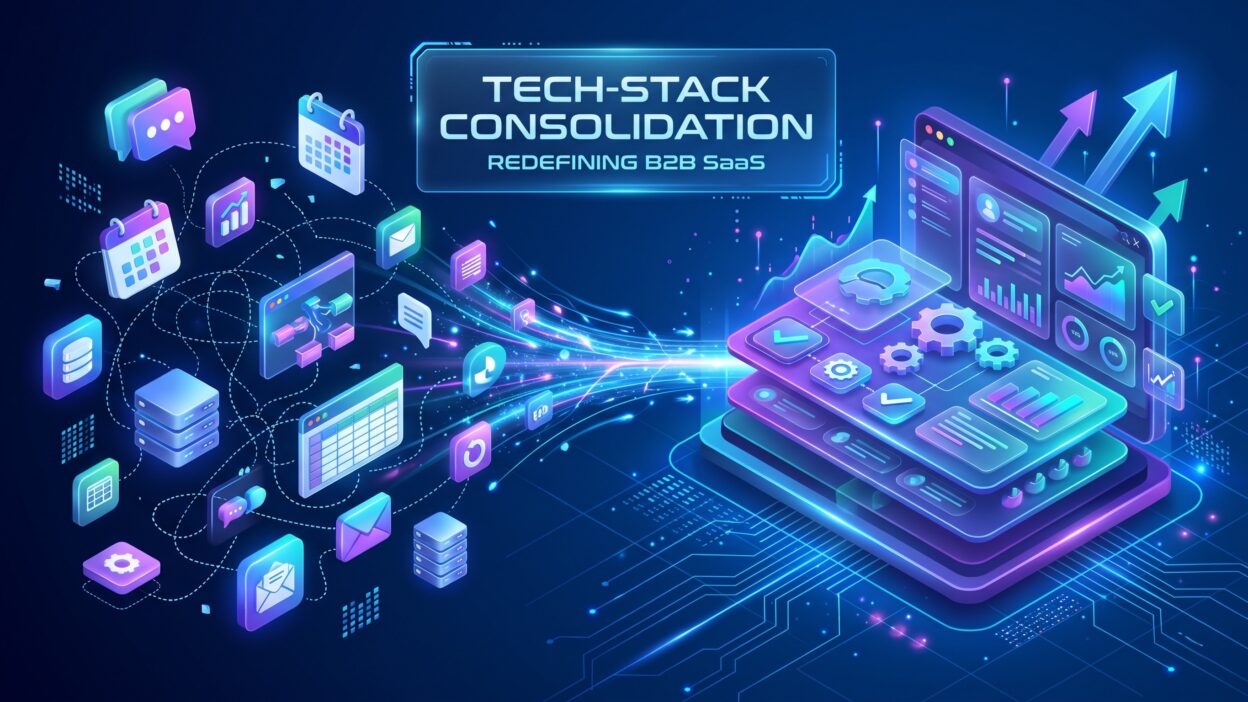
The idea is simple. You retire redundant tools. You pick a core platform. You build cleaner links between the systems that remain. Zylo describes the practice as removing redundant, underused, or unnecessary applications from the software portfolio.
B2B SaaS companies face a special version of this problem. The subscription model made buying software easy. A manager could add a tool with a credit card. Venture funding let teams grow fast without asking hard questions. ZoomInfo notes that most teams never had to justify the sprawl, and now they do.
Consolidation does not mean owning one tool for everything. No single product does every job well. The goal is a smaller, smarter set of tools. Each tool earns its place. Each tool connects to the others. Each tool has a clear owner.
The scope reaches beyond marketing. Sales teams run prospecting tools, dialers, and sequencers. Customer success teams run health scoring and ticketing tools. Finance runs billing and spend tools. Product teams run analytics and feedback tools. A full view covers all of them.
Think of the stack as a system. Systems need clear inputs and outputs. When data moves smoothly, teams move faster. When data gets stuck between apps, teams work around the gaps. Workarounds create spreadsheets, errors, and delays.
The Real Cost of Tool Sprawl
Sprawl hides in plain sight. Each tool looks cheap alone. The total looks scary.
Scale first. One 2026 roundup puts the average company at about 275 SaaS apps, from 152 at small firms to 660 at large enterprises. Enterprise numbers run higher in other studies. Zylo reports that the average enterprise manages 305 apps and spends $55 million each year on software. Few leaders can name every app on their own list.
Waste follows scale. Teams pay for seats nobody opens. Teams pay for two tools that do the same job. ClickUp cites Zylo data that enterprises waste about $18 million each year on unused or duplicate licenses. That money could fund hiring, research, or growth.
Usage tells a similar story. Gartner’s 2025 survey found that marketers use only 49 percent of their stack’s capabilities. Half the power sits idle. Renewals roll on without review.
Integration pain adds hidden cost. An ITPro report on a four-country survey found that just over half of mid-market firms run between 100 and 300 SaaS tools, and only a third call their stack fully integrated. Disconnected tools force manual exports. Reps copy data between screens. Analysts patch reports by hand.
Risk grows too. Every vendor holds data. Every integration opens a door. Security reviews pile up. Offboarding gets messy when a departing employee holds access to dozens of apps.
Visibility suffers most. The same roundup reports that complete visibility across the stack fell to 43 percent from 47 percent a year earlier. Leaders cannot fix what they cannot see.
Why Tech-Stack Consolidation Is Accelerating Now
Sprawl has existed for years. Several forces now push leaders to act.
Budgets tightened first. Gartner’s 2026 CMO survey shows martech falling to 19.4 percent of marketing budgets, down from 26.6 percent in 2021. Smaller budgets force sharper choices. Renewal talks now start with usage reports, not habit.
AI raised the stakes next. AI tools need clean, connected data. A scattered stack feeds them poor inputs. Leaders realize that a messy foundation limits every AI project. CMSWire reports that 68 percent of CIOs plan vendor consolidation in 2026, and the reasons go beyond cost.
Vendors moved too. Large platforms keep adding features. A CRM now covers email, sequencing, and reporting. Data platforms now bundle enrichment, intent, and outreach. Buyers see that one platform can replace three tools. Vendors sell that story hard.
Governance pressure rose as well. A Nintex report found that 41 percent of organizations add new tools every one to three weeks, faster than they can govern them. Compliance teams cannot keep up. Fewer tools mean fewer audits.
People change too. Leadership turnover triggers fresh vendor reviews. Cognism data cited by ZoomInfo shows that 5.22 percent of VP-and-above leaders changed roles in the past year. A new leader often questions every contract. Each change opens a window for Tech-Stack Consolidation.
ITPro calls the current squeeze a permanent correction, not a passing cost cut. Leaders who treat it as temporary will face the same problem next year.
Benefits Beyond Cost Savings
Money gets the headlines. Other gains matter more over time.
Productivity improves first. Reps log into fewer systems. They find data in one place. They spend more time with buyers. Managers coach from one dashboard instead of five.
Data quality improves next. One core platform means one record for each account and contact. Duplicates drop. Field definitions match across teams. Reports agree with each other. Leaders trust the numbers.
Speed improves as well. New hires learn fewer tools. Training takes days, not weeks. Process changes roll out across one system. A new campaign launches faster because the pieces already connect.
Security gets stronger. Fewer vendors mean fewer risk reviews. Fewer integrations mean fewer weak points. Access control becomes simpler. IT can switch off a user in one step.
Vendor leverage grows. A larger contract with one provider earns better pricing and support. Account teams pay more attention. Roadmap requests get heard.
Customer experience improves too. Teams that share data give buyers a smoother journey. A support agent sees the sales history. A rep sees open tickets before a renewal call. Customers feel that coordination.
Innovation gets room to breathe. Teams stop spending energy on integration repairs. They test new ideas. They build better workflows. Savings fund growth instead of maintenance.
How Tech-Stack Consolidation Reshapes GTM and Revenue Teams
Go-to-market teams feel the change most. Their stacks grew the fastest. Tech-Stack Consolidation changes how they work, hire, and measure.
Consider the rep workflow. A typical rep once jumped between a CRM, a data tool, a dialer, a sequencer, and a call recorder. Each switch cost focus. A consolidated setup brings those functions into fewer screens. The rep stays in flow.
Consider marketing operations. Teams once stitched together forms, email, ads, analytics, and enrichment tools. Each link needed maintenance. A unified platform cuts that work. Marketers spend time on messages instead of plumbing.
Consider revenue operations. RevOps leaders carry the load of integration and governance. They gain the most from fewer systems. They design cleaner processes. They produce reliable forecasts. They shift from firefighting to planning.
Consider customer success. Success managers need product usage, support history, and contract data together. A connected stack gives them that view. They spot risk early and act on it.
Roles evolve too. Companies hire more systems thinkers. They value people who can design workflows and manage data. Some teams create GTM engineering roles. These engineers build automations on top of the core platform.
Compensation and planning change as well. Leaders can tie territory design, quotas, and payouts to one trusted dataset. Disputes drop. Trust rises.
Culture shifts last. Teams used to choose tools by preference. Now they choose tools by fit with the shared system. Some people resist that change. Leaders must explain the why with care.
The Role of AI in Consolidation
AI sits at the center of this story. It drives both the urgency and the opportunity.
AI agents need context. An agent that drafts an email should see account history, product usage, and open deals. A scattered stack hides that context in silos. Agents then guess, and guesses create poor output. Connected data gives them the full picture.
Platforms now embed AI directly. A CRM suggests next steps. A data platform scores accounts. A support tool drafts replies. Embedded AI works best when the data lives in the same system. Bolt-on tools struggle to match it.
AI also creates new sprawl. Teams sign up for AI writing tools, AI note-takers, and AI research assistants. Each one adds cost and risk. The roundup cited earlier reports that 66.5 percent of IT leaders saw unexpected SaaS charges from consumption-based or AI pricing. Leaders need rules before AI tools multiply.
Smart teams use AI to help with consolidation itself. They analyze usage data. They map overlaps. They flag idle licenses. They draft vendor comparisons. AI speeds the discovery phase.
Judgment stays human. AI can suggest which tools overlap. People decide which workflows matter most. People weigh trust, culture, and strategy.
A Step-by-Step Framework for Tech-Stack Consolidation
Strategy fails when the order goes wrong. ZoomInfo observes that consolidation usually fails on execution sequence, not on the business case, because teams cut tools before they map what depends on them. A clear sequence prevents that trap. Use the six steps below.
Step 1: Catalog Every Tool
Build a full inventory. Pull data from finance, procurement, single sign-on, and expense reports. Ask each team what they use. Record the owner, cost, renewal date, users, and purpose for each tool. Shadow tools hide in credit card statements, so check there.
Step 2: Link Tools to Workflows
Map each tool to the process it supports. Draw the data flows. Note which tools feed others. This step shows hidden dependencies. A tool that looks minor may power a key report.
Step 3: Measure Usage and Value
Check logins, active seats, and feature use. Compare cost to impact. Interview heavy users. Ask what breaks if the tool disappears. Numbers and stories together reveal true value.
Step 4: Find Overlap and Gaps
Group tools by function. Spot duplicates. Spot places where no tool serves a need. Decide which functions deserve a core platform. Mark candidates to retire.
Step 5: Plan the Migration
Sequence the changes. Start with low-risk tools. Set dates tied to contract renewals. Plan data moves and testing. Assign owners for each step. Communicate early with affected teams. Train people before the switch.
Step 6: Retire and Review
Cancel contracts on time. Confirm data exports. Remove access. Review results after thirty, sixty, and ninety days. Collect feedback. Fix issues fast. Record lessons for the next round.
Common Mistakes That Derail Consolidation
Good plans still fail. Watch for these traps.
Leaders sometimes cut by cost alone. The cheapest tool to cut may be the most valuable to users. Savings vanish when productivity drops. Always weigh impact on work.
Teams sometimes skip dependency mapping. They cancel a tool and then discover that three reports relied on it. Panic follows. Map first, cut second.
Some leaders ignore people. Reps and marketers feel attached to their tools. A forced change without explanation breeds resistance. Involve users early. Show them how the change helps them.
Others pick a platform from a demo. Demos show the best path. Real data shows the truth. Test with your own records and workflows.
Another mistake is chasing a single vendor for everything. Lock-in raises risk. A weak module in a big platform can hurt a team. Keep best-of-breed options where they matter most.
Many teams forget migration work. Data cleaning takes time. Field mapping takes thought. History matters, so plan what to keep. Underestimating this work delays launch.
Some teams stop after the cut. Sprawl returns within a year. Without rules, people buy tools again. Governance must follow the project.
Finally, leaders sometimes skip measurement. Without a baseline, no one can prove value. Set goals before you start.
How to Choose the Core Platform
The core platform anchors the new stack. A good choice supports growth for years. A poor choice forces another migration.
Start with your workflows. List the five processes that drive revenue. Rate each platform on how well it supports them. Include handoffs between teams.
Check data foundations. Ask how the platform stores records, handles duplicates, and enriches data. Ask about data quality and coverage in your target markets. Weak data undermines every feature.
Review integration depth. Confirm native connections to your key systems. Check API limits and webhook support. Ask how the vendor handles outages and changes.
Look at AI capabilities. Ask which features run today and which sit on a roadmap. Ask how the platform uses your data. Ask about controls and transparency.
Weigh total cost. Include license fees, services, training, and admin time. Ask about pricing for added modules. Ask about renewal caps.
Check security and compliance. Request certifications and audit reports. Ask about data residency and privacy tools. Involve IT and legal in the review.
Talk to references. Choose customers of similar size and industry. Ask about adoption, support, and surprises. Ask what they would change.
Run a pilot. Give a small team real work for a few weeks. Track results against your baseline. A short test prevents long regret.
Preventing Sprawl After Tech-Stack Consolidation
The project ends. The habit must continue. Sprawl creeps back when nobody watches.
Create a simple intake process. Anyone who wants a new tool submits a short request. The request explains the need, the cost, and the overlap with existing tools. A small review group decides within days. Speed matters, because slow approval drives people to buy in secret.
Name an owner for the stack. Many companies assign this role to RevOps or IT. The owner tracks inventory, renewals, and usage. The owner reports to leadership each quarter.
Review renewals ninety days ahead. Check usage and value. Renegotiate or cancel based on facts. Stop auto-renewals that no one has reviewed.
Use spend management tools. They monitor licenses, flag idle seats, and surface shadow purchases. Automation catches what spreadsheets miss.
Standardize onboarding and offboarding. New hires get access to approved tools. Departing employees lose access on day one. Clean access control cuts risk.
Educate teams. Share the costs of sprawl. Share the results of past projects. People support rules when they understand the reasons.
Revisit the stack each year. Business needs shift. New categories appear. A yearly review keeps the stack lean and current.
Measuring the Success of Tech-Stack Consolidation
Measurement proves value. It also guides the next round of improvements.
Track cost metrics first. Measure total software spend, cost per user, and number of vendors. Compare results to your baseline. Report savings in dollars and in percentage terms.
Track usage metrics next. Measure active users, feature adoption, and license utilization. A healthy stack shows high use of every paid seat.
Track productivity metrics. Measure time spent on admin tasks, time to onboard new hires, and time to launch campaigns. Ask reps how many tools they open each day.
Track data quality metrics. Measure duplicate rates, field completeness, and report accuracy. Fewer errors signal a healthier system.
Track business outcomes. Measure pipeline created, win rates, and cycle length. These numbers connect the project to revenue. Leaders care about them most.
Track risk metrics. Count security incidents, audit findings, and time to offboard users. Lower numbers show progress.
Report results every quarter. Share wins with the whole company. Celebrate teams that adapted well. Visible success builds support for future work.
FAQs About Tech-Stack Consolidation
What is the main goal of consolidation?
The goal is a smaller, better-connected set of tools. You cut cost, reduce risk, and improve data quality. You also free time for the work that drives revenue.
How long does a typical project take?
Timelines vary with company size and complexity. A focused project can show results in ninety days. A full program can run a year or more. Tie each phase to contract renewals to avoid early termination fees.
How do I know which tools to cut?
Start with usage and overlap. Tools with low usage and duplicate functions are prime candidates. Map dependencies before you decide. Ask users what would break.
Does consolidation mean using one vendor for everything?
No. Most teams keep a few specialist tools. The aim is a core platform plus a small set of tools that earn their place. Each tool must connect well and have a clear owner.
What does consolidation do for AI projects?
It gives AI better data. Connected systems provide the context that agents and models need. Fewer tools also mean fewer new AI add-ons that need review and budget.
How do I get team buy-in?
Explain the reasons early. Share the data on cost and usage. Involve power users in tool selection. Offer training before each change. Show how the new setup saves time.
How do I stop sprawl from returning?
Set an intake process, assign a stack owner, and review renewals ahead of time. Use spend tools to track licenses. Revisit the stack every year.
Read More:-B2B Data Providers in the UK: Platforms, List Suppliers and Compliance
Conclusion

B2B SaaS grew on easy buying. That era built great products and messy stacks. The bill has arrived. Budgets shrink. AI demands clean data. Security teams demand fewer vendors. Leaders must act.
Tech-Stack Consolidation gives them a path. They catalog tools, map workflows, and measure value. They choose a core platform with care. They migrate in a smart order. They set rules that keep sprawl away. They track results and share wins.
The change is more than a cost exercise. It reshapes how teams work. Reps spend more time with buyers. Marketers spend less time on plumbing. RevOps leaders plan instead of patch. Executives trust their numbers.