
Introduction
TL;DR You need software that runs your sales and your business. Two names rise to the top of most shortlists. Both platforms are strong. They follow different philosophies.
This guide explains Odoo vs. Salesforce in plain language. You will see features, pricing, hosting, customization, and ideal users. Every section gives you facts you can act on. Prices come from public sources and change often. Confirm each number with the vendor before you buy.
The right choice saves money and time. The wrong choice drains both. Read each section with your own company in mind.
Odoo vs. Salesforce: Quick Overview
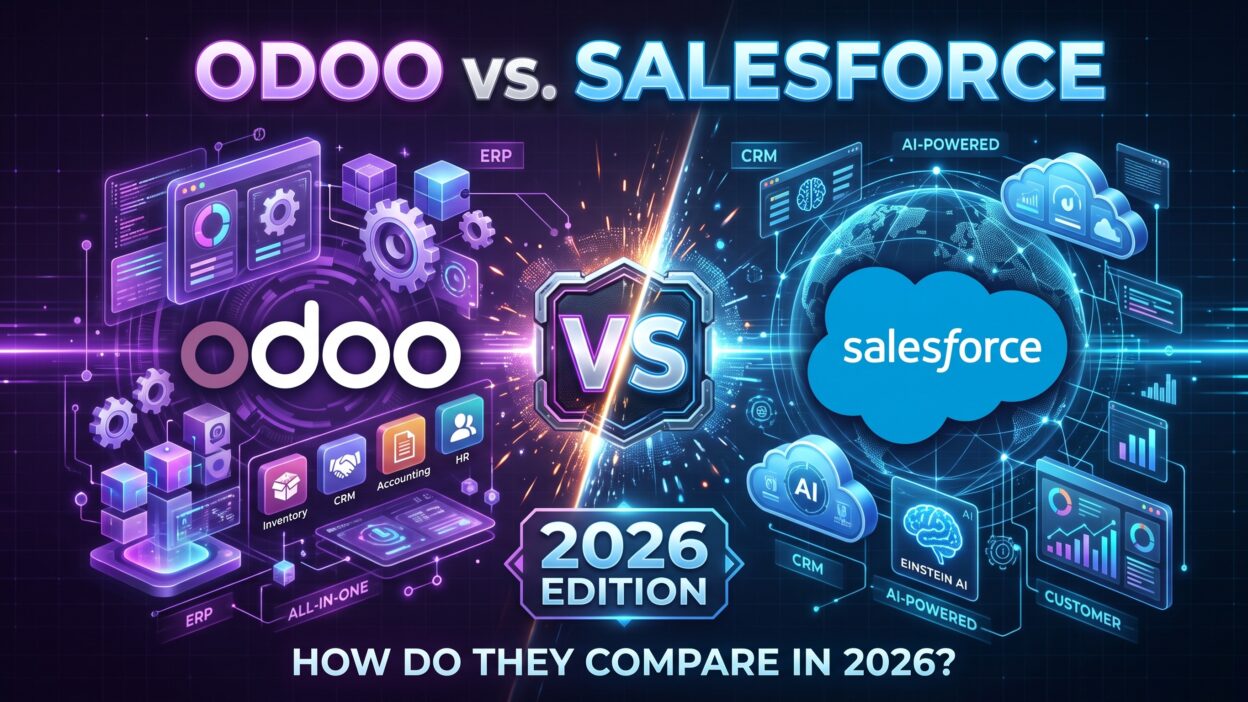
Odoo is an ERP suite with a CRM module. Salesforce is a CRM platform with a huge ecosystem. That one sentence explains most of the gap. Start with a profile of each product.
What Is Odoo?
Odoo is a modular business suite. It covers CRM, sales, accounting, inventory, manufacturing, helpdesk, marketing, and more. You pick the apps you need. Odoo ships in a free Community edition and a paid Enterprise edition. The code base is open, which gives developers freedom.
What Is Salesforce?
Salesforce is the best-known CRM on the market. Its Sales Cloud handles leads, deals, forecasts, and reporting. Service Cloud, Marketing Cloud, and other products extend the platform. A large partner network and the AppExchange marketplace add depth. Large enterprises trust it for complex sales motions.
ERP vs. CRM in One Minute
A CRM manages customer relationships. An ERP manages the whole business. It includes finance, supply chain, and operations. Odoo spans both worlds. Salesforce stays focused on customer-facing work. Many companies connect Salesforce to a separate ERP.
The Core Difference in Odoo vs. Salesforce
Odoo answers one question. How do I run my entire company on one system? Salesforce answers another. How do I win and keep customers at enterprise scale?
That gap shapes cost, setup, and daily use. Odoo gives you breadth at a lower price. Salesforce gives you depth in sales, service, and marketing. Odoo suits companies that want one database for sales, stock, and invoices. Salesforce suits companies that already run operations elsewhere.
Write down your top three needs. Match each one to a platform. The pattern usually becomes clear.
Odoo vs. Salesforce Features Side by Side
CRM and Sales Pipeline
Both tools manage leads, contacts, opportunities, and pipelines. Salesforce goes deeper on forecasting, territory rules, and enterprise sales workflows. Odoo offers a clean pipeline view and works well for small and mid-sized teams. Reps adopt it quickly. Sales operations teams at large firms often want more control than Odoo provides.
Quotes, Orders, and Invoicing
Odoo handles quotes, orders, and invoices natively. A deal moves from opportunity to invoice inside one system. Salesforce relies on add-ons such as CPQ and Billing for the same flow. Those add-ons cost more. They also need setup. Odoo wins on simplicity here.
Marketing Automation
Odoo includes email marketing and automation. Small teams get campaigns without another tool. Salesforce offers Marketing Cloud and related products. They are powerful and priced for larger budgets. Third-party sources list Marketing Cloud starting above $1,000 per month. Check current rates.
Customer Service
Odoo includes a helpdesk app. Salesforce sells Service Cloud as a separate product. Service Cloud suits large support operations with complex routing. Odoo suits smaller teams that want tickets connected to orders and invoices.
Inventory, Manufacturing, and Accounting
This area favors Odoo. Inventory, manufacturing, purchasing, and accounting live in the same suite. Salesforce does not offer native ERP functions. Companies that sell physical goods feel the difference most. They avoid costly integrations.
Automation and Workflows
Odoo offers automated actions and a workflow engine. Admins build rules without heavy code. Salesforce offers Flow, Apex, and deep automation tools. The platform handles very complex logic. Skilled admins and developers unlock that power.
AI Capabilities
Salesforce invests heavily in AI. Einstein and Agentforce target forecasting, service, and agent-style automation. Odoo is adding AI features and moving fast. Buyers who need advanced AI in sales today often lean toward Salesforce. Ask each vendor for a live demo of the features you plan to use.
Reporting and Analytics
Salesforce reporting and dashboards suit large organizations. Admins build detailed views across teams and regions. Odoo reports cover sales, stock, and finance in one place. The data stays unified. Deep custom analytics may need extra tools in either system.
Odoo vs. Salesforce Pricing in 2026
Pricing structures differ sharply. Public sources vary. Treat all figures here as guides. Confirm final quotes on each vendor site.
Salesforce Pricing
Salesforce uses tiered per-user pricing. Third-party trackers list 2026 Sales Cloud plans at about $25 per user each month for Starter, $100 for Pro Suite, $175 for Enterprise, and $350 for Unlimited. The AI-led Agentforce edition sits near $550. Billing runs annually above Starter. Add-ons such as CPQ, Service Cloud, and Marketing Cloud cost extra.
Odoo Pricing
Odoo takes a different path. The Community edition is free. Enterprise pricing uses a per-user fee. One third-party source puts the Standard plan near $25 per user each month on annual billing. Higher plans cost more. Odoo describes an all-apps approach for hosted plans. Hosting, support, and implementation add to the total. Verify current rates with Odoo.
A Real Cost Example
Picture a ten-person sales team. On Salesforce Enterprise at about $175 per user, the bill reaches roughly $21,000 each year. That figure covers licenses only. Add-ons, admin time, and partner fees raise it. On Odoo Standard at about $25 per user, the same team pays near $3,000 each year. Implementation still costs money.
One consultancy models a fifteen-user product company over five years. It finds the Salesforce-centered stack costs four to six times more than Odoo. That firm sells Odoo services, so apply caution. Build your own model with real quotes.
Hosting and Deployment Options
Odoo offers three paths. Odoo Online is the managed SaaS option. Odoo.sh is a cloud platform for developers with staging environments. Self-hosting gives full control on your own servers or a partner host. You can move between options later.
Salesforce offers one path. It runs as a SaaS platform. Salesforce handles infrastructure, updates, and maintenance. That reduces your IT burden. It also limits choice.
Data residency and compliance rules may decide this point. Regulated industries often want infrastructure control. Others prefer a hands-off cloud. Ask each vendor about certifications, regions, and audit rights.
Customization and Integrations
Customizing Odoo
Odoo offers an open code base. Developers can change modules or build new ones. Low-code tools help admins adjust screens and fields. Freedom comes with responsibility. Custom code needs upkeep during upgrades.
Customizing Salesforce
Salesforce offers clicks-not-code tools and a full developer platform. The AppExchange lists thousands of apps. Consultants and partners fill every niche. You can extend the platform almost without limit. Complexity and cost rise as you do.
Integrations
Salesforce connects to nearly every major business tool. Native connectors and APIs cover most needs. Odoo offers APIs and many connectors. Its integration list is smaller. Companies that run Odoo as an all-in-one suite need fewer connectors.
Implementation and Ease of Use
The Odoo vs. Salesforce choice affects rollout effort. Odoo apps share one interface. Users learn one system for sales, stock, and accounting. Small projects can launch within weeks. Larger ERP rollouts take months.
Salesforce implementations vary widely. A basic Sales Cloud setup takes weeks. A multi-cloud program with integrations takes many months. Most firms hire a partner. Admin roles matter. Skilled Salesforce admins command high salaries.
Both platforms reward clean data and clear processes. Map your workflow before you configure anything. Train users early. Plan a pilot team. Gather feedback before a full launch.
Pros and Cons
Odoo Strengths and Limits
Odoo wins on breadth and price. One platform covers CRM, finance, inventory, and more. Flexible hosting gives control. The open code base invites customization. Community support is active.
Limits appear at the high end. Advanced sales analytics and enterprise governance trail Salesforce. The partner network is smaller. Custom code needs careful upgrades. AI features are still maturing.
Salesforce Strengths and Limits
Salesforce wins on CRM depth and ecosystem. Forecasting, automation, and AI tools run deep. Thousands of apps and partners extend it. Enterprises trust its scale.
Limits include cost and complexity. Add-ons raise the bill fast. No native ERP exists. Admin skills and partner help add expense. SaaS-only hosting reduces control.
Which Platform Wins the Odoo vs. Salesforce Decision?
Match the platform to your business model. Size, industry, and process complexity drive the answer.
Small Businesses
Choose Odoo if you want one system for sales and operations. The price is friendlier. Setup is faster. Choose Salesforce Starter if you only need a simple CRM and expect to grow into the ecosystem.
Mid-Sized Companies
Choose Odoo if you sell products and need inventory and invoicing in the same system. Choose Salesforce if sales complexity grows and you already run a separate ERP. Model five-year costs for both.
Large Enterprises
Choose Salesforce for complex sales, service, and marketing programs. Pair it with your ERP of choice. Some enterprises run Salesforce for front-office work and Odoo for specific operations. Integration planning matters.
Manufacturers and Distributors
Choose Odoo. Native manufacturing, inventory, and accounting save integration work. Sales data and stock data share one database.
Real-World Scenarios
Picture a boutique furniture maker with twenty staff. Orders, stock, and invoices matter as much as leads. Odoo fits.
Picture a software company with a fifty-person sales team. Forecasts, territories, and partner channels drive revenue. Salesforce fits.
Picture a distributor with a warehouse and a small sales team. Reps need live stock levels when they quote. Odoo fits.
Picture a global firm with separate regional ERPs. A unified customer view matters most. Salesforce fits, with integrations.
Odoo vs. Salesforce FAQs
Which is better in the Odoo vs. Salesforce matchup for small businesses?
Odoo usually fits small businesses better. The price is lower and the suite covers more functions. Salesforce Starter works for simple CRM needs. Compare your total needs, not only CRM features.
Is Odoo a CRM or an ERP?
Odoo is an ERP suite. It includes a CRM module. You can run the CRM alone or alongside other apps.
Is Salesforce an ERP?
No. Salesforce is a CRM platform. It does not offer native ERP functions. Companies connect it to an ERP when they need one.
Which is cheaper?
Odoo costs less for most small and mid-sized teams. Salesforce costs more as you add editions and add-ons. Request itemized quotes to see your real numbers.
Can Odoo replace Salesforce?
For many small and mid-sized companies, yes. Large enterprises with complex sales needs may find gaps. Run a pilot before you migrate.
Can I use both together?
Yes. Some firms use Salesforce for sales and Odoo for operations. Connectors and APIs link the two. Plan data ownership carefully.
Which has better AI features?
Salesforce offers more mature AI today through Einstein and Agentforce. Odoo adds AI features steadily. Test the features you need in a demo.
Which platform is easier to implement?
Both need planning. Odoo uses one interface across apps. Salesforce offers deeper tools and a bigger partner ecosystem. Complexity grows with scope in either system.
Read More:-Best mParticle Alternatives Worth Considering [2026]
Conclusion

Odoo and Salesforce both deliver real value. They solve different problems. The Odoo vs. Salesforce decision comes down to scope. Odoo offers breadth, flexibility, and lower cost. Salesforce offers CRM depth, AI strength, and a massive ecosystem.
Choose Odoo if you want one platform for sales and operations. Choose it if budget matters and hosting control helps. Choose Salesforce if sales complexity drives revenue. Choose it if you already run an ERP and need enterprise-grade CRM.
Run a pilot before you commit. Use real data and real users. Measure adoption, speed, and total cost. Verify current pricing with each vendor. Your own results will settle the debate faster than any review. Pick the platform your team will use every day.